
SLIDE 1
Minterms
1 1 1
) 3 , 2 , 1 ( x x x x x x m f + + = =∑
William Sandqvist william@kth.se
1 1 1 1 1 1 1 3 2 1
1
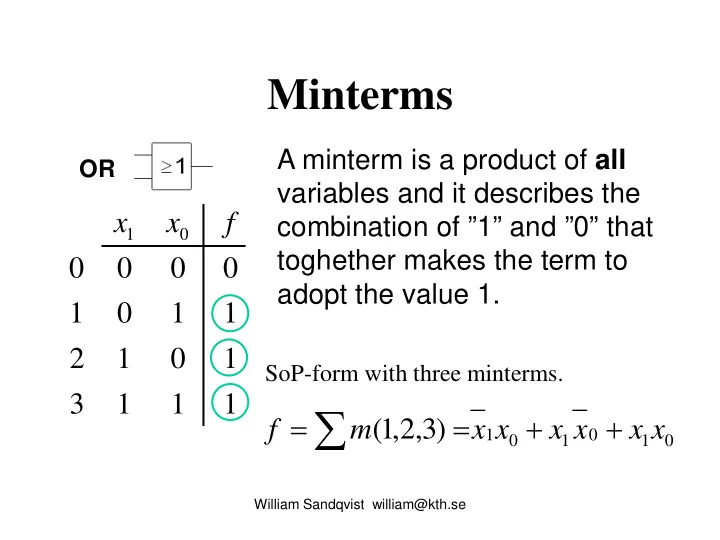
= = + + f m ( 1 , 2 , 3 ) x x x x x x 1 0 0 1 - - PowerPoint PPT Presentation
Minterms A minterm is a product of all OR variables and it describes the x x f combination of 1 and 0 that 1 0 toghether makes the term to 0 0 0 0 adopt the value 1. 1 0 1 1 2 1 0 1 SoP-form with three minterms. 3
1 1 1
William Sandqvist william@kth.se
1
1 1 1
William Sandqvist william@kth.se
1
1 1 1 1 1 1 1 1 1 1 1 1 1
William Sandqvist william@kth.se
1
1
William Sandqvist william@kth.se
William Sandqvist william@kth.se
1
x0 x1 1 0 1
m0 m1 m2 m3
x0 x1 1 0 1
1 1 1 1 3 2
1 1 1 1 3 1
1
William Sandqvist william@kth.se
1
x0 x1 1 0 1
1
1
William Sandqvist william@kth.se
AND OR XOR NAND NOR XNOR
x0 x1 1 0 1 x0 x1 1 0 1 x0 x1 1 0 1 x0 x1 1 0 1 x0 x1 1 0 1 x0 x1 1 0 1
1
1 x
1 1
1 1
1 1
1 1
William Sandqvist william@kth.se
William Sandqvist william@kth.se 1 2 1 2 1 2 1 2 1 2 1 2
William Sandqvist william@kth.se
1 2
1 2x
William Sandqvist william@kth.se
William Sandqvist william@kth.se
William Sandqvist william@kth.se
William Sandqvist william@kth.se
William Sandqvist william@kth.se
William Sandqvist william@kth.se
William Sandqvist william@kth.se
William Sandqvist william@kth.se
William Sandqvist william@kth.se
William Sandqvist william@kth.se
William Sandqvist william@kth.se
William Sandqvist william@kth.se
William Sandqvist william@kth.se
William Sandqvist william@kth.se
William Sandqvist william@kth.se
William Sandqvist william@kth.se
William Sandqvist william@kth.se
William Sandqvist william@kth.se
William Sandqvist william@kth.se
00 a b c a 1 b c 01 11 10
000 001 100 101 011 010 111 110
William Sandqvist william@kth.se
William Sandqvist william@kth.se
William Sandqvist william@kth.se
William Sandqvist william@kth.se
The frames "5" and "13" are "neighbors" in the Karnaugh map ( but they are distant from each
They correspond to two minterms with four variables, and the figure shows how, with Boolean algebra, they can be reduced to one term with three variables. What the two frames have in common is that b = 1, c = 0 and d = 1; and the reduced term expresses just that. Everywhere in the Karnaugh map where one can find two ones that are "neighbors" (vertically or horizontally) the minterms could be reduced to "what they have in common". This is called a grouping.
William Sandqvist william@kth.se
William Sandqvist william@kth.se
William Sandqvist william@kth.se
4 12 5 13 7 15
One is looking for the bigest grouping as
there is a grouping with eight ones (frames 0, 1, 3, 2, 4, 5, 7, 6). Corners (0, 2, 8, 10) is a group of four
Two of the frames (0.10) has already been included in the first group, but it does not matter if a minterm is included multiple times. All ones in the logic function must either be in a grouping, or be included as a minterm. The "1" in frame 13 may form a group with "1" in frame 5, unfortunately there are no bigger grouping for this "1".
William Sandqvist william@kth.se
William Sandqvist william@kth.se
The Karnaugh map is also useful for groupings of 0's. The groupings may include the same number of frames as the case of groupings of 1's. In this example, 0: s are grouped together in pairs with their "neighbors". Maxterms are simplified to what is in common for the frames.
William Sandqvist william@kth.se
Karnaugh maps with three and two variables are also useful. The Karnaugh map can conveniently be used for functions of up to four variables, and with a little practice up to six variables.
6
William Sandqvist william@kth.se
000 100 010 110 101 011 111
a b c
00 01 1 11 10 bc a
001
1 3 2 4 5 7 6
William Sandqvist william@kth.se
000 100 010 110 101 011 111
a b c
00 01 1 11 10 bc a
001
William Sandqvist william@kth.se
made bigger.
cover the function.
function can be covered by other implicants.
William Sandqvist william@kth.se
000 100 010 110 101 011 111
a b c
00 01 1 11 10 bc a
001
William Sandqvist william@kth.se
William Sandqvist william@kth.se
a b c f
00 01 1 11 10 bc a
William Sandqvist william@kth.se
William Sandqvist william@kth.se
OR plane AND plane
William Sandqvist william@kth.se
1
2
3
1
2
1
P
2
P
3
P
4
P
William Sandqvist william@kth.se 1
2
3
1
P
2
P
3
P
4
P
1
2
William Sandqvist william@kth.se 1
2
3
1
P
2
P
3
P
4
P
1
2
William Sandqvist william@kth.se
00 01 11 10 00 01 11 10
x1x0
x3x2
3
William Sandqvist william@kth.se
00 01 11 10 00 01 11 10
x1x0
x3x2
William Sandqvist william@kth.se
00 01 11 10 00 01 11 10
x1x0
x3x2
2 2 2
William Sandqvist william@kth.se
00 01 00 01 11 10 11 10
MSB LSB
1 2 3
x1x0
x3x2
00 01 11 10 00 01 11 10
x1x0
x3x2
00 01 11 10 00 01 11 10
x1x0
x3x2
0 1
William Sandqvist william@kth.se
1 2 3
4 =
4 =
William Sandqvist william@kth.se
110 111 101 100
000 001 011 010 00 01 11 10
x4x1x0
x3x2
1 2 3
William Sandqvist william@kth.se
110 111 101 100
000 001 011 010 00 01 11 10
x2x1x0
x4x3
1 2 3
William Sandqvist william@kth.se
x4
0 1
00 01 11 10 00 01 11 10
00 01 11 10 00 01 11 10
00 01 11 10 00 01 11 10
00 01 11 10 00 01 11 10
x3x2 x1x0 x3x2 x1x0 x3x2 x1x0 x3x2 x1x0
x5 1
1 2 3
4 =
4 =
5 =
5 =
William Sandqvist william@kth.se
110 111 101 100
000 001 011 010 000 001 011 010 110 111 101 100
x4x1x0
x5x3x2
1 2 3
William Sandqvist william@kth.se
110 111 101 100
000 001 011 010 000 001 011 010 110 111 101 100
x2x1x0
x5x4x3
1 2 3
William Sandqvist william@kth.se
00 01 11 10 00 01 11 10
x1x0
x3x2
1 2 3 1 2 3
1 2 3
William Sandqvist william@kth.se
William Sandqvist william@kth.se
x
1
x x
3
x
2
00 01 11 10 1 1 1 1 d d d d 1 00 01 11 10 x
2
x
1
x
1
x (a) SOP implementation
Two implementations of the function f ( x3,…, x0) = Σ m(2, 4, 5, 6, 10) + D(12, 13, 14, 15).
00 01 11 10 1 1 1 1 d d d d 1 00 01 11 10 x
2 x 1
+
( )
x
1 x
+
( )
(b) POS implementation x
1
x x
3
x
2
William Sandqvist william@kth.se
x
1
x x
3
x
2
00 01 11 10 1 1 1 1
00 01 11 10 x
2
x
1
x
1
x (a) SOP implementation 00 01 11 10 1 1 1 1
00 01 11 10 x
2 x 1
+
( )
x
1 x
+
( )
(b) POS implementation x
1
x x
3
x
2
Two implementations of the function f ( x3,…, x0) = Σ m(2, 4, 5, 6, 10) + D(12, 13, 14, 15).
William Sandqvist william@kth.se
3 1
William Sandqvist william@kth.se
William Sandqvist william@kth.se
William Sandqvist william@kth.se
William Sandqvist william@kth.se
William Sandqvist william@kth.se
2x3x 4x5x6 + x1x2x 3x 4x 5x6
5 3 2 5 3 2 6 4 1
6 4 1
William Sandqvist william@kth.se
5 3 2 5 3 2 6 4 1
x
6
x
4
x
1
x
5
x
2
x
3
x
2
x
3
x
5
William Sandqvist william@kth.se
William Sandqvist william@kth.se
William Sandqvist william@kth.se
William Sandqvist william@kth.se
XOR XNOR
x2 x1 1 0 1 x2 x1 1 0 1
2 1 2 1
2 1 2 1
William Sandqvist william@kth.se
1
x
2
x
3
x
4
f g h x
x
1
x
2
x
3
x
4
f g
William Sandqvist william@kth.se
William Sandqvist william@kth.se