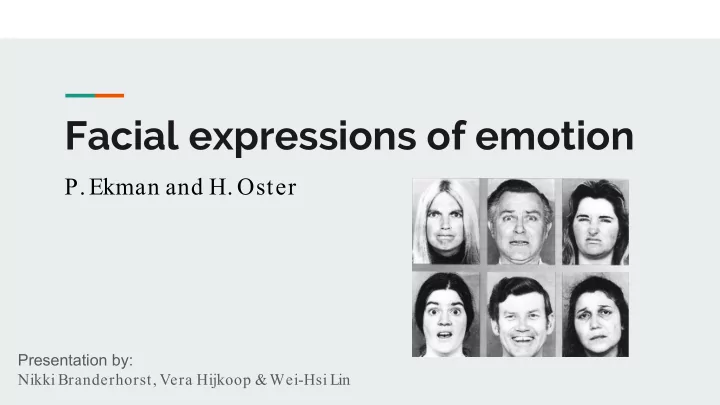
Facial expressions of emotion P. Ekman and H. Oster Presentation - - PowerPoint PPT Presentation

facial expressions of emotion
SMART_READER_LITE
LIVE PREVIEW

Facial expressions of emotion P. Ekman and H. Oster Presentation - - PowerPoint PPT Presentation

Facial expressions of emotion P. Ekman and H. Oster Presentation by: Nikki Branderhorst, Vera Hijkoop & Wei-Hsi Lin CROSS-CULTURAL STUDIES AND THE ISSUE OF UNIVERSALITY Emotions are labelled the same way regardless of culture.


slide-1
SLIDE 1

Facial expressions of emotion

Presentation by: Nikki Branderhorst, Vera Hijkoop & Wei-Hsi Lin

  • P. Ekman and H. Oster
slide-2
SLIDE 2

CROSS-CULTURAL STUDIES AND THE ISSUE OF UNIVERSALITY

  • Emotions are labelled the same way regardless of culture.
  • Members of different cultures generally show the same facial expressions of emotion

○ Culture-specific display rules

slide-3
SLIDE 3

DEVELOPMENTAL STUDIES

  • Imitation of facial movements
  • Preschool children know the most common facial

expressions

  • Social communication
slide-4
SLIDE 4

ACCURACY

  • Facial expressions of emotion can provide accurate information about emotional states
  • Facial expressions can be disguised
  • Individual differences
slide-5
SLIDE 5

FACIAL FEEDBACK

  • Self- attribution theory
  • Overt facial expression

○ Subjects showed less intense facial expression when they were told that they were being observed. ○ People are more likely to smile when interacting with others than when they are alone (Fernández Dols & Ruiz Belda, 1995; Fridlund, 1991).

slide-6
SLIDE 6

POSITIVE POINTS

  • Extensive literature review on several relevant topics on research on facial expression of emotion
  • Include relevant criticisms, unanswered questions & suggestion for further research structured by

topic

slide-7
SLIDE 7

CRITICISM (on research topic and paper)

  • Self-reported emotion is subjective
  • “Artificial” emotion in lab settings
  • Influence of posture and voice is often not considered
  • The reviewers Ekman & Oster may be subjective in reviewing their own work.
slide-8
SLIDE 8

RESEARCH QUESTION

“Do people show emotions through facial expression differently toward robots than towards humans? ”

  • Previous study about robot & human emotion focus on robots
  • Combine the findings of current study

○ People convey emotion through facial expression ○ Facial expressions can be disguised or manipulated in social interaction

  • Generalize to human-robot interaction?
slide-9
SLIDE 9

RESEARCH QUESTION

Method

  • Between-group design
  • Dependent variable: emotional intensity & facial expression
  • Independent variable: human / humanoid robot / technical robot
  • Procedure

a. Watch a video clip b. Self-reported emotional intensity evoked by the clip c. Describe the plot and feelings to a person / humanoid robot / technical robot d. Record facial expression & self-reported emotional intensity about the conversation

slide-10
SLIDE 10

RESEARCH QUESTION

Expected results

  • People disguise or manipulate emotions in social situations (Graaf, 2016).
  • People show more genuine intensity in facial expressions of emotion when communicating with a technical

robot

  • Facial expression are less aligned with the emotion they reported when interacting with human / human-

like robot

slide-11
SLIDE 11

RESEARCH QUESTION

  • Conclusion

○ Research on a robot’s ability to express emotion, the perception of a robot’s facial expression and facial expression recognition (

Bartlett, littlework, Fasel & Movellan, 2003) has been studied extensively in the

HTI domain recently. It would be interesting to explore how people show emotions and intensity of these emotions through facial expression towards robots.