
SLIDE 1
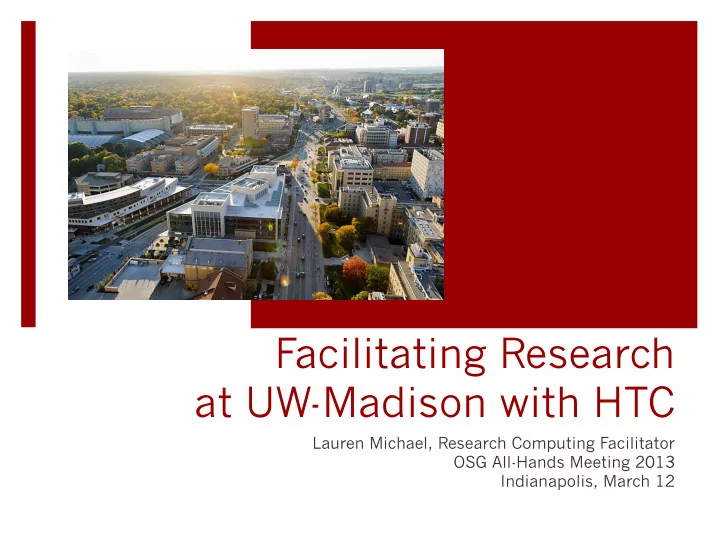
Facilitating Research at UW-Madison with HTC
Lauren Michael, Research Computing Facilitator OSG All-Hands Meeting 2013 Indianapolis, March 12
Facilitating Research at UW-Madison with HTC Lauren Michael, - - PowerPoint PPT Presentation
Facilitating Research at UW-Madison with HTC Lauren Michael, Research Computing Facilitator OSG All-Hands Meeting 2013 Indianapolis, March 12 http://chtc.cs.wisc.edu Jun10- Jun11- Quick Facts Jul11 Jul12 45 70 Million Hours
Lauren Michael, Research Computing Facilitator OSG All-Hands Meeting 2013 Indianapolis, March 12
Last 12 months Projects
Users
CHTC 126 600+ CHTC to OSG 47 102 OSG to CHTC n/a 736 Jun’10- Jul’11 Jun’11- Jul’12
Quick Facts
45 70 Million Hours Served 54 106 Research Projects 35 52 Departments 10 13 Off-Campus Researchers who use the CHTC are located all over campus (red buildings)
Centor for High Throughput Computing, est. 2006 Grid Laboratories Of Wisconsin
Dept.
CHTC submit
CHTC-managed
Thousands of Hours per Week Owned (GLOW) 53.2 CHTC 17.3 OSG 19.0 Millions of Hours, Last 12 Months
¡ All Free! ¡ Website: chtc.cs.wisc.edu
¡ “Get Started” via webform ¡ Online guides (increasingly)
¡ Consultations & Office Hours
¡ with our Research Computing Facilitators (RCFs) ¡ PI present at initial consultation ¡ One-on-one teaching and check-ups
¡ Ongoing Support
¡ User support: chtc@cs.wisc.edu ¡ Infrastructure support: htcondor-inf@cs.wisc.edu
¡ Resource Management
¡ Buy-in additions to CHTC pool ¡ Project submit nodes
¡ Courses and Seminars ¡ Collaborations
¡ Grant proposal development ¡ Projects: e.g. “Running Galaxy with HTCondor” ¡ Bosco!
¡ User Management Web App
¡ Creating user accounts ¡ Managing user groups, contact information, consultation history
softwarecarpentry.org
¡ Large I/O (submit node overload)
¡ Proxy server ¡ Post-scripts remove unnwanted files ¡ Group submit nodes
¡ Environment/Dependency Issues
¡ Options to specify Linux 5 or 6 ¡ Designated compiling machines, interactive slots ¡ Matlab, R, and Python sources and compiling tools
¡ Large, complex workflows; repetitive batches
¡ Data dropping and automated workflow
OUTPUT INPUT
drop submit
Challenges:
¡ Matlab code must be compiled (campus license) ¡ Job may fail, HTCondor returns normal (“0”) ¡ Our most common programming language
Solutions: ¡ CHTC compiling tools ¡ DAG job manager and job wrapper
¡ Submit file template, jobs submitted individually ¡ Pre-scripts and post-scripts ¡ Automated output checking and retries
¡ Website and Online Guide Improvements ¡ Accounting Improvements
¡ jobs by number, code, run time, etc. ¡ number, code, and run time by department ¡ post-consultation user behavior?
¡ HPC Resources – arriving soon!
¡ Collaboration with new Advanced Computing Infrastructure (ACI) ¡ SLURM-managed; 48 nodes X 16 cores X 8GB RAM ¡ Shared Gluster storage, 4 X 36TB ¡ Infiniband connection
in collaboration with ACI ¡ Large- and Small-Scale Computing Services
¡ Communication: central campus website ¡ Support: facilitators, online guides, wikis ¡ Learning: Software Carpentry bootcamps, DoIT software training, central advertising of UW courses ¡ Interactions: matchmaking, brown-bag discussions, user groups, seminars
¡ Computing, Storage, and Networking Resources ¡ Collaborations and Proposal Development
softwarecarpentry.org
Neuroscience and Psychological Research
Sound Wave(s) 22 electrode signals 8 nerve channels
Tyler Churchill and PI Ruth Litovsky unpublished work http://www.waisman.wisc.edu/bhl/
Can patient perception be improved with novel signal transmission to the receiver? 5 x 5000 stimuli signals generated with Matlab (~1 CPU hr each). Stimuli used in clinical trials with CI patients
Model 1: simulates auditory nerve activity from sound files Model 2: (in optimization) predicts cognitive perception from output of model 1 Up to 100,000 Matlab jobs per week 1.1 million hrs last year, ~800,000 OSG hrs
Nerve activity Frequency, Ear 1 Frequency, Ear 2
Sound Wave(s) ~30,000 hair channels (frequencies) Auditory nerve fibers
Tyler Churchill and PI Ruth Litovsky unpublished work http://www.waisman.wisc.edu/bhl/
J.Y . Chang, et al, Front. Hum. Neurosci., vol. 6, no. 317, November 2012. http://www.engr.wisc.edu/ece/faculty/vanveen_barry.html
EM algorithm predicts de novo models of connectivity strength and directionality between key brain regions, against EEG data. Algorithm optimization performed with OSG resources in the lab of
Engineering. Used by multiple UW-Madison Psychology and Psychiatry projects to study a variety of mental processes. Results impossible without DHTC. 1.8 million hours, 1.1 million OSG hours in the last 12 months EEG Brain Regions
Perception Imagination
Prefrontal cortex, Parietal lobe, Occipital lobe
Daniela Dentico, MD PHD and PI Julio Tunoni
http://tononi.psychiatry.wisc.edu/
EM algorithm determined a reverse directionality, from cognition to visual processing, in imagination versus perception. Per subject, per condition, per time: 20 initiations of 20,000 Monte Carlo iterations of the model Data analyzed as periodic, identical large batches. Similar for other studies using the EM algorithm.
Miron Livny (Director) miron@cs.wisc.edu Brooklin Gore (Manager) bgore@morgridgeinstitute.org Research Computing Facilitators: ¡ Lauren Michael lmichael@wisc.edu ¡ Bill Taylor bt@cs.wisc.edu System Administrators: ¡ Aaron Moate moate@cs.wisc.edu ¡ Nathan Yehle nyehle@cs.wisc.edu General: chtc@cs.wisc.edu