
SLIDE 1
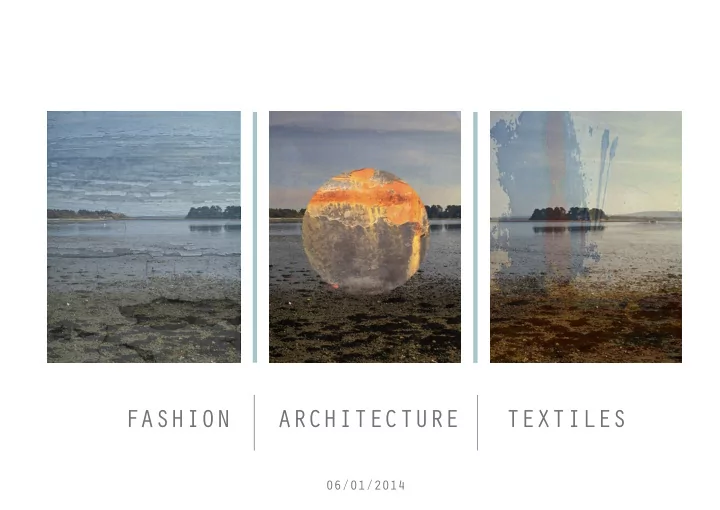
FASHION ARCHITECTURE TEXTILES 06/01/2014 INTRODUCTION TEXTURE - - PowerPoint PPT Presentation
FASHION ARCHITECTURE TEXTILES 06/01/2014 INTRODUCTION TEXTURE The 2014 F.A.T project sees the collaboration between students from Fashion, architecture, and textile design in an attempt to produce a creative outcome sampling methods, ways
The 2014 F.A.T project sees the collaboration between students from Fashion, architecture, and textile design in an attempt to produce a creative outcome sampling methods, ways of thinking and processes from each. Based within Poole quayside as a contextual setting, the aim is to creative a coherent work that aligns with the site whilst displaying aspects of all 3 subjects and their respective design processes. This report documents the creative process with regards to our respective project, highlighting and analysing the necessary issues that arose during the process and the infmuences that lead to the fjnal product. The group was assigned the word texture as an inital starting point with ideas and concepts to be generated and geared around the word throughout.
2
Everything with a surface and can be touched has a texture. From a fashion point textures can afgect a design in various ways, and can add depth to the structure or shape of garment. Texture can be achieved foremost through fabric manipulation or distortion, but also through using a variety of fabric types such as lace, velvet, fur and knits among others. Contrasting textures within a garment or outfjt can represent a mood or vision of a collection in a 3D or tactile way, it could be inviting or repellent but all to generate interest. In approaching a brief, texture is important to consider as it cn dramatically alter silhouette and the overall look. From an architectural point of view texture represents an opportunity, a chance to exhibit, change and form a materials qualities to generate and alter the atmospheres of a place., by changing the visual properties of a material the resulting space assumes visceral
application texture can signify place, and distinguish areas through subtle means as opposed to literal markers creating a more synonymous design. The architect, much like those who work in textile studies, choses a material for its base qualities and manipulates the material through a series of processes to create a refjned version for a specifjc process. In a more literal sense, texture allows for a design to adopt and mirror properties
this extent, a design can be given true identity through material replication. The recipient often already knows what to expect from specfjc materials, concrete, rough etc. Therefore architecture presents the ability to view and interact with texture and material in newer conceptual ways. From a textile point of view texture is a big inspiration for all of our
variety of ways and go through many processes to get it. It’s a way to add interest to a surface and we carry out processes such as devour, slashing, stitching, manipulation and pleating to carry this out. When we were constructing the anchor we put in techniques we knew such as trapping, weaving, folding, cutting, knotting and wrapping. We used a range of natural materials within
mix media within textiles. A big inspiration within this work was Andy Goldsworthy who weaves sticks and twigs.
3
HUMAN INTERVENTION MATERIALISTIC WOVEN
REMOVE FROM CONTEXT NEW VS OLD SCULPTURE MATERIAL
DEPTH OF MATERIAL CONSISTENCY DENSITY 3D
REFLECTIVE OF TEXTURES INTRICATE CONTEXT NATURE VINES
QUAYSIDE ANCHOR SCALE
4
5
The initial action taken after being selected for texture was to visit the site and surrounding context, in this case, Poole old town and quayside. The aim was to view the site from the respective subject views and retrieve personal interpretations of the area, this included photos and sketches etc. These separate views would then be analysed in collaboration in an attempt to establish patterns and correlations that arose within the processes. The general consensus was that texture and Poole should be our base settings from which our designs could always be related to and they would have to display a clear narrative throughout.
6
Initially the proposal for a sculpture was raised, a form created out of materialistic items found on site, enclosing or encasing a modern symbolisation of the new town. This was an attempt to glorify or exhibit the richness
Theses ideas were explored in an attempt to avoid an overly literally approach to the brief. The consensus was that although we were handed texture, the fjnal product needn’t be something that was merely a plea to ‘come and touch this work’ it needed to have a suitable narrative. A number of ideas and concepts were explored during this process ranging from, a series of small hung anchors representing man made intervention whilst hanging to avoid contextual links. Other ideas included a
7
Materials were gathered on site ranging from slates to, vegetation,. All items were gathered on site in either the old town or the quayside to ensure a continuous contextual link. The materials were then manipulated in a number of ways to stress textures and features of the materials. Upon deciding the form would take a sculptural element efgorts were made to stress the importance of a modern fjgure represented through, contextual and traditional materials. Using a branch as a base form for the structure, vines and rusted mesh were weaved up the length of the branches entwining both materials in contrast, a link that is illustrated between the old and new towns in Poole.
8
The concept of context and Poole as a setting was a key element that was highlighted during the design process. After construction of the sculpture, the structure was returned to the context from which it is generated. The combination of both modern and reclaimed materials displays a contrast in the environments in which it is placed. Its proximity to the quayside also considers the context from which the materials originate.
9
Throughout the process, clear and evident input from all 3 disciplines and subjects is exhibited. Despite contrasting thought processes and design workings, we were able to collaborate somewhat successfully. A term used throughout by both fashion and textiles was every surface has a texture, and that is not more relevant than in architecture. It has educated me to pursue a level of detail in my own design work and attend to the purpose
As a collective group issues of confmict only arose during the making process, despite clear motives and narrative for the design everyone appeared to have a difgerent image in their head which lead to a disjointed fjnal product.
valeria Trifidou - Patricia Wu Wu - Holly Walker - Naa Williams - Vicky Eastwell - Daniele Trombin - James Thomas - Therese Wihlney - ollie burton