
SLIDE 1
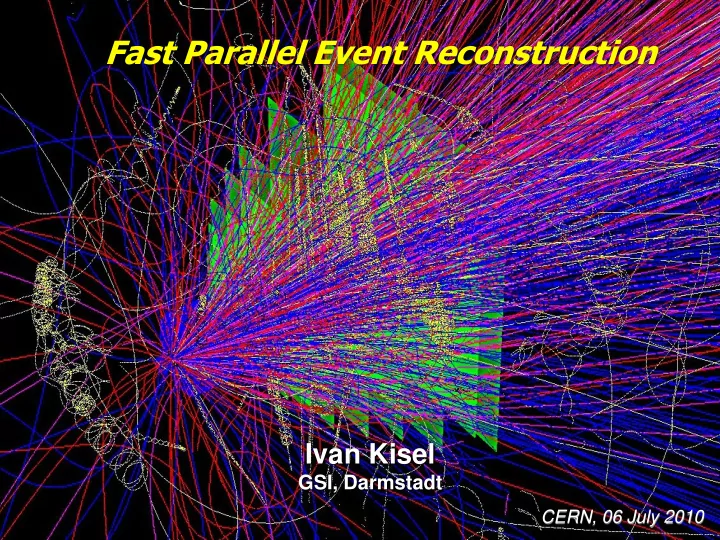
Fast Parallel Event Reconstruction Ivan Kisel GSI, Darmstadt CERN, - - PowerPoint PPT Presentation
Fast Parallel Event Reconstruction Ivan Kisel GSI, Darmstadt CERN, 06 July 2010 Tracking Challenge in CBM (FAIR/GSI, Germany) Fixed-target heavy-ion experiment 10 7 Au+Au collisions/s 1000 charged particles/collision
06 July 2010, CERN Ivan Kisel, GSI 2/20
(85% combinatorial space points) Track reconstruction in STS/MVD and displaced vertex search are required in the first trigger level. Reconstruction packages:
Cellular Automaton (CA)
Kalman Filter (KF)
KF Particle
06 July 2010, CERN Ivan Kisel, GSI 5/20
Thread Thread
2000
Cores and Threads realize the task level of parallelism
2010 2015
Process
Thread1 Thread2 … … exe r/w r/w exe exe r/w ... ...
Vectors (SIMD) = data level of parallelism
Scalar Vector
D S S S S
SIMD = Single Instruction, Multiple Data
Fundamental redesign
is necessary HEP: cope with high data rates !
Cores Threads SIMD Width Performance
06 July 2010, CERN Ivan Kisel, GSI 6/20
63% of the maximal GPU utilization (ALICE)
2x4 cores Since 2005 Since 2008 512 cores 1+8 cores Since 2006 Since 2008 32 cores
70% of the maximal Cell performance (CBM) Cooperation with Intel (ALICE/CBM)
Intel/AMD CPU NVIDIA GPU Intel MICA IBM Cell
6.5 ms/event (CBM)
Future systems are heterogeneous
06 July 2010, CERN Ivan Kisel, GSI 7/20
Vector classes: Cooperation with the Intel Ct group
06 July 2010, CERN Ivan Kisel, GSI 8/20
Vector classes:
provide full functionality for all platforms
support the conditional operators phi(phi<0)+=360; c = a+b vc = _mm_add_ps(va,vb) Scalar SIMD
Vector classes enable easy vectorization of complex algorithms
Vc increase the speed by the factor: SSE2 – SSE4 4x future CPUs 8x MICA/Larrabee 16x
Vector classes overload scalar C operators with SIMD/SIMT extensions
06 July 2010, CERN Ivan Kisel, GSI 10/20
Motivated by, but not restricted to Cell !
blade11bc4 @IBM, Böblingen: 2 Cell Broadband Engines with 256 kB Local Store at 2.4 GHz
Intel P4 Cell
10000x faster
The KF speed was increased by 5 orders of magnitude
06 July 2010, CERN Ivan Kisel, GSI 11/20
scalar double single -> 2 4 8 16 32 1.00 10.00 0.10 0.01
Scalability on different CPU architectures – speed-up 100 Data Stream Parallelism (10x) Task Level Parallelism (100x)
2xCell SPE (16 ) Woodcrest ( 2 ) Clovertown ( 4 ) Dunnington ( 6 )
SIMD Cores and Threads
Time/Track, s Threads Cores Threads SIMD Real-time performance on different Intel CPU platforms Real-time performance on NVIDIA GPU graphic cards
Scalabilty CPU GPU The Kalman Filter Algorithm performs at ns level
CBM Progr. Rep. 2008
06 July 2010, CERN Ivan Kisel, GSI 12/20
(85% combinatorial space points)
770 Tracks
Top view Front view Efficiency Scalability Problem
Highly efficient reconstruction of 150 central collisions per second
Intel X5550, 2x4 cores at 2.67 GHz
06 July 2010, CERN Ivan Kisel, GSI 13/20
Algorithm
Vector SIMD Multi-Threading NVIDIA CUDA OpenCL Time/PC
STS Detector
+ + + +
6.5 ms Muon Detector
+ +
1.5 ms TRD Detector
+ +
1.5 ms RICH Detector
+ +
3.0 ms Vertexing
+
10 μs Open Charm Analysis
+
10 μs User Reco/Digi User Analysis
+ 2009 + 2010
Future Future
Intel X5550, 2x4 cores at 2.67 GHz
The CBM reconstruction is at ms level
06 July 2010, CERN Ivan Kisel, GSI 14/20
45 participants from Austria, China, Germany, India, Italy, Norway, Russia, Switzerland, UK and USA
06 July 2010, CERN Ivan Kisel, GSI 15/20
06 July 2010, CERN Ivan Kisel, GSI 16/20
t 1990 2000 2010 t 1990 2000 2010
Consolidate efforts of:
Software redesign can be synchronized between the experiments
06 July 2010, CERN Ivan Kisel, GSI 17/20
Different experiments have similar reconstruction problems
CBM (FAIR/GSI) ALICE (CERN) Track reconstruction is the most time consuming part of the event reconstruction, therefore many-core CPU/GPU platforms. Track finding is based in both cases on the Cellular Automaton method, track fitting – on the Kalman Filter method.
NVIDIA GPU 240 cores (ALICE HLT Group) Intel CPU 8 cores (CBM Reco Group)
107 collisions/s Collider Fixed-Target Forward geometry Cylindrical geometry 104 collisions/s
06 July 2010, CERN Ivan Kisel, GSI 18/20
Track finding Track fitting Vertex finding/fitting Ring finding (PID)
Time consuming!!! Kalman Filter Kalman Filter Combinatorics
Detector/geometry independent RICH specific Track model dependent Detector dependent
Juni 28, 2010, FIAS Ivan Kisel, GSI 19/20
ALICE (CERN) CBM (FAIR/GSI) STAR (BNL) PANDA (FAIR/GSI) Host Experiments: Uni-Frankfurt/FIAS: Vector classes GPU implementation GSI: Algorithms development Many-core optimization HEPHY (Vienna)/Uni-Gjovik: Kalman Filter track fit Kalman Filter vertex fit OpenLab (CERN): Many-core optimization Benchmarking Intel: Ct implementation Many-core optimization Benchmarking
Common Reconstruction Package
06 July 2010, CERN Ivan Kisel, GSI 20/20
Follow-up Workshop: November 2010 – February 2011 at GSI
CERN
BNL ?