Fasten Your Seatbelts Dr. Paul declares that she has no - - PDF document

fasten your seatbelts
SMART_READER_LITE
LIVE PREVIEW

Fasten Your Seatbelts Dr. Paul declares that she has no - - PDF document

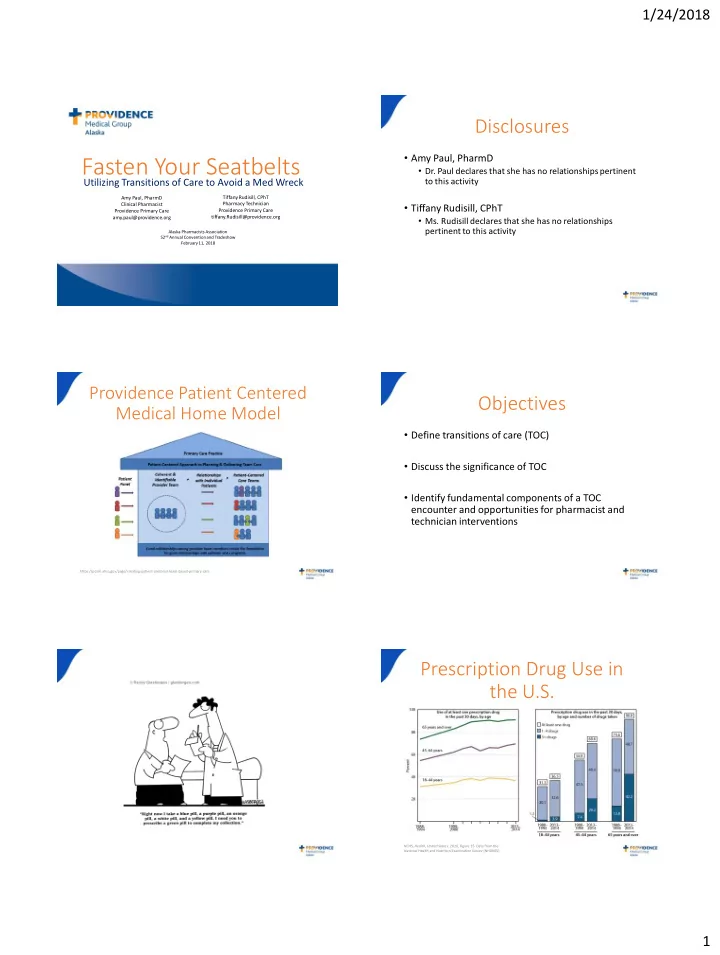
1/24/2018 Disclosures Amy Paul, PharmD Fasten Your Seatbelts Dr. Paul declares that she has no relationships pertinent to this activity Utilizing Transitions of Care to Avoid a Med Wreck Amy Paul, PharmD Tiffany Rudisill, CPhT


slide-1
SLIDE 1

1/24/2018 1

Utilizing Transitions of Care to Avoid a Med Wreck

Fasten Your Seatbelts

Alaska Pharmacists Association 52nd Annual Convention and Tradeshow February 11, 2018

Amy Paul, PharmD Clinical Pharmacist Providence Primary Care amy.paul@providence.org Tiffany Rudisill, CPhT Pharmacy Technician Providence Primary Care tiffany.Rudisill@providence.org

Disclosures

  • Amy Paul, PharmD
  • Dr. Paul declares that she has no relationships pertinent

to this activity

  • Tiffany Rudisill, CPhT
  • Ms. Rudisill declares that she has no relationships

pertinent to this activity

Providence Patient Centered Medical Home Model

https://pcmh.ahrq.gov/page/creating-patient-centered-team-based-primary-care

Objectives

  • Define transitions of care (TOC)
  • Discuss the significance of TOC
  • Identify fundamental components of a TOC

encounter and opportunities for pharmacist and technician interventions

Prescription Drug Use in the U.S.

NCHS, Health, United States, 2016, Figure 15. Data from the National Health and Nutrition Examination Survey (NHANES)

slide-2
SLIDE 2

1/24/2018 2

Risk Factors for Medication Errors

Patient Associated

  • Low health literacy
  • Polypharmacy
  • Language barriers
  • Age
  • Multiple comorbidities

Provider Associated

  • Poor communication
  • Inadequate perception
  • f risk
  • Inadequate knowledge
  • f the patient
  • Provider fatigue

www.who.int/patientsafety https://psnet.ahrq.gov/primers/primer/23/medication-errors

Consequences of Medication Errors

Inpatient Errors

Hospitalizations ED Visits Ambulatory Events

Budnitz et al. JAMA. 2006;296:1858-1866 Gandhi et al. N Engl J Med. 2003;348:1556-1564

Brake Check

  • The term “transitions of care” refers exclusively to

the movement of patients from the hospital to an ambulatory setting.

  • A. True
  • B. False

What is Transitions of Care?

  • The movement of a patient from one setting of care

to another

  • Hospital
  • Ambulatory primary care practice
  • Ambulatory specialty care practice
  • Long-term care
  • Home health
  • Rehabilitation facility
  • Pharmacy to pharmacy?

www.cms.gov www.ahrq.gov www.jointcommission.org

What is Transitions of Care to You?

  • How many of you currently perform transitions of

care activities in your practice setting?

  • What are some barriers to performing transitions of

care in your practice setting?

Why Does it Matter?

Improving health and patient safety Reducing healthcare costs

slide-3
SLIDE 3

1/24/2018 3

Why Does it Matter?

www.medicare.gov https://www.ahrq.gov/topics/hospital-readmissions.html

Health Care Reform

Accountable Care Organizations Medicare Shared Savings Program Federal Readmissions Reduction Program Fee for Service vs. Pay for Performance Meaningful Use

Why Does It Matter?

  • Quality Metrics
  • Joint Commission
  • Centers for Medicare & Medicaid
  • HCAHPS Survey
  • NCQA Healthcare Effectiveness Data & Information Set
  • Plan All-Cause Readmissions
  • Medication Reconciliation Measure
  • Physician Consortium for Performance Improvement

HCAHPS: Hospital Consumer Assessment of Healthcare Providers and Systems NCQA: National Committee for Quality Assurance

Brake Check

  • Which of the following patients are appropriate for

a transitions of care encounter?

  • A. A woman with dementia transferred from a skilled

nursing facility to the hospital

  • B. A man seeking specialty treatment from a neurologist
  • C. A patient being transferred from the ICU to the floor
  • D. A patient being discharged from home health services
  • E. All of the above

Building a Strong Foundation

Medication Reconciliation

Medication Reconciliation

  • Definition
  • The process of identifying the most accurate list possible
  • f all medications a patient is taking – including:
  • Drug name
  • Dosage
  • Frequency
  • Route
  • Indication?

by comparing the medical record to an external list

  • btained from a patient, transfer, or discharge orders.
  • This process should occur any time there is a change in

therapy or patient status

www.cms.gov Voss et al. Arch Intern Med. 2011;171:1232-7. http://www.ihi.org/Topics/ADEsMedicationReconciliation/Pages/default.aspx

Medication Reconciliation

This includes over the counter supplements and nonprescription products!

slide-4
SLIDE 4

1/24/2018 4

Medication Reconciliation

  • Goal
  • To use the information obtained within and across the

continuum of care to ensure safe and effective medication use, avoiding:

  • Omissions
  • Duplications
  • Dosing errors
  • Drug interactions

as well as to observe compliance and adherence patterns.

www.cms.gov Voss et al. Arch Intern Med. 2011;171:1232-7. http://www.ihi.org/Topics/ADEsMedicationReconciliation/Pages/default.aspx

Medication Reconciliation

Develop a list of current medications

www.jointcommission.org

Ask the right questions

Closed-Ended

  • Do you take this for…
  • You take this 2 times

per day, right?

  • Do you ever…
  • Do you have any

questions?

Open-Ended

  • What do you take for…
  • How do you take…
  • How often do you…
  • What questions do you

have for me?

Medication Reconciliation

Develop a list

  • f current

medications Develop a list

  • f medications

to be prescribed Compare the medications

  • n the two

lists

www.jointcommission.org

Develop and Compare

  • Prescribed vs. Taking
  • Medications held
  • Temporary or as needed orders
  • Anticipate needs

Medication Reconciliation

Develop a list

  • f current

medications Develop a list

  • f medications

to be prescribed Compare the medications

  • n the two

lists Make clinical decisions based on the comparison

www.jointcommission.org

slide-5
SLIDE 5

1/24/2018 5

Make Clinical Decisions

  • Duplications in therapy
  • Sub or supra-therapeutic doses
  • Therapeutic substitutions
  • Patient education

Medication Reconciliation

Develop a list

  • f current

medications Develop a list

  • f medications

to be prescribed Compare the medications

  • n the two

lists Make clinical decisions based on the comparison Communicate the new list to appropriate caregivers and the patient

www.jointcommission.org

Communication

Provider Patient

  • Chart note
  • Pharmacy Communication
  • Curbside
  • Medication Action Plan
  • Personal Medication Record

Sorry I missed you, but here’s a note of important things from my visit! Patient Name: Medication Concerns: Refills Needed: Time: Patient seen by: Patient is: Back in the Lobby or Exam Rm

Brake Check

  • Which of the following is an open-ended question?
  • A. Do you take this medication twice daily?
  • B. Do you ever miss a dose of medication?
  • C. What questions do you have for me?
  • D. Are you taking this for diabetes?
  • E. None of the above

Making Meaningful Interventions TOC Opportunities for Pharmacy

Pharmacists & Pharmacy Technicians

Medication Education Chronic Disease State Management Therapeutic Interchange Targeted Services Lab Monitoring Screening

slide-6
SLIDE 6

1/24/2018 6

Medication Education

  • JW is a 52 year old male who is a regular at your
  • pharmacy. He complains of constant fatigue due to

lack of restful sleep. He has never had an issue with insomnia in the past. He is up three to four times per night to use the bathroom. When prompted as to what time of day he takes his furosemide, he states that he takes ALL of his medications before bed.

Medication Education

  • Medication timing
  • Medication indication
  • Inhaler technique
  • Insulin administration

TOC Opportunities for Pharmacy

Pharmacists & Pharmacy Technicians

Medication Education Chronic Disease State Management Therapeutic Interchange Targeted Services Lab Monitoring Screening

Chronic Disease State Management

  • RP is a 29 year old male with a history of type 2

diabetes mellitus who presents to your clinic to establish care. He does not check his blood sugars regularly at home. When asked how often he takes his metformin, he states that he only takes it when he “feels” that his blood sugars are high or he eats a meal that is high in protein.

Chronic Disease State Management

  • Diabetes
  • Hypertension
  • Depression
  • COPD/Asthma
  • Anticoagulation
  • Congestive heart

failure

TOC Opportunities for Pharmacy

Pharmacists & Pharmacy Technicians

Medication Education Chronic Disease State Management Therapeutic Interchange Targeted Services Lab Monitoring Screening

slide-7
SLIDE 7

1/24/2018 7

Lab Monitoring

  • AV is a 28 year old female presenting to your clinic

to establish care with the psychiatric nurse

  • practitioner. She has been taking lithium for three
  • years. She states that over the past few months

she has developed some visual disturbance and difficulty maintaining her balance.

Lab Monitoring

  • Therapeutic drug levels
  • Renal function
  • Liver function
  • Electrolytes
  • Hemoglobin A1c

TOC Opportunities for Pharmacy

Pharmacists & Pharmacy Technicians

Medication Education Chronic Disease State Management Therapeutic Interchange Targeted Services Lab Monitoring Screening

Screening & Targeted Services

  • SS is a 21 year old female who is admitted to your

facility for suicidal ideation. She states she has been prescribed venlafaxine for her depression, but has not been taking it for the past month due to the fact that she lost her job and no longer receives prescription benefits.

Screening & Targeted Services

  • PHQ-9
  • Financial services
  • Nurse Case Management
  • Social Work

TOC Opportunities for Pharmacy

Pharmacists & Pharmacy Technicians

Medication Education Chronic Disease State Management Therapeutic Interchange Targeted Services Lab Monitoring Screening

slide-8
SLIDE 8

1/24/2018 8

Therapeutic Interchange

  • HJ is a 77 year old male who is transferring his

prescriptions to your pharmacy. You notice that he has only been filling his fluticasone/salmeterol every 60 days. He states he has only been using the medication once daily as it is difficult for him to remember the evening dose.

Future Opportunities?

  • Billing for pharmacy services
  • CPT Codes 99495 and 99496
  • Gather data
  • Provider status

Objectives Reviewed

  • Transitions of care is the movement of a patient

from one setting of care to another

  • Successful care transitions improve patient health

and safety and reduce costs

  • Medication reconciliation is a key component of

any transitions of care encounter – it can be a springboard for many pharmacist and technician driven interventions

Questions/Discussion

Amy Paul, PharmD Clinical Pharmacist Providence Primary Care amy.paul@providence.org Tiffany Rudisill, CPhT Pharmacy Technician II Providence Primary Care tiffany.Rudisill@providence.org