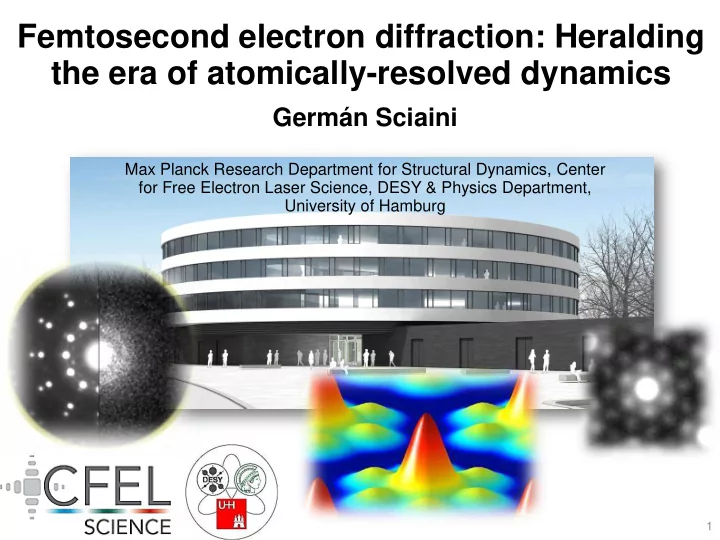
Femtosecond electron diffraction: Heralding the era of atomically-resolved dynamics
Germán Sciaini
Max Planck Research Department for Structural Dynamics, Center for Free Electron Laser Science, DESY & Physics Department, University of Hamburg
1
Femtosecond electron diffraction: Heralding the era of - - PowerPoint PPT Presentation
Femtosecond electron diffraction: Heralding the era of atomically-resolved dynamics Germn Sciaini Max Planck Research Department for Structural Dynamics, Center for Free Electron Laser Science, DESY & Physics Department, University of
Max Planck Research Department for Structural Dynamics, Center for Free Electron Laser Science, DESY & Physics Department, University of Hamburg
1
FED – similar effective brightness to 4th generation fs X-ray sources 200-keV FED setup Femtosecond electron diffraction (FED) layout LCLS European XFEL
For recent advances in the field, see:
(2011).
2
DC compact e-guns 200-300 fs 108-109 ph/pulse New DC e-gun designs 100-300 fs 109-1010 ph/pulse. RF-compression e-guns ~sub-100 fs (250 fs) 1010-1011 ph/pulse Relativistic e-guns ~sub-100 fs (200 fs) 1010-1012 ph/pulse
SLS—3rd generation LS, slicing 200 fs 300 ph/pulse Plasma sources 100 fs 103 ph/pulse. 4th generation light sources. sub-100 fs (100 fs) 1012 ph/pulse
For recent advances in FED see:
3
Major advance over conventional streak camera technologies.
Hebeisen, Sciaini et al. Opt Express 16, 3334 (2008)
Ponderomotive force:
Ponde
4
5
6
Sutherland W. Philos. Magazine (1891) 32:194, 31-43.
7
Lin et al. J. Phys. Chem. C 114, 5686 (2010)
Optical phonon period!
In news & views, Nature 458, 42 (2009).
8
Sciaini et al. irradiate crystalline bismuth with ultrashort bursts of electrons to monitor the emergence of atomic disorder during laser-induced melting. The images show electron-diffraction patterns observed before (a) and after (b) laser excitation. Atomic disorder emerges in about 200 femtoseconds (0.2 picoseconds). (Modified from a graphic by J. Harms.)
9
10
Shear mode detection becomes trivial
Full Characterization of Mechanical Properties of Nanomaterials
Harb et al. Phys. Rev. B 79, 094301 (2009)
DT = 320K Unit cell changes ~ 10-3 Å detectable.
11
http://www.physnet.uni-hamburg.de/iap/group_g/F_Praktikum/Rastertunnelmikroskopie/
Θ ~ 10o
12
STM image – real space Reciprocal space
Fluence: 2.4 mJ/cm2 DT(pump) ~ 90 K CDW_movie
13
Initial amplitude of the periodic lattice distortion ~ 0.1 Å. Atomic displacements ~ 0.02 Å
Movie_real Movie_recip
14
15
Submitted to Nature.
Chollet et al., Science 307, 86 (2005).
In collaboration with:
Tokyo Institute of Technology
Kyoto University 100-nm thick samples 100-keV FED setup
(TMTSF)2PF6 First organic superconductor
16
17
Sample degradation – diffracted intensity vs. #
100 nm thick samples, images – polarized light microscope
(a) (b)
Masked dynamics due to accumulative heating @ 1 kHz
Gao M, Jean-Ruel J et al., Opt. Express 20, 12048 (2012).
10 Hz 200000 e/pulse 280 um spot size IRF – 0.4 ps (FWHM)
Time-dependent photo-induced differential intensity changes Thermal phase transition Over 200 reflections showing time-resolved Intensity changes beyond SNR.
19
Toronto/Hamburg
Present members/Toronto
Hubert Jean-Ruel Ray Gao Lai Chung Liu Past members
Canadian Light Source
Tokyo Institute of Technology
Kyoto University
& co-workers. Wisconsin Madison
Weina Peng U of Konstanz
Maximilian Eichberger Hanjo Shäfer EPFL
Universität Duisburg-Essen
Thomas Payer
20