Few-shot Domain Adaptation 1/12 by Causal Mechanism Transfer - - PowerPoint PPT Presentation

few shot domain adaptation
SMART_READER_LITE
LIVE PREVIEW

Few-shot Domain Adaptation 1/12 by Causal Mechanism Transfer - - PowerPoint PPT Presentation

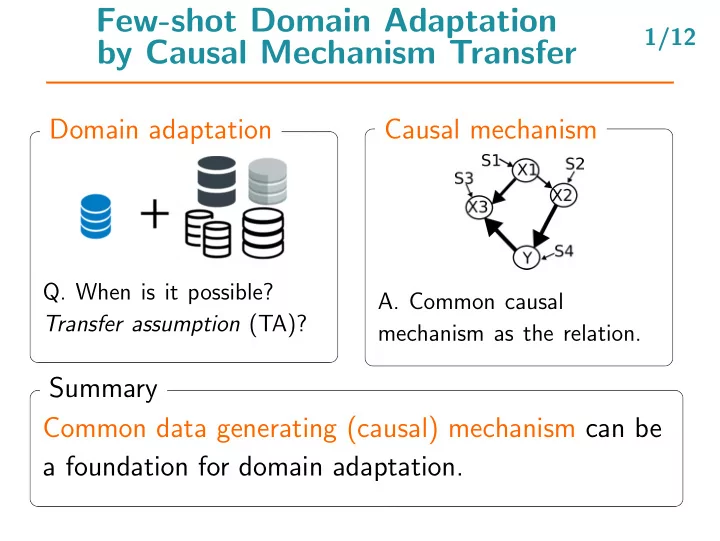
Few-shot Domain Adaptation 1/12 by Causal Mechanism Transfer Domain adaptation Causal mechanism Q. When is it possible? A. Common causal Transfer assumption (TA)? mechanism as the relation. Summary Common data generating (causal) mechanism


slide-1
SLIDE 1

Few-shot Domain Adaptation by Causal Mechanism Transfer

1/12

  • Q. When is it possible?

Transfer assumption (TA)?

Domain adaptation

  • A. Common causal

mechanism as the relation.

Causal mechanism Common data generating (causal) mechanism can be a foundation for domain adaptation. Summary

slide-2
SLIDE 2

What’s the intuition?

2/12

Humans care about finding causal knowledge be- cause, once discovered, it applies to different systems. Intuition

  • Predict disease risk from medical records.

[1]

  • Data distributions may vary for different lifestyles.
  • Common pathological mechanism across regions.

Motivating example: Regional disease prediction

slide-3
SLIDE 3

Few-shot Domain Adaptation by Causal Mechanism Transfer

Takeshi Teshima12, Issei Sato12, and Masashi Sugiyama21

1 The University of Tokyo 2 RIKEN (This work was supported by RIKEN Junior Research Associate Program.)

slide-4
SLIDE 4

Preliminary: Causal model (SEMs)

3/12

  • Generative model for the joint distribution of data.
  • Consists of deterministic functions of the form:

             X1 = f ′

1(pa1, S1)

X2 = f ′

2(pa2, S2)

X3 = f ′

3(pa3, S3)

Y = f ′

4(pa4, S4)

and an independent distribution of (S1, . . . , SD). Structural Equation Models (SEMs)1, 2 [2]

1More precisely, NPSEM-IE (Nonparametric SEM with Independent Errors). 2Acyclicity is assumed.

slide-5
SLIDE 5

Nonlinear-ICA and reduced-form SEM 4/12

                 X1 = f ′

1(pa1, S1)

X2 = f ′

2(pa2, S2)

X3 = f ′

3(pa3, S3)

Y = f ′

4(pa4, S4)

       X1 X2 X3 Y        = f        S1 S2 S3 S4       

Structural equations Reduced form Reduced form: Structural equations solved for (X, Y ).

  • Under certain identification conditions, nonlinear-ICA3

methods can estimate f (we use it in our method).

3ICA = Independent component analysis.

slide-6
SLIDE 6

Formulation 1/3: Data and goal

5/12

  • 1. Homogeneous (i.e., all domains in the same space)

X × Y ⊂ RD−1 × R

  • 2. Multi-source (i.e., multiple source domains)

Dk = {(xk,i, yk,i)}

nk i=1 i.i.d.

∼ psrc(k) (k = 1, . . . , K) (large nk)

  • 3. Few-shot supervised (i.e., target data with labels)

{(xtar,i, ytar,i)}ntar

i=1 i.i.d.

∼ ptar (ntar is small)

Basic setup: regression domain adaptation Find g : RD−1 → R s.t. R(g) := Etarℓ(g, X, Y ) is minimal. Goal: accurate predictor for the target distribution

(ℓ: loss function)

slide-7
SLIDE 7

Formulation 2/3: Each domain

6/12

  • Each domain follows a nonlinear-ICA model.
  • 1. D-dimensional ICs S

are sampled from q.

  • 2. Invertible f transforms

S into (X, Y ) = f(S).

  • Dist. p consists of (f, q)
  • f can be estimated by ICA

under assumptions.

  • f corresponds to the reduced

form of an SEM.

slide-8
SLIDE 8

Formulation 3/3: Key assumption

7/12

  • Key Assumption: generative mechanism f is common.
  • Allow flexible shift in q ⇝ Enables DA among

seemingly very different distributions.

slide-9
SLIDE 9

Proposed method: Strategy

8/12

ˆ f−1

→ →

ˆ f

  • 1. Estimate f using source domain data (NLICA).
  • 2. Estimate ICs of the target data using ˆ

f −1.

  • 3. Reshuffle the independent components.
  • 4. Generate target data from reshuffled ICs using ˆ

f.

  • 5. Train the predictor g on the generated data.

Idea: How to exploit the assumption

slide-10
SLIDE 10

Theoretical analyses

9/12

Theorem: If ˆ

f = f, the proposed risk estimator is the

uniformly minimum variance unbiased risk estimator. The method should help in terms of variance.

  • Q1. How does the method statistically help?

Theorem: generalization error bound for ˆ

f ̸= f.

Mitigate overfitting. Introduce bias.

  • Q2. What happens when ˆ

f ̸= f? What’s the catch?

slide-11
SLIDE 11

Experiment: Setup

10/12

  • Dataset: Gasoline consumption dataset [3].

▶ Panel data from econometrics (SEMs have been applied). ▶ 18 countries (=domains), 19 years, D = 4.

  • Baselines for regression domain adaptation.

Name Compared method (predictor: KRR) TarOnly Train on target. SrcOnly Train on source. S&TV Train on source, CV on target. TrAdaBoost Boosting for few-shot regression transfer [4]. IW Joint importance weight using RuLSIF [5]. GDM Generalized discrepancy minimization [6]. Copula Non-parametric R-vine copula method [7]. LOO (reference) LOOCV error estimate.

slide-12
SLIDE 12

Experiment: Result

11/12

Target (LOO) TrgOnly Prop SrcOnly S&TV TrAda GDM Copula IW(.0) IW(.5) IW(.95) AUT 1 5.88 (1.60) 5.39 (1.86) 9.67 (0.57) 9.84 (0.62) 5.78 (2.15) 31.56 (1.39) 27.33 (0.77) 39.72 (0.74) 39.45 (0.72) 39.18 (0.76) BEL 1 10.70 (7.50) 7.94 (2.19) 8.19 (0.68) 9.48 (0.91) 8.10 (1.88) 89.10 (4.12) 119.86 (2.64) 105.15 (2.96) 105.28 (2.95) 104.30 (2.95) CAN 1 5.16 (1.36) 3.84 (0.98) 157.74 (8.83) 156.65 (10.69) 51.94 (30.06) 516.90 (4.45) 406.91 (1.59) 592.21 (1.87) 591.21 (1.84) 589.87 (1.91) DNK 1 3.26 (0.61) 3.23 (0.63) 30.79 (0.93) 28.12 (1.67) 25.60 (13.11) 16.84 (0.85) 14.46 (0.79) 22.15 (1.10) 22.11 (1.10) 21.72 (1.07) FRA 1 2.79 (1.10) 1.92 (0.66) 4.67 (0.41) 3.05 (0.11) 52.65 (25.83) 91.69 (1.34) 156.29 (1.96) 116.32 (1.27) 116.54 (1.25) 115.29 (1.28) DEU 1 16.99 (8.04) 6.71 (1.23) 229.65 (9.13) 210.59 (14.99) 341.03 (157.80) 739.29 (11.81) 929.03 (4.85) 817.50 (4.60) 818.13 (4.55) 812.60 (4.57) GRC 1 3.80 (2.21) 3.55 (1.79) 5.30 (0.90) 5.75 (0.68) 11.78 (2.36) 26.90 (1.89) 23.05 (0.53) 47.07 (1.92) 45.50 (1.82) 45.72 (2.00) IRL 1 3.05 (0.34) 4.35 (1.25) 135.57 (5.64) 12.34 (0.58) 23.40 (17.50) 3.84 (0.22) 26.60 (0.59) 6.38 (0.13) 6.31 (0.14) 6.16 (0.13) ITA 1 13.00 (4.15) 14.05 (4.81) 35.29 (1.83) 39.27 (2.52) 87.34 (24.05) 226.95 (11.14) 343.10 (10.04) 244.25 (8.50) 244.84 (8.58) 242.60 (8.46) JPN 1 10.55 (4.67) 12.32 (4.95) 8.10 (1.05) 8.38 (1.07) 18.81 (4.59) 95.58 (7.89) 71.02 (5.08) 135.24 (13.57) 134.89 (13.50) 134.16 (13.43) NLD 1 3.75 (0.80) 3.87 (0.79) 0.99 (0.06) 0.99 (0.05) 9.45 (1.43) 28.35 (1.62) 29.53 (1.58) 33.28 (1.78) 33.23 (1.77) 33.14 (1.77) NOR 1 2.70 (0.51) 2.82 (0.73) 1.86 (0.29) 1.63 (0.11) 24.25 (12.50) 23.36 (0.88) 31.37 (1.17) 27.86 (0.94) 27.86 (0.93) 27.52 (0.91) ESP 1 5.18 (1.05) 6.09 (1.53) 5.17 (1.14) 4.29 (0.72) 14.85 (4.20) 33.16 (6.99) 152.59 (6.19) 53.53 (2.47) 52.56 (2.42) 52.06 (2.40) SWE 1 6.44 (2.66) 5.47 (2.63) 2.48 (0.23) 2.02 (0.21) 2.18 (0.25) 15.53 (2.59) 2706.85 (17.91) 118.46 (1.64) 118.23 (1.64) 118.27 (1.64) CHE 1 3.51 (0.46) 2.90 (0.37) 43.59 (1.77) 7.48 (0.49) 38.32 (9.03) 8.43 (0.24) 29.71 (0.53) 9.72 (0.29) 9.71 (0.29) 9.79 (0.28) TUR 1 1.65 (0.47) 1.06 (0.15) 1.22 (0.18) 0.91 (0.09) 2.19 (0.34) 64.26 (5.71) 142.84 (2.04) 159.79 (2.63) 157.89 (2.63) 157.13 (2.69) GBR 1 5.95 (1.86) 2.66 (0.57) 15.92 (1.02) 10.05 (1.47) 7.57 (5.10) 50.04 (1.75) 68.70 (1.25) 70.98 (1.01) 70.87 (0.99) 69.72 (1.01) USA 1 4.98 (1.96) 1.60 (0.42) 21.53 (3.30) 12.28 (2.52) 2.06 (0.47) 308.69 (5.20) 244.90 (1.82) 462.51 (2.14) 464.75 (2.08) 465.88 (2.16) #Best

  • 2

10 2 4

Proposed > TrgOnly when the other methods using source domain data suffer from negative transfer.

slide-13
SLIDE 13

Take-home message

12/12

  • 1. Transfer assumption of shared generative mechanism.

Developed a few-shot regression DA method.

  • 2. Proposed method extracts and uses the causal model

to reduce overfitting via data augmentation.

  • 3. Experiment with real-world data demonstrate the

validity.

ˆ f−1

→ →

ˆ f

slide-14
SLIDE 14

References

[1]

  • P. Yadav, M. Steinbach, V. Kumar, and G. Simon, ‘Mining electronic health records

(EHRs): A survey’, ACM Computing Surveys, vol. 50, no. 6, pp. 1–40, 2018. [2]

  • J. Pearl, Causality: Models, Reasoning and Inference, Second. Cambridge, U.K. ; New

York: Cambridge University Press, 2009. [3]

  • W. H. Greene, Econometric Analysis, Seventh. Boston: Prentice Hall, 2012.

[4]

  • D. Pardoe and P. Stone, ‘Boosting for regression transfer’, in Proceedings of the

Twenty-Seventh International Conference on Machine Learning, Haifa, Israel, 2010,

  • pp. 863–870.

[5]

  • M. Yamada, T. Suzuki, T. Kanamori, H. Hachiya, and M. Sugiyama, ‘Relative

density-ratio estimation for robust distribution comparison’, in Advances in Neural Information Processing Systems 24, J. Shawe-Taylor, R. S. Zemel, P. L. Bartlett,

  • F. Pereira, and K. Q. Weinberger, Eds., Curran Associates, Inc., 2011, pp. 594–602.

[6]

  • C. Cortes, M. Mohri, and A. M. Medina, ‘Adaptation based on generalized

discrepancy’, Journal of Machine Learning Research, vol. 20, no. 1, pp. 1–30, 2019.
slide-15
SLIDE 15

References (cont.)

[7]

  • D. Lopez-paz, J. M. Hernndez-lobato, and B. Schlkopf, ‘Semi-supervised domain

adaptation with non-parametric copulas’, in Advances in Neural Information Processing Systems 25, F. Pereira, C. J. C. Burges, L. Bottou, and K. Q. Weinberger, Eds., Curran Associates, Inc., 2012, pp. 665–673.