Field O ff sets class Shape { Point LL /* 4 */ , UR; /* 8 */ void - - PowerPoint PPT Presentation

field o ff sets
SMART_READER_LITE
LIVE PREVIEW

Field O ff sets class Shape { Point LL /* 4 */ , UR; /* 8 */ void - - PowerPoint PPT Presentation

Field O ff sets class Shape { Point LL /* 4 */ , UR; /* 8 */ void setCorner(int which, Point p); CS 4120 } class ColoredRect extends Shape { Introduction to Compilers Color c; /* 12 */ void setColor(Color c_); } Andrew Myers O ff


slide-1
SLIDE 1

CS 4120 Introduction to Compilers

Andrew Myers Cornell University

Lecture 31: Multiple Inheritance 16 Nov 09

CS 4120 Introduction to Compilers 2

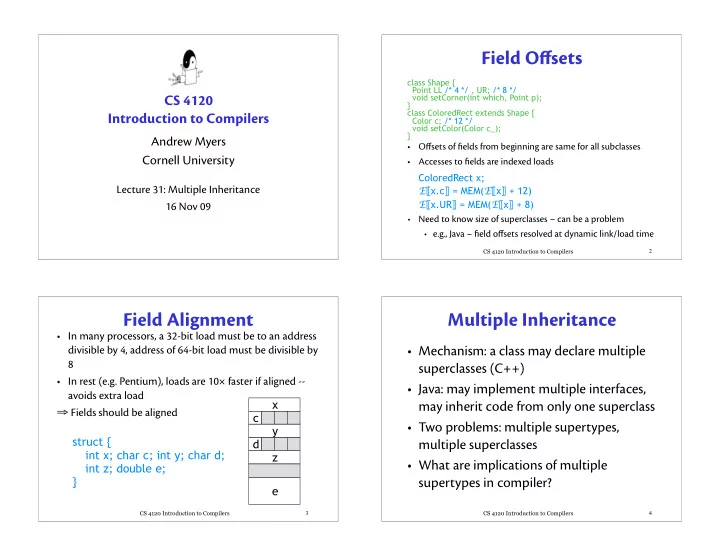
Field Offsets

class Shape { Point LL /* 4 */ , UR; /* 8 */ void setCorner(int which, Point p); } class ColoredRect extends Shape { Color c; /* 12 */ void setColor(Color c_); }

  • Offsets of fields from beginning are same for all subclasses
  • Accesses to fields are indexed loads

ColoredRect x; Ex.c = MEM(Ex + 12) Ex.UR = MEM(Ex + 8)

  • Need to know size of superclasses – can be a problem
  • e.g., Java – field offsets resolved at dynamic link/load time

CS 4120 Introduction to Compilers 3

Field Alignment

  • In many processors, a 32-bit load must be to an address

divisible by 4, address of 64-bit load must be divisible by 8

  • In rest (e.g. Pentium), loads are 10× faster if aligned --

avoids extra load Fields should be aligned struct { int x; char c; int y; char d; int z; double e; } x c y d z e

CS 4120 Introduction to Compilers 4

Multiple Inheritance

  • Mechanism: a class may declare multiple

superclasses (C++)

  • Java: may implement multiple interfaces,

may inherit code from only one superclass

  • Two problems: multiple supertypes,

multiple superclasses

  • What are implications of multiple

supertypes in compiler?

slide-2
SLIDE 2

CS 4120 Introduction to Compilers 5

Semantic problems

  • Problem 1: ambiguity

class A { int m(); } class B { int m(); } class C extends A, B {} // which m?

  • All methods, fields must be uniquely defined
  • Problem 2: field replication

class A { int x; } class B1 extends A { … } class B2 extends A { … } class C extends B1, B2 { … }

A B1 B2 C

CS 4120 Introduction to Compilers 6

Dispatch vectors break

interface Shape { void setCorner(int w, Point p); } interface Color { float get(int rgb); void set(int rgb, float value); 1 } class Blob implements Shape, Color { ... }

CS 4120 Introduction to Compilers 7

DV alternatives

  • Option 1: search with inline cache

(Smalltalk, Java)

– For each class, interface, have table mapping method names to method code. Recursively walk upward in hierarchy looking for method name –Optimization: at call site, store class and code pointer in call site code (inline caching). On call, check whether class matches cache.

CS 4120 Introduction to Compilers 8

Inline cache code

  • Let to be the receiver object:

mov t1, [to] cmp t1, [cacheClass434] jnz miss call [cacheCode434] miss: call slowDispatch

cacheClass434 cacheCode434

  • bject
  • bject class

information cache data (in data segment)

90% of calls from a site go to same code as last call from same site

slide-3
SLIDE 3

CS 4120 Introduction to Compilers 9

Option 2: Sparse dispatch vectors

  • Make sure that two methods never allocated same offset: give

Shape offset 0, Color offsets 1 and 2. Allow holes in DV!

  • Some methods can be given same offset since they never
  • ccur in the same DV
  • Graph coloring techniques can be used to compute

method indices in reasonably optimal way (finding optimum is NP-complete!)

CS 4120 Introduction to Compilers 10

Sparse Dispatch Vectors

  • Advantage: same fast dispatch code as SI case
  • Disadvantage: requires knowledge of entire type

hierarchy (makes separate compilation, dynamic loading difficult)

interface Shape { void setCorner(int w, Point p); 0 } interface Color { float get(int rgb); 1 void set(int rgb, float value); 3 } class Blob implements Shape, Color { … } setCorner get set

CS 4120 Introduction to Compilers 11

Option 3: Hash tables

  • Idea: don’t try to give all method unique indices;

resolve conflicts by checking that entry is correct at dispatch

  • Use hashing to generate method indices

– Precompute hash values! – Some Java implementations

interface Shape { void setCorner(int w, Point p); 11 } interface Color { float get(int rgb); 4 void set(int rgb, float value); 7 } class Blob implements Shape, Color { … }

CS 4120 Introduction to Compilers 12

Dispatch with Hash tables

  • What if there’s a conflict? Entries containing several methods

point to resolution code

  • Basic dispatch code is (almost) identical!
  • Advantage: simple, reasonably fast
  • Disadvantage: some wasted space in DV, extra argument for

resolution, slower dispatch if conflict Fixed # entries

set setCorner get

slide-4
SLIDE 4

CS 4120 Introduction to Compilers 13

Option 5: Binary decision trees

  • Idea: use conditional branches, not indirect jumps
  • Unique class index stored in first object word
  • Range tests used to select among n possible classes at call site in lg n

time – direct branches to code

Shape x; x.SetCorner(…) mov ebx, [eax] cmp ebx, 1 jle L1 cmp ebx, 2 je Circle$setCorner jmp Egg$setCorner L1: cmp ebx, 0 je Blob$setCorner jmp Rect$setCorner

Shape Blob Rectangle Circle Color 1 2 RGBColor Egg 4 3 Decision tree 1 2 3 2 Circle

CS 4120 Introduction to Compilers 14

Binary decision tree

  • Works well if distribution of classes is highly skewed:

branch prediction hardware eliminates branch stall of ~10 cycles

– Can use profiling to identify common paths for each call site individually – 90%/10% : usually a common path to put at top of decision tree

  • Like sparse DVs: need whole-program analysis
  • Indirect jump can have better expected execution

time for >2 classes: at most one mispredict

34 … …