Financial markets in developing countries (rough notes, use only as - PowerPoint PPT Presentation
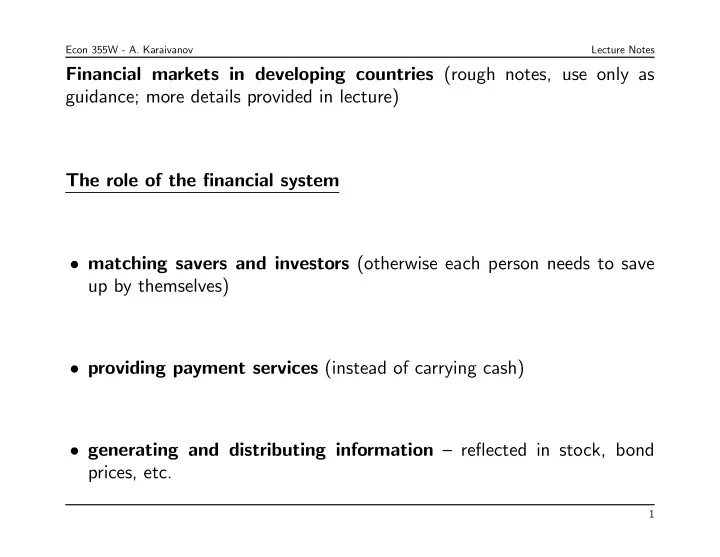
Econ 355W - A. Karaivanov Lecture Notes Financial markets in developing countries (rough notes, use only as guidance; more details provided in lecture) The role of the fi nancial system matching savers and investors (otherwise each person
Econ 355W - A. Karaivanov Lecture Notes Financial markets in developing countries (rough notes, use only as guidance; more details provided in lecture) The role of the fi nancial system • matching savers and investors (otherwise each person needs to save up by themselves) • providing payment services (instead of carrying cash) • generating and distributing information — re fl ected in stock, bond prices, etc. 1
Econ 355W - A. Karaivanov Lecture Notes • allocation of credit/capital in the economy (to the uses that yield greatest returns) • pricing, pooling and trading risk (through the insurance market, part of the fi nancial system) • providing asset liquidity (some investments are long-lived; but can be made liquid through the stock market, etc.) 2
Econ 355W - A. Karaivanov Lecture Notes Credit markets • matching skills with resources • if fi nancial markets are e ffi cient (perfect information, perfect enforcement) then resources fl ow to highest returns (highest skills) • otherwise, economic outcomes depend on how much wealth people start with, not their talents • thus, fi nancial markets are important for e ffi ciency, for the economy to reach its potential 3
Econ 355W - A. Karaivanov Lecture Notes • Why are fi nancial markets particularly likely to be imperfect in developing countries? • Buying something vs. paying are often separated over time • Presence of ‘transaction costs’ — when the time to pay comes people can be: — unable to repay ( information needed in advance to prevent this; this is costly) — unwilling to repay ( enforcement needed ex-post to prevent this; this is costly) — evidence from India: in 1997, 3.2 outstanding debt cases; 40% for more than 8 years — also, limited liability — in today’s world there are legal limits on punishment for reneging on contracts (not true in the past or in black markets) 4
Econ 355W - A. Karaivanov Lecture Notes Lenders anticipate these issues, so they: • screen borrowers (if asymmetric information problem in borrower’s riskiness/type) • monitor borrowers (if asymmetric info in borrower’s e ff ort — if cannot observe it) • threaten to cut o ff from future loans (to help with enforcement problems) • require collateral (to help with enforcement problems) 5
Econ 355W - A. Karaivanov Lecture Notes FACTS • high interest rates in LDCs (Banerjee, 2004) — 52% in rural areas in India; 28-62% in urban; in the US — 6-14% 1980-2000 — cannot be explained by default alone (explains at most 23% of the interest rate level) — cannot be explained by monopoly power alone — why kill the demand so much? also, public banks and competition from informal sector present • presence of large informal sector, including moneylenders (provides 20- 30% of all loans) • personalized interest rates (co-existence of various rates, e.g. 12% vs. 60% without arbitrage) • loan amount often restricted by borrower’s wealth/assets — no more loans possible, no matter what the interest rate — “credit rationing” 6
Econ 355W - A. Karaivanov Lecture Notes • some people not given a loan of any amount and at any o ff ered interest rate (not consistent with standard supply and demand theory under perfect markets) 7
Econ 355W - A. Karaivanov Lecture Notes • Evidence for transaction costs: — the case of Debt Recovery Tribunals in India (Visaria, 2007) — sped up resolution of civil cases about unpaid loans; — reduced loan delinquency by 6-11 percentage points — interest rates fell by 1-2 percentage points • Cross-country evidence (Djankov et al. 2006) — study 129 countries over 25 years — fi nds that lenders’ legal rights (ability to enforce repayment; sell the collateral) is positively correlated with the private debt to GDP ratio 8
Econ 355W - A. Karaivanov Lecture Notes • Financial development and growth (Rajan and Zingales, 1998) — across countries the size of domestic credit market positively correlated with GDP per capita — however, causality can run the other way around — richer countries may have larger market for credit — or, both can be caused by third factors (institutions, good government policies) — however, they also fi nd a strong positive evidence on fi nancial development on growth of industries that are more credit-dependent. • King and Levine (1993) — fi nd positive correlation between higher initial levels of fi nancial development and subsequent growth (controlling for many country and policy characteristics) 9
Econ 355W - A. Karaivanov Lecture Notes THEORY Three major problems causing fi nancial market imperfections 1. Limited enforcement — borrowers can default even if able to pay 2. Moral hazard — unobserved e ff ort by borrowers a ff ect the probability of successful investment, hence repayment 3. Adverse selection — unobserved characteristics by borrowers (e.g., riskiness) a ff ect probability of repayment • the reason for the market imperfections/failure is either contract enforcement problem (1.) or asymmetric information between lenders and borrowers (2. and 3.) 10
Econ 355W - A. Karaivanov Lecture Notes Limited Enforcement Example • suppose the borrower can choose not to repay since probability of getting caught (loan enforced) is π < 1 — limited enforcement • penalty if default and caught is F ; interest rate r, e.g. 20% (i.e. for $1 borrowed must return $(1 + r ) , e.g. $1.20) • investment of I needed to set up production; borrower has initial wealth A < I • borrower borrows I − A • output is q (if investment made) • the borrower will not default if: (1) q − (1 + r )( I − A ) > q − πF 11
Econ 355W - A. Karaivanov Lecture Notes • the above inequality says that the income if not default (left hand side) should be larger than the expected income if default (escape with the money) — the right hand side • from (1), we obtain that default will not happen as long as: A > I − πF (2) 1 + r • thus, only people with high enough wealth will be lent to (the lender will not lend to someone they know will default; think of F as jail time, etc. not something that the lender gets). • note how the limited enforcement problem creates credit rationing and ine ffi ciency! — some poor people will not obtain loans, even if their business projects are pro fi table (say q > (1 + r ) I ) 12
Econ 355W - A. Karaivanov Lecture Notes • the minimum wealth necessary to borrow depends on πF — the highr the fi ne or the probability of repayment — the more people will be able to borrow. On the other hand, the higher I (i.e., the loan required) or the interest rate, the higher the wealth threshold. • Note if the right hand side in (2) is negative then any person can borrow. • refusing future loans or interlinking can alleviate the above problems 13
Econ 355W - A. Karaivanov Lecture Notes Moral Hazard Example • suppose output from a business can be either high (success), y H = 2 or low (failure), y L = 0 • the probability of success is a function of borrower’s ‘e ff ort’, e ; assume for simplicity prob ( y H ) = e and prob ( y L ) = 1 − e. • putting e ff ort is costly, cost 1 2 e 2 • investment I = 1 required to run business; opportunity cost of funds, ρ • assume y H > (1 + r ) I — i.e. the investment is worth doing ( 2 > 1 + r ) Case I: self- fi nanced entrepreneur e (2) − ρ (1) − 1 2 e 2 max e 14
Econ 355W - A. Karaivanov Lecture Notes take the derivative and set to zero to fi nd the optimal e ff ort level: e ∗ = 2 15
Econ 355W - A. Karaivanov Lecture Notes Case II: borrowing when e ff ort is observable (no incentive/moral hazard problems) • the e ffi cient e ff ort level e ∗ will be achieved if it is possible to monitor e ff ort. • assume the lender is only paid in case of success (the borrower has nothing otherwise) • The lender’s expected pro fi t is: Π L = eI (1 + r ) − ρI = e (1 + r ) − ρ • the borrower’s expected pro fi t is Π B = e ( y H − (1 + r ) I ) − 1 2 e 2 = e (1 − r ) − 1 2 e 2 • if e ff ort is monitorable, the two parties will choose e in the the optimal way to maximize joint pro fi ts: Π = Π L + Π B = 2 e − ρ − 1 2 e 2 which is exactly the same expression as that of the self- fi nanced entrepreneur. • the same, fi rst-best e ff ort level, e ∗ is obtained as a result. 16
Econ 355W - A. Karaivanov Lecture Notes Case III: moral hazard due to unobservable e ff ort • suppose now the lender cannot observe the e ff ort the borrower puts in • the borrower knows that when output is low he will pay nothing, while when output is high he must pay the interest; • it’s as if the borrower’s success is ‘taxed’ — reduces his incentive to put in e ff ort (a ‘moral hazard’ problem occurs) • The borrower chooses e ff ort alone (to maximize his own income): e ( y H ) − e (1 + r ) I − (1 − e )(0) − 1 2 e 2 = 2 e − e (1 + r ) − 1 2 e 2 max e • take the derivative and set to zero: 2 − (1 + r ) − e = 0 17
Econ 355W - A. Karaivanov Lecture Notes or, e MH = 1 + r which is less than e ∗ (see above) • the moral hazard problem leads to lower e ff ort, and ine ffi ciency (higher default rates than in the fi rst best; lower expected output). • possible role for collateral : a collateral requirement (making the borrower lose something in the low output case) will alleviate the moral hazard problem by increasing incentives to work hard 18
Recommend
More recommend
Explore More Topics
Stay informed with curated content and fresh updates.