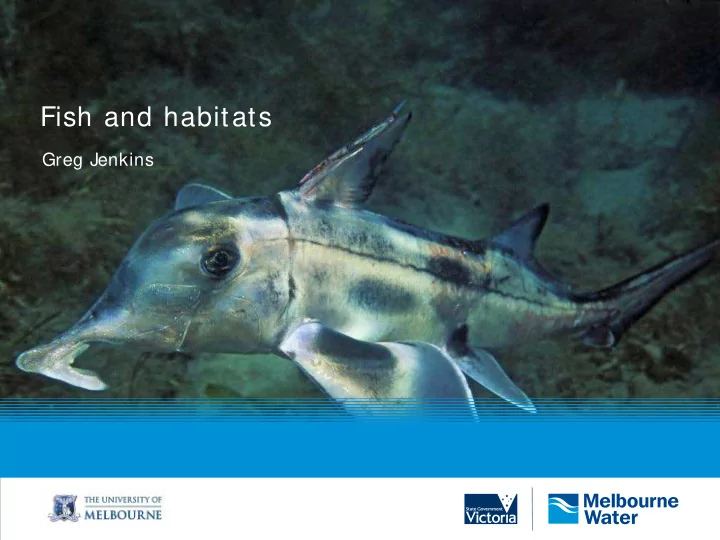
SLIDE 1
Fish and habitats
Greg Jenkins
SLIDE 2 Background
- At present, fish assemblages are only well studied in Zostera
seagrass.
- We are unsure whether key species are reliant on specific
habitats or whether alternative habitats can be utilised
- This means the resilience of fish populations to habitat loss and
the need for protection of specific habitats to support fish populations is unclear
SLIDE 3 Objectives
- To determine the specificity of fish habitat relationships in
Western Port
- To determine the resilience of fish populations to habitat
loss through the use of alternative habitats
- Improving understanding of the important values and
resilience of specific asset areas already identified in Western Port from the perspective of fish biodiversity
SLIDE 4 Sampling sites
Amphibolis Bryozoan Caulerpa Rhodoliths
+
+
Reef/algae
SLIDE 5
Amphibolis
SLIDE 6
Caulerpa
SLIDE 7
Rhodoliths
SLIDE 8
Reef/algae
SLIDE 9
Bryozoan
SLIDE 10
Stereo-video sampling
SLIDE 11
Mini Otter-trawl sampling
SLIDE 12
Dominant fish species - Amphibolis
SLIDE 13
Ornate Cowfish - Flinders
SLIDE 14
Old Wife - Flinders
SLIDE 15
Sixspine Leatherjacket– Flinders
SLIDE 16
Little Weed Whiting– Flinders
SLIDE 17
Weedy Seadragon – Balnarring
SLIDE 18
Calamari– Point Leo
SLIDE 19
Dominant fish species – Reef/Algae
SLIDE 20
Silver trevally– Cat Bay
SLIDE 21
Gummy shark, Snook – Cat Bay
SLIDE 22
Dominant fish species – Caulerpa
SLIDE 23
Key fish species – Caulerpa
SLIDE 24
Fish species – Rhodoliths
SLIDE 25
Octopus – Rhodoliths
SLIDE 26
Fish species – Bryozoan
SLIDE 27 MDS plot comparing fish assemblages
Standardise Samples by Total Transform: Log(X+1) Resemblance: S17 Bray Curtis similarity
SeasonLocation
Autumn Balnarring Spring Balnarring Autumn Cat Bay Spring Cat Bay Autumn Pt Leo Spring Pt Leo Autumn Flinders Spring Flinders
2D Stress: 0.05
SLIDE 28 Differences between locations and seasons
- Balnarring and Flinders were distinctive for bridled
leatherjackets and weedy seadragons
- Cat Bay and Pt Leo were distinctive for bluethroat
wrasse.
- Cat Bay was distinct from Point Leo in relation to
silver trevally
- Autumn was characterised by bridled and six-spine
leatherjackets while spring was distinct for weedy seadragons
SLIDE 29 Conclusions
- Amphibolis and Caulerpa had diverse and abundant
fish assemblages comparable to Zostera
- The assemblage of fish in Caulerpa was more similar
to that in Zostera
- Caulerpa, and to a lesser extent Amphibolis, may
act as a refuge habitat in the case of Zostera loss
- The nursery value of these habitats may be lower
due to greater depth (both species) and exposure (Amphibolis)
- Weedy seadragons appear to have a relatively
specific requirement for Amphibolis beds on low profile sand/ reef
SLIDE 30
Acknowledgements
Field work assistance: Brent Womersley, Tim Kenner, Andrew Brown Laboratory assistance: Tim Kenner Still photographs: Julian Finn, Mark Norman (MoV) Peter Macreadie (UTS) Funding: Melbourne Water Department of Sustainability and Environment Port Phillip Bay and Western Port Catchment Management Authority