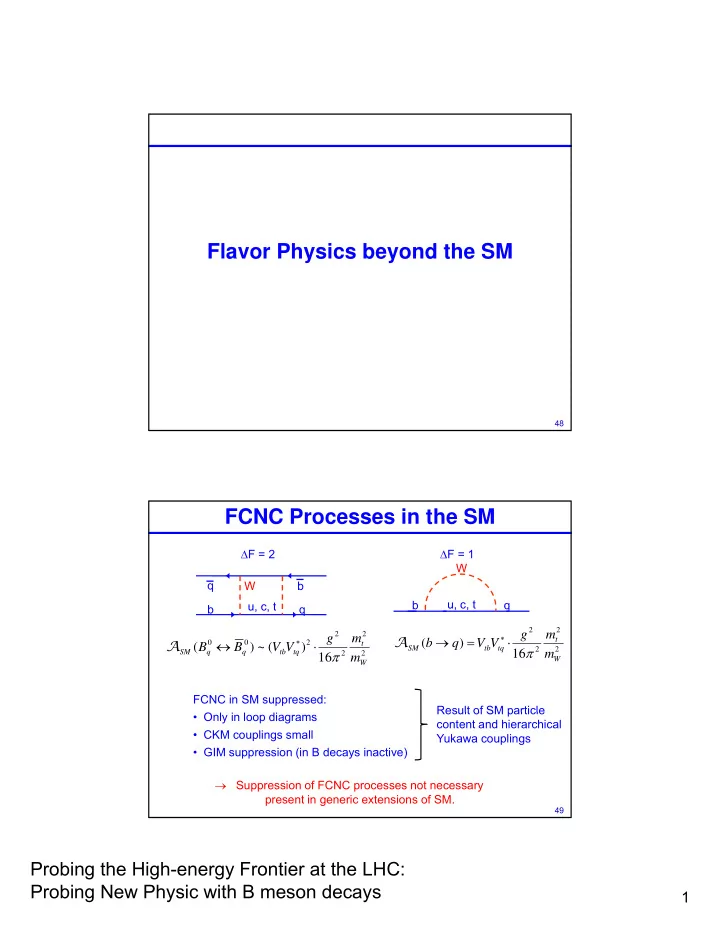
Flavor Physics beyond the SM 48 FCNC Processes in the SM F = 2 F - - PDF document

flavor physics beyond the sm
SMART_READER_LITE
LIVE PREVIEW

Flavor Physics beyond the SM 48 FCNC Processes in the SM F = 2 F - - PDF document

Flavor Physics beyond the SM 48 FCNC Processes in the SM F = 2 F = 1 W q W b b b u c t u, c, t q q u c t u, c, t b b q 2 2 g m 2 2 A g m = t A ( ) b q V V 0 0 2 t ( B B )


slide-1
SLIDE 1

Probing the High-energy Frontier at the LHC: Probing New Physic with B meson decays

1

Flavor Physics beyond the SM

48

FCNC Processes in the SM

b q u c t b u c t q b W W ΔF = 2 ΔF = 1

2 2 2 2

16 ) (

W t tq tb SM

m m g V V q b π ⋅ = →

A

2 2 2 2 2

16 ) ( ~ ) (

W t tq tb q q SM

m m g V V B B π ⋅ ↔

A

FCNC in SM suppressed: Result of SM particle b q u, c, t b q u, c, t

49

  • Only in loop diagrams
  • CKM couplings small
  • GIM suppression (in B decays inactive)

→ Suppression of FCNC processes not necessary present in generic extensions of SM. Result of SM particle content and hierarchical Yukawa couplings

slide-2
SLIDE 2

Probing the High-energy Frontier at the LHC: Probing New Physic with B meson decays

2

Flavor Violation beyond the SM

Effects of New Physics*) at Λ = O(ΛEW) on B decays can be treated in a low-energy “effective theory” approach (similar to Fermi-theory). *) electroweak

⎟ ⎞ ⎜ ⎛

NP SM

c c

New Physics in flavor changing amplitudes: “CKM” b s u, c, t b s X Y

50

⎟ ⎟ ⎠ ⎞ ⎜ ⎜ ⎝ ⎛ Λ + = + →

2 2

) (

NP W SM BSM

c m c X q b A A

factors Loop-factors In most general case NP with generic flavor structure! There are good arguments that NP should appear around the EW scale.

Flavor Problem

No indication of large O(1) New Physics contribution to FCNC processes. Puts severe constraints on New Physics. Example: ΔF=2 mixing measurements (Vtb*Vtd)2 A(Bd↔Bd) ~ 16 π2 mW

2

+ cNP 1 Λ2

~ 1

tree + generic flavor

Λ > 2×10⁴ TeV [K]

  • G. Isidori (2009)

cNP

~ 1/(16 π2) ~ (Vtb*Vtd)2 / (16 π2) ~ (Vtb*Vtd)2

loop + generic flavor tree + MFV loop+ MFV

Λ > 2×10³ TeV [K] Λ > 5 TeV [K&B] Λ > 0.5 TeV [K&B] Not too far from EW scale

51

New Physics not “visible” if CKM like flavor structure!

slide-3
SLIDE 3

Probing the High-energy Frontier at the LHC: Probing New Physic with B meson decays

3

Minimal Flavor Violation

New Physics at TeV-scale must have*) non-generic flavor structure. Flavor Physics

*) d l i

Minimal flavor violation: Standard Model Yukawa couplings are the only non-trivial flavor-breaking terms also beyond the Standard Model.

*) modulo some conspiracy

52

Minimal flavor violation realized “by construction” in MSSM SUSY models (CMSSM) often used as reference point. MFV should not be taken as granted!

Flavor Structure of New Physics

Test MFV Hypothesis - Flavor breaking terms beside SM Yukawas ? Study flavor structure of new particles if found by ATLAS/CMS.

μ μ

+

μ

Expect sizeable deviation even in MVF models

Bs mixing phase φs b → s γ penguins Very rare FCNC proc.

53

s

B

s

B B

K

s d,

B

μ

μ

ACP (Bs → J/ψ φ) Bd → K*γ Bd → K* μμ Bd,s → μμ

slide-4
SLIDE 4

Probing the High-energy Frontier at the LHC: Probing New Physic with B meson decays

4

LHCb Experiment

  • B production at the LHC
  • B event signature
  • LHCb detector

54

B Physics at the LHC

ATLAS

B Physics Program Dedicated B Experiment B Prodcution at LHC: pp @ 14 TeV → σbb ≈ 500 μb 40% B0/B+, 10% Bs, 10% b-baryons B Physics Program

55

slide-5
SLIDE 5

Probing the High-energy Frontier at the LHC: Probing New Physic with B meson decays

5

B Production at the LHC

LHCb

pp collisions at √s = 7, 10, 14 TeV

p p b

1

x

2

x Gluon-Gluon-Fusion: Correlated forward production of bb B±, B0, Bs, Bc, Λb … L

~ 2 x 1032 cm-2 s-1 (tuned)

  • ~ 1012 bb events / year (2 fb-1)

σinel ~ ( 0.89, 0.95, 1 ) ×100 mb σbb ~ ( 0.44, 0.67, 1) × 500 μb

bb Production p p b

56

  • ~ 1012 bb events / year (2 fb 1)
  • 50 kHz bb-events in LHCb
  • n = 0.7 IA / BX

(ATLAS 5…25)

Charged particle multiplicity ~ 30 / unit

  • f rapidity

θb θb

B Physics & LHCb Detector

0 6 0.8 1.0

Probability

n = # of pp interactions/crossing LHCb n=0 S/CMS

1 10 10 2

  • 2

2 4 6

eta of B-hadron pT of B-hadron

ATLAS/CMS LHCb

100 μb

LHCb

1 2 3 4

Luminosity [cm−2 s−1]

1031 1032 1033 0.2 0.4 0.6

n=1 ATLAS

1 10 10 2

  • 2

2 4 6

eta of B-hadron pT of B-hadron

ATLAS/CMS LHCb

100 μb 230 μb

LHCb:

  • Forward, single arm spectrometer, 1.9 < η < 4.9

(bb pairs correlated, mainly forward)

  • Excellent vertexing and particle ID (K/π separation)
  • “high” pT triggers, including purely hadronic modes,

very flexible

  • Luminosity tuneable by adjusting beam focus:

run at L ~ 2×1032 cm–2s–1 → n≈0.5

57

slide-6
SLIDE 6

Probing the High-energy Frontier at the LHC: Probing New Physic with B meson decays

6

Typical Event

π+

pp interaction (primary vertex) Simulated Event b-hadron

l − Κ− π+ π+ π− B0

L

  • Decay length L typical ~ 7 mm
  • Decay products with p ~ 1–100 GeV
  • Trigger on “low pt” particles (similar to backgr)

all 25 ns

58

2 m

b Physics at LHC - Summary

LHC = “b” (not only B) factory: B0, B+, Bs, Bc, b-baryons ~ 40 : 40 : 10 : 0.1 : 10 %

59

slide-7
SLIDE 7

Probing the High-energy Frontier at the LHC: Probing New Physic with B meson decays

7

Shielding wall (against radiation) Offset interaction point (to make best use of existing cavern)

LHCb Detector in its cavern

Acceptance: 15-300 mrad (bending) 15-250 mrad (non-bending)

Electronics

Muon System Magnet Tracking stations (inner and outer)

+ CPU farm Detectors can be moved away from beam-line for access

RICH1 RICH2 Calorimeters VELO

20 m

60

LHCb detector

  • Vertex locator around the interaction region

Silicon strip detector with ~ 30 μm impact-parameter resolution

61

slide-8
SLIDE 8

Probing the High-energy Frontier at the LHC: Probing New Physic with B meson decays

8

Vertex detector

  • 21 stations w/ double sided silicon sensors
  • micro-strip sensors with rφ geometry,
  • approach to 8 mm from beam

(inside complex secondary vacuum system) (inside complex secondary vacuum system) Beam

62

Vertex Reconstruction

Bs → Ds(K K π ) π

π+ 440 μm K- K+ π± 47μm 144 μm 440 μm mm 7 = L

Proper time resolution

+ −

→ D B0

+

→ π

s s

D B0

σ ~ 40 fs

t c L βγ =

63

slide-9
SLIDE 9

Probing the High-energy Frontier at the LHC: Probing New Physic with B meson decays

9

First Vertices

64

Proper time resolution

For fully reconstructed B decays: Relative momentum error < 0.1% Error dominated by vertex resolution σt ~ 40 fs

slide-10
SLIDE 10

Probing the High-energy Frontier at the LHC: Probing New Physic with B meson decays

10

Finite Proper Time Resolution

) (t P = ) , , (

/ t t

t t G e σ

τ

′ ⊗

′ −

also effects the seen asymmetry (see below)

LHCb Spectrometer

  • Tracking system and dipole magnet to measure angles and momenta

Δp/p ~ 0.4 %, mass resolution ~ 14 MeV (for Bs → DsK)

Warm Magnet, 4.2 MW, 4 Tm,

67

slide-11
SLIDE 11

Probing the High-energy Frontier at the LHC: Probing New Physic with B meson decays

11

T1 T2 T3

6 m

Main Tracking Stations

Inner Tracker: Silicon sensors

Outer Tracker

5 m

Cross to optimize occupancy for OT

1.3% area 20% tracks

264 Module OT occupancy average 4.3 % top 5.4 % corner 6.6 % side 6.3 %

68

Outer Tracker

Track

Straw tube drift chamber modules

Cathode

pitch 5.25 mm 5mm cells

ac

e

  • e
  • e
  • Straw tube winding:

Lamina Dielectrics Ltd. 2.5 m

69

slide-12
SLIDE 12

Probing the High-energy Frontier at the LHC: Probing New Physic with B meson decays

12

Outer Tracker

70

First Tracks (Nov 23rd 2009)

71

slide-13
SLIDE 13

Probing the High-energy Frontier at the LHC: Probing New Physic with B meson decays

13

First High-Energy CollIsion (2.36 TeV)

72

First “unstable” particles

K →

+

  • erg)

Ks → π+ π-

er & S.Stahl (Heidelbe

73

M.Schille

slide-14
SLIDE 14

Probing the High-energy Frontier at the LHC: Probing New Physic with B meson decays

14

LHCb detector

  • Two RICH detectors for charged hadron identification

74

RICH = Ring Imaging CHerenkov Detector

Cherenkov Radiation

n c > β if

RICH detectors are the specialized detectors to allow charged hadron (π, K, p) identification.

n

Ring Imaging

) ( 1 cos

c

n β θ =

Important for B physics, as there are many hadronic decay modes e.g.: Bs → Ds

  • K+ → (K+ K-π-) K+

Since ~7× more π than K are produced in pp events, making the mass combinations would give rise to large combinatorial background unless K and tracks can be

Ring radius → θc → β

background unless K and π tracks can be separated

75

slide-15
SLIDE 15

Probing the High-energy Frontier at the LHC: Probing New Physic with B meson decays

15

θC max

Particle Identification

RICH 1 RICH 2

θC (mrad)

250 200 150 100 50

Aerogel C4F10 gas e µ p K π 242 mrad 53 mrad 32 mrad θC max

3 radiators to cover full momentum range

ε (KK) = 88% ε (πK) = 3%

1 10 100

Momentum (GeV/c) CF4 gas 32 mrad K π

Radiator: Aerogel C4F10 Radiator: CF4 n=1.0005 n=1.03 n=1.0014

76

First RICH Rings (Dec 2009)

77

slide-16
SLIDE 16

Probing the High-energy Frontier at the LHC: Probing New Physic with B meson decays

16

Background suppression with PID

B K K No RICH With RICH

purity 13% purity 84% efficiency 79%

Bs→ K K

purity 7% purity 67% efficiency 89%

Bs→ Ds K

78

LHCb detector

  • e

h

  • Calorimeter system to identify electrons, hadrons and neutrals

Important for the first level (Level 0) of the trigger.

79

slide-17
SLIDE 17

Probing the High-energy Frontier at the LHC: Probing New Physic with B meson decays

17

LHCb detector

  • μ
  • Muon system to identify muons, also used in first level (L0) of the trigger

80

LHCb Detector

81

slide-18
SLIDE 18

Probing the High-energy Frontier at the LHC: Probing New Physic with B meson decays

18

Trigger

Calorimeter Muon system Pile-up system

B events look very much like minimum bias

82

Pile up system

Level Level-

  • 0 Hardware

0 Hardware: (4 : (4μs) s) “High “High p pT“ μ, , e e, , h, , γ signatures signatures 1.1 1.1, , 2.8 2.8, , 3.6 3.6, , 2.6 2.6 GeV GeV 40 MHz 1 MHz PC Farm: Higher Level Trigger

Readout

2 KHz Disk

Rather modest pt values → only modest rate reduction

Higher Level SoftwareTrigger

Higher Level Trigger (Software) Computing Fram ~ 10000 CPUs

  • 1. Confirmation of trigger signature

using tracking information (1 ms/track) + track impact parameter information ⇒ ~ 30 KHz

  • 2. Global event reconstruction:

inclusive & exclusive selections

~ 30 KHz

83

Storage (event size ~ 35 KB)

slide-19
SLIDE 19

Probing the High-energy Frontier at the LHC: Probing New Physic with B meson decays

19

Necessary Tool: B Flavor Tagging

B0 B0

D π+ π−

Signal B (same side tagging) Tagging B (opposite tagging)

l t

  • Fragmentation kaon near Bs

Dilution Tag εTag (%) w (%) εeff (%)

Muon 11 35 1.0 K-

b b s s u

Bs

Κ+

  • lepton
  • kaon
  • Vertex charge

form

  • scillation

if B0 +

l

Mistag rate Muon 11 35 1.0 Electron 5 36 0.4 Kaon 17 31 2.4 Vertex Charge 24 40 1.0

  • Frag. kaon (Bs)

18 33 2.1 Combined B0 (decay dependent: Combined Bs trigger + select.) ~4 ~6

u

Dilution D=(1-2w) Effective Tagging Power εeff=εTagD2

84

Effect on Asymmetry

) )( ( ) )( ( ) )( ( ) )( ( ) ( t B N t B N t B N t B N t A + − = ω

Observed asymmetry w/ wrong tag fraction

) )( ( ) )( ( ) )( ( ) 1 )( )( ( ) )( ( ) 1 )( )( ( ) )( ( ) 1 )( )( ( ) )( ( ) 1 )( )( ( ) )( ( ) )( ( ) )( ( ) )( ( ) ( t B N t B N t B N t B N t B N t B N t B N t B N t B N t B N t B N t B N t B N t B N t Ameas + − + + − − − − + − = ′ + ′ ′ − ′ = ω ω ω ω ω ω ω ω ω

Observed asymmetry w/ wrong tag fraction

) ( ) ( ) 2 1 ( ) )( ( ) )( ( ) )( ( ) )( ( ) 2 1 ( t A D t A t B N t B N t B N t B N = − = − − − = ω ω ) ( ), ( B N B N ′ ′ ) 2 1 ( ω − = D

Observed number of events of given flavor Tagging “dilution”: ω=50% → D=0 no measurement possible

slide-20
SLIDE 20

Probing the High-energy Frontier at the LHC: Probing New Physic with B meson decays

20

Dilution

ω ×(1-2ω)

Sensitivity and Tagging Power

Statistical error of asymmetry

) ( ) ( B N B N N +

T t l t b fixed

) ( ) ( ) ( ) ( B N B N B N B N A + − =

N N q pN N q N qN N

B B B

) 1 ( , = = − = =

) ( ) ( B N B N N + =

Total event number fixed Statistical error calculated according binominal distribution (A or notA):

2 / 1 2)

1 ( 1 A N A − = Δ

Tagging efficiency:

N N N ε = ′ →

2 / 1 2)

) ( 1 ( 1

meas meas

A N A − = Δ ε

q q N qN ) 1 ( ) (

2

− = σ

Tagging efficiency:

N N N ε = →

Wrong tag fraction:

A D Ameas =

We are interested in A and therefore also in the error of A

meas

A D A Δ = Δ 1 N D Astat

2

1 ~ ε Δ

= effective tagging power