Focus of the Course Overview of the Course Semantics and - - PowerPoint PPT Presentation

focus of the course overview of the course semantics and
SMART_READER_LITE
LIVE PREVIEW

Focus of the Course Overview of the Course Semantics and - - PowerPoint PPT Presentation

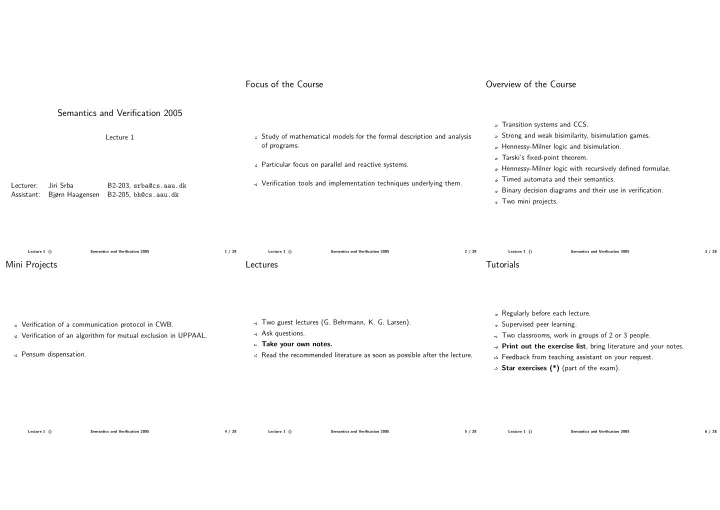
Focus of the Course Overview of the Course Semantics and Verification 2005 Transition systems and CCS. Strong and weak bisimilarity, bisimulation games. Study of mathematical models for the formal description and analysis Lecture 1 of


slide-1
SLIDE 1

Semantics and Verification 2005

Lecture 1 Lecturer: Jiri Srba B2-203, srba@cs.aau.dk Assistant: Bjørn Haagensen B2-205, bh@cs.aau.dk

Lecture 1 () Semantics and Verification 2005 1 / 28

Focus of the Course

Study of mathematical models for the formal description and analysis

  • f programs.

Particular focus on parallel and reactive systems. Verification tools and implementation techniques underlying them.

Lecture 1 () Semantics and Verification 2005 2 / 28

Overview of the Course

Transition systems and CCS. Strong and weak bisimilarity, bisimulation games. Hennessy-Milner logic and bisimulation. Tarski’s fixed-point theorem. Hennessy-Milner logic with recursively defined formulae. Timed automata and their semantics. Binary decision diagrams and their use in verification. Two mini projects.

Lecture 1 () Semantics and Verification 2005 3 / 28

Mini Projects

Verification of a communication protocol in CWB. Verification of an algorithm for mutual exclusion in UPPAAL. Pensum dispensation.

Lecture 1 () Semantics and Verification 2005 4 / 28

Lectures

Two guest lectures (G. Behrmann, K. G. Larsen). Ask questions. Take your own notes. Read the recommended literature as soon as possible after the lecture.

Lecture 1 () Semantics and Verification 2005 5 / 28

Tutorials

Regularly before each lecture. Supervised peer learning. Two classrooms, work in groups of 2 or 3 people. Print out the exercise list, bring literature and your notes. Feedback from teaching assistant on your request. Star exercises (*) (part of the exam).

Lecture 1 () Semantics and Verification 2005 6 / 28

slide-2
SLIDE 2

Exam

Individual and oral. Preparation time (star exercises). Pensum dispensation.

Lecture 1 () Semantics and Verification 2005 7 / 28

Literature

On-line literature. Compendiums (2004 + 2005, 141 kr). Best Reader Competition with award!

Lecture 1 () Semantics and Verification 2005 8 / 28

Hints

Check regularly the course web-page. Anonymous feedback form on the course web-page. Attend and actively participate during tutorials. Take your own notes.

Lecture 1 () Semantics and Verification 2005 9 / 28

Aims of the Course

Present a general theory of reactive systems and its applications. Design. Specification. Verification (possibly automatic and compositional).

1 Give the students practice in modelling parallel systems in a formal

framework.

2 Give the students skills in analyzing behaviours of reactive systems. 3 Introduce algorithms and tools based on the modelling formalisms. Lecture 1 () Semantics and Verification 2005 10 / 28

Classical View

Characterization of a Classical Program

Program transforms an input into an output. Denotational semantics: a meaning of a program is a partial function states ֒ → states Nontermination is bad! In case of termination, the result is unique. Is this all we need?

Lecture 1 () Semantics and Verification 2005 11 / 28

Reactive systems

What about: Operating systems? Communication protocols? Control programs? Mobile phones? Vending machines?

Lecture 1 () Semantics and Verification 2005 12 / 28

slide-3
SLIDE 3

Reactive systems

Characterization of a Reactive System

Reactive System is a system that computes by reacting to stimuli from its environment. Key Issues: communication and interaction parallelism Nontermination is good! The result (if any) does not have to be unique.

Lecture 1 () Semantics and Verification 2005 13 / 28

Analysis of Reactive Systems

Questions

How can we develop (design) a system that ”works”? How do we analyze (verify) such a system?

Fact of Life

Even short parallel programs may be hard to analyze.

Lecture 1 () Semantics and Verification 2005 14 / 28

The Need for a Theory

Conclusion

We need formal/systematic methods (tools), otherwise ... Intel’s Pentium-II bug in floating-point division unit Ariane-5 crash due to a conversion of 64-bit real to 16-bit integer Mars Pathfinder ...

Lecture 1 () Semantics and Verification 2005 15 / 28

Classical vs. Reactive Computing

Classical Reactive/Parallel interaction no yes nontermination undesirable

  • ften desirable

unique result yes no semantics states ֒ → states ?

Lecture 1 () Semantics and Verification 2005 16 / 28

How to Model Reactive Systems

Question

What is the most abstract view of a reactive system (process)?

Answer

A process performs an action and becomes another process.

Lecture 1 () Semantics and Verification 2005 17 / 28

Labelled Transition System

Definition

A labelled transition system (LTS) is a triple (Proc, Act, {

a

− →| a ∈ Act}) where Proc is a set of states (or processes), Act is a set of labels (or actions), and for every a ∈ Act,

a

− → ⊆ Proc × Proc is a binary relation on states called the transition relation. We will use the infix notation s

a

− → s′ meaning that (s, s′) ∈

a

− →. Sometimes we distinguish the initial (or start) state.

Lecture 1 () Semantics and Verification 2005 18 / 28

slide-4
SLIDE 4

Sequencing, Nondeterminism and Parallelism

LTS explicitly focuses on interaction. LTS can also describe: sequencing (a; b) choice (nondeterminism) (a + b) limited notion of parallelism (by using interleaving) (a| |b)

Lecture 1 () Semantics and Verification 2005 19 / 28

Binary Relations

Definition

A binary relation R on a set A is a subset of A × A. R ⊆ A × A Sometimes we write x R y instead of (x, y) ∈ R.

Properties

R is reflexive if (x, x) ∈ R for all x ∈ A R is symmetric if (x, y) ∈ R implies that (y, x) ∈ R for all x, y ∈ A R is transitive if (x, y) ∈ R and (y, z) ∈ R implies that (x, z) ∈ R for all x, y, z ∈ A

Lecture 1 () Semantics and Verification 2005 20 / 28

Closures

Let R, R′ and R′′ be binary relations on a set A.

Reflexive Closure

R′ is the reflexive closure of R if and only if

1 R ⊆ R′, 2 R′ is reflexive, and 3 R′ is the smallest relation that satisfies the two conditions above, i.e.,

for any relation R′′: if R ⊆ R′′ and R′′ is reflexive, then R′ ⊆ R′′.

Lecture 1 () Semantics and Verification 2005 21 / 28

Closures

Let R, R′ and R′′ be binary relations on a set A.

Symmetric Closure

R′ is the symmetric closure of R if and only if

1 R ⊆ R′, 2 R′ is symmetric, and 3 R′ is the smallest relation that satisfies the two conditions above, i.e.,

for any relation R′′: if R ⊆ R′′ and R′′ is symmetric, then R′ ⊆ R′′.

Lecture 1 () Semantics and Verification 2005 22 / 28

Closures

Let R, R′ and R′′ be binary relations on a set A.

Transitive Closure

R′ is the transitive closure of R if and only if

1 R ⊆ R′, 2 R′ is transitive, and 3 R′ is the smallest relation that satisfies the two conditions above, i.e.,

for any relation R′′: if R ⊆ R′′ and R′′ is transitive, then R′ ⊆ R′′.

Lecture 1 () Semantics and Verification 2005 23 / 28

Labelled Transition Systems – Notation

Let (Proc, Act, {

a

− →| a ∈ Act}) be an LTS. we extend

a

− → to the elements of Act∗ − →=

a∈Act a

− → − →∗ is the reflexive and transitive closure of − → s

a

− → and s a − → reachable states

Lecture 1 () Semantics and Verification 2005 24 / 28

slide-5
SLIDE 5

How to Describe LTS?

Syntax

unknown entity − →

Semantics

known entity programming language − → what (denotational) or how (operational) it computes ??? − → Labelled Transition Systems CCS

Lecture 1 () Semantics and Verification 2005 25 / 28

Calculus of Communicating Systems

CCS

Process algebra called “Calculus of Communicating Systems”.

Insight of Robin Milner (1989)

Concurrent (parallel) processes have an algebraic structure. P1 op P2 ⇒ P1 op P2

Lecture 1 () Semantics and Verification 2005 26 / 28

Process Algebra

Basic Principle

1 Define a few atomic processes (modelling the simplest process

behaviour).

2 Define compositionally new operations (building more complex

process behaviour from simple ones).

Example

1 atomic instruction: assignment (e.g. x:=2 and x:=x+2) 2 new operators: ◮ sequential composition (P1; P2) ◮ parallel composition (P1 |

| P2)

Now e.g. (x:=1 | | x:=2); x:=x+2; (x:=x-1 | | x:=x+5) is a process.

Lecture 1 () Semantics and Verification 2005 27 / 28

CCS Basics (Sequential Fragment)

Nil (or 0) process (the only atomic process) action prefixing (a.P) names and recursive definitions (def =) nondeterministic choice (+)

This is Enough to Describe Sequential Processes

Any finite LTS can be (up to isomorphism) described by using the

  • perations above.

Lecture 1 () Semantics and Verification 2005 28 / 28