Food Saver Common Storage & Preservation Methods This - - PDF document

food saver
SMART_READER_LITE
LIVE PREVIEW

Food Saver Common Storage & Preservation Methods This - - PDF document

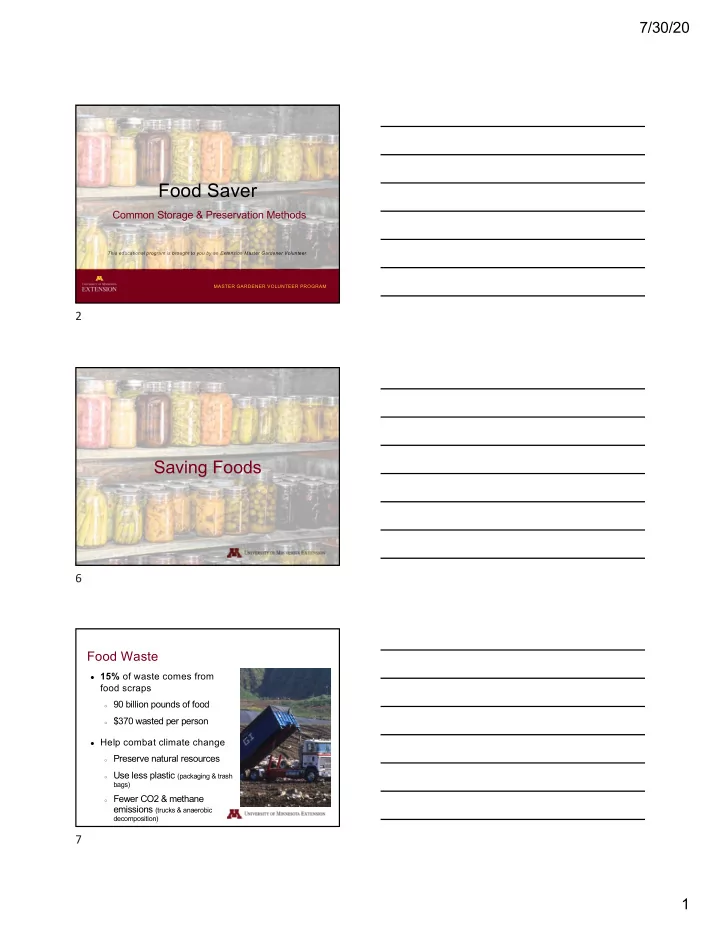
7/30/20 Food Saver Common Storage & Preservation Methods This educational program is brought to you by an Extension Master Gardener Volunteer. MASTER GARDENER VOLUNTEER PROGRAM 2 Saving Foods 6 Food Waste 15% of waste comes from


slide-1
SLIDE 1

7/30/20 1

MASTER GARDENER VOLUNTEER PROGRAM This educational program is brought to you by an Extension Master Gardener Volunteer.

Food Saver

Common Storage & Preservation Methods

2

Saving Foods

6 Food Waste

  • 15% of waste comes from

food scraps

○ 90 billion pounds of food ○ $370 wasted per person

  • Help combat climate change

○ Preserve natural resources ○ Use less plastic (packaging & trash

bags)

○ Fewer CO2 & methane

emissions (trucks & anaerobic

decomposition)

7

slide-2
SLIDE 2

7/30/20 2

Why Good Food Goes Bad

  • Naturally-occurring

enzymes

  • Physical damage
  • Oxidation
  • Microorganisms

8 Food Saving Options

  • Fresh Storage

Produce left uncut after harvest

Stored in cool or cold conditions

Best used within 1 week to 6 months*

  • Preservation

Produce cut & processed

Requires additional equipment & space

Best used within 3 months to 1 year*

* Varies based on produce, storage condition, and recipe Ph Ca

9 Harvest Produce Safely

  • Why it works

○ Reduces MICROBE numbers

  • How it works

○ Use safe (e.g., drinking) water ○ Wash hands ○ Clean tools & containers ○ Avoid harvesting produce

near scat

10

slide-3
SLIDE 3

7/30/20 3

Cure Produce

  • Why it works

○ Protects FOOD

  • How it works

○ Dries & thickens the

skin/rind

○ Temperature, humidity &

drying time varies

○ Only needed for some

foods (onion bulbs, garlic, Potatoes

& winter squash)

11 Choose Good Produce

  • Why it works

○ Protects FOOD

  • How it works

○ Avoid blemishes ○ Uses fresh produce ○ Keep produce whole &

undamaged

12 F.A.T.T.O.M. – Slowing Deterioration

  • Change the conditions

○ Food Source (protect) ○ Acidity (increase) ○ Time (limit before use) ○ Temperature (lower or raise) ○ Oxygen (remove) ○ Moisture (prevent access)

13

slide-4
SLIDE 4

7/30/20 4

Storing Fresh Produce

15 Fresh Storage

  • Why it works

○ Protects FOOD ○ Limited storage TIME ○ Lowers TEMPERATURE

(only cold conditions)

  • How to do it

○ Cure food (if needed) ○ Keep food whole (uncut) ○ Store in ideal conditions ○ Use soon after harvest or

purchase

Compared to Harvest Quality Flavor Texture Nutrition

P P P

16 Fresh Produce

  • Benefits

○ Retains texture ○ Does not require

additional equipment

  • Considerations

○ Limited time to use ○ Nutrition and flavor

decreases over time

17

slide-5
SLIDE 5

7/30/20 5

Fresh Storage Preparation

  • Choose undamaged produce

○ Keep only healthy produce ○ Avoid washing or cutting until use

  • Store in ideal location

○ Varies by produce ○ Keep storage areas clean ○ Avoid areas that get hot or cold ○ Avoid raw meats & cleaning

chemicals

18 Fresh Storage Conditions

  • Cool & Dry

50-60°F with 60% humidity

Example: Basement

  • Cold & Dry

32-40°F with 65% humidity

Example: Refrigerator

  • Cold & Damp

32-40°F with 95% humidity

Example: Root cellar OR Refrigerator with closed crisper drawer

19

Preserving Produce

21

slide-6
SLIDE 6

7/30/20 6

Preserving Produce

  • Why it works

○ Changes environment

(ACIDITY, TEMPERATURE, OXYGEN, & MOISTURE)

  • How to do it

○ Prepare food (blanch if required) ○ Follow certified recipe &

instructions

○ Store in clean & sterilized

containers

○ Store in cool, dry & dark location Compared to Harvest Quality Flavor Texture Nutrition

P P

22 Preserving Produce

  • Benefits

○ Retains nutrition ○ Shelf-stable ○ Lasts for a long time

  • Considerations

○ Texture changes ○ Requires additional

equipment

23 WARNING: Follow the Instructions

  • Use tested & trusted

sources

○ Lab-tested for safety ○ Follow recipe exactly

  • Avoid hand-me-down &

hand-made recipes

○ When in doubt, keep these in

Cold Storage conditions & use quickly

24

slide-7
SLIDE 7

7/30/20 7

Blanching

  • Why it works

○ Changes TEMPERATURE

  • How it works

○ Exposes foods to boiling water

(or steam)

○ Slows or stops enzymes ○ Preserves flavor, color

& nutrients

○ Recommended for some

vegetables (broccoli, Brussel sprouts,

cauliflower, cabbage, beans, peas, peppers, tomatoes, & summer squash)

25 Freezing

  • Why it works

○ Lowers TEMPERATURE

  • How to do it

○ Cut/chop produce to final size ○ Blanch (as required) ○ Freeze as quickly as possible ○ Package into labeled containers ○ Store in freezer Compared to Harvest Quality Flavor Texture Nutrition

P P

26 Freezing

  • Benefits

○ Easy & Fast ○ Versatile

  • Considerations

○ Limited by freezer space ○ Requires thawing time ○ Uses single-use

containers

Compared to Harvest Quality Flavor Texture Nutrition

P P

27

slide-8
SLIDE 8

7/30/20 8

Dehydration

  • Why it works

○ Removes MOISTURE

  • How to do it

Cut produce into uniform pieces

Blanch (as required)

Dehydrate

Package into labeled containers

(remove as much air as possible)

Store in cool, dry & dark location

Compared to Harvest Quality Flavor Texture Nutrition

P P

28 Dehydrating

  • Benefits

○ Lightweight & compact ○ Many dehydrating

methods & tools

  • Considerations

○ Needs rehydration time ○ May need specialized

equipment

○ Requires cool, dry & dark

storage space

Compared to Harvest Quality Flavor Texture Nutrition

P P

29 Canning

  • Why it works

Raises TEMPERATURE

Increases ACIDITY

Removes OXYGEN

  • How to do it

Use certified recipe

Blanch (as required)

Sterilize glass jars & storage lids

Follow canning instructions

Label containers & store in cool, dry & dark location

Compared to Harvest Quality Flavor Texture Nutrition

P P

30

slide-9
SLIDE 9

7/30/20 9

Canning

  • Benefits

○ Shelf-stable ○ Reusable containers

  • Considerations

○ Needs specialized

equipment

○ May need addition time ○ Requires a cool, dry &

dark storage space

Compared to Harvest Quality Flavor Texture Nutrition

P P

31 Canning

  • Water bath canning

Heats contents boiling (212º F)

Safe for acidic foods

Kills most pathogens

  • Pressure canning

Heats contents above boiling (240º F)

Use for non-acidic foods

Kills botulism pathogen

Follow recipe to determine appropriate method & timing

Ph Pr Compared to Harvest Quality Flavor Texture Nutrition

P P

32 Jelly, Jam & Preserves

  • Why it works

○ Increases ACIDITY ○ Removes MOISTURE

  • How to do it

○ Use certified recipe ○ Sterilize glass jars & lids ○ Follow canning instructions ○ Label containers & store in

cool, dry & dark location

Compared to Harvest Quality Flavor Texture Nutrition

P P

33

slide-10
SLIDE 10

7/30/20 10

Jelly, Jams & Preserves

  • Benefits

○ Many recipes available ○ Creates ready-to-use

sweet condiment

  • Considerations

○ Sugar overwhelms natural

flavor of produce

○ Excess sugar reduces

nutritional value

○ (See also: Canning) Compared to Harvest Quality Flavor Texture Nutrition

P P

34 Pickling

  • Why it works

○ Increases ACIDITY ○ Removes MOISTURE ○ Combines with Canning

  • How to do it

○ Use certified recipe ○ Sterilize glass jars & lids ○ Follow canning instructions ○ Label containers & store in

cool, dry & dark location

Compared to Harvest Quality Flavor Texture Nutrition

P

35 Pickling

  • Benefits

○ Many recipes available ○ Creates ready-to-use

savory condiment

  • Considerations

○ Salt & vinegar overwhelms

natural flavor of produce

○ Excess salt reduces

nutritional value

○ (See also: Canning) Compared to Harvest Quality Flavor Texture Nutrition

P

36

slide-11
SLIDE 11

7/30/20 11

Fermenting

  • Why it works

Increases ACIDITY

Removes OXYGEN

Removes MOISTURE

Combines with Canning

  • How to do it

Use certified recipe

Sterilize glass jars & lids

Follow canning instructions

Label containers & store in cool, dry & dark location

Compared to Harvest Quality Flavor Texture Nutrition

P

37 Fermenting

  • Benefits

○ Increases nutrition ○ Creates unique flavors

  • Considerations

○ Natural flavor of produce lost ○ Takes more time to complete ○ Requires specialized

equipment

○ (See also: Canning) Compared to Harvest Quality Flavor Texture Nutrition

P

38

Resources

43

slide-12
SLIDE 12

7/30/20 12

U of MN Extension – Food, Health & Nutrition

https://extension.umn.edu/ food-health-and-nutrition

  • Lots of information

○ Research-based

advice

○ Tutorials ○ Tips & best practices ○ More resources

44

National Center for Home Food Preservation

https://nchfp.uga.edu/

  • Established by the

Cooperative State Research, Education and Extension Service & U.S. Department of Agriculture

  • Research-based advice

for home food preservation

Tested & certified recipes

Tips & best practices

More resources

45 Extension Answer Line (online tool)

https://www.extension.iastate.edu/ humansciences/answerline

  • Call toll-free

Monday through Friday

9 am- 12pm & 1-4 pm

1-800-854-1678 (in Minnesota)

  • Provides information for consumers

with home and family questions

Supported by Extension services

Covers child development, cleaning, consumer management, food preparation, food preservation, food safety, home environment, household equipment, nutrition, textiles & laundry

46

slide-13
SLIDE 13

7/30/20 13

Master Gardeners

www.RamseyMasterGardeners.org

  • Community members & volunteers

Receive Extension education on horticultural topics

Share scientific-based information with their residents

  • Where to find Master Gardeners

Educational programs

Farmers Markets

Yard Waste Collection Sites

Fairs and other community events

47 Food Scraps Drop-off Sites

https://www.ramseycounty.us/residents/ recycling-waste/collection-sites/food- scraps

  • Supported by Ramsey County

For food scraps that would

  • therwise be thrown in the trash

7 Seasonal locations & 8 Year- round locations

Photo ID is required

48