FOR HIGH-RISK SUICIDAL VETERANS James J. Peters VA Medical Center, - - PowerPoint PPT Presentation

for high risk suicidal
SMART_READER_LITE
LIVE PREVIEW

FOR HIGH-RISK SUICIDAL VETERANS James J. Peters VA Medical Center, - - PowerPoint PPT Presentation

NOVEL APPROACHES FOR HIGH-RISK SUICIDAL VETERANS James J. Peters VA Medical Center, Bronx, NY Mental Illness Research, Education and Clinical Center Suicide Prevention and Treatment Research Program SARAH SULLIVAN, M.S., MHC-LP MARIANNE


slide-1
SLIDE 1

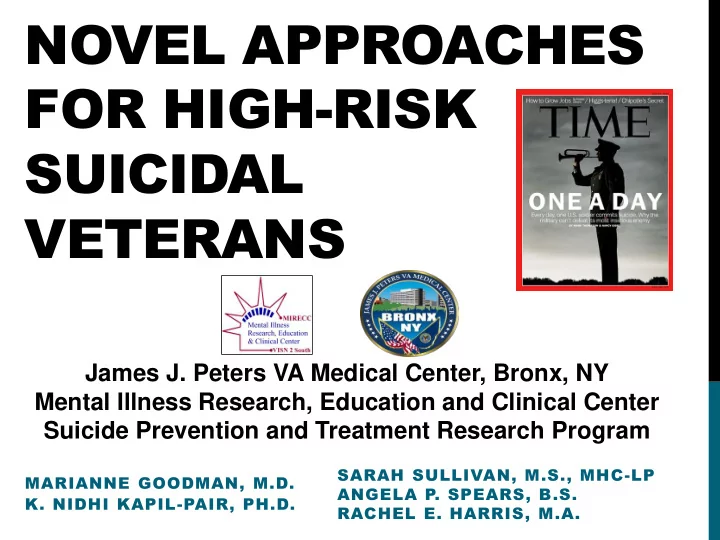
NOVEL APPROACHES FOR HIGH-RISK SUICIDAL VETERANS

MARIANNE GOODMAN, M.D.

  • K. NIDHI KAPIL-PAIR, PH.D.

SARAH SULLIVAN, M.S., MHC-LP ANGELA P. SPEARS, B.S. RACHEL E. HARRIS, M.A.

James J. Peters VA Medical Center, Bronx, NY Mental Illness Research, Education and Clinical Center Suicide Prevention and Treatment Research Program

slide-2
SLIDE 2

To address critical gaps in suicide treatment,

  • ur clinical research group has developed

three novel interventions:

  • 1. PLF - Project Life Force
  • 2. SAFER - Safe Actions for Families to

Encourage Recovery

  • 3. Using TELEHEALTH to improve outcomes

in Veterans at risk for suicide.

NOVEL INTERVENTIONS

slide-3
SLIDE 3

Question: Of all living US citizens, what percentage are Veterans?

?

Map of total US population and distribution

BACKGROUND: Q & A

slide-4
SLIDE 4

Answer: Of all living US citizens, 7.3 percent have served in the military at some point in their lives (SAMSHA).

92.7% 7.3%

% Veterans in the United States

Civilians Veterans

Map of total US population and distribution

Q & A

slide-5
SLIDE 5

Question: How many Veterans live in NY state?

?

Map of total US population and distribution

Q & A

slide-6
SLIDE 6

Answer: 806,827 Veterans are currently living in NY state.

806,827 20,392,192

# OF VETERANS IN NEW YORK STATE

NY Veterans Veterans living in other states

Map of total US population and distribution

Q & A

slide-7
SLIDE 7

Question: How many Veterans kill themselves every day?

Q & A

slide-8
SLIDE 8

Answer: 20

Q & A

Only 6 of the 20 Veterans who die by suicide each day receive services at the VA 93 Civilians, also die by suicide each day

slide-9
SLIDE 9

This is in spite of enhanced suicide prevention resources. Suicide prevention is the #1 clinical priority in the VA.

Veterans account for 18% of all suicide deaths in US adults.

THE PROBLEM: VETERAN SUICIDE

slide-10
SLIDE 10
slide-11
SLIDE 11

SUICIDE SAFETY PLAN (SSP)

The Suicide Safety Plan (SSP) is a written, prioritized list of coping strategies and resources for reducing suicide risk. It is a prevention tool, developed collaboratively by patient and clinician (Stanley & Brown, 2008). In 2008, the VA mandated that clinicians oversee the construction of an individualized SSP for every patient who is identified at “high risk” for suicide. The patient takes the SSP home for his/her use at the onset of (or during) a suicidal crises.

slide-12
SLIDE 12

(Stanley & Brown, 2008)

  • 1. Warning signs
  • 2. Internal coping strategies
  • 3. People and social settings that provide distraction
  • 4. People whom I can ask for help
  • 5. Professionals or agencies I can contact during a crisis
  • 6. Making the environment safe

BREAKDOWN OF SSP

slide-13
SLIDE 13

VA USE OF THE SSP

  • There are currently no recommended guidelines or

mechanisms for refinement of the SSP beyond its initial development.

  • There are no recommended guidelines for involving family

members or friends in the implementation of, or use of, the SSP. To address these critical gaps, our clinical research group has developed two novel interventions: SAFER - Safe Actions for Families to Encourage Recovery PLF – Project Life Force Please Note: These interventions are adjunctive to standard

  • utpatient mental health care at the James J. Peters VA Medical

Center.

slide-14
SLIDE 14

PROJECT LIFE FORCE

PLF

Keeping High-Risk Veterans Alive Through a Group Safety Planning Intervention

Funding : VA SPiRE RR&D VA MERIT, CSRD

slide-15
SLIDE 15

RCT: 6-month DBT vs. TAU in 93 high-risk suicidal Veterans: Negative study: Both groups improved in all

  • utcome

measures

ORIGINS OF PLF- DBT NEGATIVE RCT

DIALECTICAL BEHAVIOR THERAPY (DBT) TRIAL IN SUICIDAL VETERANS (GOODMAN ET . AL, 2016)

slide-16
SLIDE 16

PERSONAL ANECDOTE WITH SUICIDAL VETERAN

slide-17
SLIDE 17

Findings notable for: Wide range of use (none to several times daily) Importance of clinician collaboration Barriers/obstacles to use Problems/obstacles: Lack of social network Social withdrawal/depression Avoidant style of coping Burden too great to carry out plan alone Facilitators of use of the plan: Sharing of plan with significant others Mobile formats of the plan Individualized plans

20 Veterans interviewed after SSP construction and 1 month later

QUALITATIVE STUDY OF SUICIDE SAFETY PLAN (SSP) USE (KAYMAN ET AL., 2015)

slide-18
SLIDE 18

Findings notable for: Wide range of use (none to several times daily) Importance of clinician collaboration Barriers/obstacles to use Problems/obstacles: Lack of social network Social withdrawal/depression Avoidant style of coping Burden too great to carry out plan alone Facilitators of use of the plan: Sharing of plan with significant others Mobile formats of the plan Individualized plans

20 Veterans interviewed after SSP construction and 1 month later

PLF aims to address these concerns PLF incorporates: 1) Teaching of distress tolerance and emotion regulation skills applied to individual steps of the SSP, 2) Introduces use of a mobile SSP Application, 3) Helps Veterans identify individuals they can call for help, and practice asking for help, 4) Aims to develop detailed, personalized and meaningful SSPs, 5) Delivered in a group context offering support.

QUALITATIVE STUDY OF SUICIDE SAFETY PLAN (SSP) USE (KAYMAN ET AL., 2015)

slide-19
SLIDE 19

PROJECT LIFE FORCE

PROJECT LIFE FORCE (PLF) is a manualized, 90-minute group therapy for 10 sessions, lasting 3 months.

  • Combines psychoeducation and emotion regulation skills with suicide

safety planning development and implementation.

Group Psychotherapy Emotion Regulation Skills Psychoeducation Suicide Safety Planning Technologic integration

THE SOLUTION:

slide-20
SLIDE 20

PLF Session 2: Emotion Recognition Skills PLF Session 3: Distress Tolerance Skills PLF Session 4-5: Interpersonal Communication Skills with Family PLF Session 6: Interpersonal Communication Skills with Clinical Team PLF Session 1: Crisis Prevention Services PLF Session 7: Means Restriction

GROUP SUICIDE SAFETY PLANNING & SKILLS INTERVENTION

slide-21
SLIDE 21

1) PLF=manualized, weekly 90-minute group treatment lasting 10 weeks. 2) Each session of PLF corresponds to a step of the safety plan and teaches skills to maximize the use of that particular step of the plan. 3) PLF is augmented with education pertaining to suicide risk, means restriction and suicide prevention mobile applications. 4) A manual with 84 pages of session handouts has been developed & tested. 5) Designed to meet VA mandated monitoring and permit immediate access. 6) Capitalizes on group support & is cost effective.

Project Life Force Session Outline

Session Focus Skill Covered 1

Introduction, psychoeducation about suicide, SSP step #5 - crisis numbers, meet local SPC Crisis Management Skills Urge Restriction

2

SSP step #1 - Identification

  • f Warning Signs

Emotion, Thought or Behavior Recognition skills

3

SSP step #2 - Internal Coping Strategies Distraction Skills

4

SSP step #3 - Identifying people to help distract Making Friends Skills

5

SSP step #4 - Sharing SSP with Family Interpersonal Skills/Practicing Asking for Help

6

SSP step #5 - Professional Contacts Skills to Maximize Treatment Efficacy & Adherence

6

SSP step #6 - Making the Environment Safe Means Restriction, Psychoeducation About Methods

7

Improving Access to the SSP Use of Safety Planning Mobile Apps and Virtual Hope Box

8

Physical Health Management Decreasing Vulnerability to Negative Emotion

9

Building a Meaningful Life Building Meaning and Reasons for Living

10

Recap/Review

**PLF is one of the only manualized outpatient group treatments for suicidal individuals.

PLF SKILLS AND SAFETY PLANNING IN A GROUP
slide-22
SLIDE 22

PLF is one of the only manualized outpatient group treatments for individuals at high risk for suicide. This is surprising given that groups:

  • 1. Diminish social isolation and increasing social

support/social connectedness, a protective factor against suicide;

  • 2. It’s cost effectiveness and maximizing staff time;
  • 3. The peer movement among those who have experienced

suicidal crises is strong and growing; and

  • 4. Veterans and military service members are familiar with

working as a unit, with team approach to problems.

PLF = SAFETY PLANNING IN A GROUP FORMAT

slide-23
SLIDE 23

OPEN LABEL PILOT

Initial effectiveness in depression, suicidal symptoms, hopelessness. Feedback on each session from patient and PLF therapist. Test feasibility and tolerability of intervention on 50 Veterans. Plus post-intervention feedback from treating clinician(s).

slide-24
SLIDE 24

After 10 weeks of PLF, Veterans had: >40%  suicide symptom severity/ideation >30%  depression, >20%  hopelessness

PROJECT LIFE FORCE - OUTCOMES

CSSRS= Columbia Suicide Severity Rating Scale; BDI= Beck Depression Inventory; BHS= Beck Hopelessness Scale; BSS= Beck Suicide Ideation Scale

slide-25
SLIDE 25

Feasibility/Acceptability Pilot Data (N=45)

  • <2.0 total hours/week per

clinician

  • Veteran satisfaction 4.7 out
  • f 5 point likert scale
  • 5.0 of 5 rating on

recommending the treatment to others

  • <17% attrition
  • 100% of participants

developed updated safety plans and increased use patterns.

PROJECT LIFE FORCE - OUTCOMES

slide-26
SLIDE 26

More Effective Use of Safety Plan “Going through each step in depth makes it a living document, instead of just filling it out on the fly and never using it.”

QUALITATIVE FEEDBACK ON PLF

slide-27
SLIDE 27

Hope/Improved Depressive and Suicidal Feelings “I wake up wanting to live now.” More Effective Use of Safety Plan “Going through each step in depth makes it a living document, instead of just filling it out on the fly and never using it.”

QUALITATIVE FEEDBACK ON PLF

slide-28
SLIDE 28

Hope/Improved Depressive and Suicidal Feelings “I wake up wanting to live now.” Increased Connection & Sense of Belongingness. Lessened Loneliness “To actually connect with my brothers in this fight was

  • powerful. It’s another battle

we are facing.” More Effective Use of Safety Plan “Going through each step in depth makes it a living document, instead of just filling it out on the fly and never using it.”

QUALITATIVE FEEDBACK ON PLF

slide-29
SLIDE 29

Keeping High-Risk Veterans Alive Through a Group Safety Planning Intervention

Greg Brown, PhD University of Pennsylvania Philadelphia VA Michael Thase MD University of Pennsylvania Philadelphia VA Barbara Stanley, PhD Columbia University Psychiatric Institute Hanga Galfalvy, PhD Columbia University Psychiatric Institute Marianne Goodman, M.D. Icahn School of Medicine, Mount Sinai James J. Peters VAMC

PROJECT LIFE FORCE RCT

slide-30
SLIDE 30

SESSION 9: IN SESSION ACTIVITY

“Together we want to start to list all the big and little reasons to keep on living. We have listed some samples from other people, in

  • rder to jumpstart your own list.

As we read together the following items, try and think

  • f the aspects of your life that you take for granted.

We want to write them down as reminders of the beautiful and wonderful things in life.”

slide-31
SLIDE 31

EXAMPLES OF REASONS FOR LIVING

Watching someone talk about something they’re passionate about. The first snowfall of the season. Fresh baked cookies. Stepping on crunchy leaves. Splashing in puddles. Traveling around the world Your future children, pets, spouses, or friends

slide-32
SLIDE 32

HOMEWORK

Add reasons for living to your safety plan.

slide-33
SLIDE 33
slide-34
SLIDE 34

Special Design Features: 1) Multi-site RCT, n=265 suicidal Veterans 2) Co-investigators Drs. Brown and Stanley are creators of the VA suicide safety plan 3) Rigorous multi-method assessment of suicidal behaviors with follow-up out to 1 year. 4) Assessment training and adherence monitoring performed by 3rd site. 5) Examining impact on suicide safety planning quality 6) Explore “group cohesion” as mediator

Study Assessments, Schedule and Purpose

Domain Measure Description Source Study Contac t (Month ) Study Purpose Suicidal Behavior and Ideation

Columbia Suicide Severity Rating Scale–current & since last visit version Interim history of suicide related behaviors; severity
  • f ideation; intensity of
ideation subscales Interview 0, 3, 6,12 Primary Outcome;

Suicidal Ideation and Behavior

Suicidal behavior, Suicidal intention Identification of suicidal ideation and behavior in medical record Chart abstraction 12 Primary Outcome

Suicide

Death by suicide Death by suicide Death Certificates NVDRS 12 Primary Outcome

Depression

Beck Depression Scale Depression Self- Report 0, 3, 6,12 Secondary Outcome

Hopelessness

Beck Hopelessness Scale Hopelessness Positive and Negative Beliefs about the future Self- Report 0, 3, 6,12 Secondary Outcome

Mental Health Services

Self-report log based on the Modified Cornell Services Index MCSI Use of mental health services, SOC contacts determined from medical record Log maintained by subject & research staff 3, 6,12 Secondary Outcome

Safety Plan

Brief Survey of Safety Plan Utilization Subject self-report of using the safety plan prior to baseline assessment or during follow-up and which components were used Self-report 0, 3, 6,12 Secondary Outcome

Suicide- Related Coping

Suicide-Related Coping Measure Report of coping behaviors identified on the SPI and confidence in managing suicidal feelings. Self-report 0, 3, 6,12 Secondary Outcome

Group Cohesion

Group Psychotherapy Process Measure Group Process Outcomes Self-report 1,5,10 (weeks) Mediator

Demographic and Medical History Information

Demographic Information and History of Psychiatric, Substance Use, Medical Information MSRC Common Data Elements Interview 0,3 Descriptive

Diagnosis

Mini-International Psychiatric Interview Axis I diagnosis Interview Descriptive

Methodology Merit

slide-35
SLIDE 35

SAFE ACTIONS FOR FAMILIES TO ENCOURAGE RECOVERY

SAFER RCT

FUNDING: VA MERIT, RR&D

slide-36
SLIDE 36

RATIONALE FOR FAMILY INVOLVEMENT Psychological models of suicidality emphasize the role of social factors in the development and intensification of suicidal thoughts and behavior:

  • feeling like a burden on family and friends,
  • feelings of isolation and not belonging,
  • “unloveability” and
  • perceptions of diminished support from
  • ne’s family and social network

(Brenner et al, 2008; Farrell et al, 2015; Johnson et al, 2008; Joiner et al, 2015, Owen et al, 2015; Ellis et al., 2015)

slide-37
SLIDE 37

RATIONALE FOR FAMILY INVOLVEMENT 2015 VA Behavioral Health Autopsy Program (BHAP) Report based on interviews with 114 family members recommended:

1) educating families about suicide warning signs; 2) improving communication between the veteran and family member; 3) involving the family in the veterans’ treatment to enhance support and trust; 4) providing families with coaching on how to assist their loved one to seek help.

slide-38
SLIDE 38

RATIONALE FOR FAMILY INVOLVEMENT

Treatments targeting Family Members

Currently, the only family based group treatment available is called Family Connections (FCs; Hoffman et al., 2005, Hoffman, Fruzzetti, & Buteau, 2007).

Depression Patients of family members also show improvement and feel more validated after FC. Burden Grief

slide-39
SLIDE 39

QUALITATIVE INTERVIEWS: RATIONALE FOR FAMILY INVOLVEMENT

Our Pilot Qualitative Study: Family Themes

1) Fear of triggering urges, “I never know how he’ll react” 2) Feeling unsupported, “There’s no real support” and 3) Feeling overwhelmed, ”I didn’t know what to do” Veterans felt alone and afraid to reach out to family members.

slide-40
SLIDE 40

PROTOCOL SUMMARY

  • SAFER is a novel, 4-

session manualized intervention.

Through the use of psychoeducation, disclosure and development/revision of both the Veteran and a complementary family member safety plan, SAFER provides the tools and structure to support family involvement in suicide safety planning for Veterans at moderate risk for suicide.

slide-41
SLIDE 41

(Stanley & Brown, 2008)

WHERE SAFER FITS IN…

slide-42
SLIDE 42

SAFER INTERVENTION

SAFER is a novel, manualized, weekly, 90-minute, individual joining + 3-session family-based treatment.

Session #

Focus Homework

Individual Joining

  • Introductions, assess Veteran and family

interaction around suicide, review individual concerns, motivation.

  • Clarify intervention goals, ensure commitment.

1

  • Review of barriers to Safety Planning and family

involvement.

  • Review Veteran Safety Plan.

Veterans and family members construct a list of “reasons for living.” 2

  • Construction of family member’s safety plan.

Practice using communication skills to facilitate use of Veteran and family member plans.

  • Review Reasons for Living homework.

Try to implement safety plan in your life. Booster

  • Review of Safety Plan use for dyad.
  • Address implementation problems.
slide-43
SLIDE 43
slide-44
SLIDE 44

ELIGIBILITY - VETERAN

Inclusion Criteria: 1. Moderate risk for suicide, defined as:

  • evidence of current (within the past week) suicidal ideation, plan or intent on the

Columbia Suicide Severity Rating Scale (C-SSRS),

  • Scoring < 4 on the C-SSRS Behavior Scale, and without history of suicide

attempt in the last three months. 2. Inclusion criteria also include the availability of a consenting, qualifying family member

  • r partner.

Exclusion criteria: 1. Alcohol or drug abuse or dependence. 2. For romantic couples, “severe” intimate-partner violence as defined by the revised 20- item Conflict Tactics Scale Short Form (CTS2S) (Straus & Douglas, 2004); 3. Limited English proficiency.

ELIGIBILITY- VETERAN

slide-45
SLIDE 45

Inclusion Criteria: Family members/friends must meet at least three (two for nonrelatives) of five criteria established by (Pollak & Perlick, 1991): 1. Spouse, co-habiting significant other or parent; 2. More frequent contact than any other caregiver 3. Helps to support the Veteran 4. Contacted by treatment staff for emergencies; 5. Involvement in the patient’s treatment. Exclusion criteria: 1. Alcohol or drug abuse or dependence 2. For romantic couples, “severe” intimate-partner violence as defined by the revised 20-item Conflict Tactics Scale Short Form (CTS2S) (Straus & Douglas, 2004); 3. Limited English proficiency.

ELIGIBILITY- CAREGIVER

slide-46
SLIDE 46

PARTICIPANTS

5 10 15 20 25 30 35 40

Consented Baselines Randomized Post Post-3

Veterans Caregivers

slide-47
SLIDE 47

PARTICIPANTS

Veteran Race

White Black Native American Other/Unknown Multi-Racial Native Hawaiian Veteran Age Range: 35-84 Veteran Gender: 3 Females, 30 Males Veteran Hispanic: 13/33 Caregiver Age Range: 24-66 Caregiver Gender: 11 Females, 9 Males Caregiver Hispanic: 8/20

Caregiver Race

White Black Other/Unknown Multi-Racial Native Hawaiian

slide-48
SLIDE 48

QUALITATIVE FEEDBACK

“Having someone to reach out with such as Dr. XX.” “We need more doctors, like Dr. XX, that listen instead of constantly speaking.” “SAFER helped me keep my SSP constantly in my head and helped me go to my safety zones.” “Knowing that we are not alone.” “To have a plan that is useful.” “I liked best finding different ways to help my husband.” “Reaching out to

  • thers that are going

through what my husband is going through is helpful.”

VETERANS CAREGIVERS

slide-49
SLIDE 49

Caregivers are VERY burdened and the SAFER intervention may be further burdening them.

  • Length of SAFER intervention?

Veterans often do not have many people in their live. Veterans who do have people in their lives often do not want to participate.

  • Is there a way to better engage caregivers?

Veterans are reluctant to ask for help, and hesitant to admit vulnerability to family.

INTERIM LESSONS LEARNED

slide-50
SLIDE 50

Using Using TELEHEA TELEHEALTH TH to to Impr Improve Outcomes e Outcomes In In Veter eterans a ans at Risk f t Risk for

  • r

Suicide Suicide

Gretchen Haas, Ph.D.

VA Pittsburgh Health Care System

Marianne Goodman, M.D.

James J. Peters VA Medical Center, Bronx, NY

Adam Wolkin, M.D.

VA New York Harbor Health Care System

Funded by: Linked Standard Research Grant American Foundation for Suicide Prevention (AFSP)

slide-51
SLIDE 51

TECHNOLOGY AND SUICIDE PREVENTION Telehealth technology has become more interactive, less money and, more available to healthcare providers as a means of treating chronic medical diseases.

  • Approximately 50% of >3.4 billion smartphone/tablet

users have downloaded mHealth apps as of 2018.

  • Surveys from psychiatric out-patients reported that 69%
  • f people, and 80% of those ages <45, have a desire to

use mobile apps to track mental health.

  • However, there is a lack of comprehensive evidence-

base for mobile apps.

  • There is a complete lack of outcome data on the

efficacy of mHealth interventions for suicidal behavior.

slide-52
SLIDE 52

TECHNOLOGY AND SUICIDE PREVENTION

Crisis Text Line Caring contacts via text message/emails Automatic detection of suicidality from social media content (FB & Twitter) Mobile Applications Daily interactive monitoring systems

Examples:

slide-53
SLIDE 53

PILOT DATA

Three separate randomized pilot trials (n = 117 Veterans) were conducted. Diagnoses of Veterans included Major Depressive Disorder or Schizophrenia/Schizoaffective Disorders. No completed suicides and only 1 suicide attempt. Demonstrated that the Telehealth intervention leads to decreased suicidal ideation within three months. Preliminary data from these veteran cohorts demonstrated high acceptability rates.

Initial device used in pilot studies

slide-54
SLIDE 54

INTERACTIVE VOICE RESPONSE SYSTEM (IVR)

Length

  • f calls

is 5-8 minutes

Daily Calls

Responses automatically upload to

  • nline portal

Nurses monitor responses every 4 hours

Voice & keypad responses

2 scripts for participants: Depression & Schizoprehnia

Have you been acting in a way that disregards your safety?

slide-55
SLIDE 55

TELEHEALTH IVR SYSTEM

slide-56
SLIDE 56

TELEHEALTH IVR SYSTEM

Five Suicide Questions:

  • 1. Have you been acting in a way that disregards your safety?
  • 2. Have you felt today that life is not worth living?
  • 3. Have you thought today that you would be better off dead?
  • 4. Have you had thoughts today of wanting to harm yourself even if

you have not intended to do it?

  • 5. Do you have any intent to take your own life today or have you

been thinking about a plan to do it?

Nursing staff contacts site PI: Dr. Goodman

slide-57
SLIDE 57

TELEHEALTH STUDY GOALS

Test the effectiveness of telehealth interventions on suicidal ideation and suicidal behaviors (exploratory). Test if the telehealth system decrease risk factors and increase protective factors. Sustain connections with healthcare providers during the three months following hospital discharge. Allows for a longitudinal view

  • f suicidal risk information.
slide-58
SLIDE 58

TELEHEALTH PROTOCOL SUMMARY

Daily telehealth monitoring includes questions for participants about suicide, depressive symptoms and medication adherence. Participants will be randomized into either: Interactive Voice Response System (IVR) or Treatment As Usual (TAU). 3 month intervention will have clinical assessments at 2, 4, 8, and 12 weeks post-discharge. Recruitment: In-patient unit 40 participants per site.

slide-59
SLIDE 59

POTENTIAL BENEFITS

  • The daily check-in provides:
  • participants with hope & a sense of being

listened to

  • reminders to focus on their mental health, which

may improve medication adherence

  • consistency & a sense that one is

not alone

  • a friendly voice
  • a way to catch symptoms before they are too

severe

slide-60
SLIDE 60

POTENTIAL OBSTACLES

  • Participants don’t answer their

phone, don’t have minutes on their phone or charge their phone

  • Participants don’t like the IVR voice or

scripts and inability to engage in conversation

  • Participants turn off their phone

when depressed

  • IVR System feels too mechanical,

too repetitive and inflexible

slide-61
SLIDE 61

Sarah R. Sullivan, M.S., MHC-LP

Clinical Research Coordinator

718-584-9000 x5149 Sarah.Suillivan@va.gov

Marianne Goodman, M.D.

James J. Peters Veterans Affairs Medical Center Associate Director, VISN 2 Mental Illness, Research, Education, Clinical Center (MIRECC) Director, Suicide Prevention and Treatment Research Program Clinical Professor Psychiatry, Icahn School of Medicine Past President, North American Society for the Study of Personality Disorders (NASSPD)

718-584-9000 x5188 Marianne.Goodman@va.gov

  • K. Nidhi Kapil-Pair, Ph.D.

Clinical Psychologist, Postdoctoral Fellow 718-584-9000 x5231 Kalpana.Kapil-Pair@va.gov

Angela P. Spears, BS

Clinical Research Assistant 718-584-9000 x3021 Angela.Spears2@va.gov

Rachel E. Harris, MA

Clinical Research Coordinator 718-584-9000 x3718 Rachel.Harris6@va.gov

Presenter Contact Information THANK YOU!!