Formal Modeling in Cognitive Science 1 Noisy Channel Model Channel - - PowerPoint PPT Presentation

formal modeling in cognitive science
SMART_READER_LITE
LIVE PREVIEW

Formal Modeling in Cognitive Science 1 Noisy Channel Model Channel - - PowerPoint PPT Presentation

Noisy Channel Model Noisy Channel Model Kullback-Leibler Divergence Kullback-Leibler Divergence Cross-entropy Cross-entropy Formal Modeling in Cognitive Science 1 Noisy Channel Model Channel Capacity Lecture 29: Noisy Channel Model and


slide-1
SLIDE 1

Noisy Channel Model Kullback-Leibler Divergence Cross-entropy

Formal Modeling in Cognitive Science

Lecture 29: Noisy Channel Model and Applications; Kullback-Leibler Divergence; Cross-entropy Frank Keller

School of Informatics University of Edinburgh keller@inf.ed.ac.uk

March 14, 2006

Frank Keller Formal Modeling in Cognitive Science 1 Noisy Channel Model Kullback-Leibler Divergence Cross-entropy

1 Noisy Channel Model

Channel Capacity Properties of Channel Capacity Applications

2 Kullback-Leibler Divergence 3 Cross-entropy

Frank Keller Formal Modeling in Cognitive Science 2 Noisy Channel Model Kullback-Leibler Divergence Cross-entropy Channel Capacity Properties of Channel Capacity Applications

Noisy Channel Model

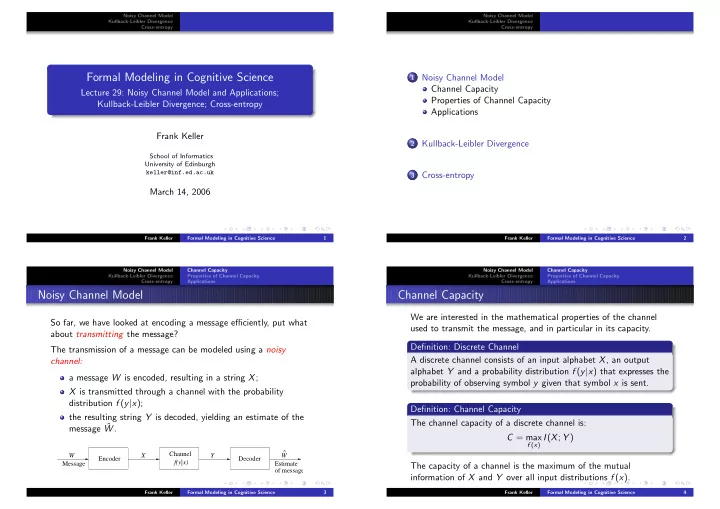
So far, we have looked at encoding a message efficiently, put what about transmitting the message? The transmission of a message can be modeled using a noisy channel: a message W is encoded, resulting in a string X; X is transmitted through a channel with the probability distribution f (y|x); the resulting string Y is decoded, yielding an estimate of the message ˆ W .

Message Encoder Channel Decoder Estimate

  • f message

W f(y|x) W ^ X Y

Frank Keller Formal Modeling in Cognitive Science 3 Noisy Channel Model Kullback-Leibler Divergence Cross-entropy Channel Capacity Properties of Channel Capacity Applications

Channel Capacity

We are interested in the mathematical properties of the channel used to transmit the message, and in particular in its capacity. Definition: Discrete Channel A discrete channel consists of an input alphabet X, an output alphabet Y and a probability distribution f (y|x) that expresses the probability of observing symbol y given that symbol x is sent. Definition: Channel Capacity The channel capacity of a discrete channel is: C = max

f (x) I(X; Y )

The capacity of a channel is the maximum of the mutual information of X and Y over all input distributions f (x).

Frank Keller Formal Modeling in Cognitive Science 4

slide-2
SLIDE 2

Noisy Channel Model Kullback-Leibler Divergence Cross-entropy Channel Capacity Properties of Channel Capacity Applications

Channel Capacity

Example: Noiseless Binary Channel Assume a binary channel whose input is reproduced exactly at the

  • utput. Each transmitted bit is received without error:

1 1

The channel capacity of this channel is: C = max

f (x) I(X; Y ) = 1 bit

This maximum is achieved with f (0) = 1

2 and f (1) = 1 2.

Frank Keller Formal Modeling in Cognitive Science 5 Noisy Channel Model Kullback-Leibler Divergence Cross-entropy Channel Capacity Properties of Channel Capacity Applications

Channel Capacity

Example: Binary Symmetric Channel

Assume a binary channel whose input is flipped (0 transmitted a 1 or 1 transmitted as 0) with probability p:

1 1 1 − p 1 − p p p

The mutual information of this channel is bounded by: I(X; Y ) = H(Y ) − H(X|Y ) = H(Y ) −

x f (x)H(Y |X = x)

= H(Y ) −

x f (x)H(p) = H(Y ) − H(p) ≤ 1 − H(p)

The channel capacity is therefore: C = max

f (x) I(X; Y ) = 1 − H(p) bits

Frank Keller Formal Modeling in Cognitive Science 6 Noisy Channel Model Kullback-Leibler Divergence Cross-entropy Channel Capacity Properties of Channel Capacity Applications

Channel Capacity

A binary data sequence of length 10,000 transmitted over a binary symmetric channel with p = 0.1:

1 1 1 − p 1 − p p p

Frank Keller Formal Modeling in Cognitive Science 7 Noisy Channel Model Kullback-Leibler Divergence Cross-entropy Channel Capacity Properties of Channel Capacity Applications

Properties Channel Capacity

Theorem: Properties of Channel Capacity

1 C ≥ 0 since I(X; Y ) ≥ 0; 2 C ≤ log |X|, since C = max I(X; Y ) ≤ max H(X) ≤ log |X|; 3 C ≤ log |Y | for the same reason. Frank Keller Formal Modeling in Cognitive Science 8

slide-3
SLIDE 3

Noisy Channel Model Kullback-Leibler Divergence Cross-entropy Channel Capacity Properties of Channel Capacity Applications

Applications of the Noisy Channel Model

The noisy channel can be applied to decoding processes involving linguistic information. A typical formulation of such a problem is: we start with a linguistic input I; I is transmitted through a noisy channel with the probability distribution f (o|i); the resulting output O is decoded, yielding an estimate of the input ˆ I.

Decoder Noisy Channel I f(o|i) O I ^

Frank Keller Formal Modeling in Cognitive Science 9 Noisy Channel Model Kullback-Leibler Divergence Cross-entropy Channel Capacity Properties of Channel Capacity Applications

Applications of the Noisy Channel Model

Application Input Output f (i) f (o|i) Machine trans- lation target language word sequences source language word sequences target language model translation model Optical charac- ter recognition actual text text with mistakes language model model

  • f

OCR errors Part of speech tagging POS sequences word sequences probability

  • f

POS sequences f (w|t) Speech recog- nition word sequences speech sig- nal language model acoustic model

Frank Keller Formal Modeling in Cognitive Science 10 Noisy Channel Model Kullback-Leibler Divergence Cross-entropy Channel Capacity Properties of Channel Capacity Applications

Applications of the Noisy Channel Model

Let’s look at machine translation in more detail. Assume that the French text (F) passed through a noisy channel and came out as English (E). We decode it to estimate the original French (ˆ F):

Noisy Channel ^ F E F f(e|f) Decoder

We compute ˆ F using Bayes’ theorem: ˆ F = arg max

f

f (f |e) = arg max

f

f (f )f (e|f ) f (e) = arg max

f

f (f )f (e|f ) Here f (e|f ) is the translation model, f (f ) is the French language model, and f (e) is the English language model (constant).

Frank Keller Formal Modeling in Cognitive Science 11 Noisy Channel Model Kullback-Leibler Divergence Cross-entropy Channel Capacity Properties of Channel Capacity Applications

Example Output: Spanish–English

we all know very well that the current treaties are insufficient and that , in the future , it will be necessary to develop a better structure and different for the european union , a structure more constitutional also make it clear what the competences of the member states and which belong to the union . messages of concern in the first place just before the economic and social problems for the present situation , and in spite

  • f sustained growth , as a result of years of effort on the part of our

citizens . the current situation , unsustainable above all for many self-employed drivers and in the area of agriculture , we must improve without doubt . in itself , it is good to reach an agreement on procedures , but we have to ensure that this system is not likely to be used as a weapon policy . now they are also clear rights to be respected . i agree with the signal warning against the return , which some are tempted to the intergovernmental methods . there are many of us that we want a federation of nation states .

Frank Keller Formal Modeling in Cognitive Science 12

slide-4
SLIDE 4

Noisy Channel Model Kullback-Leibler Divergence Cross-entropy Channel Capacity Properties of Channel Capacity Applications

Example Output: Finnish–English

the rapporteurs have drawn attention to the quality of the debate and also the need to go further : of course , i can only agree with them . we know very well that the current treaties are not enough and that in future , it is necessary to develop a better structure for the union and , therefore perustuslaillisempi structure , which also expressed more clearly what the member states and the union is concerned . first of all , kohtaamiemme economic and social difficulties , there is concern , even if growth is sustainable and the result of the efforts of all , on the part of our citizens . the current situation , which is unacceptable , in particular , for many carriers and responsible for agriculture , is in any case , to be improved . agreement on procedures in itself is a good thing , but there is a need to ensure that the system cannot be used as a political lyomaaseena . they also have a clear picture of the rights of now , in which they have to work . i agree with him when he warned of the consenting to return to intergovernmental methods . many of us want of a federal state of the national member states .

Frank Keller Formal Modeling in Cognitive Science 13 Noisy Channel Model Kullback-Leibler Divergence Cross-entropy

Kullback-Leibler Divergence

Definition: Kullback-Leibler Divergence For two probability distributions f (x) and g(x) for a random variable X, the Kullback-Leibler divergence or relative entropy is given as: D(f ||g) =

  • x∈X

f (x) log f (x) g(x) The KL divergence compares the entropy of two distributions over the same random variable. Intuitively, the KL divergence number of additional bits required when encoding a random variable with a distribution f (x) using the alternative distribution g(x).

Frank Keller Formal Modeling in Cognitive Science 14 Noisy Channel Model Kullback-Leibler Divergence Cross-entropy

Kullback-Leibler Divergence

Theorem: Properties of the Kullback-Leibler Divergence

1 D(f ||g) ≥ 0; 2 D(f ||g) = 0 iff f (x) = g(x) for all x ∈ X; 3 D(f ||g) = D(g||f ); 4 I(X; Y ) = D(f (x, y)||f (x)f (y)).

So the mutual information is the KL divergence between f (x, y) and f (x)f (y). It measures how far a distribution is from independence.

Frank Keller Formal Modeling in Cognitive Science 15 Noisy Channel Model Kullback-Leibler Divergence Cross-entropy

Kullback-Leibler Divergence

Example For a random variable X = {0, 1} assume two distributions f (x) and g(x) with f (0) = 1 − r, f (1) = r and g(0) = 1 − s, g(1) = s: D(f ||g) = (1 − r) log 1−r

1−s + r log r s

D(g||f ) = (1 − s) log 1−s

1−r + s log s r

If r = s then D(f ||g) = D(g||f ) = 0. If r = 1

2 and r = 1 4:

D(f ||g) =

1 2 log

1 2 3 4 + 1

2 log

1 2 1 4 = 0.2075

D(g||f ) =

3 4 log

3 4 1 2 + 1

4 log

1 4 1 2 = 0.1887 Frank Keller Formal Modeling in Cognitive Science 16

slide-5
SLIDE 5

Noisy Channel Model Kullback-Leibler Divergence Cross-entropy

Cross-entropy

Definition: Cross-entropy For a random variable X with the probability distribution f (x) the cross-entropy for the probability distribution g(x) is given as: H(X, g) = −

  • x∈X

f (x) log g(x) The cross-entropy can also be expressed in terms of entropy and KL divergence: H(X, g) = H(X) + D(f ||g) Intuitively, the cross-entropy is the total number of bits required when encoding a random variable with a distribution f (x) using the alternative distribution g(x).

Frank Keller Formal Modeling in Cognitive Science 17 Noisy Channel Model Kullback-Leibler Divergence Cross-entropy

Cross-entropy

Example In the last lecture, we constructed a code for the following distribution using Huffman coding: x a e i

  • u

f (x) 0.12 0.42 0.09 0.30 0.07 − log f (x) 3.06 1.25 3.47 1.74 3.84 The entropy of this distribution is H(X) = 1.995. Now compute the distribution g(x) = 2−l(x) associated with the Huffman code: x a e i

  • u

C(x) 001 1 0001 01 0000 l(x) 3 1 4 2 4 g(x)

1 8 1 2 1 16 1 4 1 16

Frank Keller Formal Modeling in Cognitive Science 18 Noisy Channel Model Kullback-Leibler Divergence Cross-entropy

Cross-entropy

Example Then the cross-entropy for g(x) is: H(X, g) = −

x∈X f (x) log g(x)

= −(0.12 log 1

8 + 0.43 log 1 2 + 0.09 log 1 16 + 0.30 log 1 4

+ 0.07 log 1

16)

= 2.030 The KL divergence is: D(f ||g) = H(X, g) − H(X) = 0.035 This means we are losing on average 0.035 bits by using the Huffman code rather then the theoretically optimal code given by the Shannon information.

Frank Keller Formal Modeling in Cognitive Science 19 Noisy Channel Model Kullback-Leibler Divergence Cross-entropy

Summary

The noisy channel can model the errors and loss when transmitting a message with input X and output Y ; the capacity of the channel is given by the maximum of the mutual information of X and Y ; a binary symmetric channel is one where each bit is flipped with probability p; the noisy channel model can be applied to linguistic problems, e.g., machine translation; the Kullback-Leibler divergence is the distance between two distributions (the cost of encoding f (x) through g(x)).

Frank Keller Formal Modeling in Cognitive Science 20