Formal Semantics Aspects to formalize Syntax : whats a syntactically - - PDF document

formal semantics aspects to formalize
SMART_READER_LITE
LIVE PREVIEW

Formal Semantics Aspects to formalize Syntax : whats a syntactically - - PDF document

Formal Semantics Aspects to formalize Syntax : whats a syntactically well-formed program? Why formalize? some language features are tricky, formalize by a context-free grammar, e.g. in EBNF notation e.g. generalizable type variables,


slide-1
SLIDE 1

Craig Chambers 164 CSE 505

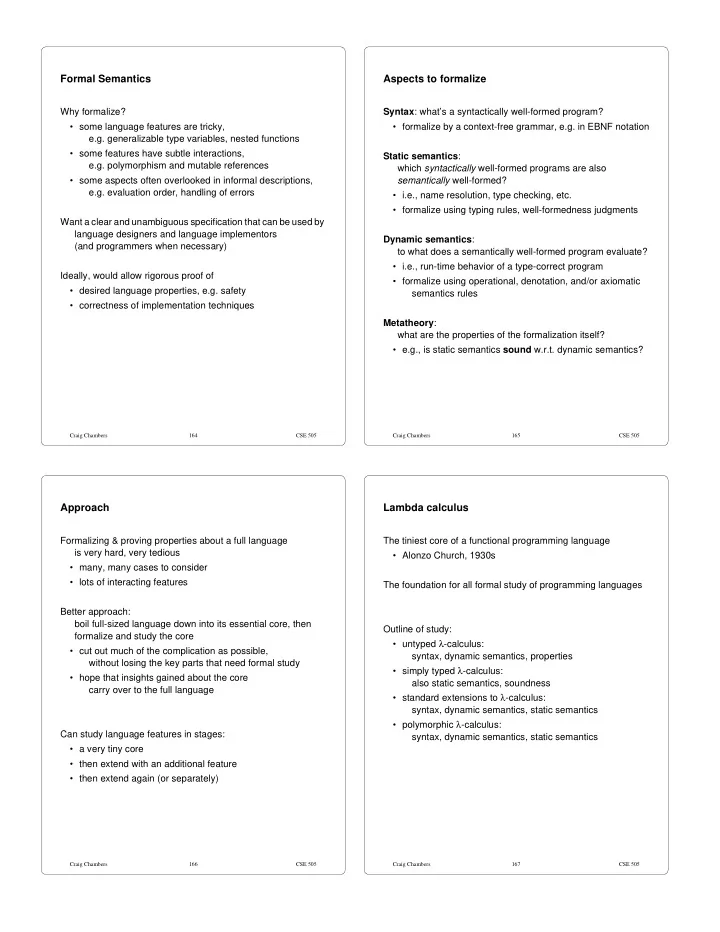
Formal Semantics

Why formalize?

  • some language features are tricky,

e.g. generalizable type variables, nested functions

  • some features have subtle interactions,

e.g. polymorphism and mutable references

  • some aspects often overlooked in informal descriptions,

e.g. evaluation order, handling of errors Want a clear and unambiguous specification that can be used by language designers and language implementors (and programmers when necessary) Ideally, would allow rigorous proof of

  • desired language properties, e.g. safety
  • correctness of implementation techniques

Craig Chambers 165 CSE 505

Aspects to formalize

Syntax: what’s a syntactically well-formed program?

  • formalize by a context-free grammar, e.g. in EBNF notation

Static semantics: which syntactically well-formed programs are also semantically well-formed?

  • i.e., name resolution, type checking, etc.
  • formalize using typing rules, well-formedness judgments

Dynamic semantics: to what does a semantically well-formed program evaluate?

  • i.e., run-time behavior of a type-correct program
  • formalize using operational, denotation, and/or axiomatic

semantics rules Metatheory: what are the properties of the formalization itself?

  • e.g., is static semantics sound w.r.t. dynamic semantics?

Craig Chambers 166 CSE 505

Approach

Formalizing & proving properties about a full language is very hard, very tedious

  • many, many cases to consider
  • lots of interacting features

Better approach: boil full-sized language down into its essential core, then formalize and study the core

  • cut out much of the complication as possible,

without losing the key parts that need formal study

  • hope that insights gained about the core

carry over to the full language Can study language features in stages:

  • a very tiny core
  • then extend with an additional feature
  • then extend again (or separately)

Craig Chambers 167 CSE 505

Lambda calculus

The tiniest core of a functional programming language

  • Alonzo Church, 1930s

The foundation for all formal study of programming languages Outline of study:

  • untyped λ-calculus:

syntax, dynamic semantics, properties

  • simply typed λ-calculus:

also static semantics, soundness

  • standard extensions to λ-calculus:

syntax, dynamic semantics, static semantics

  • polymorphic λ-calculus:

syntax, dynamic semantics, static semantics

slide-2
SLIDE 2

Craig Chambers 168 CSE 505

Untyped λ-calculus: syntax

Syntax: E ::= λI. E function / abstraction | E E call / application | I variable [That’s it!] Application binds tighter than . Can freely parenthesize as needed Example (with minimum parens): (λx. λy. x y) λz.z ML analogue (if ignore types): (fn x => (fn y => x y)) (fn z => z) Trees described by this grammar are called term trees

Craig Chambers 169 CSE 505

Free and bound variables

λI.E binds I in E An occurrence of a variable I is free in an expression E if it’s not bound by some enclosing lambda in E FV(E): set of free variables in E FV(I) = {I} FV(λI.E) = FV(E) - {I} FV(E1 E2) = FV(E1) ∪ FV(E2) FV(E) = ∅ ⇔ E is closed

Craig Chambers 170 CSE 505

α-renaming

First semantic property of λ-calculus: a bound variable in a term tree (and all its references) can be renamed without affecting the semantics of the term tree

  • cannot rename free variables

Precise definition: α-equivalence: λI1.E ⇔ λI2.[I2/I1]E (if I2 ∉ FV(E)) [E2/I]E1: substitute all free occurrences of I in E1 with E2

  • (formalized soon)

Since names of bound variables “don’t matter”, it’s convenient to treat all α-equivalent term trees as a single term

  • define all later semantics for terms
  • can assume that all bound variables are distinct
  • for any particular term tree, do α-renaming to make this so

Craig Chambers 171 CSE 505

Evaluation, β-reduction

Define how a λ-calculus program “runs” via a set of rewrite rules, a.k.a. reductions

  • “E1 → E2” means “E1 reduces to E2 in one step”

One rule: (λI.E1)E2 → [E2/I]E1

  • “applying a function to an argument expression

reduces to the function’s body after substituting the argument expression for the function’s formal”

  • this rule is called the β-reduction rule

Other rules state that the β-reduction rule can be applied to nested subexpressions, too

  • (formalized later)

Define how a λ-calculus program “runs” to compute a final result as the reflexive, transitive closure of one-step reduction

  • “E →∗ V” means “E reduces to result value V”
  • (formalized later)

That’s it!

slide-3
SLIDE 3

Craig Chambers 172 CSE 505

Examples

Craig Chambers 173 CSE 505

Substitution

Substitution is suprisingly tricky

  • must avoid changing the meaning of any variable reference,

in either substitutee or substituted expressions

  • “capture-avoiding substitution”

Define formally by cases, over the syntax of the substitutee:

  • identifiers:

[E2/I]I = E2 [E2/I]J = J (if J ≠ I)

  • applications:

[E2/I](E1 E3) = ([E2/I]E1) ([E2/I]E3)

  • abstractions:

[E2/I](λI.E) = λI.E [E2/I](λJ.E) = λJ.[E2/I]E (if J ≠ I and J ∉ FV(E2))

  • use α-renaming on (λJ.E) to ensure J ∉ FV(E2)

Defines the scoping rules of the λ-calculus

Craig Chambers 174 CSE 505

Normal forms

E →∗ V: E evaluates fully to a value V

  • →∗ defined as the reflexive, transitive closure of →

What is V? an expression with no opportunities for β-reduction

  • such expressions are called normal forms

Can define formally: V ::= λI.V | I V | I (I.e., any E except one containing (λI.E1)E2 somewhere) Q: does every λ-calculus term have a normal form? Q: is a term’s normal form unique?

Craig Chambers 175 CSE 505

Reduction order

Can have several places in an expression where a lambda is applied to an argument

  • each is called a redex

(λx.(λy.x) x) ((λz.z) (λw.(λv.v) w)) Therefore, have a choice in what reduction to make next Which one is the right one to choose to reduce next? Does it matter?

  • to the final result?
  • to how long it takes to compute it?
  • to whether the result is computed at all?
slide-4
SLIDE 4

Craig Chambers 176 CSE 505

Some possible reduction strategies

Example: (λx.(λy.x) x) ((λz.z) (λw.(λv.v) w)) normal-order reduction: always choose leftmost, outermost redex

  • call-by-name, lazy evaluation:

same, and ignore redexes underneath λ applicative-order reduction: always choose leftmost, outermost redex whose argument is in normal form

  • call-by-value, eager evaluation:

same, and ignore redexes underneath λ Again, does it matter?

  • to the final result?
  • to how long it takes to compute it?
  • to whether the result is computed at all?

Craig Chambers 177 CSE 505

Amazing fact #1: Church-Rosser Thm., Part 1

Thm (Confluence). If e1 →∗ e2 and e1 →∗ e3, then ∃ e4 s.t. e2 →∗ e4 and e3 →∗ e4. Corollary (Normalization). Every term has a unique normal form, if it exists

  • No matter what reduction order is used!

Proof? [e.g. by contradiction] e1 e2 e3 e4

Craig Chambers 178 CSE 505

Existence of normal form?

Does every term have a normal form?

  • (If it does, we already know it’s unique)

Consider: (λx.x x) (λx.x x)

Craig Chambers 179 CSE 505

Amazing fact #2: Church-Rosser Thm., Part 2

  • Thm. If a term has a normal form, then

normal-order reduction will find it!

  • applicative-order reduction might not!

Example: (λx.(λy.y)) ((λz.z z) (λz.z z)) Same example, but using abbreviations: id ≡ (λy.y) loop ≡ ((λz.z z) (λz.z z)) (λx.id) loop (Abbreviations are not really in the λ-calculus; expand away textually before evaluating) Q: How can I tell whether a term has a normal form?

slide-5
SLIDE 5

Craig Chambers 180 CSE 505

Amazing fact #3: λ-calculus is Turing-complete!

Can translate any Turing machine program into an equivalent λ-calculus program, and vice versa But how? λ-calculus lacks:

  • functions with multiple arguments
  • numbers and arithmetic
  • booleans and conditional branches
  • data structures
  • local variables
  • recursive definitions and loops

All it’s got are one-argument, non-recursive functions...

Craig Chambers 181 CSE 505

Multiple arguments, via currying

Encode multiple arguments by currying λ(X,Y).E λX.(λY.E) E(E1,E2) (E E1) E2 Multiple arguments can be had via a syntactic sugar, so they’re not essential, and they can be dropped from the core language

Craig Chambers 182 CSE 505

Church numerals

Encode natural numbers using stylized λ terms zero ≡ (λs.λz.z) ≡ (λs.λz.s0 z)

  • ne

≡ (λs.λz.s z) ≡ (λs.λz.s1 z) two ≡ (λs.λz.s (s z)) ≡ (λs.λz.s2 z) ... N ≡ (λs.λz.sN z) (N is the λ-calculus encoding of the mathematical number N) A unary representation of numbers, but one that can be used to do computation

  • a “number” N is a function that applies

a “successor” function (s) N times to a “zero” value (z)

Craig Chambers 183 CSE 505

Arithmetic on Church numerals

A basic arithmetic function: succ

  • succ N →∗ N+1

Definition: succ ≡ (λn. λs.λz.s (n s z)) Examples: succ zero = (λn.λs.λz.s (n s z)) (λs’.λz’.z’) → (λs.λz.s ((λs’.λz’.z’) s z)) → (λs.λz.s ((λz’.z’) z)) → (λs.λz.s z) = one succ two = (λn.λs.λz.s (n s z)) (λs’.λz’.s’ (s’ z’)) → (λs.λz.s ((λs’.λz’.s’ (s’ z’)) s z)) → (λs.λz.s ((λz’.s (s z’)) z)) → (λs.λz.s (s (s z))) = three

slide-6
SLIDE 6

Craig Chambers 184 CSE 505

Addition

Another basic arithmetic function: add

  • add X Y →∗ X+Y

Algorithm: to add X to Y, apply succ to Y X times Key trick: X is a function that applies its first argument to its second argument X times

  • “a number is as a number does”

Definition: add ≡ (λx.λy.x succ y) Example: add two three = (λx.λy.x succ y) two three →∗ two succ three = (λs.λz.s (s z)) succ three →∗ succ (succ three) →∗ five (pred is tricky, but doable; sub then is similar to add)

Craig Chambers 185 CSE 505

Multiplication

Another basic arithmetic function: mul

  • mul X Y →∗ X*Y

Craig Chambers 186 CSE 505

Booleans and conditionals

How to make choices? We only have functions... Key idea: true and false are encoded as functions that work differently

  • call the boolean value to control evaluation

true ≡ (λt.λe.t) false ≡ (λt.λe.e) if ≡ (λb.λt.λe.b t e) Example: if false loop three = (λb.λt.λe.b t e) false loop three →∗ false loop three = (λt.λe.e) loop three →∗ three

Craig Chambers 187 CSE 505

Testing numbers

To complete Peano arithmetic, need an isZero predicate

  • isZero N →∗ N=0

Idea: implement by calling the number on a successor function that always returns false and a zero value that is true Definition: isZero ≡ (λn.n (λx.false) true) Examples: isZero zero = (λn.n (λx.false) true) zero → (λs’.λz’.z’) (λx.false) true →∗ true isZero two = (λn.n (λx.false) true) two → (λs’.λz’.s’ (s’ z’)) (λx.false) true →∗ (λx.false) ((λx.false) true) → false

slide-7
SLIDE 7

Craig Chambers 188 CSE 505

Data structures

E.g., pairs Idea: a pair is a function that remembers its two parts (via lexical scoping & closures)

  • pair function takes a selector function that’s

passed both parts and then chooses one pair ≡ (λf.λs.λb.b f s) fst ≡ (λp.p (λf.λs.f)) snd ≡ (λp.p (λf.λs.s)) Examples: pair true four = (λf.λs.λb.b f s) true four →∗ (λb.b true four) snd (pair true four) = (λp.p (λf.λs.s)) (p t f) → (pair true four) (λf.λs.s) →∗ (λb.b true four) (λf.λs.s) → (λf.λs.s) true four →∗ four

Craig Chambers 189 CSE 505

Local variables

Encode let using functions let I = E1 in E2

  • (λI.E2) E1

Example: let x = one in let y = two in add x y

  • (λx.(λy.add x y) two) one

Doesn’t handle recursive declarations, though: let fact = ... fact ... in fact two

  • (λfact.fact two) (... fact ...)

Craig Chambers 190 CSE 505

Loops and recursion

We’ve seen that we can write infinite loops in the λ-calculus loop ≡ ((λz.z z) (λz.z z)) Can we write useful loops? I.e., can we write recursive functions? The let encoding won’t work, as we saw How about this? fact ≡ (λn. if (isZero n) one (mul n (fact (pred n))))

Craig Chambers 191 CSE 505

Amazing fact #4: Can define recursive functions non-recursively!

Step 1: replace the bogus recursive reference with an explicit argument factG ≡ (λfact.λn. if (isZero n) one (mul n (fact (pred n)))) Step 2: use the “paradoxical Y combinator” to pass factG to itself in a funky way to yield plain fact fact ≡ (Y factG) Now all we have to do is write Y in the raw λ-calculus

slide-8
SLIDE 8

Craig Chambers 192 CSE 505

The Y combinator

A definition of Y: Y ≡ (λf.(λx.f (x x)) (λx.f (x x))) Example: Y fG = (λf.(λx.f (x x)) (λx’.f (x’ x’))) fG → (λx.fG (x x)) (λx’.fG (x’ x’)) → fG ((λx’.fG (x’ x’)) (λx’.fG (x’ x’)))) = fG (Y fG) So: (Y fG) reduces to a call to fG, whose argument is an expression that, if evaluated inside fG, will reinvoke fG again with the same argument

  • normal-order evaluation will only reduce “recursive”

argument (Y fG) on demand, as needed

Craig Chambers 193 CSE 505

Example

A concrete example: factG ≡ (λfact.λn. if (isZero n) one (mul n (fact (pred n)))) fact ≡ (Y factG) (* Y fG →∗ fG (Y fG) *) fact two = Y factG two →∗ factG (Y factG) two →∗ if (isZero two) one (mul two ((Y factG) (pred two))) →∗ mul two ((Y factG) (pred two)) [doing some applicative-order reduction, for simplicity] →∗ mul two (factG (Y factG) one) →∗ mul two (if (isZero one) one (mul one ((Y factG) (pred one)))) →∗ mul two (mul one ((Y factG) (pred one))) →∗ mul two (mul one (if (isZero zero) one (mul zero ...))) →∗ mul two (mul one one) →∗ two

Craig Chambers 194 CSE 505

Letrec

Can now define a recursive version of let: letrec I = E1 in E2

  • let I = Y (λI.E1) in E2
  • can now reference I recursively inside E1

Example: letrec fact = (λn. if (isZero n) one (mul n (fact (pred n)))) in ... fact ...

Craig Chambers 195 CSE 505

Summary, so far

Saw untyped λ-calculus Saw α-renaming, β-reduction rules

  • both relied on capture-avoiding substitution
  • α-renaming defined families of equivalent term trees
  • name choice of formals doesn’t matter to semantics
  • β-reduction defined “evaluation” of a λ-calculus “program”
  • normal forms: no more β-reduction possible

the “results” of a “program”

  • reduction strategies such as normal-order & applicative-order

had different termination properties, but not different results

Church-Rosser: key confluence & normalization thms. Turing-completeness of untyped λ-calculus suggested by successfully encoding many standard PL features