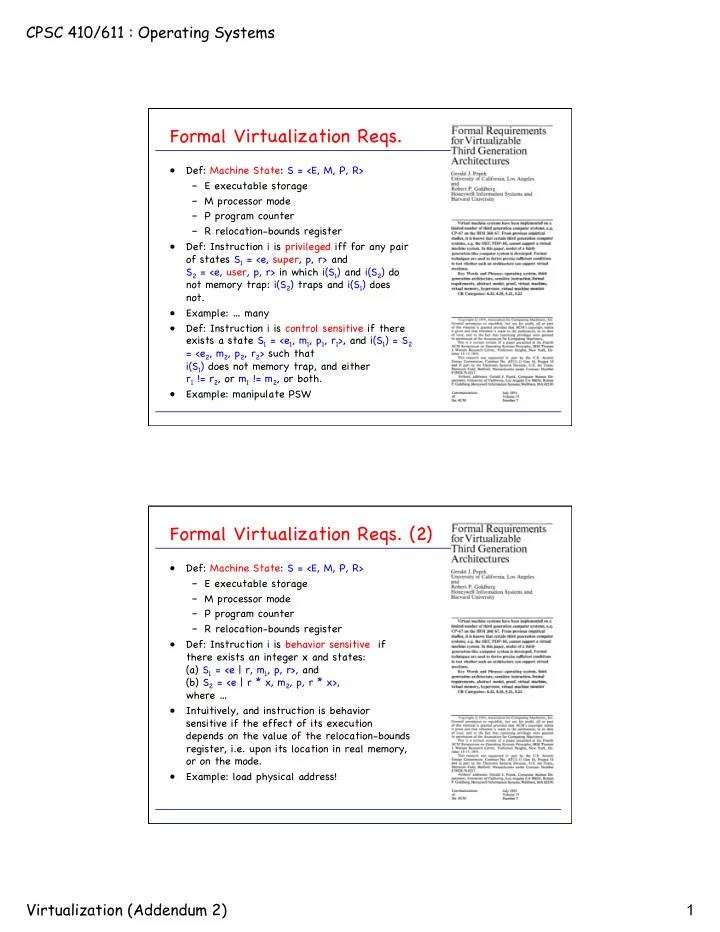
Formal Virtualization Reqs. Def: Machine State: S = <E, M, P, - - PDF document

formal virtualization reqs
SMART_READER_LITE
LIVE PREVIEW

Formal Virtualization Reqs. Def: Machine State: S = <E, M, P, - - PDF document

CPSC 410/611 : Operating Systems Formal Virtualization Reqs. Def: Machine State: S = <E, M, P, R> E executable storage M processor mode P program counter R relocation-bounds register Def:


slide-1
SLIDE 1

CPSC 410/611 : Operating Systems Virtualization (Addendum 2) 1

Formal Virtualization Reqs.

  • Def: Machine State: S = <E, M, P, R>

– E executable storage – M processor mode – P program counter – R relocation-bounds register

  • Def: Instruction i is privileged iff for any pair
  • f states S1 = <e, super, p, r> and

S2 = <e, user, p, r> in which i(S1) and i(S2) do not memory trap: i(S2) traps and i(S1) does not.

  • Example: … many
  • Def: Instruction i is control sensitive if there

exists a state S1 = <e1, m1, p1, r1>, and i(S1) = S2 = <e2, m2, p2, r2> such that i(S1) does not memory trap, and either r1 != r2, or m1 != m2, or both.

  • Example: manipulate PSW

Formal Virtualization Reqs. (2)

  • Def: Machine State: S = <E, M, P, R>

– E executable storage – M processor mode – P program counter – R relocation-bounds register

  • Def: Instruction i is behavior sensitive if

there exists an integer x and states: (a) S1 = <e | r, m1, p, r>, and (b) S2 = <e | r * x, m2, p, r * x>, where …

  • Intuitively, and instruction is behavior

sensitive if the effect of its execution depends on the value of the relocation-bounds register, i.e. upon its location in real memory,

  • r on the mode.
  • Example: load physical address!
slide-2
SLIDE 2

CPSC 410/611 : Operating Systems Virtualization (Addendum 2) 2

Formal Virtualization Reqs. (3)

  • Theorem: “For any conventional third

generation [1974] computer, a virtual machine monitor may be constructed if the set of sensitive instructions for that computer is a subset of the set of privileged instructions.”

  • Virtual Machine Map:
  • Recursive Virtualization: “A conventional third

generation computer is recursively virtualizable if it is (a) virtualizable, and (b) a VMM without any timing dependencies can be constructed for it.

Formal Virtualization Reqs. (4)

  • “Hybrid” Virtualization (with interpreted instr’s):
  • Def: Machine State: S = <E, M, P, R>

– E executable storage – M processor mode – P program counter – R relocation-bounds register

  • Def: Instruction i is user sensitive if there exists a

state S = <E, user, P, R> for which i is control sensitive or behavior sensitive.

  • Theorem: A hybrid virtual machine (HVMM) monitor

may be constructed for any conventional third generation machine in which the set of user sensitive instructions are a subset of the set of privileged instructions.

  • Example: PDP-10 JRST 1 (return to user mode) is

non-privileged, but supervisor control sensitive. Therefore, PDP-10 cannot host VMM, but can host HVMM.

slide-3
SLIDE 3

CPSC 410/611 : Operating Systems Virtualization (Addendum 2) 3

hardware

Shadow Page Table

Every time the guest modifies its page mapping, either by changing the content of a translation, creating a new translation, or removing an existing translation, the virtual MMU module will capture the modification and adjust the shadow page tables accordingly.

PTBR page table page dir PDE PTE memory PTE PTBR page table page dir PDE PTE

shadow page e table

Hypervisor Guest