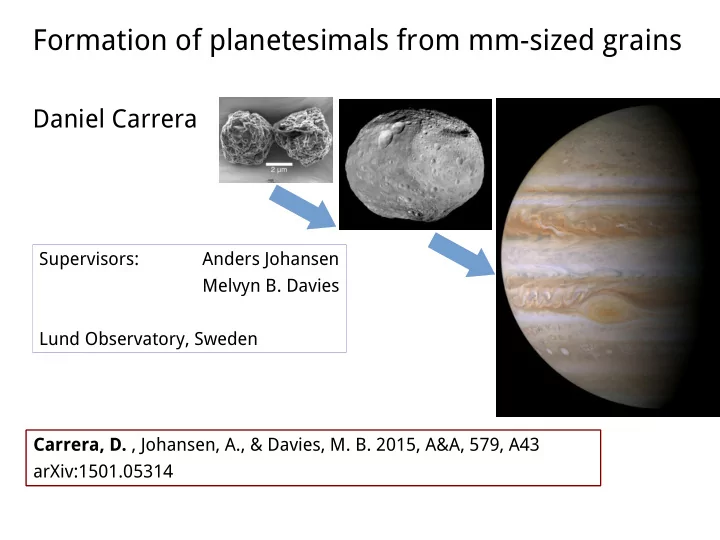
Formation of planetesimals from mm-sized grains Daniel Carrera - - PowerPoint PPT Presentation

formation of planetesimals from mm sized grains
SMART_READER_LITE
LIVE PREVIEW

Formation of planetesimals from mm-sized grains Daniel Carrera - - PowerPoint PPT Presentation

Formation of planetesimals from mm-sized grains Daniel Carrera Supervisors: Anders Johansen Melvyn B. Davies Lund Observatory, Sweden Carrera, D. , Johansen, A., & Davies, M. B. 2015, A&A, 579, A43 arXiv:1501.05314 Context: Giant


slide-1
SLIDE 1

Formation of planetesimals from mm-sized grains

Daniel Carrera

Supervisors: Anders Johansen Melvyn B. Davies Lund Observatory, Sweden Carrera, D. , Johansen, A., & Davies, M. B. 2015, A&A, 579, A43 arXiv:1501.05314

slide-2
SLIDE 2

Context: Giant planet formation (core accretion)

µm mm - cm planetesimals ~ 100 km planet cores ~ 10 M⊕ giant planets Carrera+ 2015

streaming instability

Lambrechts+ 2014

pebble accretion

Bitsch+ 2015

accretion, migration

Mustill+ 2015

dynamical evolution

Time Size

(Vesta)

coagulation

3 Myr Disc Phase

Mass must grow x1041 in ~3Myr.

slide-3
SLIDE 3

Streaming instability: Planetesimal formation

2009 simulation with particle size ~ 1 m

Johansen+ (2009) Radial direction Azimuthal direction

Sun

planetesimal (Vesta)

Problem: ~1m bodies cannot form by coagulation . . . color = Σsolid

slide-4
SLIDE 4

Goals / Aims

(1) What are the smallest particles that form particle clumps?

R = ?

(2) What are the conditions needed for the streaming instability?

Particle size Particle density Streaming instability (i.e. planetesimals) No streaming instability Parameter sweep

slide-5
SLIDE 5

Methods

Star Protoplanetary Disk Pencil Code

Brandenburg & Dobler (2002)

  • Gas:

1282 static grid

  • Solids:

particles

  • Box size:

0.2 H x 0.2 H

  • Gas mass:

0.5 Mearth

  • Solid mass:

0.4 Mmoon Radial direction Vertical direction around the entire ring

slide-6
SLIDE 6

Results

(1) What are the smallest particles that form particle clumps?

R = 1 – 4 mm (at 3 AU)

(2) What are the conditions needed to form particle clumps?

Stokes number (τf) Clumping

Streaming instability is active No clumping No clumping No clumping R = 1 – 4 mm at 3 AU

Z = Σsolid Σgas+Σsolid τf = t f Ωkep τf =

Stopping time Orbital timescale

Carrera+ (2015)

slide-7
SLIDE 7

Results / Application

M disk , R particle , Z

Planetesimal formation region Carrera+ (2015)

slide-8
SLIDE 8

Summary

(1) Jupiter has to form in ~3 Myr => planetesimals must form quickly. (2) When it works, the streaming instability can form planetesimals quickly. (3) We have found the conditions needed for the streaming instability. (4) We have shown that the streaming instability works for small particles (R ~ 1 – 4 mm at 3 AU) if the disc can concentrate particles well enough (Z ~ 0.04 – 0.07).

slide-9
SLIDE 9
slide-10
SLIDE 10

Extra slide 1: Resolution test

Simulation time (t / Orbits )

Radial coordinate (x / H) Resolution: 1282 2562 1282 2562 Particle size: τf = 0.003 / R ~ 2.5 mm τf = 0.010 / R ~ 8 mm

slide-11
SLIDE 11

Extra slide 2: Chondrule aggregates

Ormel, Cuzzi, Tielens 2008 Turbulence α = 10-4 R ~ 1.2 mm α = 10-6 R = 2-7 mm Aggregate Size

slide-12
SLIDE 12

Extra slide 3: Time between sticking collisions

Particle with radius: r Collision cross section: σ ~ π(2r)2 Time between sticking collisions:

t stick ≈ (σ vrel n F)

−1

cross section relative speed number density fraction of collisions that result in sticking