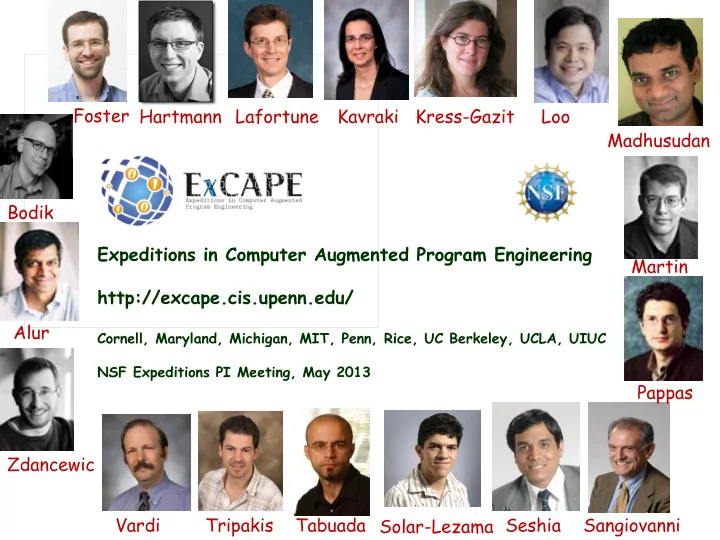
Foster Hartmann Lafortune Kavraki Kress-Gazit Loo Madhusudan - - PowerPoint PPT Presentation

foster hartmann lafortune kavraki kress gazit loo
SMART_READER_LITE
LIVE PREVIEW

Foster Hartmann Lafortune Kavraki Kress-Gazit Loo Madhusudan - - PowerPoint PPT Presentation

Foster Hartmann Lafortune Kavraki Kress-Gazit Loo Madhusudan Bodik Expeditions in Computer Augmented Program Engineering Martin http://excape.cis.upenn.edu/ Alur Cornell, Maryland, Michigan, MIT, Penn, Rice, UC Berkeley, UCLA, UIUC NSF


slide-1
SLIDE 1

Foster Bodik Alur Hartmann Zdancewic Vardi Tripakis Tabuada Kavraki Seshia Lafortune Solar-Lezama Sangiovanni Kress-Gazit Loo Madhusudan Martin Pappas Expeditions in Computer Augmented Program Engineering http://excape.cis.upenn.edu/

Cornell, Maryland, Michigan, MIT, Penn, Rice, UC Berkeley, UCLA, UIUC NSF Expeditions PI Meeting, May 2013

slide-2
SLIDE 2

Software Design Methodology

 What has changed:

Programming languages Libraries Verification technology

 What has not changed:

Programming is done by experts Fully specified by conventional programming Verification phase is distinct from design

Can we leverage modern analysis tools and increased computing power to revolutionize the task of programming?

2

slide-3
SLIDE 3

Synthesis: A Plausible Solution ?

 Classical: Mapping a high-level (e.g. logical) specification to an executable implementation Theoretical foundations: Church (1960s) Derivation of programs from constructive proofs (e.g. Kestrel) Synthesis from temporal logic specs: Clarke/Emerson (1980s) Refinement in model-based design Ongoing progress, but many challenges remain…  Recent shift in focus: Integrating different styles of specifications in a consistent executable

3

slide-4
SLIDE 4

Sketch: Program completion

Ref: Solar-Lezama et al (PLDI 2010)

Err = 0.0; for(t = 0; t<T; t+=dT){ if(stage==STRAIGHT){ if(t > ??) stage= INTURN; } if(stage==INTURN){ car.ang = car.ang - ??; if(t > ??) stage= OUTTURN; } if(stage==OUTTURN){ car.ang = car.ang + ??; if(t > ??) break; } simulate_car(car); Err += check_collision(car); } Err += check_destination(car); Backup straight Straighten Turn

When to start turning? How much to turn? Enables programmers to focus on high-level solution strategy

4

slide-5
SLIDE 5

ExCAPE Vision

Harnessing computation to transform programming:

Programming made easier, faster, cheaper

5

slide-6
SLIDE 6

Synthesis Tool: Intelligent Assistance

 Designer expresses “what”, possibly using multiple input formats  Synthesizer discovers new artifacts via integration and completion  Synthesizer solves computationally demanding problems using advanced analysis tools  Interactive iterative design  Integrated formal verification

6

slide-7
SLIDE 7

Challenge Problems Design Methodology

Apps for Mobile Platforms

Education and Knowledge Transfer

Robotic Systems Multicore Protocols Networked Systems

Computational Engines Tools and Evaluation

7

Research Organization

slide-8
SLIDE 8

Talk Outline

 Design tool for distributed protocols  Synthesis for programming robots  Synthesis to support online education  Summary of ExCAPE activities

8

slide-9
SLIDE 9

Goal: Simplify Protocol Design

 Design challenging due to asynchronous model of communication  Cache coherence protocols, Distributed coordination algorithms  Successful application domain for formal verification / model checking  Correctness involves both safety and liveness properties  Proposed solution: Allow programmers flexibility Protocol = Skeleton based on Extended-Finite-State-Machines + High-level requirements + Example behaviors

9

slide-10
SLIDE 10

TRANSIT for Distributed Protocol Design

10

slide-11
SLIDE 11

Computational Problem

 Inputs: Variable types and corresponding expression grammar For each process, 1. Control states of EFSM 2. List of all variables , input/output messages 3. Set of concrete examples + symbolic constraints High-level requirements (invariants and temporal logic formulas)  Solution strategy: Expression Inference: For each EFSM transition, generate expressions for guards and updates. Solution uses Counter-example- guided-inductive synthesis using SMT solver Z3 Check if resulting protocol meets all requirements, using a model checker (Murphi) and if not, report a counter-example

11

slide-12
SLIDE 12

Challenging Case Study: SGI Origin protocol

 Source: Laudon and Lenoski; The SGI Origin: A CCNUMA highly scalable server; ISCA 1997  Directory-based MESI protocol that handles multiple concurrent requests to same requests over unordered network  Textual description directly leads to protocol skeleton, and symbolic (incomplete) descriptions of most of the transitions  During debugging, programmer focuses on local fixes of counteexamples and adds concrete examples  Final iteration required 30 min synthesis time (with 5 Million states explored by Murphi)  SMT solver / model checker in the loop is feasible for programming

12

slide-13
SLIDE 13

Synthesis for Robot Programming

Goal: Allow end-users to program robotic behaviors Automatically (Provably Correct)

13

slide-14
SLIDE 14

Robotic controllers: Research Challenges

 How to consistently integrate physical constraints, sample trajectories, safety rules, and language/temporal-logic requirements?  How to explain infeasible requirements? How to suggest potential fixes?  How to program a synthesis engine with completion strategies that take into account the physical and continuous nature of robotics (power, safety, environment traversability)?  How to address optimality and performance?  How to evaluate human-robot interaction?  How to generate control that ports across different robots (different dynamics, control capabilities, safety considerations)?

14

slide-15
SLIDE 15

LTLMoP: Robot control from structured English

Visit all rooms Feasible specification Unsynthesizable specification

15

slide-16
SLIDE 16

Research Results

 Improving the scalability of core engine for mapping Temporal Logic formulas to Controllers: Synthesis with identifiers (Kress-Gazit, Seshia)  Synthesis of cost-optimal plans (Kress-Gazit)  Motion planning in partially unknown environments (Kavraki, Vardi)  Synthesis of controllers with robust performance in presence of uncertainties Theory of robustness for hybrid systems (Tabuada)  Accuracy in mapping discrete actions to continuous-time trajectories with durations (Kress-Gazit)  Automatic generation of environment assumptions (Alur, Topcu)

16

slide-17
SLIDE 17

Ongoing Case Study: Robotic Waiter

 Challenges: Scalability (items, costumers), uncertainty in sensing and actuation, optimality of behavior, fault recovery  Future plans: exploit symmetries, robust synthesis, task specific abstractions

17

Initial demo using LTLMoP (Kress-Gazit) and OMPL (Kavraki)

17

slide-18
SLIDE 18

Synthesis for Online Education

 Emerging opportunity: MOOCs  Challenge: Personalized feedback on assignments

Manual feedback by TAs (not scalable) Grading by peers (not reliable) Evaluation on test cases (how to translate failed tests to errors?)

 Application for ExCAPE tools for synthesis

Introductory programming assignments (Solar-Lezama, MIT) Scheduling problems in Embedded Systems course (Seshia, UC Berkeley) DFA construction in Theory of Computation (with Hartmann, UC Berkeley) see automatatutor.com

18

slide-19
SLIDE 19

Sample Problem: Derivative of a Polynomial

def computeDeriv(poly): result = [] for i in range(len(poly)): result += [i * poly[i]] if len(poly) == 1: return result # return [0] else: return result[1:] # remove the leading 0

19

slide-20
SLIDE 20

Autograder Output on a Student Solution

Student Solution + Reference Solution + Error Model

20

slide-21
SLIDE 21

Computational Engine: Sketch Synthesis Tool

1 change 2 changes 4 changes Programs satisfying spec Minimum changes S All Programs S: Student Solution

21

slide-22
SLIDE 22

Autograder Experiments (MIT 6.00)

Benchmark TestSet Generated Feedback Percentage AvgTime(s) prodBySum-6.00 268 218 81.34% 2.49

  • ddTuples-6.00

344 185 53.78% 2.65 compDeriv-6.00 103 88 85.44% 12.95 evalPoly-6.00 13 6 46.15% 3.35 compBal-stdin-6.00 52 17 32.69% 29.57 compDeriv-6.00x 918 753 82.03% 12.42 evalPoly-6.00x 541 167 30.87% 4.78

  • ddTuples-6.00x

1756 860 48.97% 4.14 iterPower-6.00x 2875 1693 58.89% 3.58 recurPower-6.00x 2938 2271 77.30% 10.59 iterGCD-6.00x 2988 2052 68.67% 17.13 hangman1-6.00x 351 171 48.72% 9.08 hangman2-6.00x 218 98 44.95% 22.09

64% 9.9s

22

slide-23
SLIDE 23

Theory / Methodology / Tools / Application domains

 Rosette: Framework for developing synthesis-enhanced DSLs (Bodik)  Enhancements to Sketch to support modularity (Solar-Lezama)  Bridging the gap between reactive synthesis and supervisory control (Lafortune, Tripakis, Vardi)  Verified LLVM Infrastructure (Martin, Zdancewic)  Platform-based design for software synthesis (Sangiovanni-Vincetelli)  Synthesis of logic for avoiding concurrency bugs (Lafortune)  Component-based synthesis for probabilistic systems (Vardi)  Theory of regular functions for quantitative analysis (Alur)  Automated cloud configuration using synthesis(Alur, Loo, Parthasarathy)  Route Shepherd for configuration of routing protocols (Loo)  Synthesis of control + scheduling for wireless control networks (Pappas)  Programming for mobile platforms (Foster, Solar-Lezama)  User studies for improving programming notations (Hartmann)

23

slide-24
SLIDE 24

Template-based Synthesis Modulo Theories

24

SyntLib: Common Format Sketch Transit Autograder Rosette

Stochastic Search Symbolic CEGIS Enumerative CEGIS

Based on input format for SMTLib 2 Problem: Given a formula φ in an SMT theory with an extra function symbol f, and context-free language L for templates, find an expression e in L such that φ[f/e] is valid Basis for synthesis competition (to be held at CAV 2014)

slide-25
SLIDE 25

Education and Outreach

 ExCAPE Summer School: June 13—16, Berkeley; 125 registrants Tutorials: Reactive synthesis (Vardi) Constraint-based program synthesis (Bodik) Synthesis for cyber-physical systems (Tabuada) + Talks  ExCAPE Webinar: Monthly talks on diverse topics  Sponsored workshops SYNT (at CAV 2013, by Solar-Lezama) Synthesis for robotics (at RSS 2013, by Kavraki and Kress-Gazit) Special session on synthesis at ACC 2013 (by Lafortune)  Graduate course at Berkeley: Program synthesis for everyone  K-12 programs: CURIE @ Cornell

25

slide-26
SLIDE 26

Rotating Postdoc Program

 Each ExCAPE postdoc has two mentors, at two different institutions  Year 2012-13: Ruediger Ehlers (Robotics) Mentors: Kress-Gazit (Cornell), Seshia (UC Berkeley)  For the upcoming year: Xiaokang Qiu (UIUC), Apps for mobile platforms Mentors: Foster (Maryland), Solar-Lezama (MIT) Indranil Saha (UCLA), Robotics Mentors: Pappas (Penn), Seshia (UC Berkeley) Christos Stergiou (UC Berkeley), Multicore protocols Mentors: Martin (Penn), Tripakis (UC Berkeley) Damian Zufferey (IST Austria), Networked systems Mentors: Loo (Penn), Parthasarathy (UIUC)

26

slide-27
SLIDE 27

 Paradigm shift in synthesis: Old: Allow more concise, high-level description New: Designer uses multiple, natural formats, Synthesis tool assists in discovering tricky logic  Paradigm shift in design tools: Old : Any compiler transformation must be polynomial-time New: Computational intractability not a show-stopper  Common theme: Guided search in a space of programs to find one that meets multiple design goals A bit like model checking, but can be interactive!

27