Foundations of AI Why learning works 1 6 . Statistical Machine - - PowerPoint PPT Presentation

foundations of ai
SMART_READER_LITE
LIVE PREVIEW

Foundations of AI Why learning works 1 6 . Statistical Machine - - PowerPoint PPT Presentation

Contents Statistical learning Foundations of AI Why learning works 1 6 . Statistical Machine Learning Bayesian Learning and Why Learning Works W olfram Burgard, Bernhard Nebel, and Andreas Karw ath 10/ 1 10/ 2 Statistical Learning


slide-1
SLIDE 1

10/ 1

Foundations of AI

1 6 . Statistical Machine Learning

Bayesian Learning and Why Learning Works

W olfram Burgard, Bernhard Nebel, and Andreas Karw ath

10/ 2

Contents Statistical learning Why learning works

10/ 3

Statistical Learning Methods

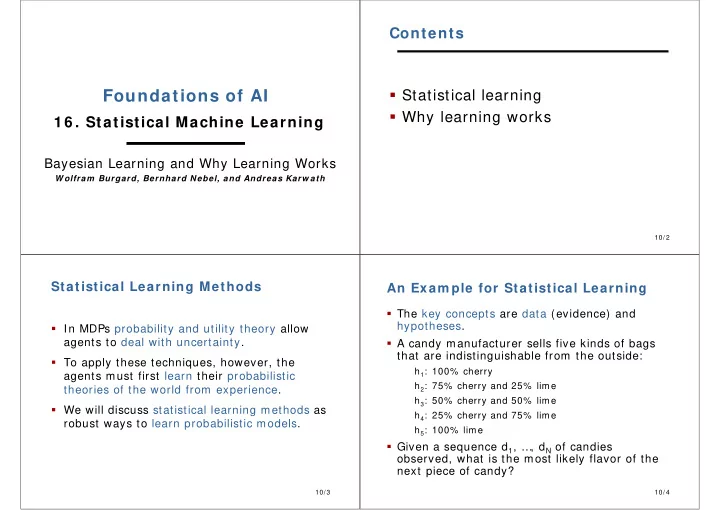
In MDPs probability and utility theory allow agents to deal with uncertainty. To apply these techniques, however, the agents must first learn their probabilistic theories of the world from experience. We will discuss statistical learning methods as robust ways to learn probabilistic models.

10/ 4

An Exam ple for Statistical Learning

The key concepts are data (evidence) and hypotheses. A candy manufacturer sells five kinds of bags that are indistinguishable from the outside:

h1 : 100% cherry h2 : 75% cherry and 25% lime h3 : 50% cherry and 50% lime h4 : 25% cherry and 75% lime h5 : 100% lime

Given a sequence d1, … , dN of candies

  • bserved, what is the most likely flavor of the

next piece of candy?

slide-2
SLIDE 2

10/ 5

Bayesian Learning

Calculates the probability of each hypothesis, given the data. It then makes predictions using all hypotheses weighted by their probabilities (instead of a single best hypothesis). Learning is reduced to probabilistic inference.

10/ 6

Application of Bayes Rule

Let D represent all the data with observed value d. The probability of each hypothesis is obtained by Bayes rule: The manufacturer tells us that the prior distribution over h1, … , h5 is given by < .1, .2, .4, .2, .1> We compute the likelihood of the data under the assumption that the observations are independently and identically distributed (i.i.d.):

10/ 7

How to Make Predictions?

Suppose we want to make predictions about an unknown quantity X given the data d. Predictions are weighted averages over the predictions of the individual hypotheses. The key quantities are the hypothesis prior P(hi) and the likelihood P(d|hi) of the data under each hypothesis.

10/ 8

Exam ple

  • Suppose the bag is an all-lime bag (h5)
  • The first 10 candies are all lime.
  • Then P(d|h3) is 0.510 because half the candies in an h3 bag

are lime.

  • Evolution of the five hypotheses given 10 lime candies

were observed (the values start at the prior!).

slide-3
SLIDE 3

10/ 9

Observations

The true hypothesis often dominates the Bayesian prediction. For any fixed prior that does not rule out the true hypothesis, the posterior of any false hypothesis will eventually vanish. The Bayesian prediction is optimal and, given the hypothesis prior, any other prediction will be correct less often. It comes at a price that the hypothesis space can be very large or infinite.

10/ 10

Maxim um a Posteriori ( MAP)

A common approximation is to make predictions based on a single most probable hypothesis. The maximum a posteriori (MAP) hypothesis is the

  • ne that maximizes P(hi|d).

In the candy example, hMAP = h5 after three lime candies in a row. The MAP learner the predicts that the fourth candy is lime with probability 1.0, whereas the Bayesian prediction is still 0.8. As more data arrive, MAP and Bayesian predictions become closer. Finding MAP hypotheses is often much easier than Bayesian learning. P(X | d) ≈ P(X | hMAP)

10/ 11

Maxim um -Likelihood Hypothesis ( ML)

A final simplification is to assume a uniform prior over the hypothesis space. In that case MAP-learning reduces to choosing the hypothesis that maximizes P(d|hi). This hypothesis is called the maximum- likelihood hypothesis (ML). ML-learning is a good approximation to MAP learning and Bayesian learning when there is a uniform prior and when the data set is large.

10/ 12

W hy Learning W orks

How can we decide that h is close to f when f is unknown? Probably approximately correct Stationarity as the basic assumption of PAC-Learning: training and test sets are selected from the same population of examples with the same probability distribution. Key question: how many examples do we need? X Set of examples D Distribution from which the examples are drawn H Hypothesis space (f ∈ H) m Number of examples in the training set

slide-4
SLIDE 4

10/ 13

PAC-Learning

A hypothesis h is approximately correct if . To show: After the training period with m examples, with high probability, all consistent hypotheses are approximately correct. How high is the probability that a wrong hypothesis hb ∈Hbad is consistent with the first m examples?

10/ 14

Sam ple Com plexity

Assumption: ⇒ P(hb is consistent with 1 example) P(hb is consistent with N examples) P(Hbad contains a consistent h) Since | Hbad | ≤ | H| P(Hbad contains a consistent h) We want to limit this probability by some small number δ: Since , we derive Sample Complexity: Number of required examples, as a function of and .

10/ 15

Sam ple Com plexity ( 2 )

Example: Boolean functions The number of Boolean functions over n attributes is | H| = 22n. The sample complexity therefore grows as 2n. Since the number of possible examples is also 2n, any learning algorithm for the space of all Boolean functions will do no better than a lookup table, if it merely returns a hypothesis that is consistent with all known examples.

10/ 16

Learning from Decision Lists

In comparison to decision trees:

  • The overall structure is simpler
  • The individual tests are more complex

This represents the hypothesis If we allow tests of arbitrary size, then any Boolean function can be represented. k-DL: Language with tests of length ≤ k.

k-DT k-DL

slide-5
SLIDE 5

10/ 17

Learnability of k-DL

(Yes,No,no-Test,all permutations) (Combination without repeating pos/ neg attributes) (with Euler’s summation formula)

10/ 18

Sum m ary ( Statistical Learning Methods)

Bayesian learning techniques formulate learning as a form of probabilistic inference. Maximum a posteriori (MAP) learning selects the most likely hypothesis given the data. Maximum likelihood learning selects the hypothesis that maximizes the likelihood of the data.

10/ 19

Sum m ary ( Statistical Learning Theory)

Decision trees learn deterministic Boolean functions. PAC learning deals with the complexity of learning. Decision lists as functions that are easy to learn. Inductive learning as learning the representation

  • f a function from example input/ output pairs.