Fourth Generation Video: Fourth Generation Video: Project Overview - - PDF document

fourth generation video fourth generation video
SMART_READER_LITE
LIVE PREVIEW

Fourth Generation Video: Fourth Generation Video: Project Overview - - PDF document

Outline Context and Background Fourth Generation Video: Fourth Generation Video: Project Overview Technical Details Preliminary Results Luiz Velho Impacts and Publications VISGRAF Laboratory - IMPA Future


slide-1
SLIDE 1

1 Fourth Generation Video: Fourth Generation Video:

Luiz Velho

VISGRAF Laboratory - IMPA

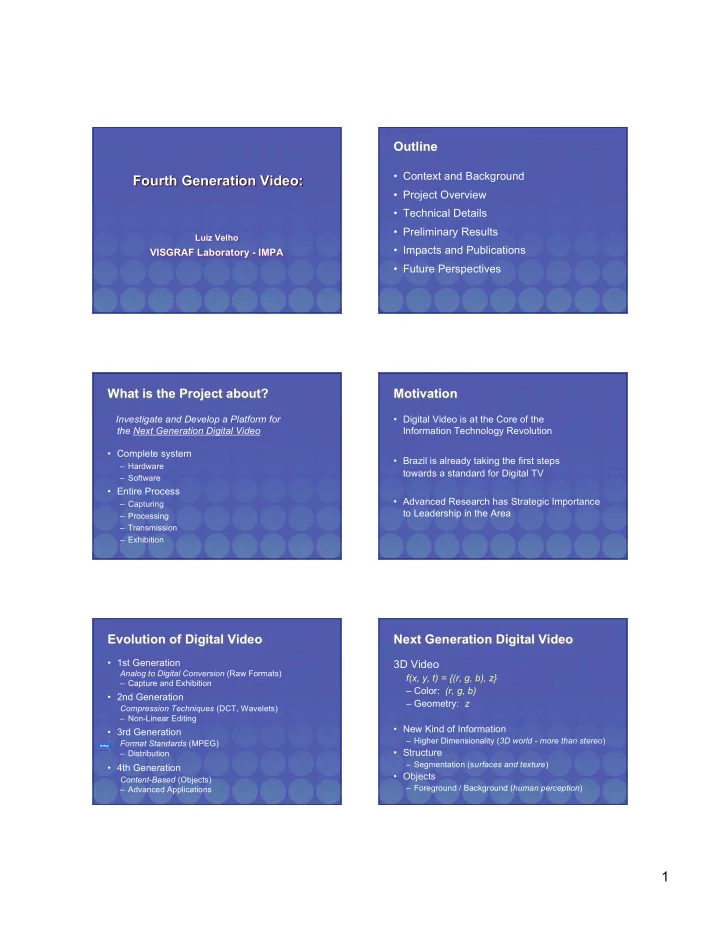
Outline

  • Context and Background
  • Project Overview
  • Technical Details
  • Preliminary Results
  • Impacts and Publications
  • Future Perspectives

What is the Project about?

Investigate and Develop a Platform for the Next Generation Digital Video

  • Complete system

– Hardware – Software

  • Entire Process

– Capturing – Processing – Transmission – Exhibition

Motivation

  • Digital Video is at the Core of the

Information Technology Revolution

  • Brazil is already taking the first steps

towards a standard for Digital TV

  • Advanced Research has Strategic Importance

to Leadership in the Area

Evolution of Digital Video

  • 1st Generation

Analog to Digital Conversion (Raw Formats) – Capture and Exhibition

  • 2nd Generation

Compression Techniques (DCT, Wavelets) – Non-Linear Editing

  • 3rd Generation

Format Standards (MPEG) – Distribution

  • 4th Generation

Content-Based (Objects) – Advanced Applications

today

Next Generation Digital Video

3D Video

f(x, y, t) = {(r, g, b), z} – Color: (r, g, b) – Geometry: z

  • New Kind of Information

– Higher Dimensionality (3D world - more than stereo)

  • Structure

– Segmentation (surfaces and texture)

  • Objects

– Foreground / Background (human perception)

slide-2
SLIDE 2

2

Novel Possibilities

  • Enhanced Techniques

– Compression – Special Effects – Shape Reconstruction

  • Advanced Applications

– Digital Television (Stereo) and Cinema – Virtual Reality and Tele-presence – Games and Theme Parks – Art and Education

Technological Paths to 3D Video

  • Range Sensors

(Video + Depth Cameras) – Low Resolution / Registration Problems – Feasible, but Expensive

  • Passive Stereo

(Pair of Video Cameras) – Not Robust – Ideal, but not Real-Time yet

  • Active Stereo

(Video Camera + Projector) – Interfering Pattern – Robust and Inexpensive

Our Choice

Structured Light Stereo

  • (b,s)-BCSL code

– The (b,s)-BCSL method defines a coding / decoding procedure for unambiguously finding the id of a stripe transition using s slides and b colors. – In our case, we use b=6 colors (R,G,B,Y,M,C) and s=2 slides which gives a code of length 900 as illustrated below: – The color transitions R,G in slide 1 and G,C in slide 2 uniquely map to the transition id p in O(1) decoding procedure. R G C G

… …

1

… …

p 899 Slide 2 color sequence: Slide 1 color sequence: p+1 p-1 Slide 2 Slide 1 Stripe transition id = p

Overview of 3D Capture Process

Projecting and Capturing Color Patterns Detecting Stripe Boundaries and Colors Camera / Projector Correspondence Photometry and Geometry Reconstruction

Step 1: Projecting and capturing color patterns

  • Two slides (S1, S2) having vertical color stripes

specially coded are projected on the object. Each slide is followed by the projection of its color complement.

  • A camera captures the four projected patterns
  • n scene.

S1 S1 S1 S1’ ’ S2 S2’ ’ S2 S2

t0 t1 t2 t3 Object Color slides

  • Zero crossings and projected color stripes

are robustly identified in camera images using complementary slides.

  • Zero crossings

Projected colors

Step 2: Detecting Stripe Boundaries and Colors

slide-3
SLIDE 3

3

  • Projected color sequences are decoded for

each zero crossing giving camera/projector correspondence.

Zero crossings Projected colors Zero crossings in camera space Corresponding stripe boundaries in projector space

+

Step 3: Camera / projector correspondence

Slide 2 Slide 1

  • Geometry is computed using camera/projector correspondence images

and calibration matrices.

  • Texture image is obtained by a simple combination of each

complementary slide pair. For example, the maximum of each channel gives an image that approximates the full white projector light.

Reconstructed texture Reconstructed geometry

+ *

Step 4: Photometry and geometry reconstruction

Video + (b,s)-BCSL code

  • The key for real time 3D video is the combination
  • f the (b,s)-BCSL code with video stream.
  • Our scheme has the following features:

– Each frame contains a slide in the even field the and its complement in the odd field. Frames (S1,S1’) and (S2,S2’) are interleaved in time. – Projector and camera are synchronized through a genlock signal. – Camera output is grabbed and pushed into the reconstruction pipeline.

Reconstruction pipeline: How it Works?

  • Our reconstruction pipeline is as simple as possible, achieving real

time 3D video with high quality geometry and photometry at 30Hz. This is possible because: – Every input frame captured gives a new texture image (by combining both fields). – New zero crossings and projected color map are computed for every input frame and correlated to the previous frame zero crossings and projected color map. The (b,s)-BCSL decoded transitions give a new geometry set.

  • The following diagram illustrates the reconstruction pipeline. The

frame arrived at time ti gives texture pi from its fields and geometry gi by correlation with the frame arrived at time ti-1.

S1S1' S2S2' S1S1' S2S2' Video frames at 30Hz t1 t2 t3 t4 p1 p2 p3 p4 g2 g3 g4

3D Data

First Example

  • The bunny-cube 3D video:

geometry texture Composed virtual scene

Visualization Styles

Moving hand (rendered with lines) Computed surface normals

slide-4
SLIDE 4

4

Deformable Shapes

  • Face and mouth movement

Articulated Objects

  • Background / Foreground

Video - SIGGRAPH 2004 Why It works?

  • Complementary slides projection is suitable for both photometry

and geometry detection.

  • Projected stripe colors are robustly recovered through

camera / projector color calibration.

  • Stripe transitions are robustly detected by zero-crossings.
  • Slides are captured at 60Hz. This is fast enough for capturing

“reasonably normal” motion between consecutive frames.

  • Transition decoding is performed in O(1).
  • While objects move the stripes projected over their surface remain

practically stationary!

Discussion

Current System Embodiment uses NTSC video Pros and Cons

  • Standard off-the-shelf equipment

– Widely Available and Good Cost-Benefit

  • Small resolution

– 640x240 per field. (It reduces the maximum number of stripes around 75.) – Composite video signal has poor color fidelity. (It reduces the transition detection precision at stripe boundaries).

Next Step: High Definition Digital Video.

Planning

  • Fourth Generation Video Platform

– Acquisition Device – 3D Video Processing – Visualization – Structuring and Encoding – Transmission – Applications

Phase One

(2003-2004)

Phase One Phase Two

(2005-2006)

slide-5
SLIDE 5

5

Conclusions

  • Platform for Next Generation Digital Video
  • Advanced the State-of-the-Art
  • First Results are Very Encouraging
  • Promising Future Developments
  • Many Applications
  • Technology Transfer