Frames, Quadratures and Global Illumination: New Math for Games - - PowerPoint PPT Presentation

frames quadratures and global illumination new math for
SMART_READER_LITE
LIVE PREVIEW

Frames, Quadratures and Global Illumination: New Math for Games - - PowerPoint PPT Presentation

Frames, Quadratures and Global Illumination: New Math for Games Robin Green Microsoft Corp Manny Ko PDI/Dreamworks WARNING This talk is MATH HEAVY We assume you understand the basics of: Linear Algebra, Calculus, 3D Mathematics


slide-1
SLIDE 1

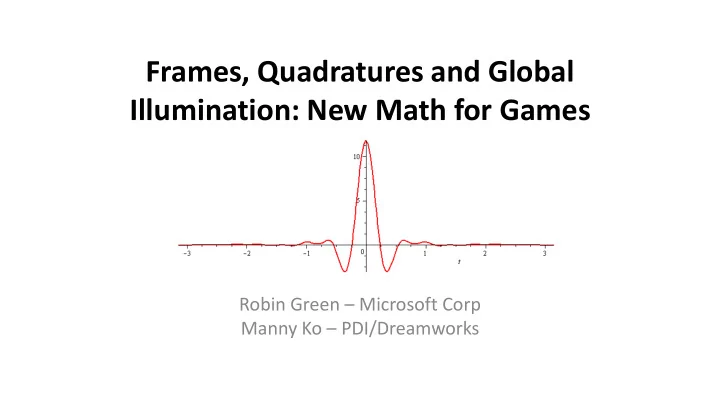
Frames, Quadratures and Global Illumination: New Math for Games

Robin Green – Microsoft Corp Manny Ko – PDI/Dreamworks

slide-2
SLIDE 2

WARNING

  • This talk is MATH HEAVY
  • We assume you understand the basics of:

– Linear Algebra, Calculus, 3D Mathematics – Spherical Harmonic Lighting, Visibility, BRDF, Cosine Term – Monte Carlo Integration, Unbiased Spherical Sampling – Precomputed Radiance Transfer, Rendering Equation

  • This is bleeding edge research (like new results last night)
  • There are still a lot of unanswered questions
slide-3
SLIDE 3

Some Definitions

  • 𝕋2 is the unit sphere in ℝ3
  • 𝜊 is a point on the sphere

𝜊 = 𝜄, 𝜒 where 𝜄 ∈ 0,2𝜌 φ ∈ 0, 𝜌 𝜊 = 𝑦, 𝑧, 𝑨 where 𝑦2 + 𝑧2 + 𝑨2 = 1

  • Right-handed coordinate system,

+ z is up

slide-4
SLIDE 4

Spherical Harmonics

  • The Real SH functions are a family of orthonormal basis

function on the sphere.

slide-5
SLIDE 5

Spherical Harmonics

  • They are defined on the sphere as a signed function of every

direction 𝑧𝑚

𝑛 𝜄, 𝜒 =

2𝐿𝑚

𝑛 cos 𝑛𝜒 𝑄𝑚 𝑛 cos 𝜄 ,

𝑛 > 0 2𝐿𝑚

𝑛 sin −𝑛𝜒 𝑄𝑚 −𝑛 cos 𝜄 ,

𝑛 < 0 𝐿𝑚

0𝑄𝑚 0 cos 𝜄 ,

𝑛 = 0

  • The functions are orthogonal to each other

𝑧𝑗 𝜊 𝑧𝑘 𝜊 ⅆ𝜊 = 𝜀𝑗𝑘 = 1, 𝑗 = 𝑘 0, i ≠ 𝑘

𝜊∈𝕋2

slide-6
SLIDE 6

SH Deficiencies

  • SH produces signed values yet all

visibility functions, BRDFs and light probes are strictly positive.

  • SH projections are global and

smooth, visibility functions are local and sharp.

  • SH reproduces a signal at the limit.

There is no guarantee the result is close to the original at low orders. Even at high orders it “rings” esp when restricted to the hemisphere.

slide-7
SLIDE 7

Haar Wavelets

  • Haar wavelets are spatially

compact and produce a lot of zero coefficients.

  • Generating 6 times the

coefficients, papers rely on compression and highly conditional code.

  • Projecting cube faces onto the

sphere introduces distortions, and seams for filtering and rotation.

slide-8
SLIDE 8

Radial Basis Functions

  • Radial Basis Functions are also

used, usually sums of Gaussian lobes.

  • Need to solve two variables –

direction and spread. Leads to conditional code that is not GPU friendly.

  • Zonal Harmonics are another

form of steerable RBF built out of

  • rthogonal parts.
slide-9
SLIDE 9
  • Haar and SH are two ends of a continuum – one smooth and global,

the other highly local and unsmooth. This is Spatial vs. Spectral compactness. Q: What lives in the middle ground?

Smoothness vs. Localization

slide-10
SLIDE 10

Spatial vs. Spectral

  • It turns out, the Spatial vs. Spectral problem is exactly

Heisenberg’s Uncertainty Principle.

  • You cannot have both spatial compactness and spectral

compactness at the same time – e.g. The Fourier transform of a delta function is infinitely spread out spectrally.

  • But… thanks to a theorem by David Slepian called the

Spherical Concentration Problem you can get pretty close.

slide-11
SLIDE 11

Fundamental Questions

  • 1. Where do these Orthonormal Basis Functions come from?
  • 2. How can we loosen the rules so we can define better

functions for our own use cases?

  • 3. What are the key properties we need to retain for our

functions to be useful?

slide-12
SLIDE 12

What You Need To Know

  • We are going to introduce Frame Theory and Spherical

Quadrature, just enough to understand two key concepts:

Parseval Tight Frames Spherical t-Designs

slide-13
SLIDE 13

Back to Fundamentals

  • We choose a vector space, like ℝ𝑜 or ℂ𝑜

𝑦 = 𝑦1, 𝑦2, … , 𝑦𝑜 where 𝐽 = 1, … , 𝑜 is an index set, we say the space has a dimension 𝑜

  • Using the rules of Arithmetic we can add and subtract vectors, or multiply

and rescale them using a Scalar value: 𝑦 + 𝑧 = 𝑦1 + 𝑧1, 𝑦2 + 𝑧2, … 𝑦𝑜 + 𝑧𝑜 3𝑦 = 3𝑦1, 3𝑦2, … 3𝑦𝑜

slide-14
SLIDE 14

Back to Fundamentals

  • When we add an Inner Product and a Norm things get interesting:

𝑦, 𝑧 = 𝑦𝑗

∗𝑧𝑗 𝑗∈𝐽

𝑦 = 𝑦, 𝑦

  • Now we can measure angles, perpendicularity, sizes, distance and

similarity: 𝑦, 𝑧 = 0 ⇒ 𝑦 ⊥ 𝑧

  • All of Geometry comes from these simple definitions
slide-15
SLIDE 15

Hilbert Spaces

  • A Hilbert space ℋ is a vector space with a finite energy

𝑓𝑗, 𝑓𝑗 < ∞

𝑗∈ℋ

  • These finite square summable signals termed 𝑀2 after Lebesgue
  • 𝑀2 is the mathematical world of data we see in the real world

– Photographs – Audio streams – Motion Capture or GPS data

slide-16
SLIDE 16

Hilbert Spaces

  • The field ℂ has the inner product 𝑦𝑧
  • The field ℝn has the dot product defined

𝑦𝑗𝑧𝑗

𝑜 𝑗=1

  • The infinite dimensional space of finite sequences ℓ2 ℕ has the

inner product 𝑦𝑗𝑧 𝑗

∞ 𝑗=1

  • The space of functions on the interval 𝑏, 𝑐 called 𝑀2 𝑏, 𝑐 has the

standard inner product: 𝑔, 𝑕 = 𝑔 𝑦 𝑕 𝑦

𝑐 𝑏

ⅆ𝑦

slide-17
SLIDE 17

Orthonormal Basis

  • An orthonormal basis Φ for Hilbert space ℋ is a set of vectors:

Φ = 𝑓𝑗 𝑗∈ℤ where each pair of vectors are mutually orthogonal: 𝑓

𝑘, 𝑓𝑙 = 𝜀 𝑘,𝑙

span Φ = ℋ

– A span(𝑦) is the set of all finite linear combinations of the elements of 𝑦

slide-18
SLIDE 18

Orthonormal Bases

  • For example

– the family

1 2𝜌𝑓𝑗𝑜𝑦 𝑜∈ℤ is an orthonormal basis for 𝑀2 −𝜌, 𝜌 called

the standard Fourier basis from which we get the Fourier transform.

x 3.142 3.142 1.571 1.571

slide-19
SLIDE 19

Orthonormal Bases

  • For example

– The family of polynomials 1, 𝑦, 𝑦2 − 1

3, 𝑦3 − 3 5𝑦, … are the Legendre

Polynomials, and form an orthonormal basis on the interval 𝑀2 −1,1

x 1 1 1 1

slide-20
SLIDE 20

Orthonormal Bases

  • For example

– The family 𝑓𝑜 𝑜=1

is an orthonormal basis on ℓ2 ℕ where 𝑓1 = 1,0,0,0,0,0,0, … 𝑓2 = 0,1,0,0,0,0,0, … 𝑓3 = 0,0,1,0,0,0,0, … – ℓ2 ℕ is the infinite dimensional space of finite, time-related signals like audio, motion capture joints or accelerometer data.

slide-21
SLIDE 21

Orthonormal Basis Characteristics

  • Projection: Given a signal or function 𝑔 ∈ ℋ

𝑑𝑗 = 𝑓𝑗, 𝑔

  • If 𝑓𝑗 is a vector, this projection is a dot product.

If 𝑓𝑗 is a function in 1D this is an integral 𝑓𝑗 𝑦 𝑔 𝑦 ⅆ𝑦

𝑐 𝑏

If 𝑓𝑗 is a function on the sphere, this integral is over the sphere 𝕋 𝑓𝑗 𝜄, 𝜒 𝑔 𝜄, 𝜒

𝜌 𝜄=0

sin 𝜒 ⅆ𝜄 ⅆ𝜒

2𝜌 𝜒=0

slide-22
SLIDE 22

Orthonormal Basis Characteristics

  • Perfect reconstruction:

𝑔 = 𝑓𝑗, 𝑔 𝑓𝑗 for all 𝑔 ∈ ℋ

𝑗∈𝐽

  • This says we can project then exactly reconstruct our signal

from just it’s coefficients

slide-23
SLIDE 23

Orthonormal Basis Characteristics

  • Parseval’s Identity:

𝑔 2 = 𝑓𝑗, 𝑔

2 for all 𝑔 ∈ ℋ 𝑗∈𝐽

  • Sometimes called norm preservation, this says that the total

energy in the function is the same as the magnitude of the coefficients.

– This is a key property for a lot of algorithms. Working on coefficients is a lot quicker than working on functions.

slide-24
SLIDE 24

ONB Characteristics

  • Successive Approximation:

𝑦 𝑙+1 =𝑦 𝑙 + 𝑓𝑙+1, 𝑦 𝑓𝑙+1

  • This is a roundabout way of saying that projecting to a subset
  • f indexes is the best approximation in a least squares sense.
slide-25
SLIDE 25

General Bases

  • We use Orthonormal Bases all the time
  • Every rotation matrix in 3D is an Orthonormal Basis
slide-26
SLIDE 26

General Bases

  • What if you chose vectors that are not orthogonal?

Φ = 𝑓1, 𝑓2 𝑓1 = 1 𝑓2 =

2 2 2 2

slide-27
SLIDE 27

General Base

  • We can still represent points, but we need a “helper” basis to

get us there. Φ = 𝑓 1, 𝑓 2 𝑓 1 = 1 −1 𝑓 2 =

2

slide-28
SLIDE 28
  • We can now project the point 𝑔 = 1

1

𝑔′ = 𝑓 𝑗, 𝑔 𝑓𝑗

2 𝑗=1

= 𝑓 1, 𝑔 𝑓1 + 𝑓 2, 𝑔 𝑓2 = 1 ∙ 1 + −1 ∙ 1 𝑓1 + 0 ∙ 1 + 2 ∙ 1 𝑓2 = 0 ∙ 𝑓1 + 2 ∙ 𝑓2

= 2

General Bases

slide-29
SLIDE 29

Biorthogonal Bases

  • This second “helper” matrix is called the dual basis Φ

𝑓1, 𝑓 1 = 1 ∙ 1 + 0 ∙ −1 = 1 𝑓2, 𝑓 2 =

2 2 ∙ 0 + 2 2 ∙

2 = 1 𝑓

𝑘, 𝑓 𝑙 = 𝜀 𝑘−𝑙 𝑥ℎ𝑓𝑠𝑓 𝜀 =

  • Biorthogonal bases are pairwise orthogonal and commute.

𝑔 = 𝑓 𝑗, 𝑔 𝑓𝑗 =

𝑗∈𝐽

𝑓𝑗, 𝑔 𝑓 𝑗

𝑗∈𝐽

slide-30
SLIDE 30

Matrix Notation

  • Now we switch to a matrix

notation.

  • Every basis in ℋ can be written

as a matrix with basis vectors as columns

  • Points are now column vectors.

Φ = 𝑓1, 𝑓2, 𝑓3, … = 𝑓1𝑦 𝑓1𝑧 𝑓2𝑦 𝑓2𝑧 ⋮ ⋮ 𝑞 = 𝑦 𝑧

slide-31
SLIDE 31

Matrix Notation

  • Our projection and reconstruction now turn into operators

𝑞 = Φ 𝑔 𝑔 = Φ∗𝑞

(where 𝑁∗ is the transpose)

  • We can now show that orthonormal bases are self dual:

Φ = Φ Φ Φ∗ = I

slide-32
SLIDE 32

Breaking the Rules

  • What happens if we add another vector to the basis?
  • Now we have an overcomplete system, and coordinates are

now linearly dependent Φ = 𝑓1, 𝑓2, 𝑓3 = 1 1 1 −1 Φ = 𝑓 1, 𝑓 2, 𝑓 3 = 2 −1 1 −1

slide-33
SLIDE 33

Breaking the Rules

Φ = 𝑓𝑗 𝑗∈𝐽 Φ = 𝑓 𝑗 𝑗∈𝐽

slide-34
SLIDE 34

Breaking the Rules

  • We can still project a point and reconstruct it

𝑔 = Φ∗𝑞

= 0 1 −1 1 1 2 −1 = 1 1

𝑞 = Φ 𝑔

= 2 −1 1 −1 1 1 = 2 −1

slide-35
SLIDE 35

General Biorthogonal Bases

  • Biorthogonal bases demonstrate Perfect Reconstruction but

we lose Norm Preservation and Successive Approximation 𝑔 = 1 1 𝑔 = 12 + 12 = 2 𝑔′ = 2 −1 𝑔′ = 22 + 02 + −1 2 = 5

slide-36
SLIDE 36

Frames

  • This redundant set of vectors Φ = 𝑓𝑗 𝑗∈𝐽 is called a frame

and the set Φ = 𝑓 𝑗 𝑗∈𝐽 is the dual frame

  • Just like biorthogonal bases the frame and it’s dual are

interchangeable and reversible

𝑔 = ΦΦ ∗𝑔 = Φ Φ∗𝑔

slide-37
SLIDE 37

Mercedes Benz Frame

  • Certain frames have properties that

mimic Orthonormal bases.

  • The Mercedes Benz frame has unit

length elements and produces a norm 3 2 times too large: 𝑓𝑗, 𝑞

2 = 3

2

3 𝑗=1

𝑞 2

  • 3 2

is the redundancy in the system. Φ𝑁𝐶 = 1 − 3 2 −1/2 3 2 −1/2

slide-38
SLIDE 38

Parseval Tight Frame

  • We can factor out this constant and

we end up with a frame that obeys Parseval’s identity Φ𝑄𝑈𝐺 =

2 3Φ𝑁𝐶

  • This is called a parseval tight frame,
  • r PTF.
  • Parseval tight frames have all the

same properties as orthonormal bases, except for successive approximation. Φ𝑄𝑈𝐺 = 2 3 − 1 2 −1/ 6 1 2 −1/ 6

slide-39
SLIDE 39

PTF-Mercedes Benz is Self Dual

  • The PTF-MB basis is self dual and preserves the norm.

Φ𝑄𝑈𝐺𝑔 = 2 3 − 1 2 −1/ 6 1 2 −1/ 6 1 1 = 0.8165 −1.1154 0.2989 = 𝑔′ Φ𝑄𝑈𝐺

𝑔′ = −1/ 2 1 2 2 3 − 1 6 − 1 6 0.8165 −1.1154 0.2989 = 1 1 = 𝑔 𝑔 = 2 𝑔′ = 1.4142

slide-40
SLIDE 40

Parseval Tight Frame

  • PTFs have exact reconstruction like orthonormal bases
  • PTFs are self dual, so we do not need a dual frame to project

𝑔 = 𝑓𝑗, 𝑔 𝑓𝑗

𝑜 𝑗=1

slide-41
SLIDE 41

Frame Bounds

  • A family of elements 𝑓𝑜 𝑜∈ℤ in a Hilbert space ℋ is a frame if

there exists positive constants 𝐵 and 𝐶 such that: 𝐵 𝑔 2 ≤ 𝑓𝑜, 𝑔

2 𝑜∈ℤ

≤ 𝐶 𝑔 2

  • The two values 𝐵 and 𝐶 are called the frame bounds
  • Ensuring 𝐵 > 0 means that the whole space is spanned
  • Ensuring 𝐶 < ∞ means the space is finite
slide-42
SLIDE 42

Frame Bounds

  • We can categorize frames based on their construction
  • Any tight frame can be factored into a PTF

𝑓𝑗 = 1 Unit Frame 𝐵 = 𝐶 Tight Frame 𝐵 = 𝐶 = 1 Parseval Tight Frame

slide-43
SLIDE 43

Gram Matrix

  • One way to check that a frame is

a tight frame is to generate the Gram Matrix ΦΦ∗

𝑁𝑗𝑘 = 𝑓𝑗, 𝑓

𝑘

  • If the frame is Parseval Tight, it

will have 1 in the leading diagonal and the frame bound A in the off- diagonals

Φ = 𝑓1, 𝑓2, 𝑓3, 𝑓4 M = ΦΦ∗ = 1 𝑏 𝑏 𝑏 𝑏 1 𝑏 𝑏 𝑏 𝑏 𝑏 𝑏 1 𝑏 𝑏 1

slide-44
SLIDE 44

Spherical Polynomials

  • A spherical polynomial is simply an

expression in 𝑦, 𝑧, 𝑨 that is evaluated on the surface of the unit sphere.

  • Add the highest power on each axis

to find the order of the polynomial, e.g. 𝑔 𝑦, 𝑧, 𝑨 = 3𝑦2 + 𝑧𝑨 is a 2 + 1 + 1 = 4th order spherical polynomial

slide-45
SLIDE 45

Integrating on the Sphere

  • We have three ways of integrating over a sphere

1. Symbolic integration over 𝕋2

𝑓𝑗 𝜄, 𝜒 𝑔 𝜄, 𝜒

𝜌 𝜄=0

sin 𝜄 ⅆ𝜄 ⅆ𝜒

2𝜌 𝜒=0

2. Numerical integration using unbiased Monte Carlo 𝐹 𝑔 ≈ 4𝜌 𝑂 𝑓𝑗 𝜊𝑜 𝑔 𝜊𝑜

𝑂 𝑜=1

slide-46
SLIDE 46

Gaussian Quadrature

  • If you are integrating a fixed order polynomial over a closed

range, Gaussian quadrature can find the integral using a small number of evaluations

  • Trapezium Rule is a quadrature for linear curves.
  • Simpson’s Rule is a quadrature for quadratic curves.

Simpson’s rule graph

slide-47
SLIDE 47

Spherical Quadrature

  • Given a set of points and their

weights, quadrature will quickly find you the integral 𝑔 𝑦 ⅆ𝑦 = 𝑥

𝑘𝑔(𝑦𝑘) 𝑂 𝑘=1 1 −1

– To find the integral over [𝑏, 𝑐] we scale the range on 𝑦𝑘

  • This also applies to integration over

the sphere, sometimes termed spherical cubature

slide-48
SLIDE 48

Spherical t-designs

  • A spherical t-design is a special

quadrature on the sphere where each point has the same weight

1 𝑂

  • There are designs in 3D for N

points from 1 to 100, the full list

  • f known low order designs is on

the web.

  • A t-design can accurately

integrate a spherical polynomial

  • f order t and below.
slide-49
SLIDE 49

Minimum Order t-designs

  • rder 2

verts 4

  • rder 3

verts 6

  • rder 4

verts 14

  • rder 5

verts 20

  • rder 6

verts 26

  • rder 7

verts 24

slide-50
SLIDE 50

The Mission

  • We need to find a spherical basis that is

– Is defined natively on the sphere – Retains the norm as a Parseval Tight Frame – Allows us to select the number of coefficients – Is spectrally and spatially concentrated – Is cheap to project – Is cheap to rotate – Exhibits rotational invariance

slide-51
SLIDE 51

Spherical Needlet

  • Thanks to Narcowitch et al, 2005 we have the Spherical

Needlet, a type of third generation Wavelet

𝑓𝑗 𝜊 = 𝜇𝑗 𝑐 ℓ 𝐶𝑘

𝑒 ℓ=0

𝑍

ℓ𝑛 𝜊 𝑍 ℓ𝑛 𝜊𝑗 ℓ 𝑛=−ℓ

Where 𝑍

ℓ𝑛 𝜊 are the complex Spherical Harmonics, 𝐶 is the bandwidth

and 𝑘 is the polynomial order

slide-52
SLIDE 52

Simplifications

  • The product-sum of all Complex Spherical Harmonics in one

“row” is just a simple Legendre polynomial: 2𝑜 + 1 4𝜌 𝑄ℓ 𝜊′ ∙ 𝜊 = 𝑍

ℓ𝑛 ∗

𝜊 𝑍

ℓ𝑛 𝜊′ ℓ 𝑛=−ℓ

  • So needlets are defined in frequency space from orthonormal

parts and are natively embedded on the sphere

slide-53
SLIDE 53

Legendre Polynomials

  • The Legendre polys are normalized to simplify the definitions.

𝑀ℓ 𝜊′ ∙ 𝜊 = 2𝑜 + 1 4𝜌 𝑄

ℓ 𝜊′ ∙ 𝜊

  • Legendre polys can be quickly generated iteratively using Bonnet’s

Recursion: 𝑜 + 1 𝑄

𝑜+1 𝑦 = 2𝑜 + 1 𝑦𝑄 𝑜 𝑦 − 𝑜𝑄 𝑜−1 𝑦

where 𝑄

0 𝑦 = 1

𝑄

1 𝑦 = 𝑦

slide-54
SLIDE 54

Littlewood-Paley Decomposition

  • The key part of the algorithm is the 𝑐

ℓ 𝐶𝑘 function.

𝑔 𝑢 = exp −

1 1−𝑢2 ,

−1 ≤ 𝑢 ≤ 1 0,

  • therwise

𝑥 𝑣 = 𝑔 𝑢 ⅆ𝑢

𝑣 −1

𝑔 𝑢 ⅆ𝑢

1 −1

𝑞 𝑢 = 1, 0 ≤ 𝑢 ≤ 1

𝐶

𝑥 1 − 2𝐶

𝐶−1 𝑢−1 𝐶

,

1 𝐶 ≤ 𝑢 ≤ 1

0, 𝑢 > 1 𝑐 𝑢 = 𝑞 𝑢

𝐶 − 𝑞 𝑢

  • Defined as a continuous function, evaluated at integer points.
slide-55
SLIDE 55

Littlewood Paley Decomposition

  • LP Decomposition allows us to break down spectral space into

chunks of bandwidth 𝐶.

slide-56
SLIDE 56

Spherical Needlet

  • For use in signal space, the needlet is defined as:

𝑓𝑗 𝜊 = 𝜇𝑗 𝑐 ℓ 𝐶𝑘 𝑀ℓ 𝜊 ∙ 𝜊𝑗

𝑒 ℓ=0

A single needlet

  • ver the

sphere quadrature weight Littlewood-Paley weighting Legendre polynomial quadrature direction

slide-57
SLIDE 57

Spherical Needlet

slide-58
SLIDE 58

What does this integrate to?

slide-59
SLIDE 59

What does this integrate to? 𝑓𝑗 𝜊 ⅆ𝜊

𝜊∈𝕋

= 0

slide-60
SLIDE 60

Needlet B=2.0 and j=1

slide-61
SLIDE 61

Needlet B=2.0 and j=2

slide-62
SLIDE 62

Needlet B=2.0 and j=3

slide-63
SLIDE 63

Needlet B=3.0 and j=1

slide-64
SLIDE 64

Needlet B=2.4 and j=1

slide-65
SLIDE 65

Spherical Basis

  • The complete spherical basis is a set of needlets, each pointing in a

quadrature direction

Φ = 𝑓𝑗 𝑗∈(1,𝑂)

1. Needlets are a solution to the Spherical Concentration Problem

  • for a given bandwidth it is the most compact spatial support

2. The sum of needlet bases over 𝑘 = 2,3,4, … form a tight frame on the sphere. 3. A needlet of order N can exactly reconstruct spherical polynomials of

  • rder N and below.
slide-66
SLIDE 66

Approximation Order

slide-67
SLIDE 67

Needlet vs. SH

slide-68
SLIDE 68

Monte Carlo Sampling

  • Sampling needlets correctly requires non-uniform sampling
slide-69
SLIDE 69

Fast Projection

  • Needlets are radially symmetric ( 𝜊 ∙ 𝜊𝑗 is a scalar)
  • The needlet function is 1D
  • Approximate the needlet with a LUT, lerp the values.

Plot error of lerp LUT versus actual function.

slide-70
SLIDE 70

Fast Rotation

  • The same rotation idea as SH, generate a matrix that

reinterprets a needlet as sums of other needlets.

𝑁𝑗𝑘 = 𝑓𝑗, 𝑆𝑓

𝑘

= 𝑓𝑗 𝜊 𝑓

𝑘 𝑆 𝜊

ⅆ𝜊

𝜊∈𝕋

  • The bases 𝑓𝑗 and 𝑆𝑓

𝑘 differ only in the quadrature direction.

  • Which falls out to be a 1D function…
slide-71
SLIDE 71

Fast Rotation

  • By calculating each angle offset

integral and tabulating it, we can generate a rotation function.

slide-72
SLIDE 72

Key Features of a Spherical Basis

  • Radially symmetric basis

– Allows fast projection – Allows fast and stable rotation

  • Defined from natively embedded atoms

– No parameterization problems – Use lifting to construct a more performant basis – Spherical concentration shows that localization is possible

  • Using Frames

– Allows simpler definition of the problem – Who needs successive approximation anyway?

slide-73
SLIDE 73

Future Work

  • Littlewood-Paley is just one partition of unity optimized for

spectral concentration. Other papers have optimized for spatial and other metrics.

slide-74
SLIDE 74

Key References

  • D. Marinucci et al, “Spherical Needlets for CMB Data Analysis”,

arxiv.org/pdf/7070.0844.pdf, 2008

  • F. Guilloux et al, “Practical Wavelet Design on the Sphere”, Applied

and Computational Harmonic Analysis, 2008

  • J. Kovacevic et al, “Life Beyond Bases: The Advent of Frames”, Signal

Processing Magazine, IEEE, Vol.24, No.4, July 2007

  • T. Hines, “An Introduction to Frame Theory”, Aug 2009,

http://mathpost.asu.edu/~hines/docs/090727IntroFrames.pdf

slide-75
SLIDE 75

𝑓𝑗 𝜊 = 𝜇𝑗 𝑐 ℓ 𝐶𝑘 𝑀ℓ 𝜊 ∙ 𝜊𝑗

𝑒 ℓ=0

A single needlet

  • ver the

sphere quadrature weight Littlewood-Paley weighting Legendre polynomial quadrature direction