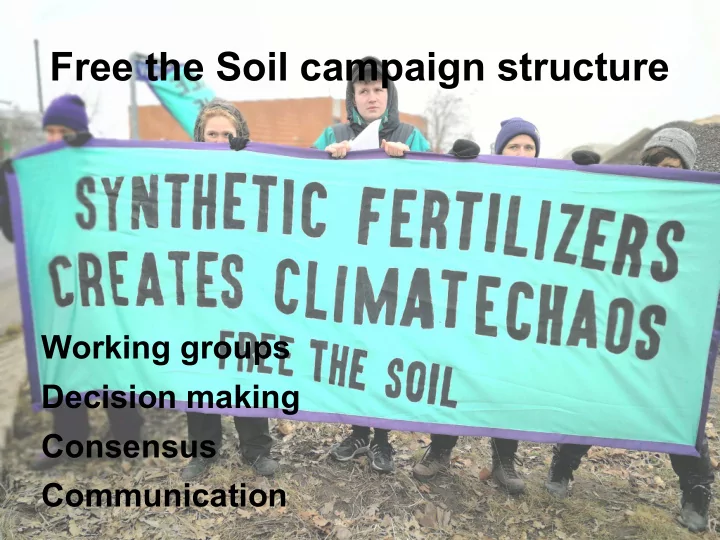
Free the Soil campaign structure Working groups Decision making - - PowerPoint PPT Presentation

free the soil campaign structure
SMART_READER_LITE
LIVE PREVIEW

Free the Soil campaign structure Working groups Decision making - - PowerPoint PPT Presentation

Free the Soil campaign structure Working groups Decision making Consensus Communication Research WG Other Working groups? Decision making Decisions are taken by consensus Big decisions concerning the whole campaign should be taken at


slide-1
SLIDE 1

Free the Soil campaign structure

Working groups Decision making Consensus Communication

slide-2
SLIDE 2

Research WG

Other Working groups?

slide-3
SLIDE 3

Decision making

  • Decisions are taken by consensus
  • Big decisions concerning the whole campaign

should be taken at the international plenaries

– (We aim for 3 big plenaries including this one)

  • Working groups have autonomy to take

decision within their area of work.

  • Decisions within the different working groups

that will effect other working groups processes should be taken collectively.

slide-4
SLIDE 4

How can working groups bring decisions forward

  • Discussion and decision at plenaries
  • The working group send out a mail describing

the decision and giving time for inputs and concerns

  • Temperature checks at plenaries to get a

feeling of the general opinion but still keeping the decision power in the working group

slide-5
SLIDE 5

Consensus decision making

  • Consensus decision making is a way of reaching

agreement between all members of a group.

  • Instead of simply voting for an item and having the

majority of the group getting their way, a group using consensus is committed to finding solutions that everyone actively supports, or at least can live with.

  • Consensus decision making ensures that all opinions,

ideas and concerns are heard and taken into account.

  • Through listening closely to each other, the group aims

to come up with proposals that work for everyone.

To learn more: https://www.seedsforchange.org.uk/consensus

slide-6
SLIDE 6

Consensus decision making

  • Stage 1: What's the issue?
  • Stage 2: Open up the discussion
  • Stage 3: Explore ideas in a broad discussion
  • Stage 4: Form a proposal
  • Stage 5: Amend the proposal
  • Stage 6: Test for agreement

– Agree – Conserns – Stand aside – Block

  • Stage 7: Work out how to implement
slide-7
SLIDE 7

Guidelines for participating in consensus meetings

  • Be willing to work towards the solution that's best for

everyone, not just what's best for you.

  • Help to create a respectful and trusting atmosphere.
  • Listen actively to what people are trying to say. Make

an effort to understand someone's position and their underlying needs, concerns and emotions.

  • Explain your own position as clearly as you can. Be
  • pen and honest about the reasons for your view

points

  • Don't be afraid of disagreement and conflict.

Consensus isn't about us all thinking the same thing.

slide-8
SLIDE 8

Communication internally

  • There is a unencrypted freethesoil maillist that

everyone involved with the campaign can join

  • There is a freethesoil crabgrass
  • Each working group figure out how they would

like to communicate internally

  • There is a process working group who aim to

facilitate and support the process

  • Each working group have a contact person in

the process working group who can take part in their internal communication