frequency, polarization and incidence angle Synthetic Aperture Radar - - PowerPoint PPT Presentation

frequency polarization and incidence angle synthetic
SMART_READER_LITE
LIVE PREVIEW

frequency, polarization and incidence angle Synthetic Aperture Radar - - PowerPoint PPT Presentation

sairam Application level challenges and issues of processing different frequency, polarization and incidence angle Synthetic Aperture Radar data using distributed computing resources Dr. R Manavalan, Mangala C-DAC, Bangalore Workshop


slide-1
SLIDE 1 sairam

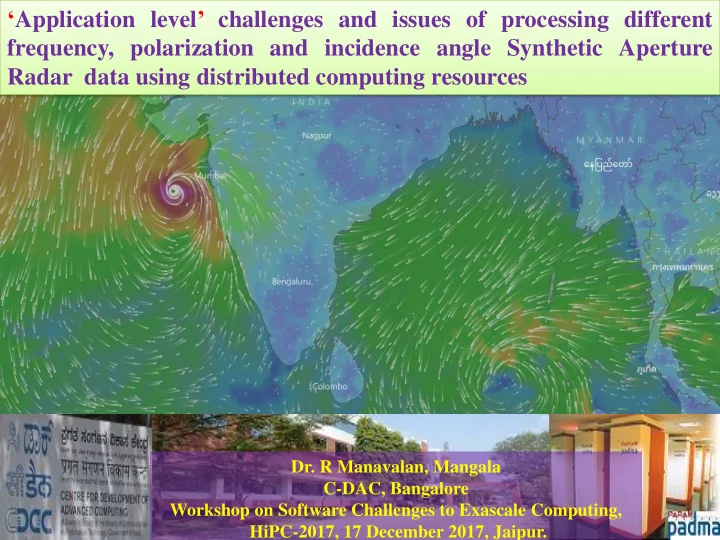
‘Application level’ challenges and issues of processing different frequency, polarization and incidence angle Synthetic Aperture Radar data using distributed computing resources

  • Dr. R Manavalan, Mangala

C-DAC, Bangalore Workshop on Software Challenges to Exascale Computing, HiPC-2017, 17 December 2017, Jaipur.

slide-2
SLIDE 2 sairam

‘Application level’ challenges and issues of processing different frequency, polarization and incidence angle Synthetic Aperture Radar data using distributed computing resources Are we having ‘real time/day wise’ information’ about

  • Cyclone movement,
  • rainfall estimation, forecasting
  • regions which are inundated due to (Ockhi) cyclone…?
  • Dr. R Manavalan, Mangala

C-DAC, Bangalore Workshop on Software Challenges to Exascale Computing, HiPC-2017, 17 December 2017, Jaipur.

slide-3
SLIDE 3

About SAR Technology, Role of SAR in regional scale disaster monitoring, Data volume/dimension of SAR based application models

  • Dec. 8 2007 - Jan. 22 2008
slide-4
SLIDE 4

S, C, L, P… RADAR data Processing - How complex the technology and issues at data capturing level

* *

slide-5
SLIDE 5

Motion sensing M-2 Clutter lock M-4 Mosaicking & North Orientation M-7 M-6 M-5 M-3 M-1 Range Compression BAQ encoding Auxiliary data extraction Synchronization Check STC correction IQ bias removal PRF slaving FDC Estimation FDC Estimation & FFT Block Processing Phase Compensation RCM Azimuth Compression & FFT

SAR Data Processing (L0 Level): Issues at computational level

Data dimension: Increase and Decrease

slide-6
SLIDE 6

Issues at computational level: Doppler Centroid Estimation Issues at computational level: Browse Processing

  • 1 to 0.1 to +1
  • 1

+1

(Clutter Lock)

slide-7
SLIDE 7

Issues at computational level: Simultaneous extraction different Polarization channels

slide-8
SLIDE 8

Issues at computational level: ‘Simultaneous’ extraction different Polarization channels

HH, VH, VV Polarization data of same region affected by flood (~ 3064 Sq.km; 12GB -> 450 MB at 4m, Time taken 6-7 hours/per scene)

Polarization

  • Co – HH/VV
  • Cross – HV/VH
  • Dual Co or Dual Cross: HH+VV, HH+HV or VV+VH
  • Quad-polarization imagery (HH, HV, VH &VV)
  • Circular (Right or Left)
  • Compact
slide-9
SLIDE 9

Image credit: ISRO/SAC

Swath coverage Selectable within 107 – 659 km off-nadir distance on either side Incidence angle coverage 12º – 55º Operating mode Polarization mode Single Pol HH/HV/VV/VH Dual Pol HH+HV/VV+VH Circular (Hybrid) Polarimetry TX: CP Rx: V and H (Experimental) Quad Pol HH+HV+VV+VH HRS 1 m(Azimuth) x 0.67 m (Range) resolution, 10 km x 10 km (10 x 100 km Experimental) Spot Min σ0 = -16 dB FRS-1 3 m(Azimuth) x 2 m (Range) resolution, 25 km swath Min σ0= -17 dB FRS-2 3 m(Azimuth) x 4 m (Range) resolution, 25 km swath Min σ0= -20 dB 9 m(Azimuth) x 4 m (Range) resolution, 25 km swath σ0= -19dB MRS 21-23 m (Azimuth) x 8 m (Range) resolution, 115 km swath Min σ0= -17 dB CRS 41-55 m (Azimuth) x 8 m (Range) resolution, 223 km swath Min σ0= -17 dB

slide-10
SLIDE 10

Sensor Mode RISAT-1 Hybrid polarimetric image of Jaipur, India in ScanSAR mode (Image credit: ISRO/SAC)

slide-11
SLIDE 11

Landsat image of Jaipur, India (Image credit: Google Earth)

slide-12
SLIDE 12

Different Frequency: C, L, P.. band SAR data

Issues at Preprocessing level: Processing of different frequency data

(Simultaneous) Simultaneous frequency airborne data from

  • NASA/JPL: AIRSAR @ C, L, P Frequency
  • DLR : F-SAR
slide-13
SLIDE 13

C-band Frequency of HH and HV Polarization L-band Frequency of HH Polarization (~ 50 x 50 Sq KM) Hours: 9 X 3@L1 Level Hours: 2 X 3@L1 Level

Data Processing at different Muti-look (Simultaneous)

slide-14
SLIDE 14

Critical information extraction

Area: 75 x75 Sq km Data reduction: 9GB to 1 Mb Time taken:

  • 2 days
  • Reduced to 45 minutes
slide-15
SLIDE 15 Sairam
  • Integrated ‘day wise’ RT/NRT system that support

Cyclone-Rainfall Estimation -Flood area mapping at country level

  • Ockhi 2017 (Nov 29 to Dec 6, 2017)
  • Data covering regional scale (country wise) cann’t be processed with

single cluster or even with few distributed resources

  • Increase and decreasing nature of data

dimension during the run time

  • Simultaneous SAR data processing SW environment
  • Different frequency data (C, L , P…)
  • Different polarization data (HH, VV, HV, VH…)
  • Different mode
  • Simultaneous multi-look of data and simultaneous post processing

SW environment at different levels Future Work : Need to work for SAR Exascale processing software mainly to meet regional scale real time disaster requirements that can make available day wise critical information

284 boats with 2641 - 462

Why Exascale? - from hardware to fundamental algorithms, programming

models, compilers and application codes

slide-16
SLIDE 16

Computational Grids which supports EO simulations

gpod.eo.esa.int cdac.in

Thanks

Information don’t have value if it has not been derived at right time by right setup

Thanks