From genes to brain to new therapeutics Daniel R. Weinberger, M.D. - - PowerPoint PPT Presentation

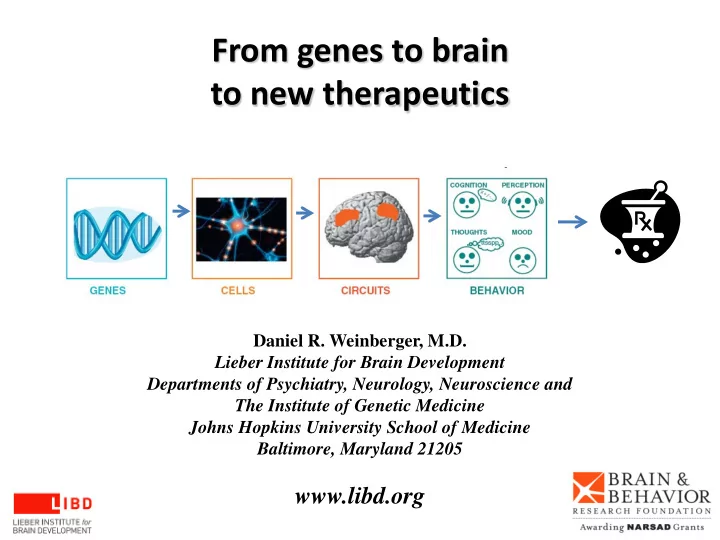
from genes to brain to new therapeutics
SMART_READER_LITE
LIVE PREVIEW

From genes to brain to new therapeutics Daniel R. Weinberger, M.D. - - PowerPoint PPT Presentation

From genes to brain to new therapeutics Daniel R. Weinberger, M.D. Lieber Institute for Brain Development Departments of Psychiatry, Neurology, Neuroscience and The Institute of Genetic Medicine Johns Hopkins University School of Medicine


slide-1
SLIDE 1

From genes to brain to new therapeutics

Daniel R. Weinberger, M.D. Lieber Institute for Brain Development Departments of Psychiatry, Neurology, Neuroscience and The Institute of Genetic Medicine Johns Hopkins University School of Medicine Baltimore, Maryland 21205

www.libd.org

slide-2
SLIDE 2

Schizophrenia: The essentials

(ca. end of the 20th century)

  • Diagnosis is based on subjective and nonspecific phenomena
  • Genes collectively account for most variance in risk
  • Environmental adversity in early development accounts for a small

increase in risk

  • Subtle deviations in childhood development
  • Abnormal function of frontal and temporal cortical circuitry
  • Subtle nonspecific abnormalities in neuronal architecture
  • Antidopaminergic drugs are therapeutic
slide-3
SLIDE 3

Age boys learned to stand

Developmental antecedents of schizophrenia are well established

The later boys stand during the first year of life, the greater the risk of schizophrenia

Isohanni M, et al. Schiz Res. 2001;52:1-19.

slide-4
SLIDE 4

5 10 15 20 25 1 2 3 Frequency of Enuresis Series1

Patients N=211 Healthy Sibs N=234 Controls N=335

* P<.0001

Increased frequency of childhood enuresis in adult patients with schizophrenia

Hyde et al Brain 2008

λs= 2.6

slide-5
SLIDE 5

Poor cognitive performance Social withdrawal Perinatal complications Genetic predisposition Older father

Other psychiatric disorder

Schizophrenia

Low SES Immigration Urbanicity

Substance abuse

Abnormal developmen t

slide-6
SLIDE 6

Psychiatric disorders are polygenic and genetically heterogeneous

affected person unaffected “nonpenetrant”

From: Goldman et al Nature Rev Genetics 2005

slide-7
SLIDE 7

The genome wide association study (GWAS) of common sequence variants in the genome

slide-8
SLIDE 8

PGC1 : can you believe 51,695 subjects?

Ripke et al Nat Gen 2011

slide-9
SLIDE 9

PGC 3 – let’s try 70,000 subjects! Now over 70 loci are GWAS “significant”

slide-10
SLIDE 10

Lancet 2013

Four “loci” identified in 61,220 subjects

slide-11
SLIDE 11

Lancet 2013

N= 61,220 subjects (33,332 cases)

Compare with: Sklar et al Nature Genetics 2011, N=11,974 cases

slide-12
SLIDE 12

An Inconvenient Question:

Why are the clinical associations so weak?

Some answers:

Heterogeneity Environmental modification

rare variants

epigenetics

Epistasis

GENES DO NOT ENCODE FOR PSYCHIATRIC SYNDROMES

slide-13
SLIDE 13

A clinician’s perspective:

Three key points in this talk

  • 1. The genes for psychiatric disorders are not for psychiatric

disorders. 2. Genetic risk is critically dependent on context (both genetic and environmental). 2. Genes impact on outcome and treatment response and will lead to new therapies.

slide-14
SLIDE 14

Genes: multiple susceptibility alleles each of small effect Cells: subtle molecular abnormalities Systems: abnormal information processing

psychosis

Behavior: complex functional interactions and emergent phenomena

Schizophrenia: genes and associated neurobiology

temperament

cognition

slide-15
SLIDE 15

“The path from changes in the score (DNA code) to changes in the music (behavior)”

Genes: multiple susceptibility alleles each of small effect Cells: subtle synaptic molecular abnormalities Distributed Neural Systems: abnormal information processing Perturbed Cognition: as an emergent phenomena

~ ~ ~

slide-16
SLIDE 16

Genes: multiple susceptibility alleles each of small effect Cells: subtle molecular abnormalities Systems: abnormal information processing

psychosis

Behavior: complex functional interactions and emergent phenomena

Schizophrenia: genes and associated neurobiology

temperament

cognition

slide-17
SLIDE 17

Unaffected Affected Wisconsin Card Sort Categories 2 4 5 6 7 8 9 10 3 1

Executive cognition in MZ twins discordant for schizophrenia

Goldberg et al Arch Gen Psych 1990

normal mean

slide-18
SLIDE 18

Genes: risk associated genotypes Cells: molecular biology Systems: abnormal information processing

Psychiatric Disorder

Behavior: complex functional interactions and emergent phenomena

Abnormal behavior reflects abnormal brain function

temperament

cognition

slide-19
SLIDE 19

Abnormal prefrontal “efficiency“ : A schizophrenia intermediate phenotype

Callicott et al. Cereb Cortex 2000 Patients > Controls (N=13) (N=18) Callicott et al. Am J Psychiatry 2003 Healthy Siblings > Controls (N=48) (N=33)

fMRI

The “N Back” working memory task

slide-20
SLIDE 20

Bipolar/schizophrenia risk associated gene CACNA1C modulates cortical efficiency during working memory in normal subjects

N=316, p=.01 FDR corrected

Bigos et al Arch Gen Psychiatry 2010

Extrapolated to N=10,000, p< 4.87e-109

slide-21
SLIDE 21

A clinician’s perspective:

Three key points in this talk

  • 1. The genes for psychiatric disorders are not for psychiatric

disorders. 2. Genetic risk is critically dependent on context (both genetic and environmental). 2. Genes will impact on outcome and treatment response and lead to new therapies.

slide-22
SLIDE 22

Genes also interact with the environment to modify the expression

  • f their individual effects. This can lead

to exaggerated, compensated, or novel effects.

slide-23
SLIDE 23
slide-24
SLIDE 24

Nicodemus et al. Mol Psychiatry 2008.

Interaction of serious OC’s with SNPs in genes associated with anoxia-ischemia

slide-25
SLIDE 25

Large structural variations in the DNA molecule (“CNVs”)

  • ccur during DNA replication

Malhotra and Sebat Cell 2012

slide-26
SLIDE 26

22q11 Hemideletion Syndrome: Velo-Cardio-Facial Syndrome (VCFS)

slide-27
SLIDE 27

Specific recurrent CNVs are found in 2-5% of patients with the diagnosis of schizophrenia

ISC Nat Genetics 2008 McCarthy et al Nat Genetics 2009

slide-28
SLIDE 28

A clinician’s perspective:

Three key points in this talk

  • 1. The genes for psychiatric disorders are not for psychiatric

disorders. 2. Genetic risk is critically dependent on context (both genetic and environmental). 2. Genes impact on outcome and treatment response and will lead to new therapies.

slide-29
SLIDE 29

Genes are keys to the biology of cells

* *

slide-30
SLIDE 30

Na+-K+ currents and the action potential

slide-31
SLIDE 31
slide-32
SLIDE 32

A Roadmap for Genes to Drugs

Gene(s) of interest RNA sequencing in brain Transcript associated with illness state Transcript associated with genetic risk Molecular mechanism

  • f association

Cell models based on molecular mechanisms Animal models based on molecular mechanisms

CLINICAL STUDIES

slide-33
SLIDE 33

Genes, brain and drugs: Conclusions...

  • Most complex behaviors are the result of multiple factors that

interact biologically.

  • Genes are the first objective clues to the causative mechanisms of

psychiatric disorders.

  • There are many developmental pathways to what we call

schizophrenia.

  • Genes for schizophrenia likely have their effects on risk by

influencing brain development.

  • The genetics of psychiatric illness is the game changer both in

understanding mechanisms and in finding therapeutic targets based on causation, not phenomenology.

Check out our website: www.libd.org

Learn more about the Brain & Behavior Research Foundation: bbrfoundation.org