From GPS and Google Maps to Spatial Computing ISTec DL, Colorado - - PowerPoint PPT Presentation

from gps and google maps to spatial computing
SMART_READER_LITE
LIVE PREVIEW

From GPS and Google Maps to Spatial Computing ISTec DL, Colorado - - PowerPoint PPT Presentation

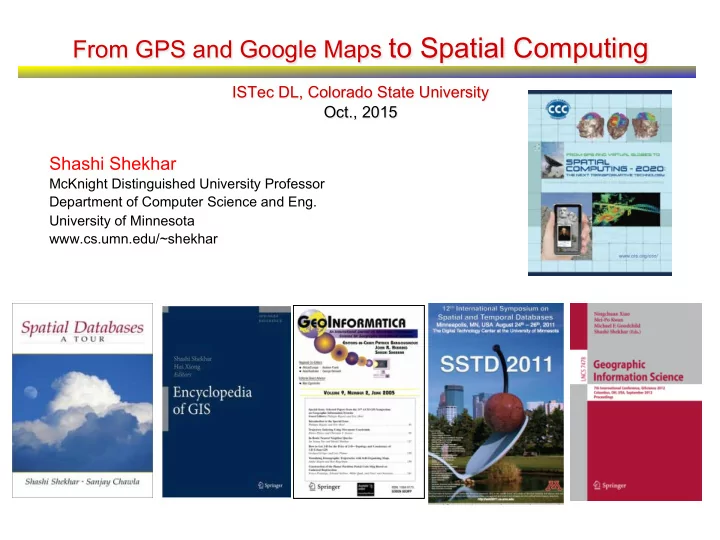
From GPS and Google Maps to Spatial Computing ISTec DL, Colorado State University Oct., 2015 Shashi Shekhar McKnight Distinguished University Professor Department of Computer Science and Eng. University of Minnesota www.cs.umn.edu/~shekhar


slide-1
SLIDE 1

From GPS and Google Maps to Spatial Computing

ISTec DL, Colorado State University Oct., 2015

Shashi Shekhar

McKnight Distinguished University Professor Department of Computer Science and Eng. University of Minnesota www.cs.umn.edu/~shekhar

slide-2
SLIDE 2

CSCI 8715: Spatial Databases CSCI 5715: From GPS and Virtual Globes to Spatial Computing

Courses

www.coursera.org/course/spatialcomputing Map of students online at Coursera.org www.spatial.cs.umn.edu/Courses/Fall13/8715

slide-3
SLIDE 3

Alumni in Academia Alumni in Industry Alumni in Government Agency Current Students

slide-4
SLIDE 4

Research Theme 1: Spatial Databases

  • nly in old plan

Only in new plan In both plans

Evacutation Route Planning Parallelize Range Queries Storing graphs in disk blocks Shortest Paths

slide-5
SLIDE 5

Theme 2 : Spatial Data Mining

Nest locations Distance to open water

Vegetation durability

Water depth Location Prediction: nesting sites

Spatial outliers: sensor (#9) on I-35 Co-location Patterns Spatial Concept Aware Summarization

Output: SaTScan

LRR = 23.02 p-value = 0.04 LRR = 27.74 p-value = 0.01 LRR = 10.61 p-value = 0.18 miles 20

slide-6
SLIDE 6

Recent Professional Activities

Spatial Computing Visioning Workshop Computing Community Consortium (CCC) Geoinformatica Journal GIScience Conference 2012 Symposium on Spatial and Temporal Database 2011

slide-7
SLIDE 7

Sources

  • From GPS and Virtual Globes to Spatial Computing 2020, CCC Report, 2013.

www.cra.org/ccc/visioning/visioning-activities/spatial-computing

  • With few slides on work from presenter’s group

Identifying patterns in spatial information: a survey of methods, Wiley Interdisc. Reviews: Data Mining and Know. Discovery , 1(3):193-214, May/June 2011. (DOI: 10.1002/widm.25).

slide-8
SLIDE 8

Outline

  • Introduction

– Spatial Computing Audience: Niche => Everyone – Spatial Computing 2020 - Workshop

  • GPS
  • Location Based Services
  • Spatial Statistics
  • Spatial Database Management Systems
  • Virtual Globes
  • Geographic Information Systems
  • Conclusions

8

slide-9
SLIDE 9

What is Spatial Computing?

  • Transformed our lives though understanding spaces and places
  • Examples: localization, navigation, site selection, mapping,
  • Examples: spatial context, situation assessment (distribution, patterns), …

Smarter Planet

slide-10
SLIDE 10

The Changing World of Spatial Computing

Last Century Last Decade Map User Well-trained few Billions Mappers Well-trained few Billions Software, Hardware Few layers, e.g., Applications: Arc/GIS, Databases: SQL3/OGIS Almost all layers User Expectations & Risks Modest Many use-case & Geo-privacy concerns

slide-11
SLIDE 11

It is widely used by Government!

Geospatial Information and Geographic Information Systems (GIS): An Overview for Congress

11

May 18th, 2011

Folger, Peter. Geospatial Information and Geographic Information Systems (GIS): Current Issues and Future

  • Challenges. Congressional Research Service. June 8th, 2009.
slide-12
SLIDE 12

12

It is only a start! Bigger Opportunities Ahead!

slide-13
SLIDE 13

13

13 13

CCC Visioning Workshop: Making a Case for Spatial Computing 2020

http://cra.org/ccc/spatial_computing.php

slide-14
SLIDE 14

Workshop Participants

14

Academia Industry Government >30 Universities 14 Organizations 12 Agencies

slide-15
SLIDE 15

Workshop Highlights

15

Organizing Committee Agenda

  • Identify fundamental research questions

for individual computing disciplines

  • Identify cross-cutting research questions

requiring novel, multi-disciplinary solutions

slide-16
SLIDE 16

Workshop Highlights

16

slide-17
SLIDE 17

Outline

  • Introduction
  • GPS

– Outdoors => Indoors

  • Location Based Services
  • Spatial Statistics
  • Spatial Database Management Systems
  • Virtual Globes
  • Geographic Information Systems
  • Conclusions

17

slide-18
SLIDE 18

Global Positioning Systems (GPS)

  • Positioning ships

– Latitude f(compass, star positions) – Longitude: dead-reckoning => marine chronometer – Longitude prize (1714), accuracy in nautical miles

  • Global Navigation Satellite Systems

– Infrastructure: satellites, ground stations, receivers, … – Use: Positioning (sub-centimeter), Clock synchronization

18

Trilateration

http://answers.oreilly.com/topic/ 2815-how-devices-gather-location- information/

http://en.wikipedia.org/wiki/ Global_Positioning_System

slide-19
SLIDE 19

Positioning Precision

19

slide-20
SLIDE 20

Trends: Localization Indoors and Underground

  • GPS works outdoors, but,

– We are indoors 90% of time!

  • Ex. malls, hospitals, airports, etc.

– Indoor asset tracking, exposure hotposts, …

  • Leveraging existing indoor infrastructure

– Blue Tooth, WiFi, Cell-towers, cameras, Other people?

  • How to model indoors for navigation, tracking, hotspots, …?

– What are nodes and edges ? WiFi Localization

http://www.mobilefringe.com/products/square-one-shopping-center-app-for-iphone-and-android/

http://rfid.net/basics/rtls/123-wi-fi-how-it-works

slide-21
SLIDE 21

Outline

  • Introduction
  • GPS
  • Location Based Services

– Queries => Persistent Monitoring

  • Spatial Statistics
  • Spatial Database Management Systems
  • Virtual Globes
  • Geographic Information Systems
  • Conclusions

21

slide-22
SLIDE 22

Location Based Services

  • Open Location Services: Queries

– Location: Where am I? (street address, <latitude, longitude> – Directory: Where is the nearest clinic (or doctor)? – Routes: What is the shortest path to reach there?

22

slide-23
SLIDE 23

23

Next Generation Navigation Services

q Eco-Routing q Best start time q Road-capacity aware

slide-24
SLIDE 24

24

Routing Challenges: Lagrangian Frame of Reference

Q? What is the cost of Path <A,C,D> with start-time t=1 ? Is it 3 or 4 ?

Path T = 0 T = 1 T = 2 T = 3 <A,C,D> 4 3 5 4 <A,B,D> 6 4 4 3

Lagrangian Graph Snapshots of a Graph

Details:A Critical-Time-Point Approach to All-Start-Time Lagrangian Shortest Paths: A Summary of Results, (w/ V. Gunturi et al.), Proc. Intl. Symp. on Spatial and Temporal Databases, Springer LNCS 6849, 2011. Complete results accepted for the IEEE Transactions on Knowledge and Data Engineering.

1

1

slide-25
SLIDE 25

Spatio-temporal Graphs: Computational Challenges

Ranking changes over time

Waits, Non FIFO Behavior

Violates stationary assumption in

Dynamic Programming

*Flights between Minneapolis and Austin (TX)

Violate assumption of Dijkstra/A*

Details:A Critical-Time-Point Approach to All-Start-Time Lagrangian Shortest Paths: A Summary of Results, (w/ V. Gunturi et al.), Proc. Intl. Symp. on Spatial and Temporal Databases, Springer LNCS 6849, 2011. Complete results accepted for the IEEE Transactions on Knowledge and Data Engineering.

slide-26
SLIDE 26

Trends: Persistent Geo-Hazard Monitoring

  • Environmental influences on our health & safety

– air we breathe, water we drink, food we eat

  • Surveillance

– Passive > Active > Persistent – How to economically cover all locations all the time ? – Crowd-sourcing, e.g., smartphones, tweets, – Wide Area Motion Imagery

slide-27
SLIDE 27

Outline

  • Introduction
  • GPS
  • Location Based Services
  • Spatial Statistics

– From Mathematical (e.g., hotspot) – To Spatial (e.g., hot features)

  • Spatial Database Management Systems
  • Virtual Globes
  • Geographic Information Systems
  • Conclusions

27

slide-28
SLIDE 28
slide-29
SLIDE 29

Spatial Statistics: Mathematical Concepts

  • Spatial Statistics

– Quantify uncertainty, confidence, … – Is it significant? – Is it different from a chance event or rest of dataset?

  • e.g., SaTScan finds circular hot-spots
  • Model Auto-correlation, Heterogeneity, Edge-effect, …

– Point Process, e.g., Ripley’s K-functions, SatScan – Geo-statistics, e.g., Kriging, GWR – Lattice-based models

29

slide-30
SLIDE 30

Semantic Gap between Spatial and Machine Learning

  • Representation choices beyond Linear Algebra
  • Environmental Criminology
  • Routine Activities Theory, Crime Pattern Theory, Doughnut Hole pattern
  • Formulation: rings, where inside density is significantly higher than outside …

Source: Ring-Shaped Hotspot Detection: A Summary of Results, IEEE ICDM 2014 (w/ E. Eftelioglu et al.)

Mathematics Concepts Relationships Sets Set Theory Member, set-union, set-difference, … Vector Space Linear Algebra Matrix & vector operations Euclidean Spaces Geometry Circle, Ring, Polygon, Line_String, Convex hull, … Boundaries, Graphs, Spatial Graphs Topology, Graph Theory, Spatial graphs, … Interior, boundary, Neighbor, inside, surrounds, …, Nodes, edges, paths, trees, … Path with turns, dynamic segmentation, …

slide-31
SLIDE 31

Detecting Patterns of Evasion1

  • Arson crimes in San Diego in 2013

– Total 33 cases (red dots on the map) – Activity Area is appr. 3000 sq. miles.

  • Arsonist caught in top green ring2

(1) http://www.sandiego.gov/police/services/statistics/index.shtml (2) http://www.nbcsandiego.com/news/local/Suspected-Arson-Grass-Fires-Oceanside-Mesa-Drive- Foussat-Road-218226321.html

Green: Rings with LR >10 & p-value < 0.20 SaTScan output

Count (c)= 14 LR = 28.18 p-value = 0.01 miles 20

Significant Ring Detection

Output: SaTScan

Count (c)= 4 LRR = 23.02 p-value = 0.04 Count (c) = 15 LRR = 27.74 p-value = 0.01 Count (c) = 4 LRR = 10.61 p-value = 0.18 miles 20 ¡miles ¡ ¡20 ¡ ¡0 ¡

Input

31 ¡

Details: Ring-Shaped Hot-Spot Detection: A Summary of Results, IEEE Intl. Conf. on Data Mining, 2014.

slide-32
SLIDE 32

Trends: Spatial-Concept Aware Patterns

  • Spatial Concepts

– Natural geographic features, e.g., rivers, streams, … – Man-made geographic features, e.g., transportation network – Spatial theories, e.g., environmental criminology – doughnut hole

  • Spatial-concept-aware patterns

– Hotspots: Circle => Doughnut holes – Hot-spots => Hot Geographic-features

Details: A K-Main Routes Approach to Spatial Network Activity Summarization, (w/ D. Oliver et al.) IEEE Transactions on Knowledge and Data Engineering, 26(6):1464-1478, 2014.

slide-33
SLIDE 33

Co-locations/Co-occurrence

  • Given: A collection of

different types of spatial events

  • Find: Co-located

subsets of event types

Details: Discovering colocation patterns from spatial data sets: a general approach, (w/ H. Yan et al.), IEEE Transactions on Knowledge and Data Engineering, 16(12), Dec. 2004.

slide-34
SLIDE 34

Fast Algorithms to Mine Colocations from Big Data

Participation ratio pr(fi, c) of feature fi in colocation c = {f1, f2, …, fk}: fraction of instances of fi with feature {f1, …, fi-1, fi+1, …, fk} nearby

Participation index PI( c ) = min{ pr( fi, c ) } Properties:

(1) Computational: Non-monotonically decreasing like support measure Allows scaling up to big data via pruning (2) Statistical: Upper bound on Cross-K function n Comparison with Ripley’s K-function (Spatial Statistics)

K-function (B , A) 2/6 = 0.33 3/6 = 0.5 6/6 = 1 PI (B , A) 2/3 = 0.66 1 1

A.1 A.3 B.1 A.2 B.2 A.1 A.3 B.1 A.2 B.2 A.1 A.3 B.1 A.2 B.2

slide-35
SLIDE 35

35

Ex.: Spatial Auto-Regression Parameter Estimation

Name Model Classical Linear Regression Spatial Auto-Regression

ε xβ y + =

ε xβ Wy y + + = ρ

framework spatial

  • ver

matrix

  • d

neighborho

  • by
  • :

parameter n) correlatio

  • (auto

regression

  • auto

spatial the : n n W ρ

  • Maximum Likelihood Estimation
  • Computing determinant of large matrix is a hard (open) problem!

– size(W) is quadratic in number of locations/pixels. – Typical raster image has Millions of pixels – W is sparse but not banded.

A parallel formulation of the spatial autoregression model for mining large geo-spatial datasets, SIAM Intl.Workshop on High Perf. and Distr. Data Mining, 2004.

SSE n n L − − − − = 2 ) ln( 2 ) 2 ln( ln ) ln(

2

σ π ρW I

slide-36
SLIDE 36

Cascading spatio-temporal pattern (CSTP)

36

q Input: Urban Activity Reports q Output: CSTP

q Partially ordered subsets of ST event types.

q Located together in space. q Occur in stages over time.

q Applications: Public Health, Public Safety, …

TimeT1 Assault(A) Drunk Driving (C) Bar Closing(B) Aggregate(T1,T2,T3) TimeT3 TimeT2

B A C

CSTP: P1

Details: Cascading Spatio-Temporal Pattern Discovery, (w/ P. Mohan et al.), IEEE Transactions on Knowledge and Data Engineering, 24(11), Nov. 2012.

slide-37
SLIDE 37

37

MDCOP Motivating Example : Input • Manpack stinger

(2 Objects)

  • M1A1_tank

(3 Objects)

  • M2_IFV

(3 Objects)

  • Field_Marker

(6 Objects)

  • T80_tank

(2 Objects)

  • BRDM_AT5

(enemy) (1 Object)

  • BMP1

(1 Object)

slide-38
SLIDE 38

38

MDCOP Motivating Example : Output

  • Manpack stinger

(2 Objects)

  • M1A1_tank

(3 Objects)

  • M2_IFV

(3 Objects)

  • Field_Marker

(6 Objects)

  • T80_tank

(2 Objects)

  • BRDM_AT5

(enemy) (1 Object)

  • BMP1

(1 Object)

Details: Mixed-Drove Spatiotemporal Co-Occurrence Pattern Mining,, (w/ M. Celik et al.) IEEE Transactions on Knowledge and Data Engineering, 20(10), Oct. 2008.

slide-39
SLIDE 39

Outline

  • Introduction
  • GPS
  • Location Based Services
  • Spatial Statistics
  • Spatial Database Management Systems

– Scalability => Privacy

  • Virtual Globes
  • Geographic Information Systems
  • Conclusions

39

slide-40
SLIDE 40

Spatial Databases for Geometry

  • Dice, Slide, Drill-down, Explore, …

– Closest pair(school, pollution-source) – Set based querying

  • Reduce Semantic Gap
  • Simplify code for inside, distance, …
  • 6 geometric data-types
  • Operations: inside, overlap, distance, area, …
  • Scale up Performance
  • Data-structures: B-tree => R-tree
  • Algorithms: Sorting => Geometric

40

slide-41
SLIDE 41

41

  • Check-in Risks: Stalking, GeoSlavery, …
  • Ex: Girls Around me App (3/2012), Lacy Peterson [2008]
  • Others know that you are not home!

The Girls of Girls Around Me. It's doubtful any

  • f these girls even know they are being
  • tracked. Their names and locations have been obscured

for privacy reasons. (Source: Cult of Mac, March 30, 2012)

Challenge: Privacy vs. Utility Trade-off

slide-42
SLIDE 42

Challenge: Geo-privacy, geo-confidentiality, …

  • Emerging personal geo-data

– Trajectories of smart phones, gps-devices, life-trajectories and migrations, …

  • Privacy: Who gets my data? Who do they give it to? What promises do I get?
  • Socio-technical problem

– Need policy support – Challenges in fitting location privacy into existing privacy constructs (i.e HIPPA, Gramm-Leach-Bliley, Children's Online Privacy Protection Act)

  • Groups interested in Geo-Privacy

– Civil Society, Economic Entities, Public Safety ,Policy Makers

http://illumemagazine.com/zine/articleDetail.php?FBI-GPS-Tracking-and-Invasion-of-Privacy-13346

slide-43
SLIDE 43

Outline

  • Introduction
  • GPS
  • Location Based Services
  • Spatial Statistics
  • Spatial Database Management Systems
  • Virtual Globes & VGI

– Quilt => Time-travel & Depth

  • Geographic Information Systems
  • Conclusions

43

slide-44
SLIDE 44

Virtual Globes & Volunteered Geo-Information

  • Virtual Globes

– Visualize Spatial Distributions, Patterns – Visual drill-down, e.g., fly-through

  • Change viewing angle and position
  • Even with detailed Streetview!
  • Volunteered Geo-Information

– Allow citizens to make maps & report – Coming to public health! – People’s reporting registry (E. Brokovich)

– www.brockovich.com/the-peoples-reporting-registry-map/

44

slide-45
SLIDE 45

Virtual Globes in GIS Education

  • Coursera MOOC: From GPS and Google Earth to Spatial Computing
  • 21,844 students from 182 countries (Fall 2014)
  • 8 modules, 60 short videos, in-video quizzes, interactive examinations, …
  • 3 Tracks: curious, concepts, technical
  • Flipped classroom in UMN on-campus course
slide-46
SLIDE 46

Opportunities: Time-Travel and Depth in Virtual Globes

  • Virtual globes are snapshots
  • How to add time? depth?

– Ex. Google Earth Engine, NASA NEX – Ex. Google Timelapse: 260,000 CPU core-hours for global 29-frame video

  • How may one convey provenance,

accuracy, age, and data semantics?

  • What techniques are needed to integrate

and reason about diverse available sources?

http://googleblog.blogspot.com/2013/05/a-picture-of-earth-through-time.html

slide-47
SLIDE 47

Outline

  • Introduction
  • GPS
  • Location Based Services
  • Spatial Statistics
  • Spatial Database Management Systems
  • Virtual Globes
  • Geographic Information Systems

– Geo => Beyond Geo

  • Conclusions

47

slide-48
SLIDE 48

Geographic Information Systems & Geodesy

  • GIS: An umbrella system to

– capture, store, manipulate, analyze, manage, and present diverse geo-data. – SDBMS, LBS, Spatial Statistics, … – Cartography, Map Projections, Terrain, etc. – Q? How to model time? Spatio-temporal?

  • Reference Systems

– Which countries in North Korea missile range?

– 3D Earth surface displayed on 2D plane – Spherical coordinates vs. its planar projections – Q? What are reference systems for time?

48

Original Correction

http://odt.org/hdp/

slide-49
SLIDE 49

Opportunities: Beyond Geographic Space

  • Spaces other than Earth

– Challenge: reference frame?

  • Ex. Human body

– What is Reference frame ?

  • Adjust to changes in body
  • For MRIs, X-rays, etc.

– What map projections?

– Define path costs and routes to reach a brain tumor ?

Oliver, Dev, and Daniel J. Steinberger. "From geography to medicine: exploring innerspace via spatial and temporal databases." Advances in Spatial and Temporal Databases. Springer Berlin Heidelberg, 2011. 467-470.

http://convergence.ucsb.edu/issue/14

Outer Space Moon, Mars, Venus, Sun, Exoplanets, Stars, Galaxies Geographic Terrain, Transportation, Ocean, Mining Indoors Inside Buildings, Malls, Airports, Stadiums, Hospitals Human Body Arteries/Veins, Brain, Neuromapping, Genome Mapping Micro / Nano Silicon Wafers, Materials Science
slide-50
SLIDE 50

Outline

  • Introduction
  • GPS
  • Location Based Services
  • Spatial Statistics
  • Spatial Database

Management Systems

  • Virtual Globes
  • Geographic Information

Systems

  • Conclusions

50

slide-51
SLIDE 51

Courtesy: Watson BG

Courtesy: NASA NOAA Courtesy: Wikipedia

Courtesy: ecowatch.com

Joachim von Braun, Director General at IFPRI

Courtesy: mercurynews.com Wikimedia Commons/CC BY 3.0 Courtesy: the Washington Post

Food-Energy-Water

(Pumps)

Food-Energy (Biofuel) Ag-Water: Aral Sea Shrinkage Food-Water

Climate Change: 2014 CA Drought Soils: 1930s Dust Bowl Food-Energy-Water : Ogallala Aquifer Depletion Urbanization

Water- Energy

Courtesy: nbcnews

slide-52
SLIDE 52

Nexus of Food, Energy, Water Security

  • U.N. : FAO reports,

– U.N. University – Nexus Observatory

  • U.K. – EPSRC projects

  • U. Southampton: Vaccinating the Nexus (Paul

Kemp) – Water, Energy, Food WEFWeb, U Glasgo (Marian Scott) – Env. Statistics – Steping Up, U Machester (Alice Bows-Larkin)

  • USA:

– NSF: INFEWS, $70M in FY16 – Reports from OSTP, NIC, USDOE, …

  • Spatial computing is essential

– Water census (USGS) – Local sourcing, virtual water trade – Landscape redesign, – Precision Agriculture – …

52

slide-53
SLIDE 53

Recommendations

  • Spatial Computing has transformed our society

– It is only a beginning! – It promises an astonishing array of opportunities in coming decade

  • However, these will not materialize without support
  • Universities

– Institutionalize spatial computing

  • GIS Centers, a la Computing Centers of the 1960’s

– Incorporate spatial thinking in STEM curriculum

  • During K-12, For all college STEM students?
  • Government

– Increase support spatial computing research

– Larger projects across multiple universities – Include spatial computing topics in RFPs – Include spatial computing researchers on review panels – Consider special review panels for spatial computing proposals

53