From microscopic to macroscopic noise: the dynamics of transitions - - PowerPoint PPT Presentation

from microscopic to macroscopic noise the dynamics of
SMART_READER_LITE
LIVE PREVIEW

From microscopic to macroscopic noise: the dynamics of transitions - - PowerPoint PPT Presentation

From microscopic to macroscopic noise: the dynamics of transitions around noisy networks George Wynne Supervisors: Rosemary Harris & Claire Postlethwaite Introduction - We study of heteroclinic networks which are collections of


slide-1
SLIDE 1

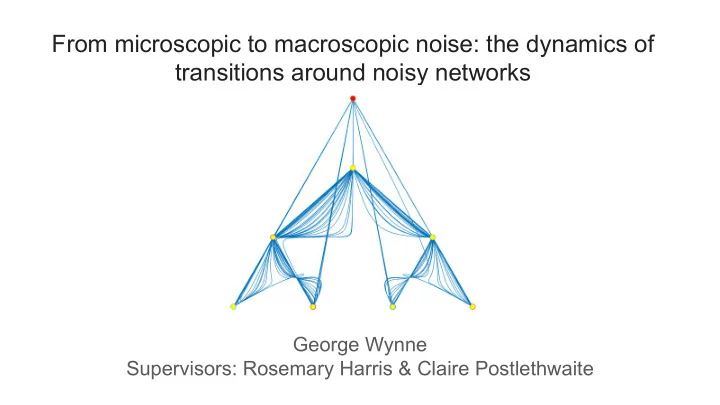
From microscopic to macroscopic noise: the dynamics of transitions around noisy networks

George Wynne Supervisors: Rosemary Harris & Claire Postlethwaite

slide-2
SLIDE 2

Introduction

  • We study of heteroclinic networks which are collections of heteroclinic cycles,

essentially just the phase space of some ODE.

  • We then add noise to the ODE and see what happen.
  • The micro effects are the movement near equilibria, the macro is the

sequence of equilibria visited.

slide-3
SLIDE 3

Example trajectories

  • By changing parameters in the below equation we can ‘realise’ a large class
  • f graphs
slide-4
SLIDE 4

Example trajectories

  • Blue points = (+- 1,0,0), Green points = (0,+-1,0), Black points = (0,0,+-1)
  • Order of equilibria is 1,2,3,1,2,3,1,.....

v_{1} v_{2} v_{3}

slide-5
SLIDE 5

Local effects from linearising equations

  • ‘Lift-off’ occurs when the contraction from

the previous equilibrium point is weaker than expansion to the next equilibrium point.

slide-6
SLIDE 6

OU Simulations

  • Previous analysis of this lift of assumed the initial value of the outgoing direction was zero. I

investigated the effects of it starting at a non-zero value. This is reasonable to investigate since lift-off could have been propagated through the network

slide-7
SLIDE 7

Input distribution is positive mean Gaussian, histogram is obtain from simulations of OU process

slide-8
SLIDE 8

Macro effects

  • The micro effects can cause

different paths of the network to be explored.

  • This raises the question of

memory effects in the network

  • Compounding lift-off can get

complicated

slide-9
SLIDE 9

What was found

  • Closed form formula for neighbourhood hitting time of exit direction
  • Integrated this against solution of OU process to get distribution of lift-offs at

the time when the particle leaves the neighbourhood

  • Obtained approximations of its mean & derived equations for the mode of the

hitting time distribution.

  • Obtained noise scaling result of mean lift-off in the context of previous lift-off

having occurred in the network.

slide-10
SLIDE 10

What still needs to be investigated

  • Results applying these lift-off effects in more complicated networks with

multiple input and output directions at equilibria

  • Understanding analytic properties of lift-off distribution
  • Obtaining better approximations for mean lift-off in terms of the noise

parameter

  • Simulations to check whether Gaussian lift-off distribution is valid in more

complicated networks

slide-11
SLIDE 11

Thank you for listening!