From O(n (n)) to O(n *(n)) Recent Results for Splay Trees Joan M. - - PDF document

from o n n to o n n recent results for splay trees
SMART_READER_LITE
LIVE PREVIEW

From O(n (n)) to O(n *(n)) Recent Results for Splay Trees Joan M. - - PDF document

From O(n (n)) to O(n *(n)) Recent Results for Splay Trees Joan M. Lucas The College at Brockport State University of New York Western New York Theory Day May 2, 2008 Based on: Splay Trees, Davenport-Schinzel Sequences, and the Deque


slide-1
SLIDE 1

1

From O(n α(n)) to O(n α*(n)) Recent Results for Splay Trees

Joan M. Lucas The College at Brockport State University of New York Western New York Theory Day May 2, 2008

Based on: “Splay Trees, Davenport-Schinzel Sequences, and the Deque Conjecture”, Seth Pettie, SODA, January 2008

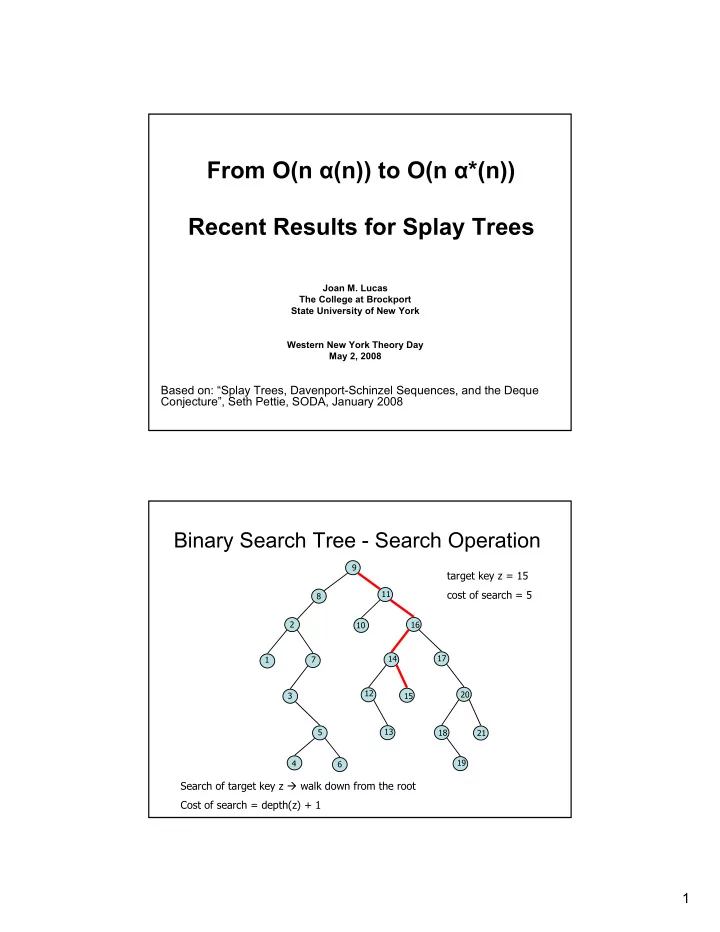
Binary Search Tree - Search Operation

1 4 3 5 7 6 2 13 12 11 10 9 8 21 20 18 17 16 15 14 19

Search of target key z walk down from the root Cost of search = depth(z) + 1 target key z = 15 cost of search = 5

slide-2
SLIDE 2

2

Search Problem

Given binary search tree T0 and a sequence of target keys X= { x1, x2, x3, …. xm } Search for and locate each key at total minimal cost T0

x1 x3 x2 x4 x1 x3 x2 x4 x1 x3 x2 x4 x1 x3 x2 x4

assume m ≥ n

Balanced Binary Search Trees

AVL (height balanced) Red-black

height of tree = O(log n) Drawbacks:

  • Extra memory (balance factor, color)
  • Not adaptive: X= { 1, 1, 1, 1, 1, …. 1 }

cost = O( m log n )

  • ptimal cost = O( n + m )
slide-3
SLIDE 3

3

Alter Tree Shape using Rotations

T0

x1 x1 x1 x1 (2)

We can alter the shape of the tree by rotating an edge

  • constant time operation
  • preserves symmetric order
  • changes the depths of some nodes in the tree

Search Problem using Rotations

OPT (T0, X) = cost of the sequence of rotations and searches which minimize the total cost T0

rotations

x2

T1 T2 Tm

x1 x2 xm

rotations rotations

……

x1 xm

Given binary search tree T0 and a sequence of target keys X= { x1, x2, x3, …. xm } Nodes higher in the tree are cheaper to find

slide-4
SLIDE 4

4

Locality of Reference Principle

T0

rotations

x1

T1 T2 Tm

xm x1 x2 xm

rotations rotations

……

x2 x2 x1 x2 xm x1 xm

Target key X of a search is likely to be a target of another search in near future So move X to the root to make subsequent searches faster (e.g., LRU, cache, working set)

Splay Tree

No limit on the shape of the tree Reshape the tree after each search to move the target key to the root

slide-5
SLIDE 5

5

Splay Tree

xi Zig case: odd number of edges on path final rotation is of edge (xi, root) Zig-zig case: Zig-zag case: xi xi xi xi

Before and After

xi xi

slide-6
SLIDE 6

6

Sequential Access Case

Most extreme initial tree, height = n sequence of target keys X= { 1, 2, 3, 4, …. n }

32 31 30 5 4 3 2 1

Sequential Access Case

node 1 rotates to the root using repeated “zig-zigs”

1

slide-7
SLIDE 7

7

Sequential Access Case

node 2 rotates to the root using repeated “zig-zigs”

Sequential Access Case

node 3 rotates to the root using repeated “zig-zigs”

slide-8
SLIDE 8

8

Sequential Access Case

Splay trees are “building in balance” automatically

Splay trees match Balanced trees

T0

rotations

x1

T1 T2 Tm

xm x1 x2 xm

rotations rotations

……

x2 x2 x1 x2 xm x1 xm

Claim: Splay trees behave very well over the entire sequence of operations. Theorem (Sleator and Tarjan, 1985): Given binary search tree T0 and a sequence of target keys X= { x1, x2, x3, …. xm }, the total cost of performing these searches is O ( m log n )

slide-9
SLIDE 9

9

Dynamic Optimality

T0

rotations

x2

T1 T2 Tm

x1 x2 xm

rotations rotations

……

x1 xm

A binary search tree algorithm A is dynamically optimal if for every (T0,X) costA(T0, X) ≤ c OPT (T0, X) for some constant c. Conjecture (Sleator and Tarjan, 1985): Splay trees are dynamically optimal.

Corollaries of Dynamic Optimality

  • Static Optimality Theorem (1985): Let qi be the number of

times i is accessed, then the total access time for splay trees is O ( m + ∑ qi log ( m/qi ) )

  • Working Set Theorem (1985): Let tj be the number of

distinct items accessed between the last access of i(j), and the current access, then the total access time for splay trees is O( n log n + m + ∑ log(tj + 1) )

  • Dynamic Finger Theorem (2000): the total access time for

splay trees is O( m + ∑ log( | i(j) – i(j+1) | + 1 )

slide-10
SLIDE 10

10

What Access Sequences are Easy?

  • Static Optimality Theorem (1985): Let qi be the number of

times i is accessed, then the total access time for splay trees is O ( m + ∑ qi log ( m/qi ) )

  • Working Set Theorem (1985): Let tj be the number of

distinct items accessed between the last access of j, and the current access, then the total access time for splay trees is O( n log n + m + ∑ log(tj + 1) )

  • Dynamic Finger Theorem (2000): the total access time for

splay trees is O( m + ∑ log( | i(j) – i(j+1) | + 1 )

  • Sequential Access Theorem (1985): The total time for X =

{ 1, 2, 3, … n } is O(n)

Unfolding a Tree into Vine

Any tree can be unfolded into a left vine using at most (n-1) rotations The left vine tree can be folded into any tree using at most (n-1) rotations

* *

slide-11
SLIDE 11

11

Sequential Access is Easy

OPT (T0, X) ≤ (n - 1) + n – 1 = O(n) when X = { 1, 2, 3, 4, 5, …. n } T0

n - 1 rotations

T2 T3

……

1 2 3 2 3 n 1 n 1 2 3 n 1 rotation 1 rotation

T1 Theorem (Tarjan 1985): Given binary search tree T0 the total cost of performing a sequence of n accesses in sequential order is O ( n )

Deque Access

1 2 3 4 5 6 7 8 9

X = { 1, 9, 8, 2, 3, 7, 4, 5, 6 } Deque (double-ended queue) Access each element once in an “from the outside in” fashion

1, 2, 3, 4, 5, 6, 7, 8, 9

slide-12
SLIDE 12

12

Deque Access is Easy

T0

2n - 2 rotations

……

1 2 7 1 9 9 1 2 2 8 5 6 4 3 1 2 8 9 8 1 2 8 9

OPT (T0, X) ≤ (2n - 2) + 1 + 2(n-2) = O(n) Theorem (Sundar 1992): Given binary search tree T0 the total cost of performing a sequence of n deque-ordered accesses is O ( n α (n) )

Ackermann’s function:

7 14 128 6 5 4 3 2 1 n 12 10 8 6 4 2 A1(n) 64 32 16 8 4 2 A2(n) 265,536 2^2^2^2 =216 2^2^2 =16 2^2 = 4 2 A3(n) 216 4 2 A4(n) 2

2

2

65,536

A1(j) = 2j Ai+1(j) = Ai Ai Ai Ai (1)

j

…. …. …. …. …. …. …. …. ….

slide-13
SLIDE 13

13

Inverse Ackermann: α(n)

7 14 128 6 5 4 3 2 1 n 12 10 8 6 4 2 A1(n) 64 32 16 8 4 2 A2(n) 265,536 2^2^2^2 =216 2^2^2 =16 2^2 = 4 2 A3(n) 216 4 2 A4(n) 2

2

2

65,536

…. …. …. …. …. …. …. …. ….

Define: α(n) = min { i ≥ 1 : Ai( 4 ) ≥ log(n) }

Iterated Inverse Ackermann: α*(n)

7 14 128 6 5 4 3 2 1 n 12 10 8 6 4 2 A1(n) 64 32 16 8 4 2 A2(n) 265,536 2^2^2^2 =216 2^2^2 =16 2^2 = 4 2 A3(n) 216 4 2 A4(n) 2

2

2

65,536

…. …. …. …. …. …. …. …. ….

Define: α*(n) = min { i ≥ 1 : α α … α α ( n ) ≤ 2 }

i

slide-14
SLIDE 14

14

New Result

T0

2n - 2 rotations

……

1 2 7 1 9 9 1 2 2 8 5 6 4 3 1 2 8 9 8 1 2 8 9

OPT (T0, X) ≤ (2n - 2) + 1 + 2(n-2) = O(n) Theorem (Sundar 1992): Given binary search tree T0 the total cost of performing a sequence of n deque-ordered accesses is O ( n α (n) ) Theorem (Pettie 2008): Given binary search tree T0 the total cost of performing a sequence of n deque-ordered accesses is O ( n α* (n) )

What is the cost of deque-splaying?

WLOG : Splay is “spinal” along the left-path (not necessarily to the root)

slide-15
SLIDE 15

15

Sundar: divide-and-conquer

B[x,y]

x y

Divide the tree into “blocks” of consecutive keys.

Sundar: divide-and-conquer

Each block corresponds to a well-defined sub-tree

slide-16
SLIDE 16

16

Sub-problem rotations

Each rotation is either entirely inside a sub-problem, forming a “deque splaying” operation in that sub-problem

Or cross-block rotations

Or the rotation is “invisible” to every sub-problem

slide-17
SLIDE 17

17

Accounting for cross-block rotations

Shrink every sub-problem into a single node, at the common ancestor of all nodes in that block. We need to account for the rotations that are between sub-problems

Global sub-problem

Set the parent of each “block subtree root” to be the nearest black ancestor This creates a well-defined binary search tree of these “block roots”

slide-18
SLIDE 18

18

How does a splay effect global sub-problem?

Each rotation not contained in a sub-problem is a regular rotation in the global sub-problem

Seth Pettie (2008): α to α *

T0

2n - 2 rotations

……

1 2 7 1 9 9 1 2 2 8 5 6 4 3 1 2 8 9 8 1 2 8 9

OPT (T0, X) ≤ (2n - 2) + 1 + 2(n-2) = O(n) Theorem (Sundar 1992): Given binary search tree T0 the total cost of performing a sequence of n deque-ordered accesses is O ( n α (n) ) Theorem (Pettie 2008): Given binary search tree T0 the total cost of performing a sequence of n deque-ordered accesses is O ( n α* (n) )

NEW TECHNIQUE using Davenport- Schinezel sequences

slide-19
SLIDE 19

19

Davenport-Schinzel Sequences (1965)

A s-DS sequence is any finite sequence u = a1 a2 a3 a4 ….. al

  • ver the infinite alphabet A = { 1, 2, 3, 4, …. } such that:
  • u has no immediate repetitions
  • u does not contain a sub-sequence isomorphic to v = abababa,

(i.e., no alternating sub-sequence of length s)

s

Extremal function λs(n)

λs(n) = max { |u| : u is an (s+2)-DS sequence and ||u|| ≤ n }

What is the longest sequence you can form, using only n symbols, with no immediate repetitions, and avoiding the sub-sequence aba…..ba?

s+2

slide-20
SLIDE 20

20

Extremal function λ2(3)

λ2(3) = max { |u| : u is an 4-DS sequence and ||u|| ≤ 3 }

What is the longest sequence you can form, using only 3 symbols, with no immediate repetitions, and avoiding the sub-sequence abab?

λ, 1, 12, 121, 1213, 12131, 123, 1231, 1232, 12321

Geometric application

S2 S1 S3 Consider the “lower envelope” of these segments

slide-21
SLIDE 21

21

Geometric application

S2 S1 S3 Label each region by the line segment Si that is minimal on that region 1 3 2 2 3 2 1 3

Geometric application

S2 S1 S3 Sequence: 2, 1, 2, 3, 2, 3, 1, 3 cannot contain subsequence “ababa” 1 3 2 2 3 2 1 3

slide-22
SLIDE 22

22

λ3(n) is complexity of lower envelope

S2 S1 S3 1 3 2 2 3 2 1 3

λ3(n) = max { |u| : u is a 5-DS sequence and ||u|| ≤ n }

λs(n)

S2 S1 S3 1 3 2 2 3 2 1 3

λs(n) = complexity when the Si can intersect ≤ (s-2) times

slide-23
SLIDE 23

23

λ2(n) is linear

Theorem (Davenport-Schnizel 1965): λ2(n) = 2n - 1

The longest possible sequence using n symbols, with no immediate repetition and avoiding the sub-sequence abab, has length 2n - 1 λ2(n) ≥ 2n - 1 1, 2, 3, …… n-1, n, n-1, ……. 2, 1

Proof: 2n – 1

≤ λ2(n) ≤ 2n – 1

Agarwal, Sharir, and Shor (1989)

What is the longest sequence you can form, using only n symbols, with no immediate repetitions, and avoiding the sub-sequence aba…..ba?

s+2

O( n 2(1+o(1)) α(n) ) λ6(n) O( n 2(1+o(1)) α(n) /2 ) λ5(n) λ4(n) λ3(n) λ2(n) λ1(n) O( n α(n) (1+o(1)) α(n) ) Ω ( n 2α(n) ) Θ ( n 2 α(n) ) Θ ( n α(n) ) 2n - 1 n

2 2

slide-24
SLIDE 24

24

Deque Splaying

Theorem (Sundar 1992): Given binary search tree T0 the total cost of performing a sequence of n deque-ordered accesses is O ( n α (n) ) Theorem (Pettie 2008): Given binary search tree T0 the total cost of performing a sequence of n deque-ordered accesses is O ( n α* (n) ) Proof: Characterize the cost of Deque Splaying as a Davenport-Schnizel sequence, then cut-and- paste the results of Agarwal et. al. If X is a deque-ordered sequence, then OPT (T0, X) = O(n)

Describe rotations as DS sequence

Non-sub-problem nodes that are touched by a splay from a node in sub-problem j are “affiliated” with j

5 4 3 2 1

1 1 1 1 1

Same idea of dividing nodes into consecutive sub-problems

slide-25
SLIDE 25

25

Describe rotations as DS sequence

5 4 3 2 1

1 1

Node receives this label if no ancestor is in the same block, or has the same affiliation. Non-sub-problem nodes that are touched by a splay from a node in sub-problem j are “affiliated” with j

1 1 1

Describe rotations as DS sequence

5 4 3 2

1 1 2

Non-sub-problem nodes that are touched by a splay from a node in sub-problem j are “affiliated” with j

1 1 1 2 2 2 2 2 2

Node receives this label if no ancestor is in the same block, or has the same affiliation.

2

slide-26
SLIDE 26

26

Describe rotations as DS sequence

5 4 3

Non-sub-problem nodes that are touched by a splay from a node in sub-problem j are “affiliated” with j

2 2 2 2 2 2 2 1 1 1 1 1 3 3 3 3

Sequence: …… 3, 1, 2, ……. Node receives this label if no ancestor is in the same block, or has the same affiliation. Multiple labels on a node are given in descending order

2

Forbidden sub-sequence babba

b b b a b a a b,a a

affiliated with sub-problem a Sequence: ………. b …. a ….. b ………. b …….. a …….. ……. Cannot have second appearance of ‘b’ after the appearance of an ‘a’

slide-27
SLIDE 27

27

Forbidden sub-sequence babba

b b b a b a a b,a a

Sequence: ………. b …. a ….. b ………. b …….. a …….. …….

Therefore abababa is also forbidden So this is a 5-DS sequence, whose length is bounded by O( n α(n) (1+o(1)) α(n) )

Deque Splaying

Theorem (Sundar 1992): Given binary search tree T0 the total cost of performing a sequence of n deque-ordered accesses is O ( n α (n) ) Theorem (Pettie 2008): Given binary search tree T0 the total cost of performing a sequence of n deque-ordered accesses is O ( n α* (n) ) Proof: Characterize the cost of Deque Splaying as a Davenport-Schnizel sequence, then cut-and-paste the results of Agarwal et. al. Improvements? Use generalized DS sequences (with known linear bounds)? If X is a deque-ordered sequence, then OPT (T0, X) = O(n)

slide-28
SLIDE 28

28

Generalized DS Sequences

Ex(v,n) = max { |u| : u does not contain v, u is ||v|| regular, and ||u|| ≤ n }

What is the longest sequence you can form, using only n symbols, with no symbol repetition in any ||v|| substring, and avoiding the sub-sequence v? Theorem (Klazar, 1995) : Ex(abba, n) = O(n) Ex(abcdabcd, n) = O(n) Ex(aabbccaabbcc, n) = O(n) Open Problem: Ex(abacabc, n) = ??? Linear? Super-linear?