From Specification to Code put(x: G) -- add x to stack require - - PDF document

from specification to code
SMART_READER_LITE
LIVE PREVIEW

From Specification to Code put(x: G) -- add x to stack require - - PDF document

class STACK[G] -- A stack of Gs count: INTEGER empty: BOOLEAN -- true if empty full: BOOLEAN -- true if full From Specification to Code put(x: G) -- add x to stack require -- precondition (and back again) not full do


slide-1
SLIDE 1

From Specification to Code

(and back again)

Software Engineering Andreas Zeller • Saarland University

class STACK[G] -- A stack of G’s count: INTEGER empty: BOOLEAN -- true if empty full: BOOLEAN -- true if full end put(x: G) -- add x to stack require -- precondition not full do … -- implementation ensure -- postcondition not empty item = x count = old count + 1 end

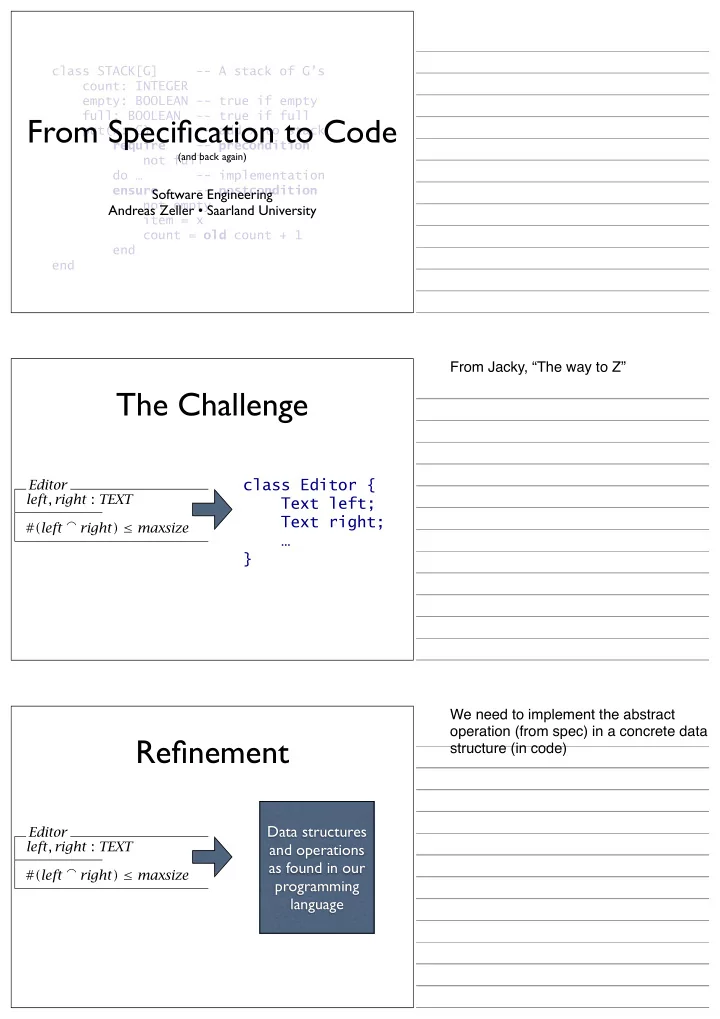
Editor left, right : TEXT #(left right) ≤ maxsize

The Challenge

class Editor { Text left; Text right; … }

Editor left, right : TEXT #(left right) ≤ maxsize

Refinement

Data structures and operations as found in our programming language

From Jacky, “The way to Z” We need to implement the abstract

  • peration (from spec) in a concrete data

structure (in code)

slide-2
SLIDE 2

Data Refinement

  • Most Z data types can be directly refined

into traditional data structures

  • Sets become arrays or trees
  • Sequences become lists or arrays
  • Maps become hash tables or trees

Schema Refinement

  • Z variables are translated into variables or

(better) object attributes

Editor left, right : TEXT #(left right) ≤ maxsize

class Editor { Text left; Text right; … }

Operation Refinement

  • Operations must be implemented in the

actual programming language

  • Implementation is constructive while

specification is (typically) declarative

  • We want to ensure correctness!
slide-3
SLIDE 3

Refinement

Abstract s : P X AStore ∆Abstract x? : X s′ = s ∪ {x?}

Data structures and operations as found in our programming language

Refinement

Abstract s : P X Concrete ss : seq X AStore ∆Abstract x? : X s′ = s ∪ {x?} CStore ∆Concrete x? : X ss′ = ss x?

The concrete operation must satisfy all properties

  • f the abstract operation!

Refinement

s

s ∪ {x?} s′ ss ss x? ss′

Abstract Operation Concrete Operation

ran ran

s = ran ss ∧ s′ = ran ss′

  • We need an operation to express the

relationship between the representations Refinement using range

We must show that the two data structures are equal!

slide-4
SLIDE 4

Refinement Proof

s

s ∪ {x?} s′ ss ss x? ss′

Abstract Operation Concrete Operation

ran ran ss’ = ss x? ∧ s = ran ss ∧ s′ = ran ss′ ⇒ s′ = s ∪ {x?}

Why is this a valid formula?

Refinement Schema

Abs Abstract Concrete s = ran ss

  • Defines relationship between concrete and

abstract structures

Proof Obligation

Abstract Operation Concrete Operation

AbstractOp ConcreteOp ∀ ∆Abstract; ∆Concrete; x? : X • pre AbstractOp ∧ ConcreteOp ∧ ∆Abs ⇒ AbstractOp Abstract Abstract′ Concrete Concrete′

Abs Abs

This has to be shown for every operation!

If all preconditions are met, then the result must be equivalent, too. The range operator “ran” is the schema appropriate for this example. Every

  • ther refinement must come with its own
  • peration.

This is the more abstract pattern

slide-5
SLIDE 5

All Proof Obligations

  • Valid initial state
  • Same or weaker precondition
  • Same or stronger postcondition

∀ ∆Abstract; ∆Concrete; x? : X • pre AbstractOp ∧ ConcreteOp ∧ ∆Abs ⇒ AbstractOp ∀ Abstract; Concrete • ConInit ∧ Abs ⇒ AbsInit ∀ Abstract; Concrete; x? : X • pre AbstractOp ∧ Abs ⇒ pre ConcreteOp

A Pragmatic Approach

  • Instead of proving all conditions,

we may just as well check them.

  • Essence of design by contract

Design by Contract

  • A contract of a method describes
  • what the method requires (precondition)
  • what the method provides (postcondition)
  • The contract binds clients (method callers)

and suppliers (method implementors)

Now that is a lot to prove! From Meyer: Object-Oriented Software Construction, §11 “Design by Contract”

slide-6
SLIDE 6

A Stack

class STACK[G] -- A stack of G’s count: INTEGER empty: BOOLEAN -- true if empty full: BOOLEAN -- true if full end

A Stack

class STACK[G] -- A stack of G’s count: INTEGER empty: BOOLEAN -- true if empty full: BOOLEAN -- true if full end top: G -- returns topmost item require -- precondition not empty do … -- implementation end

A Stack

class STACK[G] -- A stack of G’s count: INTEGER empty: BOOLEAN -- true if empty full: BOOLEAN -- true if full end put(x: G) -- add x to stack require -- precondition not full do … -- implementation ensure -- postcondition not empty item = x count = old count + 1 end

An example in Eiffel – an OO language that supports contracts http://en.wikibooks.org/wiki/ Computer_programming/ Design_by_Contract http://en.wikibooks.org/wiki/ Computer_programming/ Design_by_Contract

slide-7
SLIDE 7

Stacks in Z

Stack count : N state : {empty, filled, full} item : G put ∆Stack x? : G state = full state′ = empty item′ = x? count′ = count + 1

Preconditions

  • Expresses the constraints under which a

method functions properly

  • Applies to all calls of the method

top: G -- returns topmost item require -- precondition not empty

Postconditions

  • Expresses the properties of the state

resulting from a method execution

  • Applies to all calls of the method

put(x: G) -- add x to stack ensure -- postcondition not empty item = x count = old count + 1 end

“old” stands for the value at method entry

slide-8
SLIDE 8

Checking Contracts

  • Contracts are checked at runtime
  • Failing contracts indicate internal errors

(and therefore raise exceptions)

  • Contracts guarantee correctness –

if the program terminates

  • Can also be used for program proofs (as Z)

Rights and Obligations

If you promise to call m with pre satisfied, then I, in return, promise to deliver a final state in which post is satisfied.

Design by Contract

Method

Obligations Benefits Client Supplier

Satisfy precondition Obtain postcondition Satisfy postcondition Rely on precondition This is the actual contract – between client and supplier

slide-9
SLIDE 9

Design by Contract

put(x)

Obligations Benefits Client Supplier

Only call put(x) on a non-full stack

  • Stack is updated
  • x is on top
  • Count is increased
  • Update stack
  • Put x on top
  • Increase count

Need not check whether stack is full

Contract Violations

  • A violation in the precondition

indicates a defect in the client

  • A violation in the postcondition

indicates a defect in the supplier

  • Useful for locating defects

(and for putting the blame on someone)

A Bounded Stack

class BOUNDED_STACK[G] -- A stack of G’s count: INTEGER capacity: INTEGER … more attributes and methods end

slide-10
SLIDE 10

An Invariant

class BOUNDED_STACK[G] -- A stack of G’s count: INTEGER capacity: INTEGER … more attributes and methods end put(x: G) -- add x to stack require -- precondition 0 ≤ count and count ≤ capacity … do … -- implementation ensure -- postcondition 0 ≤ count and count ≤ capacity … end

Class Invariants

class BOUNDED_STACK[G] -- A stack of G’s count: INTEGER capacity: INTEGER … more attributes and methods end invariant 0 ≤ count count ≤ capacity capacity = rep.capacity empty = (count = 0) full = (count = capacity) count > 0 ⇒ rep[count] = item

Class Invariants…

  • must hold after the constructor
  • must hold before and after

every public method call

  • must hold before the destructor (if any)

We call this an invariant - a condition that holds at the beginning and at the end of every public method rep stands for the internal representation (say, an array) Note: In Eiffel, array[1] is the first element

slide-11
SLIDE 11

Contracts and Inheritance

  • The Liskov substitution principle applies:
  • same or weaker precondition
  • same or stronger postcondition
  • In Eiffel, parent pre-/postconditions are

always tested first

Invariants in Java

  • Few languages explicitly support contracts
  • We therefore need to implement them

using the available language constructs

  • Most frequently used: assertions

A Red/Black Tree

class RedBlackTree { }

http://en.wikipedia.org/wiki/ Red_black_tree

slide-12
SLIDE 12

Class Invariant

class RedBlackTree { private boolean inv() { assert rootHasNoParent(); assert rootIsBlack(); assert redNodesHaveOnlyBlackChildren(); assert equalNumberOfBlackNodesOnSubtrees(); assert treeIsAcyclic(); assert parentsAreConsistent(); return true; } } class RedBlackTree { private boolean redNodesHaveOnlyBlackChildren() { workList = new LinkedList(); workList.add(rootNode()); while (!workList.isEmpty()) { Node current = (Node)workList.removeFirst(); Node cl = current.left; Node cr = current.right; if (current.color == RED) { assert cl == null || cl.color == BLACK; assert cr == null || cr.color == BLACK; } if (cl != null) workList.add(cl); if (cr != null) workList.add(cr); } return true; }

Using Contracts

class RedBlackTree { void add(Object element) { assert inv(); // Invariant // actual operation goes here assert inv(); // Invariant } } assert has(element); // Postcondition

We use an inv() method to check the invariant – using assert() This is one of the checked properties We check the invariant at the beginning and the end of each public method

slide-13
SLIDE 13

Java Modeling Language

  • JML is a formal specification language
  • Provides annotations (assertions) for
  • preconditions
  • postconditions
  • invariants
  • All integrated into Java code

Using JML

  • JML annotations are added as comments in

Java source (/*@ … @*/ or //@ …)

  • Contracts expressed as boolean expressions
  • using some special operators

\result, \forall, \old…

  • and some special keywords

requires, ensures, invariant…

Red/Black Tree in JML

class RedBlackTree { //@ invariant rootHasNoParent() //@ invariant rootIsBlack() //@ more invariants… //@ ensures has(\old element) void add(Object element) { // actual operation goes here } }

Note the usage of \old to refer to the initial value

slide-14
SLIDE 14

Data Invariants in JML

private final Object[] objs; /*@ invariant objs != null &&

  • bjs.length == CURRENT_OBJS_SIZE &&

(\forall int i; 0 <= i && i < CURRENT_OBJS_SIZE;

  • bjs[i] != null);

@*/

Example: Date

set hour ∆Date h? : N 0 ≤ h? ≤ 23 hours′ = h? minutes′ = minutes seconds′ = seconds Date hours : N minutes : N seconds : N 0 ≤ hours ≤ 23 0 ≤ minutes ≤ 59 0 ≤ seconds ≤ 60

Date in Eiffel

invariant 0 ≤ hours() && hours() ≤ 23 0 ≤ minutes() && minutes() ≤ 59 0 ≤ seconds() && seconds() ≤ 60 set_hour (h: INTEGER) is

  • - Set the hour from `h'

require 0 ≤ h and h ≤ 23 ensure hour = h minutes = old minutes seconds = old seconds

We can document design decisions this way.

slide-15
SLIDE 15

Date in Java

boolean inv() // invariant { return (0 ≤ hour() && hour() ≤ 23) && (0 ≤ minutes() && minutes() ≤ 59) && (0 ≤ seconds() && seconds() ≤ 60); }

Date in Java

void set_hour(int h) { int old_minutes = minutes(); int old_seconds = seconds(); assert (inv()); // Actual code goes here assert (inv()); assert (hour() == h); assert (minutes() == old_minutes && seconds() == old_seconds); }

Date in JML

class Date { //@ invariant 0 ≤ hours() && hours() ≤ 23 //@ invariant 0 ≤ minutes() && minutes() ≤ 59 //@ invariant 0 ≤ seconds() && seconds() ≤ 60 /*@ requires 0 ≤ h && h ≤ 23 @ ensures hours() == h && @ minutes() == \old(minutes()) && @ seconds() == \old(seconds()) @*/ void set_hour(int h) { … } }

slide-16
SLIDE 16

A Purse in JML

public class Purse { final int MAX_BALANCE; int balance; //@ invariant 0 ≤ balance && balance ≤ MAX_BALANCE; byte[] pin; /*@ invariant pin != null && pin.length == 4 && @ (\forall int i; 0 ≤ i && i < 4; @ 0 ≤ byte[i] && byte[i] ≤ 9) @*/ /*@ requires amount ≥ 0; @ assignable balance; @ ensures balance == \old(balance) - amount && @ \result == balance; @ signals (PurseException) balance == \old(balance); @*/ int debit(int amount) throws PurseException { … }

To check or not to check

  • Checking assertions is expensive

(especially invariants)

  • Assertions can be activated and deactivated

(typically at compile time)

  • Assertions should not have any side effects

(i.e., change the state of the program)

  • Assertions should be the only mechanism

to check for contracts and consistency

(exception: external input must always be checked by extra code)

Hoare on Assertions

It is absurd to make elaborate security checks

  • n debugging runs, when no trust is put in the

results, and then remove them in production runs, when an erroneous result could be expensive or disastrous. What would we think

  • f a sailing enthusiast who wears his life-jacket

when training on dry land but takes it off as soon as he gets to sea?

C.A.R. Hoare (1973): Hints on Programming Language Design. Stanford University Artificial Intelligence memo AIM-224/STAN-CS-73-403.

slide-17
SLIDE 17

Meyer on Assertions

  • Assess, from an engineering perspective:
  • How much you trust the correctness of

the software

  • How crucial it is to get the utmost

efficiency

  • How serious the damage of an

undetected run-time error can be

  • Consider at least checking preconditions

Static JML checking

  • JML is usually checked at runtime…
  • but can also be used to check programs at

compile time!

  • Approach: ESC/Java by Leino et al.

(“Extended Static Checker for Java”)

class Bag { int[] a; int n; int extractMin() { int m = Integer.MAX_VALUE; int mindex = 0; for (int i = 1; i ≤ n; i++) { if (a[i] < m) { mindex = i; m = a[i]; } } n--; a[mindex] = a[n]; return m; } }

From ESC/Java2 documentation http://kind.ucd.ie/products/opensource/ ESCJava2/

slide-18
SLIDE 18

class Bag { int[] a; int n; int extractMin() { int m = Integer.MAX_VALUE; int mindex = 0; for (int i = 1; i ≤ n; i++) { if (a[i] < m) { mindex = i; m = a[i]; } } n--; a[mindex] = a[n]; return m; } }

ESC/Java Demo

class Bag { int[] a; int n; int extractMin() { int m = Integer.MAX_VALUE; int mindex = 0; for (int i = 1; i ≤ n; i++) { if (a[i] < m) { mindex = i; m = a[i]; } } n--; a[mindex] = a[n]; return m; } } class Bag { int[] a;//@ invariant a != null; int n; //@ invariant 0 ≤ n && n ≤ a.length; //@ requires n > 0; int extractMin() { int m = Integer.MAX_VALUE; int mindex = 0; for (int i = 0; i < n; i++) { if (a[i] < m) { mindex = i; m = a[i]; } } n--; a[mindex] = a[n]; return m; } }

From ESC/Java2 documentation http://kind.ucd.ie/products/opensource/ ESCJava2/ From ESC/Java2 documentation http://kind.ucd.ie/products/opensource/ ESCJava2/ From ESC/Java2 documentation http://kind.ucd.ie/products/opensource/ ESCJava2/

slide-19
SLIDE 19

Mining Specifications

  • Specifications can also be learned from

existing code

  • Popular approach: learn from executions

public int ex1511(int[] b, int n) { int s = 0; int i = 0; while (i != n) { s = s + b[i]; i = i + 1; } return s; }

Postcondition

b[] = orig(b[]) return == sum(b)

Precondition

n == size(b[]) b != null n <= 13 n >= 7

Daikon

  • Run with 100 randomly generated arrays
  • f length 7–13

Daikon

Run Run Run Run Run Trace Invariant Invariant Invariant Invariant

get trace filter invariants report results

Postcondition

b[] = orig(b[]) return == sum(b)

Daikon was developed by Michael Ernst (1999)

slide-20
SLIDE 20

Getting the Trace

Run Run Run Run Run Trace

  • Records all variable values at all function

entries and exits

  • Uses VALGRIND to create the trace

Filtering Invariants

Trace Invariant Invariant Invariant Invariant

  • Daikon has a library of

invariant patterns over variables and constants

  • Only matching patterns are

preserved

Method Specifications

x = 6 x ∈ {2, 5, –30} x < y y = 5x + 10

z = 4x +12y +3

z = fn(x, y) A subseq B x ∈ A sorted(A)

using primitive data using composite data checked at method entry + exit

slide-21
SLIDE 21

Object Invariants

string.content[string.length] = ‘\0’ node.left.value ≤ node.right.value this.next.last = this checked at entry + exit of public methods

Matching Invariants

A == B s size(b[]) n

public int ex1511(int[] b, int n) { int s = 0; int i = 0; while (i != n) { s = s + b[i]; i = i + 1; } return s; }

sum(b[]) return

  • rig(n)

Pattern Variables …

== s n size( b[]) sum (b[])

  • rig(

n)

ret s n size(b[]) sum(b[])

  • rig(n)

ret

Matching Invariants

s i n A == B s size(b[]) n sum(b[]) return

  • rig(n)

Pattern Variables …

run 1

✘ ✘ ✘ ✘ ✘ ✘ ✘ ✘ ✘ ✘

slide-22
SLIDE 22

== s n size( b[]) sum (b[])

  • rig(

n) ret s n size(b[]) sum(b[])

  • rig(n)

ret

Matching Invariants

s i n A == B s size(b[]) n sum(b[]) return

  • rig(n)

Pattern Variables … ✘ ✘ ✘ ✘ ✘ ✘ ✘ ✘ ✘ ✘

run 2

✘ ✘ ✘ ✘ ✘ ✘ ✘ ✘ ✘ ✘

== s n size( b[]) sum (b[])

  • rig(

n) ret s n size(b[]) sum(b[])

  • rig(n)

ret

Matching Invariants

s i n A == B s size(b[]) n sum(b[]) return

  • rig(n)

Pattern Variables … ✘ ✘ ✘ ✘ ✘ ✘ ✘ ✘ ✘ ✘

run 3

✘ ✘ ✘ ✘ ✘ ✘ ✘ ✘ ✘ ✘

== s n size( b[]) sum (b[])

  • rig(

n) ret s n size(b[]) sum(b[])

  • rig(n)

ret

Matching Invariants

s == sum(b[]) ✘ ✘ ✘ ✘ ✘ ✘ ✘ ✘ ✘ ✘ ✘ ✘ ✘ ✘ ✘ ✘ ✘ ✘ ✘ ✘ s == ret n == size(b[]) ret == sum(b[])

slide-23
SLIDE 23

Matching Invariants

s == sum(b[]) s == ret n == size(b[]) ret == sum(b[])

public int ex1511(int[] b, int n) { int s = 0; int i = 0; while (i != n) { s = s + b[i]; i = i + 1; } return s; }

Daikon Discussed

  • As long as some property can be
  • bserved, it can be added as a pattern
  • Pattern vocabulary determines the

invariants that can be found (“sum()”, etc.)

  • Checking all patterns (and combinations!)

is expensive

  • Trivial invariants must be eliminated

Summary