
SLIDE 1
From the Wilderness to the Media and the Human Realm
From the Wilderness to the Media and the Human Realm Welcome - - PowerPoint PPT Presentation
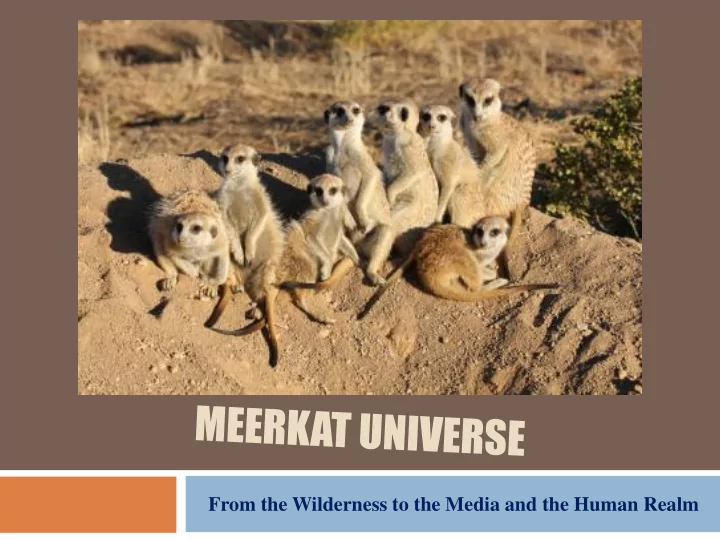
From the Wilderness to the Media and the Human Realm Welcome Project Goal With this project, my aim is to explore the universe of meerkats by highlighting the following: the way these non-human animals are represented in a number of media
From the Wilderness to the Media and the Human Realm
Meerkats, also known as Suricata Suricatta, belong to the mongoose species and originate from portions
Desert area. In Afrikaans (the Dutch-derived language of South Africa), “meerkat” means marsh cat or lake cat, although they are not cats.
All meerkats have light brown furs with stripes on their backs, dark patches around their eyes and slender tails that enable them to find a balance and to communicate when standing on two legs and not in a four-legged position.
“Many contemporary folk tales contain fragments of ancient myths, often from religions that disappeared long ago. Others are educational, in that they explain why certain things are the way they are. Still others, such as the fable, impart a moral lesson, and all serve to entertain as well.” ~ Margo DeMello, Animals and Society It is fascinating that animals are able to serve as types in folklores. In African folklores, meerkats serve as protectors with their ability to protect villagers from a pack of werewolves. The meerkats are known as “Sun Angels”, while the werewolves are being labeled as “Moon Devils” with their villainy portrayals.
Within their natural habitat in the wilderness, meerkats are highly social and live in packs consisting of up to three familial groups with up to thirty individuals in a pack. They depend
from predators like jackals and owls. In addition, they also battle rival mobs. Group solidarity matters. Roles are assigned on a daily basis, including:
the others go out to hunt for food
be watched and looked after
A meerkat society is no democracy. The alpha female and male reign supreme. Females and males compete with other meerkats within their gender to have the biggest bodies – the criteria to become an alpha female and male. Only the alpha female is allowed to give birth to pups. When lower level females do manage to birth their own litter of pups, retaliation is swift and
bereaved mothers with two options: leave the colony, or earn their keep as wet-nurses for the
With meerkats’ popularity on media, it is the right time to explore the way humans engage with them in literature and also on film and television.
Children’s author Emily Gravett’s storybook Meerkat Mail captures the cheerful, lively spirit of a meerkat in the friendly central character Sunny. DeMello’s theoretical statement about animals “representing a number of characteristics that humans have or that the author wants to teach to the reader” is reflected in the plot and illustrations. Sunny represents a human’s desire to travel the world and discover new things but there’s also a message about appreciating
through Sunny’s humanlike quality. He’s approachable and willing to meet new friends and make connections.
Timon helped popularize meerkats in the world of cinema starting with his debut in The Lion King. In the “midquel” The Lion King 1 ½, which serves as an origin story, audiences get to have a closer look at Timon’s character and find out what it has been like for him to live with his mob, including his Ma. Timon is given his own identity that separates him from his fellow meerkats, who value their traditional roles of digging tunnels and performing sentry duty to look out for hyenas and other predators. He dreams of something bigger and a better life for them, where they don’t have to continuously live their daily lives trying to survive. Even though he represents the meerkats, his goals give him a human quality, where he has the desire to help his own kind find better ways of living. Venturing into the outside world, he discovers “hakuna matata” - which eventually means learning the value of friendship – and also finds a new habitat for the meerkats, a safe haven in the jungle. In this film, meerkats are given more layers, where they can be viewed as great thinkers and capable of dreaming up better lives for their own kind. It shows that they can look out for one another and encourages humans to also treat others – both human beings and animals – in their surroundings with care and compassion.
“What’s so bad about dreaming of a better home?”
In this four-season Animal Planet documentary series presented by a group of researchers forming the Kalahari Meerkat Project (KMP), the lives and deaths of members of a meerkat mob called the Whiskers are being broadcasted using actual footages captured by the KMP cameras. Viewers are able to form a connection with the Whiskers through the narratives created by the production team to make the featured meerkats relatable and through technological innovations that revolutionizes documentary filmmaking. “Thanks to changes in technology that make documentary filmmaking easier, and especially that makes it easier to film animals in the wild, viewers have the opportunity to see wild animals in a way that we could never see them before”, and in Meerkat Manor, they can “watch the romantic entanglements, fights, friendships, and even “gang wars” of animals whose behavior – as it is translated to us through the narration – seems awfully humanlike.” ~ DeMello Audiences champion the Whiskers during their battle with their rivals the Lazulis, root for Daisy/Carlos, and find Shakespeare heroic and courageous. The alpha female brutality is shown in Flower, the leader of the group. In Season 1, she banished her two daughters Tosca and Mozart for giving birth to pups. With the meerkats being complicated enough to have individual personalities and to face family issues, viewers can easily relate to them.
He’s the star of the video commercials for price comparison site Compare the Market. As an animal used for marketing, Aleksandr Orlov, an anthropomorphic aristocratic meerkat, sports a red velvet smoking jacket and silk cravat as he hangues ignorant consumers who confuse his genealogical website, comparethemeerkat.com, with a cheap and cheerful car insurance seller, comparethemarket.com. With his famous catchphrase “Simples!”, exaggerated Russian accent, sarcasm, quick thinking demeanor and entrepeneurship skills, he has garnered plenty of followers on social media, where he constantly amuses them with oddly twisted answers to even simple questions. With ads that also show his family members and even explore their historical
decision to take over the family business, audiences find that they can connect to his success story and motivational energy.
In what ways do humans envision their interactions with meerkats? By looking at meerkats in venues that enable human-meerkat interactivity, it’s possible to observe the different ways humans perceive them. The concept of kinship is also explored. “Humans create kinship with other species through a myriad of methods, manners and imaginings.” ~ Agustin Fuentes and Natalie Porter
Meerkats living in captivity tend to experience challenges in comparison to wild meerkats. “All wild animals in captivity are subjected to restrictions and loss of control, forced interspecies interaction and intrusion either through performances or by being put on display, and monotony, all while held in artificial settings that have little resemblance to habitats that support their evolutionary heritage and adaptations”. ~ Lori Marino, Critical Terms for Animal Studies Researches on captive meerkats have produced results that reflect Marino’s statement. These meerkats are given limited space to move around freely.
“Small groups of meerkats – such as those commonly seen in zoos and safari parks – are at greater risk of chronic stress. Although they are not at risk from predators, living in small enclosures and being constantly exposed to high numbers of human visitors also increase stress. Captive meerkats in larger groups spent less time vigilant; they were also less vigilant in the presence of more human visitors but still have a sentry present for a larger proportion of the time.” ~ Katy Scott, Behavior and Endocrynology of Meerkats in Zoos
Human perspective. Swiss photographer Markus Walti finds the group above adorable and shy.
Zoos, wildlife parks and public spaces that care for their meerkats help keep the meerkats active and healthy. Click here to watch a video from the Zoological Society
Following the trend in pet cafes, the Meerkat Friends Café in Seoul enables visitors to enjoy their favorite coffee and snacks in the company of meerkats. CLICK HERE TO WATCH A VIDEO FROM SEOUL SEARCHING
In certain countries like the UK, Japan and Russia, meerkats are able to form interactions with humans as pets. The Royal Society for the Prevention of Cruelty to Animals (RSPCA) asserts that meerkats are “explorative creatures” that “do not make suitable domestic animals due to their wild nature and demanding needs” and that “while it’s currently legal to own a meerkat as a pet, it’s also a legal requirement under the Animal Welfare Act that owners meet all of the needs of the animal in a way that allows for natural behaviors.” Still, domesticated meerkats are everywhere. Instagram meerkats have gained popularity with the owners posting clips of the meerkats’ daily activities, presenting them “as media” to bring joy to others and to share what a meerkat’s life at a human home is like. The videos display the socially active behavior
meerkat connection in a home environment. They also portray the characteristics of meerkats that resemble traditional pets.
Final question: How can meerkats continue to be positively represented?
References
Brown, Stephen. “Mascot Mania: Monkeys, Meerkats, Martians and More.” Brand Mascots and Other Marketing Animals, edited by Stephen Brown and Sharon Ponsonby-McCabe. Routledge, 2014, pp. 1-16. Caroline Hawkins, creators. Meerkat Manor. Oxford Scientific Films and Animal Planet International, 2005. Cooper (@meerkat_cooper). 16 December, 2018. https://www.instagram.com/p/BrcXMjAna4U/ Cosmos editorial team. “A meerkat stares into an uncertain future.” Cosmos Magazine, The Royal Institution of Australia Inc., 18 February, 2019. https://cosmosmagazine.com/biology/a-meerkat-stares-into-an-uncertain-future Davidson, Molly. My First Book About Meerkats. Mendon Cottage Books, 2016. DeMello, Margo. Animals and Society: An Introduction to Human-Animal Studies. Columbia University Press, 2012. Edmonds, Patricia. “When Meerkats Choose Who Has Sex, Heft Helps.” National Geographic Wild, National Geographic Society, 2017. https://www.nationalgeographic.com/magazine/2017/02/basic-instincts-meerkat- sex/?utm_source=Social&utm_campaign=wild&utm_medium=Twitter&utm_content=link_twwd20170202MeerkatSex&sf53835127=1 Gorman, James. “Somewhere Between Animals and Humans, the Meerkats.” The New York Times, The New York Times Company, 18 July 2006. https://www.nytimes.com/2006/07/18/science/18side.html Gravett, Emily. Meerkat Mail. Simon and Schuster, 2006. Fuehrer, T. 2003. "Suricata suricatta" (On-line), Animal Diversity Web. Accessed April 1, 2020 at https://animaldiversity.org/accounts/Suricata_suricatta/ Fuentes, Agustin and Porter, Natalie. “Kinship.” Critical Terms for Animal Studies, edited by Lori Gruen. University of Chicago Press, 2018, pp. 183- 194. Manson, Marshall. “Watch Out Geico Gecko, Aleksandr the Meerkat Is Social Media King of Car Insurance.” Fast Company, Mansuetto Ventures LLC, 7 September 2009. https://www.fastcompany.com/1306885/watch-out-geico-gecko-aleksandr-meerkat-social-media-king-car-insurance Marino, Lori. “Captivity.” Critical Terms for Animal Studies, edited by Lori Gruen. University of Chicago Press, 2018, pp. 99-109. Meerkats.Net. 2005. Retrieved from http://www.meerkats.net. Monty (@meerkat_monty). 2019. 29 November, 2019. https://www.instagram.com/p/B5c1mK3ALUX/ Nuwer, Rachel. “Baby-Murdering Meerkat Alpha Females Enslave Subordinates As Wet Nurses.” Smithsonian Magazine, Smithsonian Institution, 10 October 2013, https://www.smithsonianmag.com/science-nature/baby-murdering-meerkat-alpha-females-enslave-subordinates-as-wet-nurses-1207037/. Reid Park Zoo. “The Meerkat Mob at Reid Park Zoo Has Grown By Three!” Reid Park Zoo, Red Park Zoo, 27 March 2018. https://reidparkzoo.org/blog/the-meerkat-mob-at-reid-park-zoo-has-grown-by-three/ RSPCA (n.d.). Meerkats. https://www.rspca.org.uk/adviceandwelfare/pets/other/meerkats Scott, Katy. “Behavior and Endocrynology of Meerkats in Zoos.” University of Exeter, University of Exeter, May 2014. https://ore.exeter.ac.uk/repository/bitstream/handle/10871/16393/ScottK.pdf?sequence=4 Scott, Katy. “Captive meerkats at risk of stress.” Phys, Science X Network, 18 April 2017. https://phys.org/news/2017-04-captive-meerkats-stress.html Smith, P.A. “Meerkats.” Animal Fact Guide, Animal Fact Guide, 24 August 2014. https://animalfactguide.com/animal-facts/meerkat/ Seoul Searching. (20 April, 2017). “Meerkat café in Seoul.” [Video File]. Retrieved from https://www.youtube.com/watch?v=QKfDnmtAIjw Stuffed Safari. 2020. Retrieved from https://www.stuffedsafari.com/Realistic-Stuffed-Meerkat-10-Inch-Plush-Animal-p/ar-26228.htm. Surya (@meerkat_suren). 2020. 20 January, 2020. https://www.instagram.com/p/B7iZlV2IiEL/ The Lion King 1 ½. Directed by Bradley Raymond, Walt Disney Pictures, Walt Disney Animation Australia and Disneytoon Studios, 2004. Triedfeldt, Laurie. World of Wonder: People and Places. Quill Driver Books/Word Dancer Press, 2008. ZSL London Zoo. “Meet the Meerkats at ZSL London Zoo.” ZSL London Zoo, Royal Guard, 2020. https://www.zsl.org/meet-the-animals/meerkats ZSL London Zoo. (2020). Meet the Meerkats at ZSL London Zoo [Video File]. Retrieved from https://www.youtube.com/watch?v=Dqlu3UXhPBs