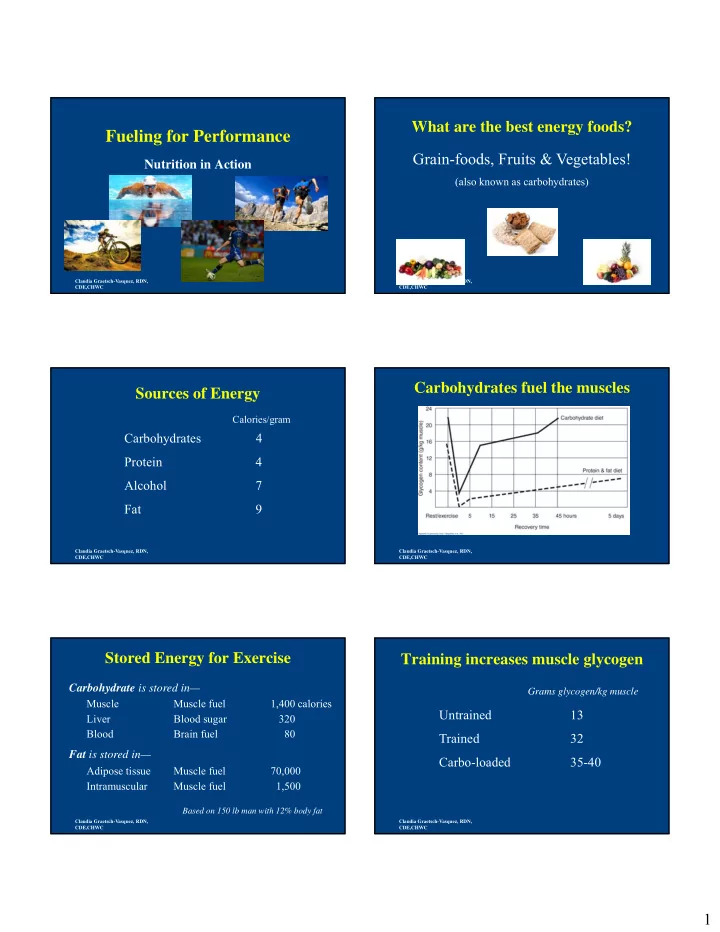
Fueling for Performance Grain-foods, Fruits & Vegetables! - - PDF document

fueling for performance
SMART_READER_LITE
LIVE PREVIEW

Fueling for Performance Grain-foods, Fruits & Vegetables! - - PDF document

What are the best energy foods? Fueling for Performance Grain-foods, Fruits & Vegetables! Nutrition in Action (also known as carbohydrates) Claudia Graetsch-Vasquez, RDN, Claudia Graetsch-Vasquez, RDN, CDE,CHWC CDE,CHWC Carbohydrates


slide-1
SLIDE 1

1

Claudia Graetsch-Vasquez, RDN, CDE,CHWC

Fueling for Performance

Nutrition in Action

Claudia Graetsch-Vasquez, RDN, CDE,CHWC

What are the best energy foods? Grain-foods, Fruits & Vegetables!

(also known as carbohydrates)

Claudia Graetsch-Vasquez, RDN, CDE,CHWC

Sources of Energy

Carbohydrates 4 Protein 4 Alcohol 7 Fat 9

Calories/gram

Claudia Graetsch-Vasquez, RDN, CDE,CHWC

Carbohydrates fuel the muscles

Claudia Graetsch-Vasquez, RDN, CDE,CHWC

Stored Energy for Exercise

Carbohydrate is stored in—

Muscle Muscle fuel 1,400 calories Liver Blood sugar 320 Blood Brain fuel 80

Fat is stored in—

Adipose tissue Muscle fuel 70,000 Intramuscular Muscle fuel 1,500

Based on 150 lb man with 12% body fat

Claudia Graetsch-Vasquez, RDN, CDE,CHWC

Training increases muscle glycogen

Untrained 13 Trained 32 Carbo-loaded 35-40

Grams glycogen/kg muscle

slide-2
SLIDE 2

2

Claudia Graetsch-Vasquez, RDN, CDE,CHWC

Carbohydrates for rapid recovery

After hard exercise, consume 0.5 to 0.75 g carb/lb*–

  • As soon as tolerable 0 - 30 minutes post-exercise
  • At next meal

1 - 2 hours post-exercise

  • Snacks

Every two hours for 6 hours

* a little protein can also be beneficial

Claudia Graetsch-Vasquez, RDN, CDE,CHWC

Recovery foods

Carb (g) Pro (g) Cals Yogurt, flavored, 6 oz 26 8 160 Cheerios w/ milk 32 11 200 Pasta + meat sauce 80 20 450

Wt (lb) Carbs (g) Pro Cals

100 75 20 ~400 150 115 30 ~600 200 150 40 ~800

Recommended dose: ~0.5-0.75 g Carb/lb within 30 min. ~0.1-0.2 g Pro/lb Repeat every two hours x 4-6 hours

Refuel with about three times more carbs than protein!

Claudia Graetsch-Vasquez, RDN, CDE,CHWC

Recovery Fluids

Best choice: a beverage with three times more carb than protein

Beer 8

  • Gatorade

14

  • Coke

26

  • Cranberry Juice

43

  • Chocolate milk, Nesquik 29

8 Muscle Milk 6 15

Fluid

Gm Carb/8 oz. Gm Pro/8 oz

Claudia Graetsch-Vasquez, RDN, CDE,CHWC

Low carb diet + Repeated exercise = Fatigue

Claudia Graetsch-Vasquez, RDN, CDE,CHWC

What kinds of carbs should I eat?

Claudia Graetsch-Vasquez, RDN, CDE,CHWC

Fruit = “Quality Carbs”

EAT LESS: Refined Sugars EAT MORE: Natural sugars

Soda pop Orange juice Sports drinks Raisins Candy All fruits Marshmallows Fruit juices Natural fruit-sugars are preferable to refined sugars

slide-3
SLIDE 3

3

Claudia Graetsch-Vasquez, RDN, CDE,CHWC

Grains, Beans, Starches = Quality Carbs

Choose more whole or lightly processed grains Granola, Wheaties, oatmeal Rye bread, whole wheat bagel, multi-grain rolls Corn tortillas, popcorn, Triscuits Chili, lentil soup, hummus, refried beans Potato, (brown) rice, (whole wheat) pasta

Claudia Graetsch-Vasquez, RDN, CDE,CHWC

Building your sports diet

Carbs: The foundation of each meal

Grain-Fruit-Veg

~3 - 5 gm Carb / lb body weight during intense training

Protein: Accompaniment to each meal

~0.5-0.75 gm Pro/ lb body weight (1-1.5 g/kg)

Fat: A little (healthy) fat at each meal

~25% of total calories (~50-80 g/day)

Claudia Graetsch-Vasquez, RDN, CDE,CHWC

Breakfast Choices: High Fat vs High Carb

Eggs, 2 fried Bacon, 2 slices Buttered toast, 2 slices Total calories: 500 55% fat, 25% carb Cereal, big bowl Banana, medium Milk (2% fat), 8 ounces Total calories: 500 10% fat, 75% carb

Claudia Graetsch-Vasquez, RDN, CDE,CHWC

Meal choices: High fat vs high carb

Big Mac Small fries Total calories: 800 40% fat, 40% carb Spaghetti, 2.5 cups Tomato sauce, meat balls Total calories: 800 20% fat, 60% carb

Claudia Graetsch-Vasquez, RDN, CDE,CHWC

Food labels: Useful information!

Carbs Protein Fat

Skim vs 2% Low-fat Milk

Claudia Graetsch-Vasquez, RDN, CDE,CHWC

How to calculate calories

Ice cream (Haagen Dazs) 1/2 cup = 250 calories

20 gm CARB x 4 cals/gm = 80 Carb-cals (32%) 17 gm FAT x 9 cals/gm = 150 Fat-cals

(60%)

5 gm PRO x 4 cals/gm = 20 Pro-cals

(8%)

slide-4
SLIDE 4

4

Claudia Graetsch-Vasquez, RDN, CDE,CHWC

Carbohydrate-loading for endurance exercise

Claudia Graetsch-Vasquez, RDN, CDE,CHWC

How to Carbohydrate-Load

  • Maintain familiar, high-carb training diet
  • Enjoy carbs as the foundation of each meal
  • Reduce pre-event training
  • Muscles need time to get fully fueled

The carbohydrates saved by not exercising get used to “carbo-load” the muscles.

Claudia Graetsch-Vasquez, RDN, CDE,CHWC

A little bit...? A lot…?

How much protein do I need?

Claudia Graetsch-Vasquez, RDN, CDE,CHWC

To build muscles—

  • Strength training (+ maturity)
  • Adequate protein (pre- & post-exercise)
  • Extra calories (from carbohydrates)
  • Frequent eating throughout the day

Claudia Graetsch-Vasquez, RDN, CDE,CHWC

Protein needs vary

Protein needs increase with–

  • Growth
  • Start of an exercise program
  • Calorie restriction (dieting, anorexia)
  • Depleted glycogen stores

Claudia Graetsch-Vasquez, RDN, CDE,CHWC

Protein needs

Current RDA, sedentary adult 0.4 Recreational exerciser, adult 0.5 - .75 Competitive athlete 0.6 - 0.8 Growing teenage athlete 0.9 - 1.0 Adult building muscle mass 0.7 - 0.8 Athlete restricting calories 0.8 - 1.0

Grams Protein/lb

slide-5
SLIDE 5

5

Claudia Graetsch-Vasquez, RDN, CDE,CHWC

Protein from standard foods

HS Football player, 200 lbs 0.7 - 1.0 140 - 200 Marathoner, 150 lbs 0.6 - 0.8 90 - 120 Young gymnast, 80 lbs 0.9 - 1.0 72 - 80

Safe intake/lb Gm PRO/day

2 lg

Egg whites 7 gm PRO

2 Tb Peanut butter

8

16 oz Milk

16

1 can Tuna (5 oz)

25

6 oz Chicken or Beef

45

Claudia Graetsch-Vasquez, RDN, CDE,CHWC

Would extra protein supplements help?

Insert illustration

Claudia Graetsch-Vasquez, RDN, CDE,CHWC

Greek yogurt, 8 oz 23 .07 1.65 Tuna, 5 oz can 25 .06 1.50 Eggs, 2 large 12 .04 .46 Instant dry milk, 1/4 c 8 .03 .25 Protein powder Muscle Milk 16 .08 1.20 Protein Bar PowerBar 20 .06 1.25

Protein: Supplements vs food

Gm Pro/serv $ / gm $ /serv

Claudia Graetsch-Vasquez, RDN, CDE,CHWC

What about eating meat…?

  • Fatty red meat can be bad for health

Limit greasy burgers, pepperoni, bacon, sausage.

  • Lean red meat is excellent for:
  • Iron - to prevent anemia
  • Zinc - to help with healing

Claudia Graetsch-Vasquez, RDN, CDE,CHWC

Iron deficiency in female athletes

Anemia in female varsity college athletes: 20% of volleyball and basketball players 50% of soccer players

A recipe for anemia: Red meat? NO Iron-enriched breakfast cereal? NO Heavy menstrual losses? YES

Eichner, Sports Science Exchange, 14(2) 2001

Claudia Graetsch-Vasquez, RDN, CDE,CHWC

Iron in foods

Tuna, 1 can 2* Chicken leg, 4 oz 2* Beef, 4 oz 3* Spinach, 1/2 cup cooked 1 Raisins, 1/3 cup 1 Oatmeal, 1/2 c dry, unenriched 1 Bran flakes, 1 oz enriched 8

*Iron from meats is absorbed better than iron from vegetables, fruits, grains. Iron (mg) RDA: Men, 8 mg Women, 18 mg

slide-6
SLIDE 6

6

Claudia Graetsch-Vasquez, RDN, CDE,CHWC

Tips for Vegetarian Athletes

  • Eat generous portions of beans, tofu, peanut butter
  • Plant proteins are not concentrated sources of protein.

1/2 cup beans

  • nly 6 g protein

1/4 cake tofu

  • nly 6-8 g

2 tbsp peanut butter

  • nly 7-8 g
  • Milk, yogurt & cheese are protein boosters

1 cup low-fat milk 8 g protein 1 oz cheese 8 g 1 cup Greek yogurt 23 g

Claudia Graetsch-Vasquez, RDN, CDE,CHWC

Should I take vitamin supplements? Does exercise increase vitamin needs?

Claudia Graetsch-Vasquez, RDN, CDE,CHWC

Do athletes need extra vitamins & minerals?

  • Athletes & non-athletes had similar vitamin status
  • Exception: Athletes had lower serum ferritin (iron)
  • Stronger vitamin status ≠ better performance

(apart from anemia) CONCLUSION: Athletes generally eat extra vitamins!

A review of 90 studies examining vitamin and mineral status in athletes’ blood suggests–

Claudia Graetsch-Vasquez, RDN, CDE,CHWC

For vitamins: Eat healthful foods!

The more you exercise–

  • the more food you can eat.
  • the more vitamins you can get.

Vitamins are re-used, not used up.

Claudia Graetsch-Vasquez, RDN, CDE,CHWC

Guide to Good Eating

Claudia Graetsch-Vasquez, RDN, CDE,CHWC

DON’T JUST EAT; EAT RIGHT–

Breads, cereals, whole grains

At each meal choose foods made from– Wheat Rice Oats Corn At least half your grains should be whole grains

Foundation of every meal–for muscle-fuel, fiber, B-vitamins

slide-7
SLIDE 7

7

Claudia Graetsch-Vasquez, RDN, CDE,CHWC

DON’T JUST EAT; EAT RIGHT–

Fruits & vegetables

Best fruit choices include: Oranges Grapefruit Melons Bananas Berries Kiwi Best vegetable choices are colorful: Broccoli Spinach Carrots Peppers Tomato Squash

A generous amount with each meal (fiber, carbs, phytochemicals, C, A)

Claudia Graetsch-Vasquez, RDN, CDE,CHWC

DON’T JUST EAT; EAT RIGHT–

Calcium-rich foods

1 cup Milk or Yogurt, low-fat 1.5 oz. Cheese, low-fat 2 cups Cottage cheese, low-fat

Non-dairy sources

8 oz. Soy milk or Tofu 1 cup Calcium-enriched orange juice 1.5 cup Broccoli, kale, leafy green vegetables 3-4 oz. Salmon or sardines with bones

3 - 4 low-fat servings daily

Claudia Graetsch-Vasquez, RDN, CDE,CHWC

DON’T JUST EAT; EAT RIGHT–

Protein-rich foods

Chicken, turkey, fish Lean beef, pork, lamb Milk, yogurt, cheese* Eggs Nuts, peanut butter Lentils, beans, tofu

Small amount at each meal for protein, iron, zinc

*Poor sources of iron and zinc

Claudia Graetsch-Vasquez, RDN, CDE,CHWC

What & when should I eat pre-exercise?

Claudia Graetsch-Vasquez, RDN, CDE,CHWC

Pre-exercise fuel improves performance

7 subjects, carbo-loaded x 3 days; biked hard to exhaustion Trial A: No breakfast 109 minutes to exhaustion Trial B: With breakfast (400 cals) 136 minutes to exhaustion

Schabort, Noakes. MSSE 31 (3):464. 1999

Claudia Graetsch-Vasquez, RDN, CDE,CHWC

Pre-exercise meal timing

Large meal: 4 - 6 hours Lighter meal: 2 - 3 hours Snack: .5 - 1 hour Timing varies with:

  • Intensity of exercise
  • Personal tolerance to food
slide-8
SLIDE 8

8

Claudia Graetsch-Vasquez, RDN, CDE,CHWC

Pre-exercise food guidelines

  • Carbohydrate-rich
  • Low fat
  • Moderate protein
  • Extra fluids
  • Appropriate portions
  • Tried and true

Claudia Graetsch-Vasquez, RDN, CDE,CHWC

What’s good for quick energy before exercise...?

Claudia Graetsch-Vasquez, RDN, CDE,CHWC

Pre-exercise sugar

  • Generally enhances performance (but not health)
  • May cause hypoglycemia and needless fatigue

if you are “sugar sensitive”

Safest best: Avoid sweets 15 - 45 minutes pre-exercise

Claudia Graetsch-Vasquez, RDN, CDE,CHWC

The best energy boosters

BREAKFAST and LUNCH!

  • Prevent the need for quick energy
  • Eat before you run out of fuel.

Claudia Graetsch-Vasquez, RDN, CDE,CHWC

Breakfast: Better than a quick fix

STUDY: Athletes with low glycogen stores biked hard

for 45 minutes, then sprinted for 15 minutes

Trial Improvements during final sprint

#1. Baseline: No fuel, only water

  • --Snack five minutes pre-exercise---

#2. Sugar (180 cals glucose) + water +10 % #3. Energy bar (270 cals) + water +10 % #4. Breakfast 4 hrs before + Energy bar + water +20 %

(800 cals)

Claudia Graetsch-Vasquez, RDN, CDE,CHWC

What’s best for energy during exercise?

  • Sports drinks
  • Diluted juices (1/2 strength)
  • Energy bars, gels, gummy candy + water
  • Banana, raisins, dried fruit

Target 100 - 300 calories of carbs/hour, after the first hour For exercise >1 hour, maintain blood glucose with––

slide-9
SLIDE 9

9

Claudia Graetsch-Vasquez, RDN, CDE,CHWC

What about coffee …? ...Does caffeine enhance performance?

Claudia Graetsch-Vasquez, RDN, CDE,CHWC

Caffeine and exercise

Pro: May make exercise seem easier and enhance performance. Con: May cause nervousness, upset stomach, and “coffee jitters.”

Each person responds differently. Know your body!

Claudia Graetsch-Vasquez, RDN, CDE,CHWC

Caffeine: Individual responses

STUDY:

10 subjects , 6 trials--3 with caffeine Exercise test: 30 minutes progressively harder cycling Caffeine dose: 3 mg caffeine/lb 1 hour pre-exercise Measured: Total work performed (calories)

+25 +12 +14 +9 +8 +6 +5 +1 +.5

  • 1.5

Improvements with caffeine (calories burned)

Claudia Graetsch-Vasquez, RDN, CDE,CHWC

Caffeine in foods & drugs

Coke, 12 oz can 35 mg Clif Shot, mocha 50 Excedrin, 1 tablet 65 Red Bull, 8 oz. can 80 Vivarin, 1 tablet 200 Coffee, 12 oz mug 150

Dose that aids performance: 1.5 to 4 mg caffeine/lb body wt

About 225 to 600 mg caffeine for 150 lb person

Claudia Graetsch-Vasquez, RDN, CDE,CHWC

What’s best for fluids?

Recovery drink?

Claudia Graetsch-Vasquez, RDN, CDE,CHWC

Fluid choices

  • For exercise <60 minutes: water
  • For exercise >60 minutes: water + carbs

Target 100-250 calories/hour from a beverage with 50-80 cal/8 oz

Gatorade 6 % Carb 50 Cals/8 oz. PowerAde 7 % 70 Cola 11 % 100 Apple juice 12 % 120

slide-10
SLIDE 10

10

Claudia Graetsch-Vasquez, RDN, CDE,CHWC

Fluid goals

  • Prevent dehydration
  • Drink before you are thirsty!

Claudia Graetsch-Vasquez, RDN, CDE,CHWC

Dehydration hurts performance

Percent

  • Lbs. lost

Physical Effect Dehydration (for 150 lb person)

1% 1.5 Increased body temperature 3% 4.5 Impaired performance 5% 7.5 G.I. problems, heat exhaustion 7% 10.5 Hallucinations 10% 15.0 Circulatory collapse

Claudia Graetsch-Vasquez, RDN, CDE,CHWC

Symptoms of dehydration

  • Dark urine
  • Small volume of urine
  • Elevated heart rate
  • Headache

Urine Color Chart* 1-3 = adequately hydrated

*Source: L. Armstrong PhD

Claudia Graetsch-Vasquez, RDN, CDE,CHWC

Fluid guidelines

Event Fluid goals

  • 2 hours pre-exercise

16 - 24 ounces

  • 15 minutes pre-exercise

8 - 16 ounces

  • Every 15 minutes during

6 - 12 ounces

  • After exercise

Until urine is pale

  • Daily

Enough to urinate every 2 - 4 hours

Claudia Graetsch-Vasquez, RDN, CDE,CHWC

Do I need sports drinks to replace electrolytes?

Claudia Graetsch-Vasquez, RDN, CDE,CHWC

Sodium losses during exercise

One pound of sweat loss contains: 450 - 700 mg. sodium Losses in 1 hour hard exercise in heat: 900 - 2,800 mg. Sodium content of the body: 97,000 mg (42 tsp salt) Replacements mg sodium

Coke, 8 oz. 1 Cheese stick, 1 oz 200 Endurolytes, 1 capsule 40 Pizza, 1 slice 500 Gatorade, 8 oz. 110 Salt, 1/4 teaspoon 600 Gatorade Endurance 200 Soup, 1 can 2,200

slide-11
SLIDE 11

11

Claudia Graetsch-Vasquez, RDN, CDE,CHWC

Sodium replacement

  • While training: not necessary

The typical athlete’s diet provides enough sodium

  • During moderate exercise: not necessary
  • During ultra-distance events: wise choice

Consuming additional salt–

Claudia Graetsch-Vasquez, RDN, CDE,CHWC

How can I gain weight healthfully?

Claudia Graetsch-Vasquez, RDN, CDE,CHWC

Hard Gainers

  • Overfed 1,000 calories per day x 100 days
  • Sedentary lifestyle in metabolic ward
  • Weight gain range: 9 - 29 lbs Average: 18 lbs
  • Weight gain: similar with each pair of twins
  • Bouchard. NE J Med 322:1447, 1990

Overfeeding Study with 12 sets of identical twins–

Claudia Graetsch-Vasquez, RDN, CDE,CHWC

Weight gain tip

Consistently eat three full meals every day plus afternoon and bedtime snacks.

Claudia Graetsch-Vasquez, RDN, CDE,CHWC

Weight gain tip

Eat larger portions.

Claudia Graetsch-Vasquez, RDN, CDE,CHWC

Drink calorie-boosting fluids

Fluid Amount Cost

Cranapple juice 12 oz. $ .55 Instant Breakfast 8 oz. $ .55 Ensure Plus 8 oz. $1.50

For 230 calories:

slide-12
SLIDE 12

12

Claudia Graetsch-Vasquez, RDN, CDE,CHWC

Choose calorie-dense foods

Calories/cup Orange juice 110 Cranberry juice 170 Cheerios 90 Granola 500 Green beans 40 Corn 140

Claudia Graetsch-Vasquez, RDN, CDE,CHWC

Weight gain tip

Do strengthening exercises to build muscles.

Claudia Graetsch-Vasquez, RDN, CDE,CHWC

How can I lose weight and have energy to exercise?

Claudia Graetsch-Vasquez, RDN, CDE,CHWC

Weight loss tip-

Enjoy a satisfying breakfast and lunch, then have a lighter dinner.

Breakfast/Snack Lunch/Snack Dinner/Snack

Male 700-800 700-800 700-800 Female 500-600 500-600 500-600 Minimum calories for most athletes–

Claudia Graetsch-Vasquez, RDN, CDE,CHWC

Weight loss tip-

Limit fatty & fried foods

  • Butter
  • Cheese
  • Margarine
  • Chips
  • Mayonnaise
  • Salad dressing
  • Oil
  • French fries

Claudia Graetsch-Vasquez, RDN, CDE,CHWC

Weight loss tip-

Fuel muscles with wholesome carbohydrates

  • Bran cereal
  • Whole wheat bagels • Potato
  • Fruits
  • Multi-grain breads • Vegetables
slide-13
SLIDE 13

13

Claudia Graetsch-Vasquez, RDN, CDE,CHWC

Weight loss tip-

Be realistic with weight goals!

Females: 1/2 - 1 lb / week Males: 1 - 2 lb / week Weight loss targets–

Claudia Graetsch-Vasquez, RDN, CDE,CHWC

Weight loss warning-

Don’t get too thin!

The thinnest athlete ≠ the best athlete

Claudia Graetsch-Vasquez, RDN, CDE,CHWC

Words of sports nutrition wisdom

When you eat well,

  • You feel better and
  • You exercise better

You will always win with good nutrition!