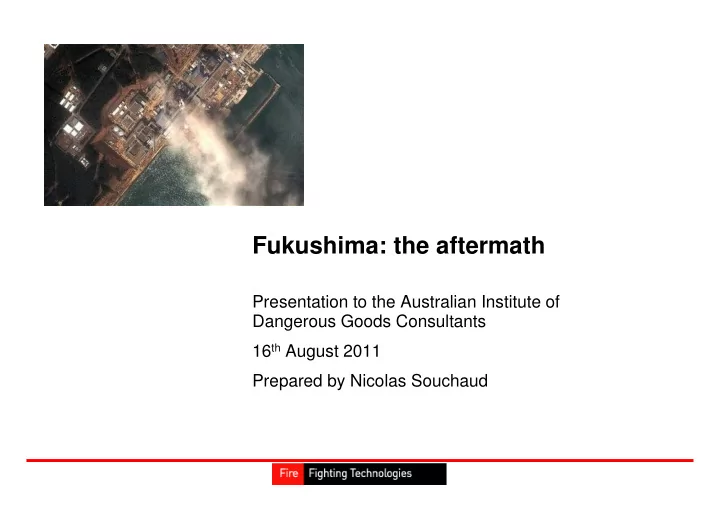
Fukushima: the aftermath Presentation to the Australian Institute of - - PowerPoint PPT Presentation

fukushima the aftermath
SMART_READER_LITE
LIVE PREVIEW

Fukushima: the aftermath Presentation to the Australian Institute of - - PowerPoint PPT Presentation

Fukushima: the aftermath Presentation to the Australian Institute of Dangerous Goods Consultants 16 th August 2011 Prepared by Nicolas Souchaud Agenda Introduction Nuclear Power Plants Japan Germany France United


slide-1
SLIDE 1

Fukushima: the aftermath

Presentation to the Australian Institute of Dangerous Goods Consultants 16th August 2011 Prepared by Nicolas Souchaud

slide-2
SLIDE 2

1

Agenda

  • Introduction
  • Nuclear Power Plants

– Japan – Germany – France – United Kingdom – Slovenia – Sweden – Lithuania – European Union – Korea – China – United States of America – World

  • Conclusion
  • Q & A
slide-3
SLIDE 3

2

Introduction

  • HYTRANS High Volume Pump

– Purpose: to carry large amounts of water over long distances – Containerized equipment including hydraulically driven submersible pump(s) and diesel engine power pack

  • Earthquakes and fires following earthquakes

– August 1999: Izmit earthquake and ensuing refinery fire – 2010: City of Berkeley’s Mobile Disaster Fire Protection System – 24th February 2011: Christchurch earthquake

slide-4
SLIDE 4

3

NPPs - Japan

  • Japan imports 99% of its oil

– after 1973 oil shock, push for NPP

  • NIMBY after Three Mile Island & Chernobyl

– some of the highest electricity tariffs in the world – nuclear industry on the mend since

  • in 2005, 25% of Japanese felt nuclear energy was safe
  • in 2010, 40% felt so
  • in July 2011, 70.3% wanted Japan to do away with nuclear power
  • Nuclear represents 30% of Japan’s power generation (was meant to increase to 37% by 2014)
  • There are 54 reactors at 21 NPPs

– 9 new reactors by 2020 – 5 more by 2030

  • 10 electrical power companies
slide-5
SLIDE 5

4

NPPs - Japan

  • March 11: a Magnitude 9 subsea megathrust earthquake

struck off the north west coast of Japan

  • March 11: following the earthquake, a tsunami hits.

Fukushima, a 2nd generation NPP with 4+2 reactors, gets hit affecting ¼ of Tokyo power generation capacity – Electrical power supply (main & emergency) was knocked out – Core Cooling System (main & Emergency) pumps ceased to function – Nuclear fuel rods heated up (possibly piercing through the tanks of reactors 1, 2 and 3)

  • March 18: SDF and TFD use truck-mounted monitors to

spray sea water on reactor #3 to cool down the facility’s

  • verheating fuel rods. The Tokyo Fire Department has 8

High Volume Pumps each with 3km of hoses. 2 were used at Fukushima.

slide-6
SLIDE 6

5

NPPs - Japan

  • March 22: a converted concrete pump truck

with 62m boom replaces fire trucks

  • March 30: 4 more converted concrete pump

trucks are flown in

  • May 2: Parliament passed a $50 billion

emergency budget for disaster relief – FDMA to purchase 3 x 22,000L/min HYTRANS pumps

slide-7
SLIDE 7

6

NPPs - Japan

  • June 7:

– Review of radioactive emissions upward: 770 000 TeraBecquerels (15% of Chernobyl’s) – Creation of independent nuclear safety authority

  • June 11:

– TEPCO shares fell 75% since March 11 with 28% of its installed capacity still shut down (Fukushima is 1.8% of Japan’s energy capacity) – TEPCO’s objectives remain the same:

  • 6-10m3/h of fresh water is pumped, still using a temporary system, in the reactors’ vessel to

cool the 4 reactors’ fuel

  • Pump nitrogen to avoid oxygen/hydrogen mix build-up
  • After stabilisation, take control with definitive closed-loop cooling system
  • June 15:

– Radioactive water treatment plant operational, treating 1,000 tons per day

slide-8
SLIDE 8

7

NPPs - Japan

  • July 15:

– 30,000 tons of radioactive water treated

  • July 19:

– Government announces the end of the first step in the 6 nuclear reactors’ stabilization process, with a closed loop cooling system, but for reactor 4

  • July 24:

– 70.3% of Japanese polled support Prime Minister Naoto Kan's call to do away with nuclear power

  • July 29:

– 100,000 tons of highly radioactive water still to be treated

  • Looking ahead:

– The cooling system to be re-established in full in January 2012 – Water decontamination

  • Less radioactive water
  • Highly radioactive mud (120 x less volume)

– 2500 tons of uranium to dismantle => 10 to 20 year operation

slide-9
SLIDE 9

8

NPPs - Japan

  • HYTRANS has sold so far

– 3 x 22,000L/min pumps to FDMA – 4 x 3,500L/min pumps with Hose Recovery Units and several km hose to Atomic Power Company and Kansai Power Company

slide-10
SLIDE 10

9

NPPs - Germany

  • 2006: during a heat wave, the KGG NPP ordered 2 High Volume Pumps as a mobile back-up cooling system
  • March 14: Germany’s coalition government announced a three-month delay in its decision to extend the lifespan of

Germany’s 17 elderly NPPs

  • March 15: Chancellor Angela Merkel announced the temporary closure of the 7 NPPs (out of Germany’s 17

reactors still in operation)

  • May 30:

– Germany decides to close all its reactors by 2022, which represent 23% of its gross electricity generation – The 7 NPPs (and an 8th reactor that experienced repetitive breakdowns) will never be re-activated – Berlin wishes to cut Germany’s electricity consumption by 10% – Berlin banks on offshore wind farms, gas and coal power plants The 7 NPPs being shut down means: 6.6% of Germany’s electricity generation lost More imports of gas from Russia Imports from France (nuclear) and the Czech Republic (coal) doubled overnight CO2 emissions may increase 4%

  • July 14: The federal agency responsible for power supply, warns that Germany could face power shortages come

the winter unless there is sufficient power generating capacity in reserve.

slide-11
SLIDE 11

10

NPPs - France

France has 59 reactors (out of Europe’s 144) generating 80-85% of the country’s electricity Electricity in France is 40% cheaper than the European average, 50% cheaper than Germany’s

  • March 23: NPP safety 5-point audit requested by the French Prime Minister with a preliminary report due before the

end of 2011 (flooding risk / earthquake risk / power supply loss / water cooling system loss / incident operational management)

  • March 25: President Sarkozy promised to shut down the NPPs which fail tests conducted by the EU
  • June 5: poll shows that

– 62% of French people want out of nuclear over 25 to 30 years – 15% want out quickly – 55% aren’t concerned about French NPPs

  • June 27: President Sarkozy announces that a billion euros to the nuclear programme of the future, particularly fourth-

generation technology

  • July 25: Greenpeace questions safety of EPR (3rd generation NPP by AREVA in case of power loss longer than 24

hours)

  • July 29: Presentation of EDF’s 2011-2015 strategy. EDF will double their investments to increase lifespan of its NPPs

from 40 to 60 years and reinforce nuclear security

  • 2016: 1st EPR will become operational
slide-12
SLIDE 12

11

NPPs – United Kingdom

The UK has 18 reactors generating about 18% of its electricity and all but one of these will be retired by 2023.

  • May 17: release of Interim Report by the Office for Nuclear Regulation. No major changes needed

for future new NPPs. For existing NPPs, 26 recommendations, e.g. review flood defences, try to minimise the amount kept in spent fuel pools and look at back-up electricity for cooling functions

  • June 23: First major announcement on the future of nuclear in the UK since the Fukushima

accident – The government has renewed its support for nuclear power. It backs a new generation of nuclear power stations because it believes they provide the necessary security of supply while helping reduce carbon emissions. – Eight new nuclear power plant sites named

  • July 20: Nuclear companies have cleared another hurdle in their quest to build new UK power

stations, after parliament approved planning laws allowing plants to be built more quickly The first two stations are due to be completed by EDF and Centrica by 2018. RWE is planning to build the UK's third new nuclear station by about 2020 with fellow German utility E.ON

slide-13
SLIDE 13

12

Krško Nuclear Power Plant - Slovenia

  • 1 x 666MW(e) Westinghouse 2 PWR NPP
  • Construction started in 1975 / connected to the grid in 1981 / end of plant life 2023
  • Part-owned by Slovenia (a EU country) and Croatia (candidate for EU membership)
  • Delivers 37.8% of Slovenia’s and 15% of Croatia’s electricity in 2009

The European commission tightened security requirements and

  • rdered additional tests to be conducted throughout EU

countries especially for NPPs built before the 1990s. Seismic tests showed that a magnitude 5.5 or more earthquake, which is very likely to happen in the region, could leave NPPs without water supply. If no mitigation is implemented, the EU commission threatened to shut down non-compliant NPPs. Whilst regulatory pressure existed prior to the Fukushima accident, the latter translated into urgency to implement mitigation measures It resulted in the immediate purchase of 1 off-the-shelf HS60 + accelerated delivery for 1 x HS450

slide-14
SLIDE 14

13

NPPs - Sweden

Sweden has 3 NPPS and 10 reactors (50%)

  • 1980: ban on nuclear power following Three Mile Island level 5 accident
  • 2010 June 17: Swedish parliament approved a bill by 2 votes (174 Vs 172) to phase out pre-1980

reactors and to build new nuclear reactors on existing NPP sites

  • March 13: Prime Minister Reinfeldt said that there would be no review and that the “decision still

stands”. The lifting of the ban is, for the time being, secure. Government committed to reducing its reliance on greenhouse gases. The government announced also that it was expanding its nuclear regulator’s mandate to include reviewing the safety of the existing reactors.

  • March 22: Poll

– 36% of Swedes support a phasing out of the country’s NPPs (up from 15% in 2008) – 21% of Swedes are in favour of further developing the country’s NP capacity (down from 47% in 2008)

  • May 30: Environment Minister Carlgren criticized Germany’s decision to decommission its NPP as

“unrealistic” to meet the dual challenge of both cutting nuclear power dependency and of climate emissions

slide-15
SLIDE 15

14

NPP - Lithuania

  • 2009: closure of Soviet-era plant in Ignalina. Lithuania was one of the world’s most nuclear-energy

dependent countries

  • March 28-30: 88% of Lithuanians polled oppose a new NPP (was 41% in January)
  • July 14: the Ministry of Energy selected Hitachi-GE to build the country’s new NPP
slide-16
SLIDE 16

15

NPPs – European Union

  • The EU prepares a clean-up of its installed park of NPPs, with safety tests to get rid of the most

vulnerable reactors in order to limit the risk of an accident similar to Fukushima.

  • The test protocol is still to be defined but it will apply to the 143 reactors in operation in 14 of the

EU’s 27 member countries

  • March 21-22: all European nuclear safety authorities met in Helsinki to start defining objectives,

scope, methodology and schedule of pan-European test protocol

slide-17
SLIDE 17

16

NPPs – Korea

Korea has 21 Nuclear Plant Reactors generating 40% of its electricity, 8 more are under construction , 2 are to be shut down and 10 are planned to be built by 2030

  • Late 2009: Korea won its first export contract (4 3rd generation APR1400 reactors for the UAE)
  • Jan 2010: the ministry of Knowledge Economy declared that (Korea) KEPCO would export 80

reactors by 2030 and become the 3rd exporter after France (Areva) and the USA (Westinghouse)

  • Late 2010: Korea announced plan to build 35 NPPs by 2024 to generate 50% of its electricity
  • March 11: The president of the Korean Institute of Nuclear Safety stated, “There is no change in the

government’s plan for expansion of nuclear power plants” by reasoning that “there is no alternative to nuclear energy at this stage.”

  • March 28: the minister of Knowledge Economy reconfirmed South Korea’s commitment to

expanding its nuclear sector as he assured his country’s nuclear industry about his government’s continued support when he stated, "Our answer to the nuclear industry is that we need to keep going."

  • 2013: connection to the grid of KEPCO’s 1st 3rd generation APR1400 reactor
slide-18
SLIDE 18

17

NPPs - China

Of the world’s 65 reactors under construction, 27 are in China According to 5-year plans, today’s capacity of 10.8 GW, is to increase to 40 GW by 2015 and 86 GW by 2020 (6%) with 66 NPPs by 2020T Today China has – 4 NPPs with a total of 11 2nd generation reactors – 4 planned NPPs with a total of 16 planned reactors (10 of which are 3rd generation with 2009 technology by Westinghouse)

  • March 12: the Deputy Chief of Environmental Protection Authority stated that “development of NPPs and

current arrangement on nuclear energy development will not be changed”

  • March 16: the Chinese government only suspended approval for new nuclear power stations so as to

revisit and if necessary revise safety standards

  • March 26: the Chinese government clearly stated its commitment to continue its nuclear program,

reaffirming its goal of developing nuclear power as a clean energy source while stressing the safety of the country's nuclear power facilities

  • March 28: revision of nuclear power targets. 2020 90GW capacity reduced by 10 GW.

Officials expect that the government will probably stop ordering 2nd generation reactors and migrate to 3rd generate ones (Areva’s EPR or Westinghouse’s AP1000)

slide-19
SLIDE 19

18

NPPs – United States of America

The USA has 104 commercial reactors operating at 65 NPPs, generating 19.6% of the country’s

  • electricity. 23 reactors are identical to Fukushima’s 2 reactors that exploded. 12 are newer versions
  • f that model

After 9/11, the cooling system of NPP was identified as a weak point for NPP operators to review

  • March 14: Head of NRC said the 104 reactors in the US were built to withstand earthquakes and

tsunamis.

  • May 31: US President Barack Obama reaffirmed that there won’t be any suspension of the US

nuclear program (20.2%) – pledge to generate 80% of electricity from clean energy sources by 2035 – No new NPP built since the 1979 Three Mile Island partial meltdown In 2007, thanks to loan guarantees for NPP voted by Congress 28 applications for new NPP were filed but today there are only 2 NPP under construction as GFC hit demand Applications to extend 20 NPPs licences are before the government, 15 more expected shortly, 64 have already been granted by the NRC

slide-20
SLIDE 20

19

NPPs - World

  • 440 nuclear reactors operate in 30 countries (80% in OECD countries)
  • they generate 14% of the world’s electricity
  • they have a median age of 27 years (40 year design life)
slide-21
SLIDE 21

20

NPPs - World

slide-22
SLIDE 22

21

NPPs - World

For

  • Despite Fukushima, Japan has no intention of stopping its NPPs (28.9%)
  • India (2.2%) and China (1.9%) have launched extensive nuclear programs to meet their respective

energy needs

  • In Europe, Czech Republic (33.8%), Bulgaria (35.9%), Ukraine, Slovakia, Romania, Lithuania,

Hungary, Finland, Spain and the Netherlands pursue their programs

  • Russia sees no reason to stop work on 10 reactors in development. This frees up gas for export.
  • Asian countries: Pakistan (3%), planned reactors in Bangladesh, Indonesia, Vietnam, Thailand,

Philippines

slide-23
SLIDE 23

22

NPPs - World

Against

  • Austria (0%), Belgium (51.6%), Switzerland (39.5%), Denmark (10% - imported), Portugal, Greece,

Ireland, Latvia, Lichtenstein, Luxembourg, Malta and Norway are turning or have already turned their back on nuclear energy

  • Italy (0% - all 4 reactors already shutdown): on June 12th a referendum said “no thanks” to nuclear

power

  • Australia and New Zealand
  • Malaysia
  • Israel
slide-24
SLIDE 24

23

NPPs - World

slide-25
SLIDE 25

24

NPPs - World

2009 carbon emissions

  • 50 billion tons (industry, deforestation, other gases)
  • 30 billion tons (industry alone)
  • 9 billion tons (electricity generation alone)

Nuclear generation saves 2 billion tons of carbon emissions Comparison:

  • 2 billion tons = total yearly carbon emissions of Germany + Japan
  • Hazelwood

– 16 million tons of carbon emissions per year – 5% of Australia’s total energy demand (25% of Victoria’s) – 2.8% of Australia’s carbon emissions

slide-26
SLIDE 26

25

Conclusion

  • Except for the knee-jerk reaction in “green” Germany, most existing nuclear countries pursue their

program (after reviews of existing plant security) yet public opinion pushes for greater emphasis on gas and renewables plus efficiency

  • Mixed reactions from countries that aspired to build NPPs
  • Fukushima killed low-cost nuclear => renewed focus on 3rd generation reactor
  • An April 12 study by UBS showed that 30 NPPs may be closed as a result of Fukushima
  • Fuel storage and reprocessing are still the industry’s weaknesses
slide-27
SLIDE 27

26

Q & A

Fire Fighting Technologies International Pty Ltd Address: Suite 104, 117 Old Pittwater Road - Brookvale NSW 2100 Phone: +61 2 9091 0360 Email: info@ffti.com.au Web: www.ffti.com.au