
SLIDE 1
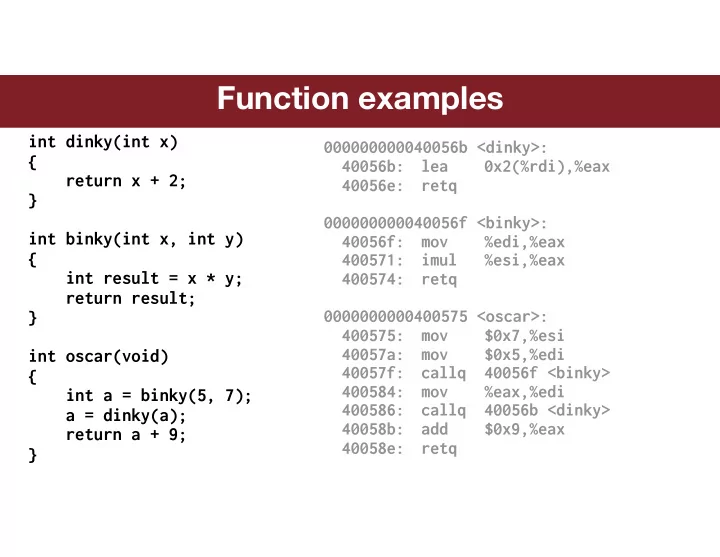
Function examples int dinky(int x) 000000000040056b <dinky>: - - PowerPoint PPT Presentation
Function examples int dinky(int x) 000000000040056b <dinky>: { 40056b: lea 0x2(%rdi),%eax return x + 2; 40056e: retq } 000000000040056f <binky>: int binky(int x, int y) 40056f: mov %edi,%eax { 400571: imul %esi,%eax
push src
Decrement %rsp to make space, store src value at new top of stack
pop dst
Copy topmost value from stack into dst register; increment %rsp
callq <fn>
Transfer control to named function push %rip onto stack (this becomes resume address), set %rip to fn address
retq
pop %rip (resume address should be topmost on stack)
One %rax that is shared by all Need a set of conventions to ensure functions don’t trash other’s data Registers divided into callee-owned and caller-owned
Caller cedes these registers at time of call, cannot assume value will be preserved across call to callee Callee has free reign over these, can overwrite with impunity
Callee-owned: registers for 6 arguments, return value, %r10, %r11
Caller retains ownership, expects value to be same after call as it was before call Callee can "borrow" these from caller but must write down saved value and restore it before returning to caller
Caller-owned: all the rest (%rbx, %rbp, %r12-%r15)
Caller about to make a call, must cede callee-owned registers
If value in a callee-owned register that will be needed after the call, must make a copy before making the call
Callee needs to "borrow" caller-owned register
Must first copy value, later restore the value from saved copy before returning
push to save value to stack, pop to restore
Stored in registers whenever possible
What if too many? Compiler can re-use register when live ranges don’t overlap Spill to stack (push/pop) as needed
What can’t be stored in register?
Variable too large (struct, array) &var used requires that var be stored in memory
If more than 6 arguments, extras passed on stack If parameter or return value does not fit in 64-bit register (struct?), written to stack
How recursion is implemented Why local variables allocated on stack are cheap Why initial contents of locals is garbage, how can change with context of call Consequence of function returning address into deallocated stack frame
Resume address is stored in stack frame If access to neighbor overruns (such as access off end of array), what is consequence? If resume address is trashed, what happens?
Execution must be faithful to language semantics
Order of operations, precedence, etc.
Must obey conventions for interoperability
Function call/return, use of registers
Instructions must be legal, meet ISA contract
i.e. lea scale must be 1,2, 4, 8
Can re-order operations that don’t have dependencies Can substitute equivalent sequence mov $0, %eax xor %eax, %eax and $0, %eax C spec liberates compiler in terms of undefined behavior
Uninitialized variable, missing return, integer overflow, dereference NULL,…
0000000000400836 <CF>: push %rbp mov %rsp,%rbp mov %rdi,-0x18(%rbp) movq $0x1010101,-0x10(%rbp) mov -0x10(%rbp),%rax shl $0x7,%rax mov %rax,-0x8(%rbp) mov -0x18(%rbp),%rax sub -0x10(%rbp),%rax and -0x8(%rbp),%rax pop %rbp retq
unsigned int CF(unsigned int val) { unsigned int ones = ~0U/UCHAR_MAX; unsigned int highs = ones << (CHAR_BIT - 1); return (val - ones) & highs; }
How does knowing this influence how you write the code in the first place?
0000000000400860 <CSE>: push %rbp mov %rsp,%rbp mov %edi,-0x14(%rbp) mov %esi,-0x18(%rbp) mov -0x18(%rbp),%eax add $0x32,%eax mov %eax,-0x8(%rbp) mov -0x14(%rbp),%eax imul -0x8(%rbp),%eax mov -0x18(%rbp),%edx add $0x32,%edx sub %edx,%eax mov %eax,-0x4(%rbp) mov -0x18(%rbp),%eax lea 0x32(%rax),%edx mov -0x4(%rbp),%eax
Also can apply to repeated address calculations!
int CSE(int num, int val) { int a = (val + 50); int b = num*a - (50 + val); return (val + (100/2)) + b; }
0000000000400892 <SR>: push %rbp mov %rsp,%rbp mov %edi,-0x14(%rbp) mov -0x14(%rbp),%edx mov %edx,%eax shl $0x2,%eax add %edx,%eax mov %eax,-0x8(%rbp) mov -0x14(%rbp),%eax mov $0x1,%edx mov %eax,%ecx mov %edx,%esi shl %cl,%esi mov -0x8(%rbp),%eax cltd idiv %esi mov %eax,-0x4(%rbp) mov -0x8(%rbp),%edx mov -0x4(%rbp),%eax
int SR(int val) { unsigned int b = 5*val; int c = b / (1 << val); return (b + c) % 2; }
Cost-per-instruction varies, not all created equal
00000000004008c2 <CM>: push %rbp mov %rsp,%rbp mov %edi,-0x14(%rbp) movl $0x0,-0x4(%rbp) mov -0x14(%rbp),%eax add %eax,%eax lea 0x0(,%rax,8),%edx sub %eax,%edx mov %edx,%eax add $0x6,%eax add %eax,-0x4(%rbp) mov $0x9,%eax cltd idivl -0x14(%rbp) cmp -0x4(%rbp),%eax jg 4008d0 <CM+0xe> mov -0x4(%rbp),%eax pop %rbp retq
0000000000400840 <CM>: mov $0x9,%eax xor %ecx,%ecx cltd idiv %edi imul $0xe,%edi,%esi add $0x6,%esi add %esi,%ecx cmp %eax,%ecx jl 400850 <CM+0x10> mov %ecx,%eax retq
int CM(int val) { int sum = 0; do { sum += 6 + 14*val; } while (sum < (9/val)); return sum; }
Why is beneficial to move work outside loop body?
00000000004008f9 <DC>: push %rbp mov %rsp,%rbp sub $0x20,%rsp mov %edi,-0x14(%rbp) mov %esi,-0x18(%rbp) mov -0x14(%rbp),%eax cmp -0x18(%rbp),%eax jge 400921 <DC+0x28> mov -0x14(%rbp),%eax cmp -0x18(%rbp),%eax jle 400921 <DC+0x28> mov $0x400e0c,%edi callq 400690 <puts@plt> movl $0x0,-0x4(%rbp) jmp 400938 <DC+0x3f> mov -0x8(%rbp),%eax imul -0x4(%rbp),%eax mov %eax,-0x8(%rbp) addl $0x1,-0x4(%rbp) cmpl $0x270e,-0x4(%rbp) jle 40092a <DC+0x31> mov -0x14(%rbp),%eax cmp -0x18(%rbp),%eax jne 40094f <DC+0x56> addl $0x1,-0x14(%rbp) jmp 400953 <DC+0x5a> addl $0x1,-0x14(%rbp) cmpl $0x0,-0x14(%rbp)
int DC(int a, int b) { if (a < b && a > b) // can never be true! printf("The end of the world is near!"); int result; for (int i = 0; i < 9999; i++) result *= i; if (a == b) a++; // if/else obviously same else a++; if (a == 0) return 0; // if/else same, not so obvious else return a; }
0000000000400692 <main>: push %rbp mov %rsp,%rbp sub $0x20,%rsp mov %edi,-0x14(%rbp) mov %rsi,-0x20(%rbp) mov $0x0,%eax callq 400450 <rand@plt> mov %eax,-0x4(%rbp) mov -0x4(%rbp),%eax mov %eax,%edi callq 400566 <CF> mov %eax,%edx mov -0x4(%rbp),%eax add %edx,%eax mov %eax,-0x4(%rbp) mov -0x4(%rbp),%eax mov $0x6b,%esi mov %eax,%edi callq 400588 <CSE> add %eax,-0x4(%rbp) mov $0x6b,%edi callq 4005ba <SR> add %eax,-0x4(%rbp) mov $0x6b,%edi
0000000000400430 <main>: sub $0x8,%rsp xor %eax,%eax callq 400410 <rand@plt> lea -0x1010101(%rax),%edx add $0x8,%rsp and $0x80808080,%edx add %edx,%eax imul $0x9e,%eax,%eax lea 0xbc3(%rax,%rax,1),%eax retq int main(int argc, char *argv[]) { int x = rand(); x += CF(x); x += CSE(x, 107); x += SR(107); x += CM(107); x += DC(x, 107); return x; }
Decomposition is good! Have your cake and eat it, too!