Functional Assessment of The Lower Kinetic Chain Dr. Anthony Luke - - PowerPoint PPT Presentation

functional assessment of the lower kinetic chain
SMART_READER_LITE
LIVE PREVIEW

Functional Assessment of The Lower Kinetic Chain Dr. Anthony Luke - - PowerPoint PPT Presentation

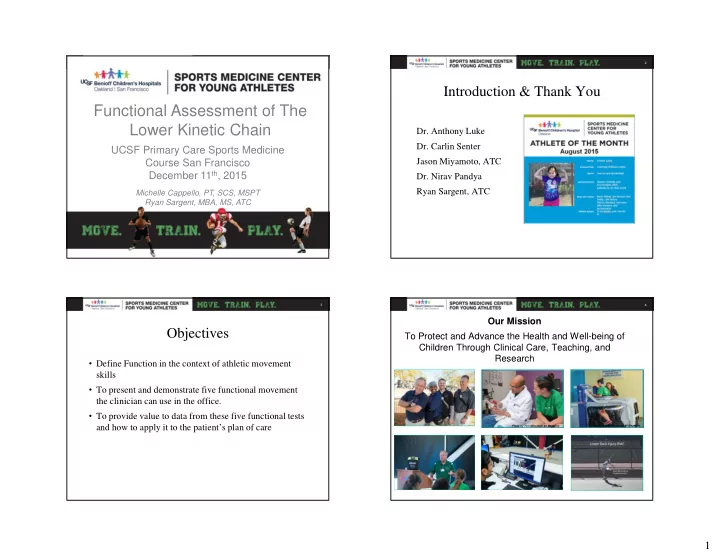
1 2 Introduction & Thank You Functional Assessment of The Lower Kinetic Chain Dr. Anthony Luke Dr. Carlin Senter UCSF Primary Care Sports Medicine Jason Miyamoto, ATC Course San Francisco December 11 th , 2015 Dr. Nirav Pandya


slide-1
SLIDE 1

1

1

Functional Assessment of The Lower Kinetic Chain

UCSF Primary Care Sports Medicine Course San Francisco December 11th, 2015

Michelle Cappello, PT, SCS, MSPT Ryan Sargent, MBA, MS, ATC

2

Introduction & Thank You

  • Dr. Anthony Luke
  • Dr. Carlin Senter

Jason Miyamoto, ATC

  • Dr. Nirav Pandya

Ryan Sargent, ATC

3

Objectives

  • Define Function in the context of athletic movement

skills

  • To present and demonstrate five functional movement

the clinician can use in the office.

  • To provide value to data from these five functional tests

and how to apply it to the patient’s plan of care

4

The Mission

Our Mission To Protect and Advance the Health and Well-being of Children Through Clinical Care, Teaching, and Research

Photo by Tom Minczeski 86 Magazine Photo by Tom Minczeski 86 Magazine

slide-2
SLIDE 2

2

5

Define Function

func·tion

  • 1. an activity or purpose

natural to or intended for a person or thing.

  • 2. perform

6

Antonyms of Function

Inactivity, idleness… Sit: to rest with the body supported by the buttocks, to remain inactive

7

Our Mission To Protect and Advance the Health and Well-being

  • f Children [people]…

The body is a motion machine; If it stops moving, it’s systems slow down: muscular, lymphatic, digestive and circulatory

8

  • Slouching is depressing (2012 SF State)
  • Poor digestion: squished organs is like stepping on a garden hose
  • Compression: Slumped sitting adds 175% more intradiscal pressure
  • vs. standing. Shallow breathing – diaphragm is a spinal stabilizer
  • Immobility leads to further immobility – we lose our S curve in our

spine and can’t absorb shock

  • Immobility leads to heart disease: the heart needs increased effort to

pump blood that pools in the lower body

  • So, Straighten up & MOVE

Our Mission To Protect and Advance the Health and Well-being

  • f Children [people]…
slide-3
SLIDE 3

3

9

Primal “Natural” Movements

Rolling Crawling Squat Lunge

10

Primal “Natural” Movements

11

Primal “Natural” Movements

12

Primal “Natural” Movements

slide-4
SLIDE 4

4

13

What Is Functional Testing? And Why you should do it?

  • Ability to move in multi-planar directions as assessed

via non-traditional testing.

  • Test provide qualitative and quantitative information
  • Activities in daily living
  • Building blocks of movement in context of life & sport
  • Relates to developmental mile stones in critical stages
  • f growth

14

How & Why Move

Afferent Input – joint position senses information Muscle Balance – agonist/antagonist, tight/weak Reflexive / Automatic Activation – ON/OFF, stabilize to mobilize Muscular Endurance – coordination of movement patterns, posture

Lower Crossed Syndrome www.jandaapproach.com

15

Structure vs. Function

Functional Continuum Identify the Source vs. the Cause of symptoms Painful Limited Plan of care: training mobility vs. stability

16

slide-5
SLIDE 5

5

17

Lower Quarter Screen

18

Definition of Tests

1.Deep Squat 2.Single Leg Balance 3.Single Leg Squat 4.Hop for Distance 5.Front Plank/Push-up Test

19

Standing Dynamic Functional Positions

typically find an athlete in 1 of 3 positions when engaged with the ground

= = =

Test in these positions to test how stable and mobile they are so we know were to go in our training programs

20

Deep Squat/Overhead Deep Squat

  • Purpose

– Assess mobility of hips, knees, and ankles – Overhead reach for thoracic spine and shoulders

  • Procedure

– Position the client/athlete so that they are standing with feet shoulder-width apart. – Overhead squat: Hold the dowel so that a 90°angle is formed at bilateral elbows when the dowel is just above the head. – Have client press the dowel overhead until bilateral elbows are extended. – Instruct client to gradually descend into a squat position with bilateral heels on the floor and the dowel extended maximally overhead.

  • Analysis of optimal movement

– Upper torso parallel with tibia – Femur below horizontal – Knees aligned over feet – Down aligned over feet

  • Interpretation of movement faults

– Limited mobility – Strength deficit in quads or gluteals

slide-6
SLIDE 6

6

21

Deep Squat

22

Single Leg Balance

  • Purpose

– Observe pelvic control for functional stability – Indicator of balance strategies – Single-leg stance indicative of mid-stance

  • Procedure

– Stand on one leg – Raise opposite hip to 45°/ knee to 90° – Arms at side

  • Analysis of optimal movement

– Look for excessive pelvic shift – Note pelvic unleveling – Excessive shaking or rotation of knee or ankle

  • Interpretation of movement faults

– Inhibition or weakness of lateral pelvic stabilizer – Over-dominance of hip medial rotators – Poor proprioception

23

Single Leg Balance Coaching Points

GOOD BAD

24

Single Leg Squat

  • Purpose

– Assess Functional Strength – Assess Balance – Assess Dynamic Flexibility

  • Procedure

– Stand on single leg – Keep Trunk and Upper Body Upright – Squat down as far as possible

  • Analysis (Qualitative)

– Watch for excessive knee flexion – Note loss of balance or uncontrolled motions

  • Interpretation

– Poor Glute or Quad Strength – Poor Balance – Decreased Trunk Control

slide-7
SLIDE 7

7

25

Single Leg Squat Coaching Points

26

Single Leg Hop for Distance

  • Purpose

– Functional lower extremity test – as part of a Hop Test sequence as described by Noyes. Noyes FR, Barber SD, Mangine RE. Abnormal lower limb symmetry determined by function hop tests after anterior cruciate ligament rupture. Am J Sports Med. 1991; 19: 513– 51 – Assess overall single lower extremity power, balance and control as it relates to limb symmetry

  • Procedure

– Keep hand placement consistent – i.e. hands on hips, behind the back, free – Jump Horizontally as far as possible – Hold landing position for 2 seconds

  • Analysis

– Based on distance jumped – Determine limb symmetry – Quality is important Karyn Haitz, Rebecca Shultz, Melissa Hodgins, Gordon O. Matherson, J Ortho Sports Phys Ther 2014.

  • Interpretation

– Relationship between asymmetry and limitations in jumping/landing in healthy athletes have < 9% difference. – Mean values: Men 154.5 cm Women 121.2 cm

Start 6m 27

Hop for Distance Coaching Points

Hop Test Sequence

4 Hop Test Sequence:

  • Single-leg Hop
  • Timed Hop Over a 6-m Course
  • Triple Hop
  • Crossover Hop

28

Front Plank/Prone Bridge

  • Purpose

– To assess static/isometric trunk endurance and control

  • Procedure

– Prone on elbows – Elbows shoulder width apart – Feet in narrow base without touching – Elevate trunk so only forearms and toes are on the ground – Maintain shoulder, hips, and ankles in a straight line – Hold until fatigued, record time

  • Analysis

– Record time until athlete is no longer able to hold position

  • Interpretation

– Significant decreased time in those with back pain – Mean Values in seconds: – Clients without back pain = 72.5 s, Clients with back pain = 28.3 s (pain generated at 15 seconds)

slide-8
SLIDE 8

8

29

Front Plank/Push Up Coaching Points

GOOD BAD

30

Lower Quarter Screen

Post Testing Pre Testing

Drop Jump Drop Jump Deceleration Deceleration Peak VIT Peak VIT 31

Questions?

Ryan Sargent, MBA ATC Program Manager of Athlete Development rsargent@mail.cho.org Michelle Cappello, PT, SCS Clinical Director Sports Medicine Center for Young Athletes mcappello@mail.cho.org