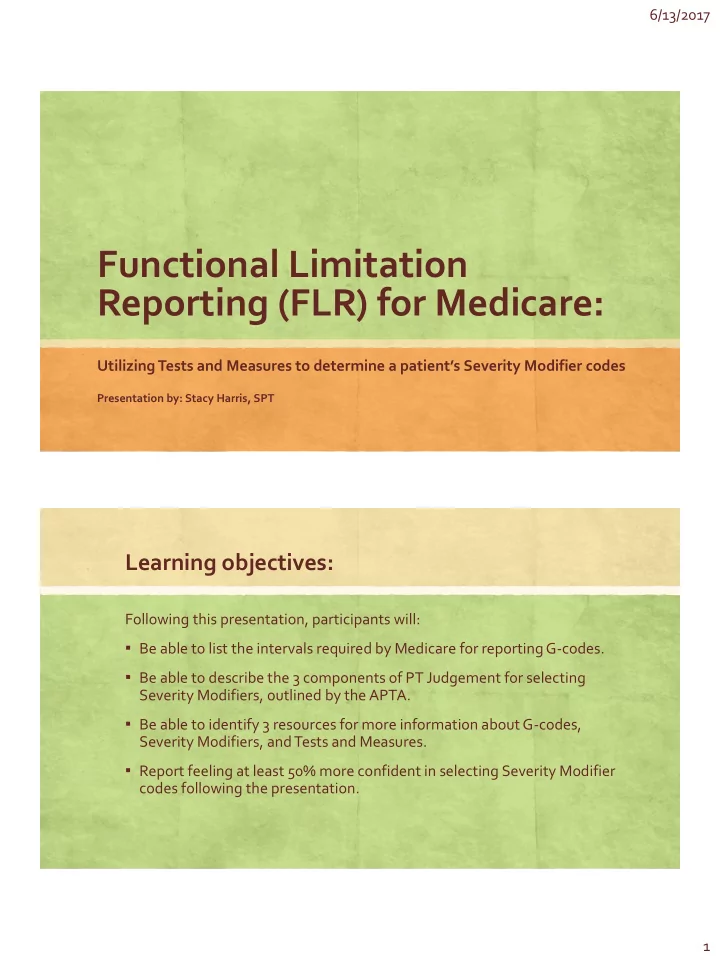
Functional Limitation Reporting (FLR) for Medicare: Utilizing Tests - - PDF document

functional limitation
SMART_READER_LITE
LIVE PREVIEW

Functional Limitation Reporting (FLR) for Medicare: Utilizing Tests - - PDF document

6/13/2017 Functional Limitation Reporting (FLR) for Medicare: Utilizing Tests and Measures to determine a patients Severity Modifier codes Presentation by: Stacy Harris, SPT Learning objectives: Following this presentation, participants


slide-1
SLIDE 1

6/13/2017 1

Functional Limitation Reporting (FLR) for Medicare:

Utilizing Tests and Measures to determine a patient’s Severity Modifier codes

Presentation by: Stacy Harris, SPT

Learning objectives:

Following this presentation, participants will:

▪ Be able to list the intervals required by Medicare for reporting G-codes. ▪ Be able to describe the 3 components of PT Judgement for selecting

Severity Modifiers, outlined by the APTA.

▪ Be able to identify 3 resources for more information about G-codes,

Severity Modifiers, and Tests and Measures.

▪ Report feeling at least 50% more confident in selecting Severity Modifier

codes following the presentation.

slide-2
SLIDE 2

6/13/2017 2

Introduction to Functional Limitation Reporting

Definition of Functional Limitation used by CMS1

The International Classification of Functioning, Disability and Health (ICF) Functional Limitation = Activity Limitation + Participation Limitation

slide-3
SLIDE 3

6/13/2017 3

Intervals for Reporting Functional Limitation G-codes1

Typically:

  • 1. Evaluation
  • 2. Progress reporting
  • 3. Discharge

Also when:

▪ Primary functional limitation has ended and therapy is needed for a

different limitation in the same episode of care

Selecting the Primary Functional Limitation1

It should reflect the predominant limitation that therapy is intended to address. If more than one limitation exists, the primary is chosen as:

  • 1. Most clinically relevant to a successful outcome
  • 2. Yields the quickest and/or greatest progress
  • 3. Greatest priority for patient
slide-4
SLIDE 4

6/13/2017 4

Progression of Reporting1 PT G-Code Categories1

  • 1. Mobility: Walking & Moving Around
  • 2. Changing & Maintaining Body Position
  • 3. Carrying, Moving & Handling Objects
  • 4. Self-Care
  • 5. Other PT/OT Primary Functional Limitation
  • 6. Other PT/ OT Subsequent Functional Limitation
slide-5
SLIDE 5

6/13/2017 5

Clarification of PT G-Code Categories:2

http://www.apta.org/Payment/Medicare/C

  • dingBilling/FunctionalLimitation/Clarifica

tionofICFCategories/

More information on use of “Other” categories1

Use the “other” categories when…

▪ Functional Limitation is not defined by 1 – 4

▪ Ex. Pelvic Health

▪ Therapy is not intended to treat a Functional Limitation

▪ Ex. Wound Care

▪ Selected measurement tool provides a composite functional score

AND limitation is not clearly defined by 1 – 4

▪ Ex. OPTIMAL by APTA – Limitations may be in more than one category

slide-6
SLIDE 6

6/13/2017 6

Severity Modifier:1

Indicates the % of Functional Impairment Determined by:

▪ Score from assessment tool, if composite (ex. OPTIMAL by APTA) ▪ Clinical judgement when combining multiple measurement tools ▪ Clinical judgement to assign modifiers ▪ 0% impairment when not intended to address Functional Limitation

Considerations for Determining Severity Modifier Codes

slide-7
SLIDE 7

6/13/2017 7

CMS recommends using these tools (not required):3

  • 1. National Outcomes Measurement System (NOMS) by the American

Speech-Language Hearing Association

  • 2. Patient Inquiry by Focus On Therapeutic Outcomes, Inc. (FOTO)
  • 3. Activity Measure – Post Acute Care (AM-PAC)
  • 4. OPTIMAL by Cedaron through the American Physical Therapy

Association

Outpatient Physical Therapy Improvement in Movement Assessment Log (OPTIMAL) 4

http://www.apta.org/ OPTIMAL/

slide-8
SLIDE 8

6/13/2017 8

4 4

Scoring:

4

slide-9
SLIDE 9

6/13/2017 9

4 4

slide-10
SLIDE 10

6/13/2017 10

4

If you choose not to use CMS recommended tools: 3

Therapist must document objective, measurable patient physical function using:

▪ Functional assessment individual item and summary scores

OR

▪ Functional assessment scores from tests and measurements

validated in the professional literature appropriate for the condition OR

▪ Other measurable progress towards goals for functioning in the

home environment

slide-11
SLIDE 11

6/13/2017 11

APTA’s EDGE Taskforce5

Suggested Tests/Measures for “High-Volume Conditions” http://www.ptnow.org/FunctionalLimitationReporting/TestsMeasures

APTA Tests and Measures Database6

http://www.ptnow.org/tests-measures

slide-12
SLIDE 12

6/13/2017 12

APTA Clinical Summaries7

Information on Managing Specific Conditions http://www.ptnow.org/clinical-summaries http://www.ptnow.org/clinical-summaries-detail/urniary-incontinence8

slide-13
SLIDE 13

6/13/2017 13

Requirements for Reporting G-Codes

Reporting Example1

slide-14
SLIDE 14

6/13/2017 14

Required Documentation1

▪ How was selection made?

  • Include details
  • Need to be able to reproduce the process

▪ Long term goals must align with functional impairments ▪ Progress reports required at least every 10 treatment days

Unique situations1

  • 1. No functional limitation

▪ Ex. Wound care – “Other” PT/OT Primary Functional Limitation, 0% impaired

for current status and goal

  • 2. Maintenance therapy
  • Medicare Benefit Policy Manual

▪ 220.2 – Reasonable and Necessary Outpatient Rehabilitation Therapy Services,

Section D – Maintenance Programs

▪ Parkinson’s, MS, Progressive Degenerative Disease ▪ https://www.cms.gov/Regulations-and-

Guidance/Guidance/Manuals/Downloads/bp102c15.pdf

slide-15
SLIDE 15

6/13/2017 15

Choosing Appropriate Tests and Measures

Types of Standardized Measurements1

▪ Performance based

▪ Abilities of patient are measured based on specific tasks directed to them by

the therapist

▪ Ex. Berg, 6 Min Walk test, 9 Hole Peg Test

▪ Self-report

▪ Surveys measure a patient’s perceived impact of the disorder/symptoms on

their basic functions, activities, and participation

▪ Ex. OPTIMAL, Oswestry Disability Index, Parkinson’s Disease Quality of Life

questionnaires

slide-16
SLIDE 16

6/13/2017 16

Selecting a Standardized Measure1

Important Characteristics

▪ Reliability – captures the same info, under same conditions, by 1 or more

examiners (precision)

▪ Validity – measures what it claims to measure (accuracy) ▪ Standard Error of Measure (SEM) – the extent of the measurement error among

repeated scores, helps determine range of “true” scores

▪ Responsiveness – ability to detect change ▪ Minimal Detectable Change (MDC) – amount of change you have to exceed to

show true change beyond the error of the tool

▪ Minimal Clinically Important Difference (MCID) - the amount of change needed

for us to believe there has been a clinically meaningful change

Where to look?9

Rehab Measures Database - http://www.rehabmeasures.org

Browse Instruments Search by Category Search by Instrument Name OR Just go to “Google” and type “rehab measures” followed by instrument name.

  • Ex. “rehab measures TUG”
slide-17
SLIDE 17

6/13/2017 17

Using Clinical Judgement

Tests and Measures: Determining % Limitation

▪ Many factors to consider:

▪ Score interpretation guidelines included with instrument ▪ Norms

Age

Gender

Diagnosis (i.e. stroke, Parkinson’s, TBI)

▪ Cut-Off Scores ▪ MCID

▪ Examples: Berg Balance Scale, Dynamic Gait Index

slide-18
SLIDE 18

6/13/2017 18

Integrating Results – 3 Components1 When can a score be used on its own? 1

Things to consider…

  • 1. If it has good predictive validity

▪ Predictive validity – the ability of the outcome of the test to predict a future

  • utcome
  • 2. Are there other patient characteristics that can influence outcome
  • f assessment

▪ Ability to follow directions, level of alertness, etc.

slide-19
SLIDE 19

6/13/2017 19

Determining G-Code/Severity Modifiers1

Functional Limitation Reporting Toolkit – http://www.apta.org/FLR/Toolkit/

▪ Examples, Pg. 12

▪ Example 1: Interpretation of Scores For Performance-Based Instrument ▪ Example 2: Interpretation of Scores For Self-Report Instrument

▪ Case Studies, Pg. 13 – 17

▪ Case 2: Orthopedic Patient, Private Practice Setting

Other Useful Links

▪ Medicare Functional Reporting Information -

https://www.cms.gov/Medicare/Billing/TherapyServices/Functional- Reporting.html

▪ APTA General Information on Functional Limitation Reporting -

http://www.apta.org/Payment/Medicare/CodingBilling/FunctionalLi mitation/ (APTA Member Access)

slide-20
SLIDE 20

6/13/2017 20

Questions?

Resources

1.

  • APTA. Functional Limitation Reporting for Medicare Part B Patients: A Toolkit. http://www.apta.org/FLR/Toolkit/. Accessed June 12, 2017.

2.

  • APTA. Functional Limitation Reporting Categories and the International Classification of Functioning, Disability and Health (ICF).

http://www.apta.org/Payment/Medicare/CodingBilling/FunctionalLimitation/ClarificationofICFCategories/. Accessed June 12, 2017.

3.

  • CMS. Medicare Benefit Policy Manual Chapter 15. https://www.cms.gov/Regulations-and-

Guidance/Guidance/Manuals/Downloads/bp102c15.pdf. Accessed June 12, 2017.

4.

  • APTA. OPTIMAL 1.1 Data Collection Instrument. http://www.apta.org/OPTIMAL/. Updated October 10, 2013. Accessed June 12, 2017.

5.

  • APTA. Functional Limitation Reporting (FLR) Under Medicare: Tests and Measures for High-Volume Conditions. PT Now.

http://www.ptnow.org/FunctionalLimitationReporting/TestsMeasures. Accessed June 12, 2017.

6.

  • APTA. Tests & Measures. PT Now. http://www.ptnow.org/tests-measures. Accessed June 12, 2017.

7.

  • APTA. Clinical Summaries. PT Now. http://www.ptnow.org/clinical-summaries. Accessed June 12, 2017.

8.

  • APTA. Urinary Incontinence in Women. PT Now. http://www.ptnow.org/clinical-summaries-detail/urniary-incontinence. Accessed June 12,

2017.

9.

Rehabilitation Institute of Chicago. Rehabilitation Measures Database. http://www.rehabmeasures.org. Accessed June 12, 2017.

slide-21
SLIDE 21

6/13/2017 21

Thank you!