
SLIDE 1
Fundamental Principle of Counting
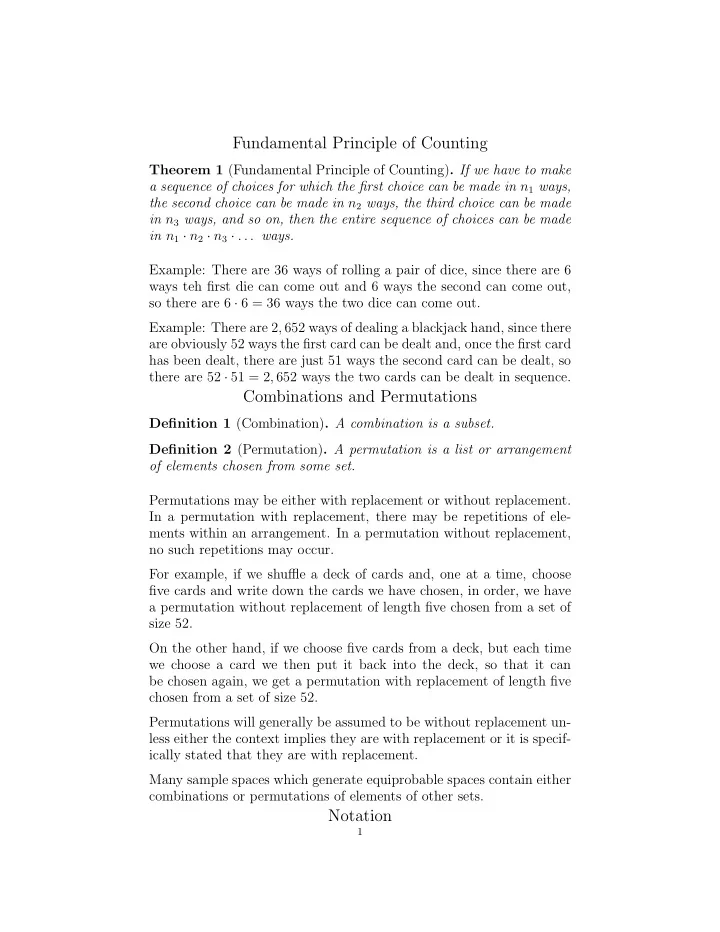
Theorem 1 (Fundamental Principle of Counting). If we have to make a sequence of choices for which the first choice can be made in n1 ways, the second choice can be made in n2 ways, the third choice can be made in n3 ways, and so on, then the entire sequence of choices can be made in n1 · n2 · n3 · . . . ways. Example: There are 36 ways of rolling a pair of dice, since there are 6 ways teh first die can come out and 6 ways the second can come out, so there are 6 · 6 = 36 ways the two dice can come out. Example: There are 2, 652 ways of dealing a blackjack hand, since there are obviously 52 ways the first card can be dealt and, once the first card has been dealt, there are just 51 ways the second card can be dealt, so there are 52 · 51 = 2, 652 ways the two cards can be dealt in sequence.
Combinations and Permutations
Definition 1 (Combination). A combination is a subset. Definition 2 (Permutation). A permutation is a list or arrangement
- f elements chosen from some set.