Fundamentals of Signals Overview Equation for a line Definition x ( - - PowerPoint PPT Presentation

fundamentals of signals overview equation for a line
SMART_READER_LITE
LIVE PREVIEW

Fundamentals of Signals Overview Equation for a line Definition x ( - - PowerPoint PPT Presentation

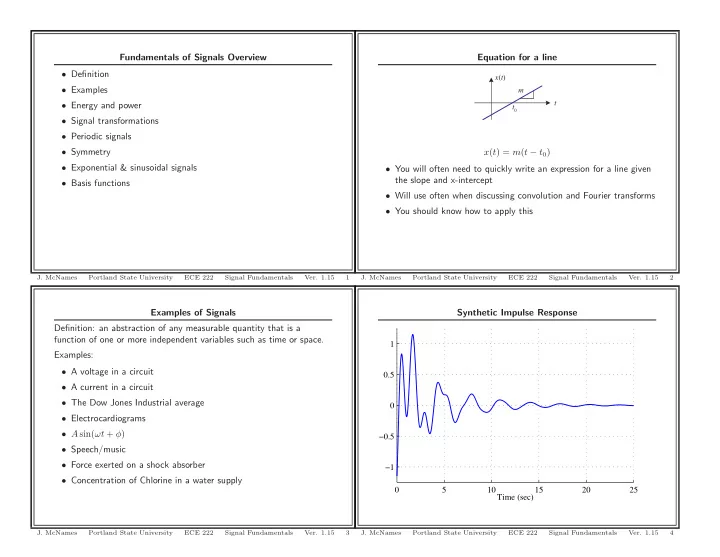
Fundamentals of Signals Overview Equation for a line Definition x ( t ) Examples m t Energy and power t 0 Signal transformations Periodic signals Symmetry x ( t ) = m ( t t 0 ) Exponential & sinusoidal signals


slide-1
SLIDE 1

Examples of Signals Definition: an abstraction of any measurable quantity that is a function of one or more independent variables such as time or space. Examples:

  • A voltage in a circuit
  • A current in a circuit
  • The Dow Jones Industrial average
  • Electrocardiograms
  • A sin(ωt + φ)
  • Speech/music
  • Force exerted on a shock absorber
  • Concentration of Chlorine in a water supply
  • J. McNames

Portland State University ECE 222 Signal Fundamentals

  • Ver. 1.15

3

Fundamentals of Signals Overview

  • Definition
  • Examples
  • Energy and power
  • Signal transformations
  • Periodic signals
  • Symmetry
  • Exponential & sinusoidal signals
  • Basis functions
  • J. McNames

Portland State University ECE 222 Signal Fundamentals

  • Ver. 1.15

1

Synthetic Impulse Response

5 10 15 20 25 −1 −0.5 0.5 1 Time (sec)

  • J. McNames

Portland State University ECE 222 Signal Fundamentals

  • Ver. 1.15

4

Equation for a line

t t0 m x(t)

x(t) = m(t − t0)

  • You will often need to quickly write an expression for a line given

the slope and x-intercept

  • Will use often when discussing convolution and Fourier transforms
  • You should know how to apply this
  • J. McNames

Portland State University ECE 222 Signal Fundamentals

  • Ver. 1.15

2

slide-2
SLIDE 2

Arterial Blood Pressure

0.5 1 1.5 2 2.5 60 70 80 90 100 110 120 Time (sec) ABP (mmHg)

  • J. McNames

Portland State University ECE 222 Signal Fundamentals

  • Ver. 1.15

7

Microelectrode Recording

2 2.01 2.02 2.03 2.04 2.05 2.06 −0.6 −0.4 −0.2 0.2 0.4 0.6 0.8 Time (sec)

  • J. McNames

Portland State University ECE 222 Signal Fundamentals

  • Ver. 1.15

5

Speech

1.2 1.25 1.3 1.35 1.4 1.45 1.5 1.55 1.6 1.65 −0.4 −0.3 −0.2 −0.1 0.1 0.2 0.3 0.4 Time (sec) Linus: Philosophy of Wet Suckers

  • J. McNames

Portland State University ECE 222 Signal Fundamentals

  • Ver. 1.15

8

Electrocardiogram

0.5 1 1.5 2 2.5 6.5 7 7.5 8 8.5 Time (sec)

  • J. McNames

Portland State University ECE 222 Signal Fundamentals

  • Ver. 1.15

6

slide-3
SLIDE 3

Signal Energy & Power

  • For most of this class we will use a broad definition of power and

energy that applies to any signal x(t) or x[n]

  • Instantaneous signal power

P(t) = |x(t)|2 P[n] = |x[n]|2

  • Signal energy

E(t0, t1) = t1

t0

|x(t)|2 dt E(n0, n1) =

n1

  • n=n0

|x[n]|2

  • Average signal power

P(t0, t1) = 1 t1 − t0 t1

t0

|x(t)|2 dt P(n0, n1) = 1 n1 − n0 + 1

n1

  • n=n0

|x[n]|2

  • J. McNames

Portland State University ECE 222 Signal Fundamentals

  • Ver. 1.15

11

Chaos

50 100 150 200 250 300 350 400 450 −15 −10 −5 5 10 15 Time (samples)

  • J. McNames

Portland State University ECE 222 Signal Fundamentals

  • Ver. 1.15

9

Signal Energy & Power Comments Usually, the limits are taken over an infinite time interval E∞ = ∞

−∞

|x(t)|2 dt E∞ =

  • n=−∞

|x[n]|2 P∞ = lim

T →∞

1 2T T

−T

|x(t)|2 dt P∞ = lim

N→∞

1 2N + 1

N

  • n=−N

|x[n]|2

  • We will encounter many types of signals
  • Some have infinite average power, energy, or both
  • A signal is called an energy signal if E∞ < ∞
  • A signal is called a power signal if 0 < P∞ < ∞
  • A signal can be an energy signal, a power signal, or neither type
  • A signal can not be both an energy signal and a power signal
  • J. McNames

Portland State University ECE 222 Signal Fundamentals

  • Ver. 1.15

12

Discrete-time & Continuous-time

  • We will work with both types of signals
  • Continuous-time signals

– Will always be treated as a function of t – Parentheses will be used to denote continuous-time functions – Example: x(t) – t is a continuous independent variable (real-valued)

  • Discrete-time signals

– Will always be treated as a function of n – Square brackets will be used to denote discrete-time functions – Example: x[n] – n is an independent integer

  • J. McNames

Portland State University ECE 222 Signal Fundamentals

  • Ver. 1.15

10

slide-4
SLIDE 4

Example 1: Workspace (2)

  • J. McNames

Portland State University ECE 222 Signal Fundamentals

  • Ver. 1.15

15

Example 1: Energy & Power Determine whether the energy and average power of each of the following signals is finite. x(t) =

  • 8

|t| < 5

  • therwise

x[n] = j x[n] = A cos(ωn + φ) x(t) =

  • eat

t > 0

  • therwise

x[n] = ejωn

  • J. McNames

Portland State University ECE 222 Signal Fundamentals

  • Ver. 1.15

13

Signal Energy & Power Tips

  • There are a few rules that can help you determine whether a

signal has finite energy and average power

  • Signals with finite energy have zero average power:

E∞ < ∞ ⇒ P∞ = 0

  • Signals of finite duration and amplitude have finite energy:

x(t) = 0 for |t| > c ⇒ E∞ < ∞

  • Signals with finite average power have infinite energy:

P∞ > 0 ⇒ E∞ = ∞

  • J. McNames

Portland State University ECE 222 Signal Fundamentals

  • Ver. 1.15

16

Example 1: Workspace (1)

  • J. McNames

Portland State University ECE 222 Signal Fundamentals

  • Ver. 1.15

14

slide-5
SLIDE 5

Example 2: Axes for x(t + 2) & x( t

2)

x(t)

1 1 2 3 4

  • 1
  • 1
  • 2
  • 3
  • 4

t t

1 1 2 3 4

  • 1
  • 1
  • 2
  • 3
  • 4

t

1 1 2 3 4

  • 1
  • 1
  • 2
  • 3
  • 4
  • J. McNames

Portland State University ECE 222 Signal Fundamentals

  • Ver. 1.15

19

Signal Transformations

  • Time shift: x(t − t0) and x[n − n0]

– If t0 > 0 or n0 > 0, signal is shifted to the right – If t0 < 0 or n0 < 0, signal is shifted to the left

  • Time reversal: x(−t) and x[−n]
  • Time scaling: x(αt) and x[αn]

– If α > 1, signal appears compressed – If 1 > α > 0, signal appears stretched

  • J. McNames

Portland State University ECE 222 Signal Fundamentals

  • Ver. 1.15

17

Example 2: Axes for x(2t) & x(2 − 2t)

x(t)

1 1 2 3 4

  • 1
  • 1
  • 2
  • 3
  • 4

t t

1 1 2 3 4

  • 1
  • 1
  • 2
  • 3
  • 4

t

1 1 2 3 4

  • 1
  • 1
  • 2
  • 3
  • 4
  • J. McNames

Portland State University ECE 222 Signal Fundamentals

  • Ver. 1.15

20

Example 2: Signal Transformations

x(t)

1 1 2 3 4

  • 1
  • 1
  • 2
  • 3
  • 4

t t

1 1 2 3 4

  • 1
  • 1
  • 2
  • 3
  • 4

t

1 1 2 3 4

  • 1
  • 1
  • 2
  • 3
  • 4

Use the signal shown above to draw the following: x(−t), x(t − 1), x(t + 2), x( t

2), x(2t), x(2 − 2t).

  • J. McNames

Portland State University ECE 222 Signal Fundamentals

  • Ver. 1.15

18

slide-6
SLIDE 6

Example 4: Odd Symmetry

x(t)

1 1 2 3 4

  • 1
  • 1
  • 2
  • 3
  • 4

t t

1 1 2 3 4

  • 1
  • 1
  • 2
  • 3
  • 4

t

1 1 2 3 4

  • 1
  • 1
  • 2
  • 3
  • 4

Draw the odd component of the signal shown above.

  • J. McNames

Portland State University ECE 222 Signal Fundamentals

  • Ver. 1.15

23

Even & Odd Symmetry xe(t) =

1 2 (x(t) + x(−t))

xo(t) =

1 2 (x(t) − x(−t))

x(t) = xe(t) + xo(t)

  • The symmetry of a signal under time reversal will be useful later

when we discuss transforms

  • A signal is even if and only if x(t) = x(−t)
  • A signal is odd if and only if x(t) = −x(−t)
  • cos(kω0t) is an even signal
  • sin(kω0t) is an odd signal
  • Any signal can be written as the sum of an odd signal and an even

signal

  • J. McNames

Portland State University ECE 222 Signal Fundamentals

  • Ver. 1.15

21

Example 5: Even & Odd Symmetry

t

1 1 2 3 4

  • 1
  • 1
  • 2
  • 3
  • 4

t

1 1 2 3 4

  • 1
  • 1
  • 2
  • 3
  • 4

t

1 1 2 3 4

  • 1
  • 1
  • 2
  • 3
  • 4

Show that the sum of the even and odd components of the signal is equal to the original signal graphically.

  • J. McNames

Portland State University ECE 222 Signal Fundamentals

  • Ver. 1.15

24

Example 3: Even Symmetry

x(t)

1 1 2 3 4

  • 1
  • 1
  • 2
  • 3
  • 4

t t

1 1 2 3 4

  • 1
  • 1
  • 2
  • 3
  • 4

t

1 1 2 3 4

  • 1
  • 1
  • 2
  • 3
  • 4

Draw the even component of the signal shown above.

  • J. McNames

Portland State University ECE 222 Signal Fundamentals

  • Ver. 1.15

22

slide-7
SLIDE 7

Example 6: Aean, A = 1 and a = ± 1

5

−10 −5 5 10 15 20 25 30 200 400 600 −10 −5 5 10 15 20 25 30 2 4 6 8 Time (n)

  • J. McNames

Portland State University ECE 222 Signal Fundamentals

  • Ver. 1.15

27

Periodic Signals A signal is periodic if there is a positive value of T or N such that x(t) = x(t + T) x[n] = x[n + N]

  • The fundamental period,T0, for continuous-time signals is the

smallest positive value of T such that x(t) = x(t + T)

  • The fundamental period,N0, for discrete-time signals is the

smallest positive integer of N such that x[n] = x[n + N]

  • Signals that are not periodic are said to be aperiodic
  • J. McNames

Portland State University ECE 222 Signal Fundamentals

  • Ver. 1.15

25

Example 6: MATLAB Code

n = -10:30; % Time index subplot(2,1,1); y = exp(n/5); % Growing exponential h = stem(n,y); set(h(1),’Marker’,’.’); set(gca,’Box’,’Off’); subplot(2,1,2); y = exp(-n/5); % Decaying exponential h = stem(n,y); set(h(1),’Marker’,’.’); set(gca,’Box’,’Off’); xlabel(’Time (n)’);

  • J. McNames

Portland State University ECE 222 Signal Fundamentals

  • Ver. 1.15

28

Exponential and Sinusoidal Signals Exponential signals x(t) = Aeat x[n] = Aean where A and a are complex numbers.

  • Exponential and sinusoidal signals arise naturally in the analysis of

linear systems

  • Example: simple harmonic motion that you learned in physics
  • There are several distinct types of exponential signals

– A and a real – A and a imaginary – A and a complex (most general case)

  • J. McNames

Portland State University ECE 222 Signal Fundamentals

  • Ver. 1.15

26

slide-8
SLIDE 8

Example 7: MATLAB Code

fs = 500; % Sample rate (Hz) t = -10:1/fs:30; % Time index (s) a = j; A = 1; y = A*exp(a*t); h = plot3(t,imag(y),real(y),’b’); hold on; h = plot3(t,ones(size(t)),real(y),’r’); h = plot3(t,imag(y),-ones(size(t)),’g’); hold off; grid on; xlabel(’Time (s)’); ylabel(’Imaginary Part’); zlabel(’Real Part’); title(’Complex:Blue Real:Red Imaginary:Green’); view(27.5,22);

  • J. McNames

Portland State University ECE 222 Signal Fundamentals

  • Ver. 1.15

31

Sinusoidal Exponential Signal Comments x(t) = Aeat = A(ea)t = Aαt x[n] = Aean = A(ea)n = Aαn When a is imaginary, then Euler’s equation applies: ejωt = cos(ωt) + j sin(ωt) ejωn = cos(ωn) + j sin(ωn)

  • Since |ejωt| = 1, this looks like a coil in a plot of the complex

plane versus time

  • ejωt is Periodic with fundamental period T = 2π

ω

  • Real part is sinusoidal: Re{Aejωt} = A cos(ωt)
  • Imaginary part is sinusoidal: Im{Aejωt} = A sin(ωt)
  • These signals have infinite energy, but finite (constant) average

power, P∞

  • J. McNames

Portland State University ECE 222 Signal Fundamentals

  • Ver. 1.15

29

Sinusoidal Exponential Harmonics

  • In order for ejωt to be periodic with period T, we require that

ejωt = ejω(t+T ) = ejωtejωT for all t

  • This implies ejωT = 1 and therefore

ωT = 2πk where k = 0, ±1, ±2, . . .

  • There is more than one frequency ω that satisfies the constraint

x(t) = x(t + T) where T = 2πk

ω

  • The fundamental frequency is given by k = 1:

ω0 = 2π T0

  • The other frequencies that satisfy this constraint are then integer

multiples of ω0

  • J. McNames

Portland State University ECE 222 Signal Fundamentals

  • Ver. 1.15

32

Example 7: Aeat, A = 1 and a = j

−10 10 20 30 −1 1 −1 −0.5 0.5 1 Imaginary Part Complex:Blue Real:Red Imaginary:Green Time (s) Real Part

  • J. McNames

Portland State University ECE 222 Signal Fundamentals

  • Ver. 1.15

30

slide-9
SLIDE 9

Example 9: Discrete-Time Harmonics

−1 1 φ0 −1 1 φ1 −1 1 φ2 −1 1 φ3 −10 −5 5 10 15 20 25 30 35 40 −1 1 φ4 Time (n)

  • J. McNames

Portland State University ECE 222 Signal Fundamentals

  • Ver. 1.15

35

Sinusoidal Exponential Harmonics Continued A harmonically related set of complex exponentials is a set of exponentials with fundamental frequencies that are all multiples of a single positive frequency ω0 φk(t) = ejkω0t where k = 0, ±1, ±2, . . .

  • For k = 0, φk(t) is a constant
  • For all other values φk(t) is periodic with fundamental frequency

|k|ω0

  • This is consistent with how the term harmonic is used in music
  • Sinusoidal harmonics will play a very important role when we

discuss Fourier series and periodic signals

  • J. McNames

Portland State University ECE 222 Signal Fundamentals

  • Ver. 1.15

33

Example 9: MATLAB Code

n = -10:40; % Time index

  • mega = 2*pi/20;

% Frequency (radians/sample) N = 4; for cnt = 0:N, subplot(N+1,1,cnt+1); phi = exp(j*cnt*omega*n); h = stem(n,real(phi)); set([h(1)],’Marker’,’.’); ylim([-1.1 1.1]); ylabel(sprintf(’\\phi_%d’,cnt)); set(gca,’YGrid’,’On’) if cnt~=N, set(gca,’XTickLabel’,[]); end; end; xlabel(’Time (n)’); figure; t = -10:0.01:40; % Time index

  • mega = 0.05*2*pi;

% Frequency (radians/sec) - 0.05 Hz N = 4; for cnt = 0:N, subplot(N+1,1,cnt+1); phi = exp(j*cnt*omega*t); h = plot(t,real(phi)); ylim([-1.1 1.1]); ylabel(sprintf(’\\phi_%d’,cnt)); grid on; if cnt~=N, set(gca,’XTickLabel’,[]); end; end; xlabel(’Time (s)’);

  • J. McNames

Portland State University ECE 222 Signal Fundamentals

  • Ver. 1.15

36

Example 8: Continuous-Time Harmonics

−1 1 φ0 −1 1 φ1 −1 1 φ2 −1 1 φ3 −10 −5 5 10 15 20 25 30 35 40 −1 1 φ4 Time (s)

  • J. McNames

Portland State University ECE 222 Signal Fundamentals

  • Ver. 1.15

34

slide-10
SLIDE 10

Example 10: MATLAB Code

n = -10:40; % Time index C = 1; subplot(2,1,1); a = 0.1 + j*0.5; y = real(C*exp(a*n)); % Growing exponential t = min(n):0.1:max(n); h = plot(t, real(C*exp(real(a)*t)),t,-real(C*exp(real(a)*t))); set(h,’Color’,[0.5 0.5 0.5]); hold on; h = stem(n,y); set(h(1),’Marker’,’.’); hold off; box off; grid on; ylim([-50 50]); ylabel(’Real Part’); subplot(2,1,2); a = -0.1 + j*0.5; y = real(C*exp(a*n)); % Growing exponential t = min(n):0.1:max(n); h = plot(t, real(C*exp(real(a)*t)),t,-real(C*exp(real(a)*t))); set(h,’Color’,[0.5 0.5 0.5]); hold on; h = stem(n,y); set(h(1),’Marker’,’.’); hold off; box off; grid on; ylim([-2 2]); xlabel(’Time (n)’); ylabel(’Real Part’);

  • J. McNames

Portland State University ECE 222 Signal Fundamentals

  • Ver. 1.15

39

Damped Complex Sinusoidal Exponentials x(t) = Aeat x[n] = Aean

  • When a is complex, these become damped sinusoidal exponentials
  • Let a = α + jω. Then

x(t) = Aeat = (Aeαt) × ejωt x[n] = Aean = (Aeαn) × ejωn

  • Thus, these are equivalent to multiplying an complex sinusoid by a

real exponential

  • J. McNames

Portland State University ECE 222 Signal Fundamentals

  • Ver. 1.15

37

Example 11: Aeat, A = 1 and a = ±0.05 + j2

−10 10 20 30 −2 2 −2 2 Imaginary Part Complex:Blue Real:Red Imaginary:Green Real Part −10 10 20 30 −2 2 −2 2 Imaginary Part Time (s) Real Part

  • J. McNames

Portland State University ECE 222 Signal Fundamentals

  • Ver. 1.15

40

Example 10: Aean, A = 1 and a = ±0.1 + j0.5

−10 −5 5 10 15 20 25 30 35 40 −50 50 Real Part −10 −5 5 10 15 20 25 30 35 40 −2 −1 1 2 Time (n) Real Part

  • J. McNames

Portland State University ECE 222 Signal Fundamentals

  • Ver. 1.15

38

slide-11
SLIDE 11

Discrete-Time Unit Step

n

1

The discrete-time unit step is defined as u[n] =

  • 0,

n < 0 1, n ≥ 0

  • J. McNames

Portland State University ECE 222 Signal Fundamentals

  • Ver. 1.15

43

Example 11: MATLAB Code

fs = 500; % Sample rate (Hz) t = -10:1/fs:30; % Time index (s) subplot(2,1,1); a = -0.05 + j*2; y = C*exp(a*t); h = plot3(t,imag(y),real(y),’b’); hold on; h = plot3(t,2*ones(size(t)),real(y),’r’); h = plot3(t,imag(y),-2*ones(size(t)),’g’); hold off; grid on; ylabel(’Imaginary Part’); zlabel(’Real Part’); title(’Complex:Blue Real:Red Imaginary:Green’); axis([min(t) max(t) -2 2 -2 2]); view(27.5,22); subplot(2,1,2); a = +0.05 + j*2; y = C*exp(a*t); h = plot3(t,imag(y),real(y),’b’); hold on; h = plot3(t,2*ones(size(t)),real(y),’r’); h = plot3(t,imag(y),-2*ones(size(t)),’g’); hold off; grid on; xlabel(’Time (s)’); ylabel(’Imaginary Part’); zlabel(’Real Part’); axis([min(t) max(t) -2 2 -2 2]); view(27.5,22);

  • J. McNames

Portland State University ECE 222 Signal Fundamentals

  • Ver. 1.15

41

Discrete-Time Basis Functions

  • There is a close relationship between δ[n] and u[n]

δ[n] = u[n] − u[n − 1] u[n] =

n

  • k=−∞

δ[k] u[n] =

  • k=0

δ[n − k]

  • The unit impulse can be used to sample a discrete-time signal

x[n]: x[0] =

  • k=−∞

x[k]δ[k] x[n] =

  • k=−∞

x[k]δ[n − k]

  • This ability to use the unit impulse to extract a single value of x[n]

through multiplication will play an important role later in the term

  • J. McNames

Portland State University ECE 222 Signal Fundamentals

  • Ver. 1.15

44

Discrete-Time Unit Impulse

n

1

The discrete-time unit impulse is defined as δ[n] =

  • 0,

n = 0 1, n = 0

  • Sometimes called the unit sample
  • Also called the Kroneker delta
  • Note that δ[n] has even symmetry so δ[n] = δ[−n]
  • J. McNames

Portland State University ECE 222 Signal Fundamentals

  • Ver. 1.15

42

slide-12
SLIDE 12

Continuous-Time Unit Impulse

t ue(t) t

  • e

e

  • e

e t u(t) t 1 1

δe(t) δ(t)

  • δe(t) due(t)

dt

  • As e → 0 ,

– ue(t) → u(t) – δe(t) for t = 0 becomes very large – δe(t) for t = 0 becomes zero

  • δ(t) lime→0 δe(t)
  • J. McNames

Portland State University ECE 222 Signal Fundamentals

  • Ver. 1.15

47

Continuous-Time Unit Step

t u(t) 1

u(t)

  • t < 0

1 t > 0

  • Sometimes known as the Heaviside function
  • Discontinuous at t = 0
  • u(0) is not defined
  • Not of consequence because it is undefined for an infinitesimal

period of time

  • J. McNames

Portland State University ECE 222 Signal Fundamentals

  • Ver. 1.15

45

Continuous-Time Unit Impulse Continued

t 1

δ(t)

δ(t)

  • t = 0

∞ t = 0 e

−e

δ(t) dt = 1 for any e > 0

  • Also known as the Dirac delta function
  • Is zero everywhere except zero
  • The impulse integral serves as a measure of the impulse amplitude
  • Drawn as an arrow with unit height
  • 5δ(t) would be drawn as an arrow with height of 5
  • J. McNames

Portland State University ECE 222 Signal Fundamentals

  • Ver. 1.15

48

Unit Step for Switches

vs Linear Circuit t=0 vsu(t) Linear Circuit Linear Circuit t=0 is isu(t) Linear Circuit

  • u(t) useful for representing the opening or closing of switches
  • We will often solve for or be given initial conditions at t = 0
  • We can then represent independent sources as though they were

immediately applied at t = 0. More later.

  • J. McNames

Portland State University ECE 222 Signal Fundamentals

  • Ver. 1.15

46

slide-13
SLIDE 13

Unit Impulse Sampling Property +∞

−∞

x(t)δ(t) dt = +∞

−∞

x(0)δ(t) dt = x(0) +∞

−∞

δ(t) dt = x(0) Similarly, +∞

−∞

x(t)δ(t − t0) dt = +∞

−∞

x(t0)δ(t − t0) dt = x(t0) +∞

−∞

δ(t − t0) dt = x(t0)

  • J. McNames

Portland State University ECE 222 Signal Fundamentals

  • Ver. 1.15

51

Continuous-Time Unit Impulse Comments δ(t) =

  • t = 0

∞ t = 0

  • The impulse should be viewed as an idealization
  • Real systems with finite inertia do not respond instantaneously
  • The most important property of an impulse is its area
  • Most systems will respond nearly the same to sharp pulses

regardless of their shape - if – They have the same amplitude (area) – Their duration is much briefer than the system’s response

  • The idealized unit impulse is short enough for any system
  • J. McNames

Portland State University ECE 222 Signal Fundamentals

  • Ver. 1.15

49

Unit Impulse Sampling Property x(t) = +∞

−∞

x(τ)δ(τ − t) dτ

  • This integral does not appear to be useful
  • It will turn out to be very useful
  • It states that x(t) can be written as a linear combination of scaled

and shifted unit impulses

  • This will be a key concept when we discuss convolution next week
  • J. McNames

Portland State University ECE 222 Signal Fundamentals

  • Ver. 1.15

52

Unit Impulse Properties δ(t)x(t) = δ(t)x(0) δ(at) = 1 |a|δ(t) δ(−t) = δ(t) δ(t) = du(t) dt u(t) = t

−∞

δ(τ) dτ

  • J. McNames

Portland State University ECE 222 Signal Fundamentals

  • Ver. 1.15

50

slide-14
SLIDE 14

Basis Function Relationships u(t) = t

−∞

δ(τ) dτ du(t) dt = δ(t) t

−∞

u(τ) dτ = r(t) r(t) = t

−∞

u(τ) dτ dr(t) dt = u(t) t

−∞

r(τ) dτ =

1 2r(t)2

  • If we can write a signal x(t) in terms of u(t) and r(t), it is easy to

find the derivative

  • Similarly, it is easy to integrate
  • J. McNames

Portland State University ECE 222 Signal Fundamentals

  • Ver. 1.15

55

Example 12: Continuous-Time Unit-Ramp

t r(t) 1

r(t)

  • t ≤ 0

t t ≥ 0 What is the first derivative?

  • J. McNames

Portland State University ECE 222 Signal Fundamentals

  • Ver. 1.15

53

Basis Functions Translated

t u(t-t0) t 1 1 t r(t-t0) 1 t0 t0 t0

δ(t-t0)

  • Can write simple expressions for the functions translated in time
  • Can scale the amplitude
  • Any piecewise linear signal can be written in terms of basis

functions

  • This makes it easy to calculate derivatives and integrals
  • Will not discuss how this term
  • Sufficient to know it can be done
  • J. McNames

Portland State University ECE 222 Signal Fundamentals

  • Ver. 1.15

56

Example 13: Continuous-Time Unit-Ramp Integral

t r(t) 1

What is the integral of the unit ramp?

  • J. McNames

Portland State University ECE 222 Signal Fundamentals

  • Ver. 1.15

54