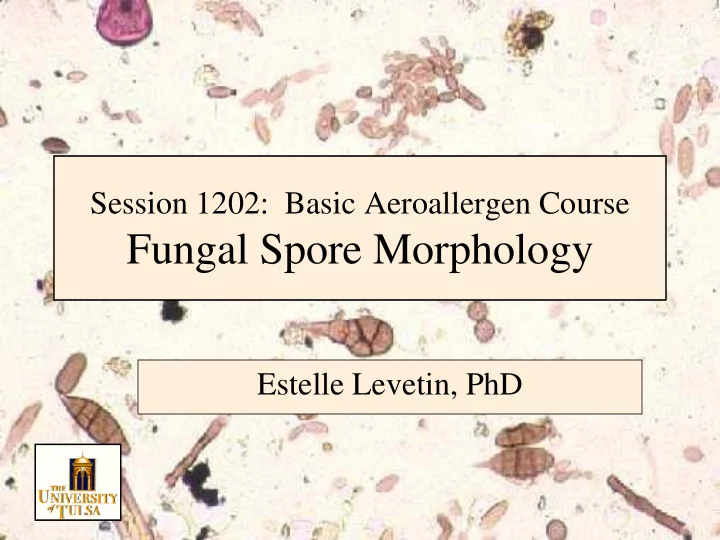
SLIDE 1
Session 1202: Basic Aeroallergen Course
Fungal Spore Morphology
Estelle Levetin, PhD
SLIDE 3
Fungal Spore Characteristics
SLIDE 4 Characteristics
- Spore size
- Spore shape
- Number of cells
- Attachment Scars
- Wall characteristics
- Spore color
SLIDE 5 Spore Size, Shape, and Septation
- SIZE: 2mm to 100 mm
- SHAPE: Globose, elliptical, fusiform,
asymmetric, lemon-shaped, barrel-shaped, curved
- SEPTATION: Non-septate (one cell),
single septum, transverse septa, transverse and longitudinal septa, random septa, pseudoseptate
SLIDE 6 Other Characteristics
- ATTACHMENTS: Attachment scars,
attachment pegs
- APPENDAGES
- WALL CHARACTERISTICS: Smooth,
granular, reticulate, spines, warts, wall thickness
- COLOR: Hyaline (colorless) to deeply
pigmented
SLIDE 7 Globose Barrel-shaped Non-septate Random septa Lemon-shaped Club-shaped Transverse septa Attachment scars Elliptical Curved Transverse and Longitudinal septa Ornaments: spines Asymmetric and germ pore Cylindrical Pseudoseptate Appendages
SLIDE 8
Spore color
SLIDE 9 Asexual Spores
Also known as Deuteromycetes, Fungi Imperfecti (imperfect fungi),
SLIDE 10 Asexual Spores
- Typically the most abundant spores in the
atmosphere
- Conidia often formed on specialized hyphae
called conidiophores
- Asexual stage of ascomycetes
- Look for attachment scars where the spores
were attached to the conidiophore or to each
SLIDE 11
Cladosporium
SLIDE 12
Note the septum
Cladosporium
SLIDE 13
Several species of Cladosporium are common in the atmosphere
SLIDE 14
Note the prominent attachment scars on Cladosporium conidia
SLIDE 15
SLIDE 16
Alternaria
SLIDE 17
Alternaria
SLIDE 18
SLIDE 19
Curvularia
SLIDE 20
Curvularia Nigrospora Drechslera
SLIDE 21 Drechslera-type spores
fungi have similar cylindrical spores
– Drechslera – Bipolaris – Exserohilum – Helminthosporium
SLIDE 22
Drechslera-type spores
SLIDE 23
Pithomyces
SLIDE 24
Note the colorless attachment at the base of Pithomyces spores
SLIDE 25
Pithomyces in culture
SLIDE 26
Epicoccum
SLIDE 27
Epicoccum spore cluster (sporodochium)
SLIDE 28 Penicillium species
conidiophores (spore bearing structures)
spherical to oval and form in chains
SLIDE 29 Aspergillus species
conidiophores (spore bearing structures)
spherical to oval and form in chains
SLIDE 30
Penicillium-Aspergillus type spores
SLIDE 31
Penicillium-Aspergillus type spores
SLIDE 32
Aspergillus niger in culture Aspergillus niger spores
SLIDE 33
Fusarium
SLIDE 34
Botrytis
SLIDE 35
Oidium
SLIDE 36
Other Asexual Spores on the NAB Count sheet
SLIDE 37
Cercospora
SLIDE 38
Nigrospora
Nigrospora Culture Air Sample
SLIDE 39
Periconia
SLIDE 40
Polythrincium Peronospora
SLIDE 41
Stemphylium
SLIDE 42
Torula
SLIDE 43
Other Asexual Spores NOT on the NAB Count Sheet
SLIDE 44
Spegazzinia
SLIDE 45
Tetraploa
SLIDE 46
Pestalotiopsis
SLIDE 47
Stachybotrys
SLIDE 48
Division Ascomycota
SLIDE 49
Eight ascospores are produced in each ascus without any attachment scars
SLIDE 50
Ascospores are sometimes found in groups of eight in air samples
SLIDE 51
*Leptosphaeria ascospores
SLIDE 52
*Chaetomium ascospores
SLIDE 53
*Pleospora ascospores
SLIDE 54
Diatrypella ascospores (*Family Diatrypaceae)
SLIDE 55
Phaeosphaeria annulata
Bright field Phase contrast
SLIDE 56
Sporomiella ascospores
SLIDE 57
Venturia ascospores
SLIDE 58
Paraphaeosphaeria ascospore
SLIDE 59
Leptosphaerulina ascospore
SLIDE 60
Various ascospores
SLIDE 61
Many ascospores on a rainy day
SLIDE 62
Division Basidiomycota
SLIDE 63
Basidiospore Basidium
Attachment
SLIDE 64
*Ganoderma basidiospores
SLIDE 65
*Agrocybe-type *Coprinus-type
Other basidiospores that are easy to recognize
SLIDE 66
Coprinus and Ganoderma basidiospores
SLIDE 67 Psathyrella Psathyrella velutina Russula Stropharia
SLIDE 68 Boletus Thelephora Galerina Chlorophylum
SLIDE 69 Lycoperdon Calvatia Pisolithus Scleroderma
SLIDE 70
Mixed Basidiospores
SLIDE 71
Rust spores: Puccinia
Puccinia uredospores Puccinia teliospores
SLIDE 72
Smut Spores
SLIDE 73
Smut Spores
SLIDE 74
Myxomycete (slime mold) spores
SLIDE 75
Other slime mold spores