
SLIDE 1
1
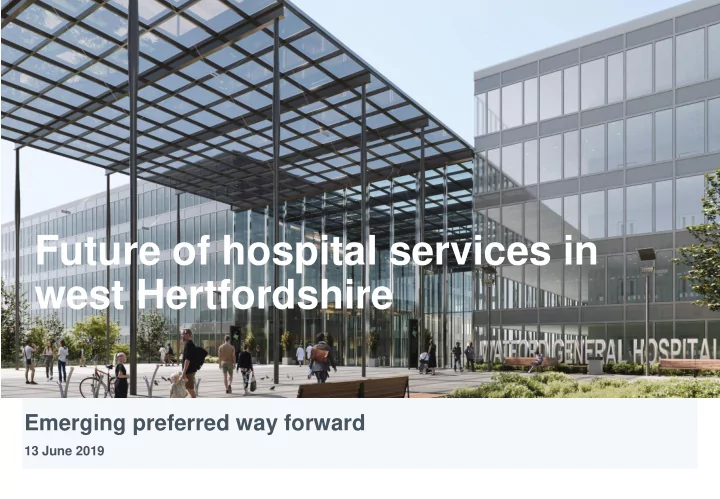
Future of hospital services in west Hertfordshire
Emerging preferred way forward
13 June 2019
Future of hospital services in west Hertfordshire Emerging - - PowerPoint PPT Presentation
Future of hospital services in west Hertfordshire Emerging preferred way forward 13 June 2019 1 1 Purpose of today Purpose To present a summary of the outputs from both the qualitative and quantitative appraisal of the options
1
Emerging preferred way forward
13 June 2019
Purpose of today
3
Purpose
appraisal of the options shortlist.
‘preferred way forward’
back to the Trust and CCG Board as part of decision-making Approval of the full SOC document and preferred way forward will be at the Trust Board and CCG Board meetings held in public in July
Background and context
5
The wider context
set out the vision for health and care services
care provided as close to home as possible
primary care facilities across the CCG footprint and a similar amount will be spent over the next 6 years
diabetes services, new outpatient models in community settings, virtual clinics, advice and guidance and tele-dermatology are just some examples of changes taking place which are transforming the kinds of care available outside of hospital
context in mind and remember that most healthcare is not delivered from hospitals.
6
We have been trying to secure funding for a long time!
2007-2009 Delivering a Healthy future
at Watford; St Albans planned care centre and Hemel closed its ED.
Watford to support additional emergency care were due to be replaced by PFI new build in 2014
1990s
Future plans for West Herts health provision under discussion
2003 Investing in Your Health
serving all of Hertfordshire
number of acute hospitals from four to two
2015-2016 Your Care, Your Future
Widespread public engagement regarding future of healthcare provision in West Hertfordshire, led by Herts Valleys CCG.
2014
manage increased demand.
2019 WHHT SOC Refresh
Trust updating business case to reflect financial constraint from regulators – capital investment sought must be in line with Trust annual turnover (c. £350m)
3 2 1 5 6 4
2016-2017 WHHT SOC
would be quicker, more affordable and more deliverable than a new hospital on a greenfield site.
investment ask was too much.
7 1 2 3 4 5 6 7
7
National context and key messages from regulators
level of demand from health systems across the country
infrastructure projects are no longer supported and will not be approved
return on investment assumptions will be closely scrutinised and regulators will need to be absolutely assured that the costs of capital (depreciation and interest payments) can be afforded by the health system
not exceed the Trust’s annual turnover. We were advised to review our SOC in this context.
encouraged to submit a revised SOC / ‘bid’ to regulators with a view to trying to secure funding through the comprehensive spending review.
8
CCG Board Submit SOC to regulators Formal Regulator review of SOC Develop / Approve Full Business Case (FBC)
August 2022 16 July
Initial Regulator review of SOC Develop / Approve Outline Business Case (OBC) Building works commence STP CEOs/Chairs Trust Board Comprehensive Spending Review (CSR)
WHHT Board confirm ‘preferred way forward’ and sign off SOC in public STP CEOs and Chairs confirm ‘preferred way forward’ and sign off SOC (private)
CCG Board confirm ‘preferred way forward’ and sign off SOC in public
11 July Late July Sept-Oct 2020-21 2023 December
High level timeline
Recap of the case for change
10
We need to invest to ensure care is delivered from buildings that are fit for purpose in a way that supports our wider aims for the future of healthcare and meets expected future demand
We need to develop services in a way that is affordable to commissioners, to funders and to the Trust on both a capital and revenue basis, as quickly as possible
Objectives
We need to change the way acute hospital services are delivered to meet the standards we expect, by enhancing separation of emergency and planned care services and consolidating services across locations where possible
11
57%
Of our estate is below Condition B, the minimum required standard
Reminder of key factors within the case for change
80%
Of our estate at WGH is assessed to be in ‘poor’ or ‘worse condition’
10%
Of the WHHT inpatient bed base is in single rooms, against a standard of 50%
56%
Increase in size of delivery suite is required to meet standards
50%
Increase in size of six bedded bays is required to meet standards
Is required to address backlog maintenance and functionally suitability. Twice this would be required to implement these changes. Clinical adjacencies are poor across the Trust, impacting significantly on clinical oversight, workforce efficiency & patient experience. Theatres are non-compliant for size, clinical layout, adult/child segregation and lack resilient ventilation systems that could potentially affect clinical safety. Is the Trust’s annual deficit
12
Risks to business continuity since April 2019
A burst water main resulted in no toilet facilities for day surgery and renal patients being diverted to alternative sites 2 waste water leaks in the A&E department this month - one in majors resulted in a loss of six cubicles for six hours Failed generator test resulted in loss of ventilation in Theatres - patients had to be diverted for 3 hours The single lift (lift 9) that connects main clinical buildings frequently breaks, so patients have to be transferred by ambulance An ambulance had to be sourced 8 times to provide inter- building transfer due to lift 9 failure, costing thousands of pounds
13
Our six bedded bays are half the size they should be We need to move to more four bedded bays to allow for more space and flexibility
14
“In a modern hospital, at least half of the rooms would be single en-suite, providing patients with privacy and dignity and allowing us to better manage infections. Only 10% of our patients are in single rooms. We have to improve this. Our patients deserve better”
Tracey Carter, Chief Nurse
15
“Mothers in our Delivery Suite are giving birth in rooms that have limited scope for expansion and do not easily promote active
modernisation with en suite facilities to promote privacy and dignity at such a special time in women’s lives”
Colette Mannion, Director of Midwifery and Gynaecology
16
“Vital parts of the Trust’s IT infrastructure, which support our clinical services, are spread out across the whole Trust, sometimes in tucked away places that make maintenance and repair a real challenge.”
Sean Gilchrist, Director of Digital Transformation
17
“We are currently spending money to ensure statutory compliance and to mitigate areas of highest risk. Backlog maintenance liability has continued to grow. The very real issues of reducing this backlog and the functional suitability of our buildings are not being addressed. If nothing is done, the cost of maintaining the estate will continue to grow at an increasing rate without any real improvement in condition” Patrick Hennessey, Director of Environment, WHHT
Model of care
19
Complex Surgery & Critical Care Women’s and Children’s A&E Ambulatory Care Specialist Inpatients Cancer & ‘One stop shops’ Long Term Conditions Older People’s Care Planned Medicine Planned Surgery
Planned Care
Urgent Care Outpatients Diagnostics
New integrated care and technology pathways support more patients to be cared for at home or in the community Improved facilities, capacity & investment in new technologies enable us to make the best use of the specialist skills of our clinical staff & reduce the need for patients to travel out of area for more specialist care
KEY
Emergency & Specialised Care/Hot Services Planned Care/Cold Services Services common to both emergency & planned care sites
Our model of care
20
Site Current example pathway for treatment of prostate cancer
O/P appt Scan Biopsy Follow up Bone Scan Oncology appt Operation Radio- therapy Urologist appt
WGH SACH HHGH Bushey Lister Mount Vernon
2 3 4* 5 6 7 8 9
Multiple points of reference:
1*
* Can happen at any of WHHT sites
Current pathway – prostate cancer
21
Site Future example pathway for treatment of prostate cancer
O/P appt Scan Biopsy Follow up Bone Scan Oncology appt Operation Radio- therapy Urologist appt
WGH SACH HHGH Bushey Lister Mount Vernon
2 3 4 5 6 7 8 9
Single point of reference:
work together
patients
1
Future pathway – prostate cancer
Overview of the four shortlisted
23
Increasing investment in planned care
Key features of the shortlisted options
WGH WGH
Ambulatory + Assessment New Women & Children's (inc.Obs/GynaeTheatres) 6 Theatres in PMOK building Some improvement to bed configuration Ambulatory + Assessment New Women & Children's block (excl. theatres) New Theatres & Critical care block Significant improvement to bed configuration
WGH
Ambulatory + Assessment
WGH
Ambulatory + Assessment New Women & Children's block (excl. theatres) New Theatres & Critical care block Some improvement to bed configuration 6 Theatres in PMOK building Limited improvement to bed configuration New Women & Children's (inc.Obs/GynaeTheatres)
Medicine
(HHH)
Surgery
(SACH)
Refurb Theatres Refurb IP beds, +HDU Endoscopy & Complex Diagnostics Consolidate site to improve layout and support long- term condition care Max Planned Care at Site, new layout / adjacencies New build As per 3 site option, with HHH OP moved to SACH Full refurb / new build Current Planned Care levels, min reconfig/adjacencies UTC plus at SACH and extended GP access, urgent
care in Hemel Max Planned Care at Site, new layout / adjacencies UTC plus at new site, extended GP access, urgent
in Hemel & St Albans UTC plus UTC minus UTC plus at HHH and extended GP access, urgent
in St Albans
Min Planned Care
(SACH)
Max Planned Care
(HHH)
Max Planned Care
(New Site) Increasing investment at WGH for emergency and specialist care
1 2 3 4
24
The ‘as is’ across all hospitals in west Herts
HHH SACH WGH
Activity type 17/18 A&E (majors) 72,500 A&E (minors*) 21,800 Non-elective 113,000 Elective 6,800 Daycase/procedures 25,900 Outpatients 247,100 Activity type 17/18 A&E (majors)
28,300 Non-elective
8,600 Outpatients 112,700 Activity type 17/18 A&E (majors)
14,300 Non-elective
5,300 Daycase/procedures 17,600 Outpatients 104,400
* Includes Urgent Treatment Centre (UTC) activity or Minor Injuries Unit (MIU) activity
25
‘As is’ at WGH: over 80% of the site is in ‘poor’ or worse condition, with 40% of the buildings over 40 years old
Building Current condition Functional suitability
Princess Michael of Kent (PMoK) B/C C Women’s and Children’s Services (WACS) C Cx Acute Admissions Unit (AAU) B B Shrodells and surge capacity C Cx Others C Cx and Dx
Condition A As new B Sound & operationally safe B/C Currently operational, but will need major investment or replacement within next 5 years to remain sound and operationally safe. C Operational, but needs major investment or replacement now to remain sound and operationally safe. D Operationally unsound Functional Suitability A Very satisfactory B Satisfactory, minor changes needed C Not satisfactory, major change needed D Unacceptable CX & DX Rebuild required. Current building cannot be refurbished as clinical space
KEY
26
‘As is’ at SACH: the layout limits the ability to comply fully with NHS building standards
Building Current condition Functional suitability Gloucester B/C B Moynihan C C Runcie C C Other C Cx
Condition A As new B Sound & operationally safe B/C Currently operational, but will need major investment or replacement within next 5 years to remain sound and operationally safe. C Operational, but needs major investment or replacement now to remain sound and operationally safe. D Operationally unsound Functional Suitability A Very satisfactory B Satisfactory, minor changes needed C Not satisfactory, major change needed D Unacceptable CX & DX Rebuild required. Current building cannot be refurbished as clinical space
KEY
27
‘As is’ at HHGH: around 30% of the site is currently unoccupied
Building Current condition Functional suitability Tudor D D Jubilee / Marnham / Diagnostics B/C C Verulam B/C B QE2 C Cx
Condition A As new B Sound & operationally safe B/C Currently operational, but will need major investment or replacement within next 5 years to remain sound and operationally safe. C Operational, but needs major investment or replacement now to remain sound and operationally safe. D Operationally unsound Functional Suitability A Very satisfactory B Satisfactory, minor changes needed C Not satisfactory, major change needed D Unacceptable CX & DX Rebuild required. Current building cannot be refurbished as clinical space
KEY
28
Option 1: WGH
29
Option 1: SACH
30
Option 1: HHGH
31
Option 3: WGH
32
Option 3: HHGH
33
Option 4: WGH
34
Option 4: New planned care centre
35
Amount of capital allocated by option
(£m) Do Minimum Option 1 Option 2 Option 3 Option 4 Emergency Care 75 298 288 231 185 Planned Care 17 52 62 137 177 Total - WHHT 92 350 350 368 363 % spend on Emergency Care 81% 85% 82% 63% 51% A&E majors A&E minors UTC Non Elective Elective Day Case Out- patient % Activity on WGH site (17/18) 100% 34% 100% 56% 50% 53%
Outputs from stakeholder panel
37
The qualitative appraisal of the shortlisted options has been informed by scoring undertaken by a stakeholder panel but also incorporates views on the extent to which shortlisted options address the overall case for change. The panel comprised:
ability to achieve the non-financial benefits using a scoring framework:
Stakeholder panel qualitative scoring process
Clinicians Other Trust Other CCG Partner
Public
+1 +2 +3 Large adverse impact Moderate adverse impact Slight adverse impact Neutral
no change from today
Slight beneficial impact Moderate beneficial impact Large beneficial impact
38
ROLE
benefits
determine a preferred way forward.
MEETINGS
Stakeholder evaluation panel
39
Summary of stakeholder panel scoring
to moderate beneficial impact in comparison with today
again equating to a slight to moderate beneficial impact
respectively), equating to a slight adverse impact in comparison with today
‒ Clinicians (Trust and CCG) and other Trust staff scored Option 1 as having the greatest beneficial impact ‒ Non-clinical stakeholders from outside the Trust (CCG staff, other organisations and the public) scored Option 4 as having the greatest beneficial impact. The results are close for Options 1, 3 and 4
40
Summary of scores according to impact on desired benefits
Max EC (WGH), Min PC (SACH & HHH) Mid EC (WGH), Mid PC (SACH) Min EC (WGH), Max PC (HHH) Min EC (WGH), Max PC (new PC hospital) Do Minimum: no consolidation
1.5
1.6 1.2
1.4
1.0 1.2
1.5 0.2 1.2 1.3
1.7
1.0 1.6
1.5
1.2 1.3
Safety &
Patient experience Workforce satisfaction Future flexibility Combined 1 2 3 4
KEY Highest beneficial impact score Highest adverse impact score
41
Summary of scores according to stakeholder group
Max EC (WGH), Min PC (SACH & HHH) Mid EC (WGH), Mid PC (SACH) Min EC (WGH), Max PC (HHH) Min EC (WGH), Max PC (new PC hospital) Do Minimum: no consolidation
Clinical Trust other CCG other Other Patient 1 2 3 4 Combined
1.7
1.3 0.9
1.9 0.0 1.3 1.1
0.9
1.4 1.6
1.2
1.3 1.8
1.7
0.9 1.7
1.5
1.2 1.3
KEY Highest beneficial impact score Highest adverse impact score
42
Option 1
the greatest volume of activity and complexity
HHGH Option 2
is the greatest volume of activity and complexity of patients
will not address issues with clinical adjacencies Option 3
patient and staff experience
Option 4
experience
Summary of each shortlisted option
Outputs from quantitative appraisal
44
Capital required for construction
Construction costs for the options are supplied an independent firm of cost consultants in conformance with applicable standards and guidance. These have been compared with comparable, recent projects and undergone an initial high-level review with NHSE PAU.
NB Costs are stated at current prices including VAT.
All figures rounded to the nearest £1m Do Min Option 1 Option 2 Option 3 Option 4 1 Departmental Costs 26 143 142 153 139 2 On-Costs 33 67 65 66 79 3 Works Cost Total 59 209 207 219 219 4 Provisional Location Adjustment (BCIS 110)
10%
included 10% included 10% included 10% included 10% included
5 Sub-total 59 209 207 219 219 6 Project Fees
14%
7 14% 24 14% 24 14% 26 14% 26 7 Non-Works Costs
3%
2 3% 6 3% 6 3% 7 3% 7 8 Equipment Costs
20%
5 20% 29 20% 28 20% 31 20% 28 9 Planning Contingency
5%
3 6% 13 7% 14 6% 13 8% 18 10 Sub-total 76 281 280 295 296 11 Optimism Bias
21%
16 25% 69 25% 70 25% 73 22% 66 12 Total (excluding inflation) 92 350 350 368 363 13 Inflation Adjustment 16 59 59 61 73 14 Total (including inflation) 107 408 408 430 435
45
Net capital funding requirement and ‘the turnover test’
PDC constraint expressed in the public engagement. Options 3 & 4 are within 5%
(£m) Do Min Option 1 – 3 site Option 2 – SACH Option 3 – HHH Option 4 – New Site Capital works costs 92 350 350 368 363 Net land acquisitions (15) (20) (23) (18) Net capital requirement 92 335 330 345 345
All values at current prices including VAT
Year Turnover (£m) 18/19 outturn 333 19/20 planned 365
46
£350m capex means £18m of capital charges
0.0 5.0 10.0 15.0 20.0 25.0 30.0 35.0 100 200 300 400 500 600 700
Total capital charge vs Trust Turnover
The higher the capex, the higher the capital charge
Capex (£m) Dividend rate Depreciation (years) Revenue pressure 3.50% 12.3 60 5.8 18.1 Trust Turnover (£m) 350.0 Revenue pressure as % of Trust turnover 5.2% 350.0
There is a linear relationship between the amount of capex and the extra cost pressure due to capital charges. This calculates at about 5% of capex assuming 3.5% dividend and 60 years depreciation. If capex is pegged to turnover, this is 5% of turnover which is likely to be at the highest end of ADDITIONAL savings to be expected in any year.
Capex Capital charges
47
Equivalent Annual (Cost)/Value (EAC)/EAV detail
Do Min £m Option 1 £m Option 2 £m Option 3 £m Option 4 £m Land purchases/(disposals)
0.5 0.6 0.3 Buildings residual value 0.4 1.4 1.6 1.5 2.0 Constructions costs (3.6) (11.6) (11.6) (12.2) (11.7)
(0.3) (3.0) (3.0) (3.1) (2.9) Estate running cost benefits (0.5) 2.9 3.4 4.5 5.0 Service benefits 5.3 16.3 16.3 16.3 15.3 Total 1.2 6.4 7.2 7.4 8.1
The EAV is a measure of value for money offered by each option, showing the balance
* Equivalent Annual Value (EAV) works on a similar principle to Net Present Value (NPV), but is adjusted to an annual figure to allow for projects of different appraisal periods. i.e. it gives the expected value (financial benefits less costs) and in current prices. An NPV or EAV should be positive for a project to proceed.
48
Impact on net surplus/(deficit)
therefore will improve the Trust’s financial position.
34/35 and option 1 returning the Trust to surplus in 36/37.
surplus within the modelled 70 years.
Equalities analysis
50
Summary of equalities analysis of shortlisted options
Summary of impact 1 Maximising investment at WGH will lead to a positive impact for women and children, older people, people with disabilities and carers, particularly due to optimising the layout of beds. However this may be offset by limiting investment in planned care services which will impact older people and those with a disability to a greater extent. 2 Significant investment at WGH will lead to a positive impact for women and children, older people, people with disabilities and carers, albeit this will be limited by reduced improvement to layout of beds/wards at WGH. Women and children, older people and people with disabilities from Hemel will be disproportionately impacted by a shift in where planned care services are delivered. 3 Limiting investment at WGH will likely lead to a negative impact for older people, people with disabilities and carers, as there will be limited improvement to the layout of beds and Theatres/Critical Care. Maximising investment in planned care will positively impact older people and people with disabilities, but people in those groups from St Albans will be disproportionately impacted by a shift in where planned care services are delivered. 4 Minimising investment at WGH will likely lead to a negative impact for older people, people with disabilities and carers, as there will be no improvement to the layout of beds and no Theatres and Critical Care unit. Maximising investment in planned care will positively impact older people, people with disabilities and carers, but people in those groups from St Albans and Hemel will be disproportionately impacted by a shift in where planned care services are delivered. D M Minimising investment in services across WHHT will likely lead to a disproportionately negative impact
Stakeholder engagement and views
52
Stakeholder engagement
Public meetings to update residents at each stage and answer questions:
Responses to questions and correspondence arising from public meetings and also general correspondence (approximately 250 items) Meetings and briefings with local MPs Engagement with local authorities through scrutiny committees and health and wellbeing partnership meetings, including extended sessions at HCC health scrutiny committee Updates to Herts and west Essex Sustainability and Transformation Partnership Discussions at PPI committees and at other patient groups Engagement with WHHT and CCG staff at internal meetings and briefings Regular updates through established channels: WHHT and CCG websites; CCG stakeholder letters
53
Summary of feedback from stakeholder engagement
Views differ and in Dacorum in particular, there are groups who continue to lobby for a new build emergency and planned care hospital on a new site. Key themes in questions and comments from public meetings and from correspondence:
repair and location versus the merits of new build hospital on a site in the ‘north’ of the area (where a number of main population centres are)
capital costs)
when other trusts have done this in the past (e.g. Midland Metropolitan) and are pursuing this as a preferred option currently (PAHT)
growth and life-span of buildings.
54
Summary of feedback from stakeholder panel
Key themes emerging from the stakeholder panel on 15th May when presented with
will be a compromise
Overall, access/travel/car parking seen as a major factor when determining service reconfiguration
look at some case studies/scenarios
care hospital on a new site is the only viable long term solution.
Summary
56
Appraisal summary
highest overall, but the scores are close, with different stakeholder groups having different views
highest EAV of the shortlisted options, but the results are also close
change in determining a preliminary view on the likely preferred way forward
CCG Boards on 11th July.
57
Emerging ‘preferred way forward’
It is proposed that Option 1 should be the preferred way forward taken forward to OBC:
complex and urgent needs are treated and services need to be sustainable; all works at WGH proposed within Option 1 are necessary
above critical estate works at this time.
Next steps
59
Next steps
SOC published Trust board
DRAFT SOC document published Representations from public will be invited - for consideration by the trust and CCG boards WHHT board discuss and agree ‘preferred way forward’ and sign off of SOC
CCG board STP CEO meeting
CCG board consider ‘preferred way forward’ for approval and SOC sign off STP CEOs consider sign
and approval
‘preferred way forward
20 June 11 July 11 July 16 July July - Aug
Engagement with local authority and NHS partners to gain support prior to final submission to regulators
60