Future Strategic leaders' Congress M Iitime Hashpornts: Aus ralia 's - - PDF document

future strategic leaders congress
SMART_READER_LITE
LIVE PREVIEW

Future Strategic leaders' Congress M Iitime Hashpornts: Aus ralia 's - - PDF document

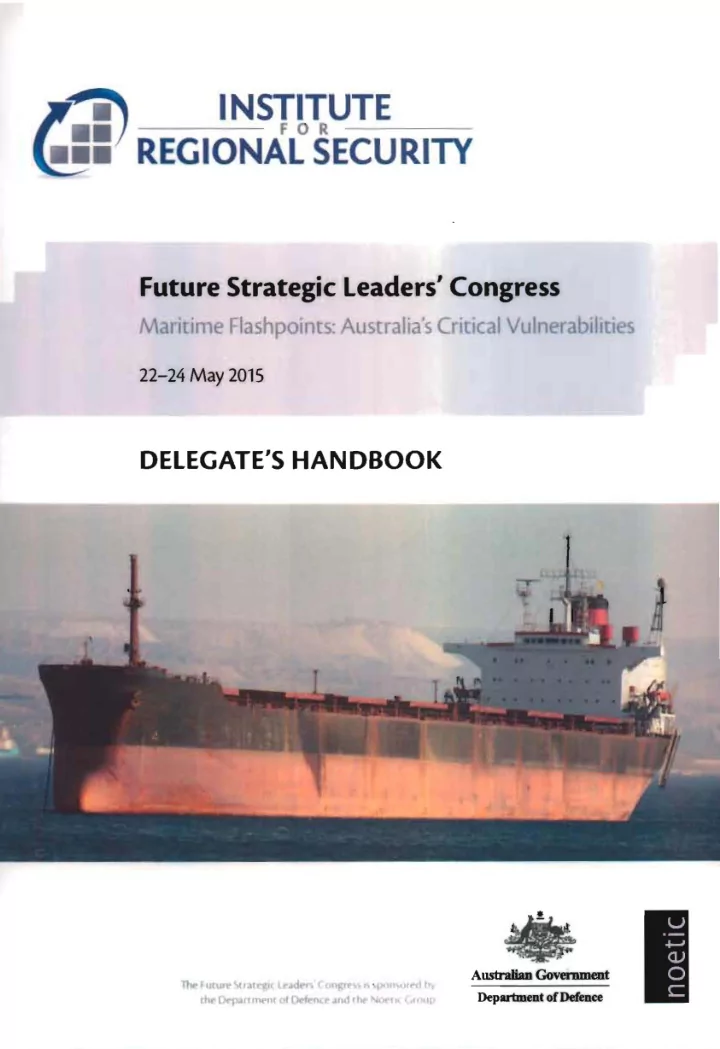
~Ultfr r~l; Future Strategic leaders' Congress M Iitime Hashpornts: Aus ralia 's Critic I Vuln r brhti 22-24 May 2015 DELEGATE'S HANDBOOK }r Australian Government n ..... lItu lr \rt .. ...... d r l . .. t<l ' 1:N\11 IIr~1 t 'i (I I,. I,ll


slide-1
SLIDE 1

Future Strategic leaders' Congress

M Iitime Hashpornts: Aus ralia's Critic I Vuln r brhti

22-24 May 2015

DELEGATE'S HANDBOOK

}r

Australian Government

n.....lItu lr \rt ..

r~l; ......d r l . ~Ultfr .. t<l ' 1:N\11 IIr~1 t'i

rh r { rr rnenr I [

t'- f1(t' .04.1 r l't

(I I,. I,ll II I

Department of Defence

slide-2
SLIDE 2

Securitys Future Strategic Leaders'

_11 of pror

noung regional sta bility and urage innovative tlunki ng about our- to foste r- tile next generat ion of saders' Program was established by eet the second core goal. Previous

se two goals to become the premier

e valuable learning expenences.

  • setting. rnvite a number of security

unger practrtioners and researchers

a tOPiCthat is Important for au. We

and stimul atin g. Given the range of

tile tO PICS at hand we emphasise tile making it memorable for all. ateful to OU t guest presen ters and me from thei

r-

exceptio nally busy

rth us, We also thank our sponsors.

nd the Noetic Group for their forward to working with you ove r the

Congress Program

Friday 22May 2015 1700-1800 Arrival, registration and unpack London Shed 1800-1830 Pre-dinnerdrinks Outside the Mess

1830-1 930

Dinner

Mess

1930-1940 Welcome andweekend London Shed MrPeter Nicholson AOI Mr

  • verview

Drew McKinnieI Mr Br ett Biddington AM, Institute For Regional Security 1940-2035 Session #1 : Scene setting Lo

ndon Shed Mr Lee Cordner AM. University

  • f

Adelaide 2035-2135

London Shed Keynote Address CO RE Andrew Gou

gh RANR,

Representing Chief of Navy Director General Navy Capability and Q&A Plans and Engagement 2135- Fireside drinks and discussions Saturday 23 May 2015 0730-0830 Br eakfast

Mess

0830-0930 Session #2: Why are SLoG London Shed Mr Peter Malpas, Braemar ACM criticalto our national Shipbroking security and prosperity? Dr Sanu Kainikara, Air Power Development Centre 093 0-0950 Session #2Q&A London Shed 0950-1 010 Morn ing Tea

Mess

1010-11 10

Session #3 : W hat are the

London Shed RADM (Rtd) Simon Cull

en AM , threats to Australia's

CSC

SLoG? Dr Sanu

Kainikara, Air Power

Development Centre 1110-1125 Session #3Q&A 1125·1130 Coffee break (br-ing back to London shed)

11 30-1230

Syndicate Session #1 London Shed and break-out rooms 1230-1330 Lunch

Mess 1330-1430 Session #4. Global and

London Shed MrIan Biggs, Assistan t Regional: Australia. South Secretary, Departmen t of

East Asia and SLoe

Foreign Affairs and Trade BRIG Michael Mahy, Military Strategy, Department of Defence 14 30-1500 Session #4Q&A 15 00-1700 Aftern oon tea then fre e time 1700-1800 Syndicate session #2 London Shed
slide-3
SLIDE 3

Congress Program

Saturday 23May 2015 cant 1800-1900 Dinner

Mess

1900-1945

Session #6: Best practices, London Shed Dr Jennifer Moroney, RAND challenges and lessons Australia from international partnering in the Asia- Pa cific region and Q&A 1945--

Conversations in the breezeway London Shed area

Sunday 24Mal 2015

0730-0830

Breakfast

Mess 0830-0930 Key Note Address an d Q&A Tea I Coffee break

London Shed Mr Michael Pezzullo, Secretary, Department Immigration and Border Protection 0930-0935 0935-1 030 1030-1100 Session #7: W hat is the future of Australia's

maritime secur

ity and SLo C through our region? and

Q&A Momin.9. Tea

(bring

back to

London Shed Mess London shed) Prof Carl Thayer, University of New South Wales, AD FA 110 0-1130 Syndicate session 2 cont I Panel Q&A London Shed

11 30-1150

Congress Wrap-up London Shed

11 50-1300

Lunch

Mess

Pack up & depart

Please note tills program was current ill lime of printi ng - Ftittev 151' \lla)' 2015

Speakersand IFRS Directors Mr Br ett Biddington A

M

  • Director. Institute For Regional Seq

Brett Biefdington is thefounderof a specialises in space and cyber 5 national ea member

Envir onme

Treasurer , Security w addresses that Austral He is the II

Association

co1

11mittee

Australia'

  • scrence. t

(STEM)ecu

Between 2 Systems' global space team. In 2002 Brett left the Royal Austral: 23 years of service. He was an I moving into capability developme

  • control. intelligence. surveillance.

projects including the Jindalce 0 and unclassified space u uuauves. He is an Adjunct Professor In the University in Perth. W estern Austral' In June 2012 tle was aornnteo as a services to the Australian space s

  • 4-
slide-4
SLIDE 4

Professor Carl Thayer Conduct of theCongress

Professor Emeritus. University of New South Wales (UNSW)

The Congress will IJe conc lucted as

Australian Defence Force Academy (ADFA)

plenary and syndicate discussrons. The program will be broken into a Carlyle A. Thayer is Professor Emeritus at Til e University of New so utn Wales participants to work closely W ith .

1

(UNSW) at the Australian Defence Force Academy (ADFA). Canberra. He was educated at Brown University and holds an M.A. degree in Southeast ASian Studies from Yale and a PllD in International Relations from Til e Australian National University. Thayer jorned til e UNSW in 19 79 and taught first in The Faculty of Military Studies at the The Royal Military College-Duntroon (1979-85) before tra nsferring to UNSW@ADFA. He was given 'leave In tile national interest' to take up til e positi on

  • f Deputy Chair of the Depar

t ment of Regional Studies t the Asia-Pacific Center for Security Studies (APCSS). U.S. Pacific Command. Hawaii (1999-02). On return to Australia he was secondecl to Deakin University and served as On-Site Academic Co-

  • roinator at Weston c reek for the Defence and

Strategic Studies Course. the senior course. at the Centre for Defence and Strategic Stud ies (CDSS) at the Austra lian Defence College (2002­04 ). He later oirecteo Regional Security Studies at th e Australian Command and Staff College (2006­07 and 2010). Professor Thayer was the C, V. Starr Distmguished Visiting Professor at the School of Advanced International Studies, Johns Hopkins University In w ashington (2005) and til e Inaugural Frances M. and Stephen F. Fuller Distinguished Visiting Professor at tile Center for International Studies . Ohio unlversity (2008). He is also director of Thayer Consultancy. a small business registered in Australia In 2002 that provides political analysis of current regional security issues and othe r research support to selected clients. Thayer is writes a regular column on Soutlleast Asia defence and security colum nist for The Diplomat. Professor Thayer is til e author of over 500 publicauons includrng: so utneast Asia: Patterns of Security Cooperation. ASPI Strategy Report. Canberra: Australian Strategic Poticy Institute. 2010. security leaders In a relaxed enWO G th e weekend include:

  • A series of presentations focus'

facing Australia.

  • Syndicate sessions ­ small g

industry leaders to discuss a s

  • Informal discussions and ­fire,

We request you be at the approona that the agenda and discussion can

Discussions off-the-record

The Institute For Regional Security

I

111 a trusted environment; so all dlsc(

be st rictly off­t he­record and under

DressCode

The dress code for the Congress W ill

In Confidence

Til e content of th is Delegate Han correspondence and information Security remain In­Confidence and

Security

Given the array of dignitaries attend,

  • rganisers by carrying photographu
  • f til e Congress and by wearing

y o ~

room.

Mobile Phone Coverage

Mobile phone coverage IS 1 I111ite

  • campus. IFR

S staff can point youto you can get a signal (depending on

­20-

slide-5
SLIDE 5

What is the Future of Australia’s Maritime Security and SLOC Through Our Region?

Emeritus Professor Carl Thayer Presentation to Future Strategic Leaders Program, Kioloa, NSW May 24, 2015

slide-6
SLIDE 6

Australia’s Maritime Security

slide-7
SLIDE 7

Increase in Merchant Shipping

2003-13

slide-8
SLIDE 8

Introduction

  • Australia has vital national interests:

– Respect for international law and norms – Freedom of navigation – Unimpeded trade – Freedom of over flight in international airspace above the maritime domain – Rules-based regional order – peaceful settlement of disputes

slide-9
SLIDE 9

Maritime Security

  • Sea Lines of Communication (SLORC)

– Commercial ships and vessels – Military ships and vessels

  • Economic interdependence

– Destabilising state actions or armed conflicts are dampened and unlikely – But there are still risks

slide-10
SLIDE 10
slide-11
SLIDE 11

Challenges

  • China’s rise and military modernisation

– Security dilemma

  • Arms build up by regional states

– Military technology and weapons systems – Growth of submarine fleets – Cruise missiles

  • Hot spots

– East China Sea, Taiwan, South China Sea

slide-12
SLIDE 12

Extended Range of China’s Anti-Ship Cruise Missiles

slide-13
SLIDE 13
slide-14
SLIDE 14

First and Second Island Chains

slide-15
SLIDE 15
slide-16
SLIDE 16
  • China’s military

modernisation

  • Surface

combatants

  • Aircraft

carrier(s)

  • Conventional

and nuclear submarines

  • Ballistic

missiles

  • Cruise missiles
slide-17
SLIDE 17

Underwater sensors (fixed and mobile) to detect submarine movements

slide-18
SLIDE 18

Yulin Naval Base, Hainan Island

slide-19
SLIDE 19
slide-20
SLIDE 20
slide-21
SLIDE 21
slide-22
SLIDE 22
slide-23
SLIDE 23
slide-24
SLIDE 24

Mischief Reef

slide-25
SLIDE 25

Fiery Cross Reef

slide-26
SLIDE 26

Johnson South Reef

slide-27
SLIDE 27
slide-28
SLIDE 28

Future Strategic Environment

  • Australia’s security environment will be

more challenging over the next 20 years

  • Erosion of Australia’s historical military

capability and technological advantages

  • Strait line extrapolations of current

trends risky

  • What are the plausible alternatives?
slide-29
SLIDE 29

Future Strategic Environment

  • Strategic uncertainty
  • Broader range of possible strategic futures
  • Wild cards

– Instability in China and/or Indonesia – Deterioration of China-US relations – Eruption of armed conflict – US abandonment – Climate change

slide-30
SLIDE 30
slide-31
SLIDE 31

Southeast Asia: Climate stress, recent conflict, global trade routes and choke points

slide-32
SLIDE 32

What is the Future of Australia’s Maritime Security and SLOC Through Our Region?

Emeritus Professor Carl Thayer Presentation to Future Strategic Leaders Program, Kioloa, NSW May 24, 2015