FY2016 HPAI Response Surveillance of Backyard Flocks Around - - PowerPoint PPT Presentation

fy2016 hpai response
SMART_READER_LITE
LIVE PREVIEW

FY2016 HPAI Response Surveillance of Backyard Flocks Around - - PowerPoint PPT Presentation

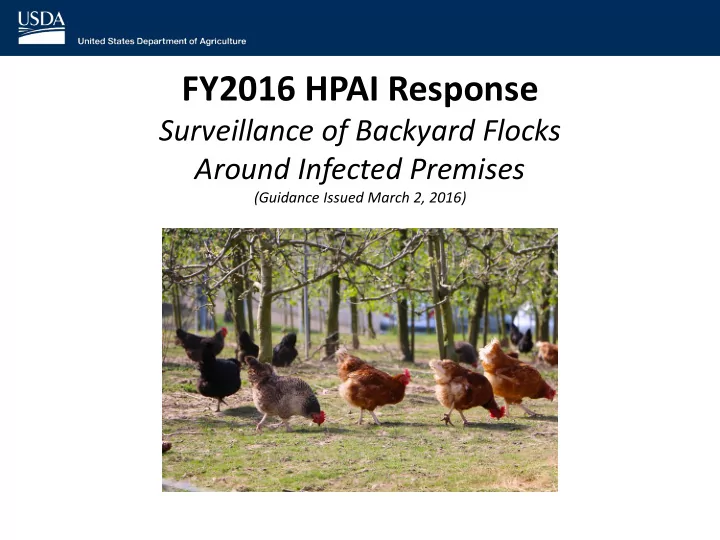
FY2016 HPAI Response Surveillance of Backyard Flocks Around Infected Premises (Guidance Issued March 2, 2016) 1 Policy Update Provides responders with revised procedures learned from the 2014 2015 highly pathogenic avian influenza

slide-1
SLIDE 1

FY2016 HPAI Response

Surveillance of Backyard Flocks Around Infected Premises

(Guidance Issued March 2, 2016) 1

slide-2
SLIDE 2

Policy Update

  • Provides responders with revised procedures learned from

the 2014–2015 highly pathogenic avian influenza (HPAI)

  • utbreak.

2

  • Definitions
  • Introduction
  • Communication
  • Visiting Premises
  • Priorities for Surveillance

Activities in the Control Area

  • Passive Surveillance
  • Routine/Active Surveillance
  • Recommended Sampling

Scheme

  • Documentation

Key Components

2

slide-3
SLIDE 3

Definitions

3

Contact Premises: Premises with susceptible poultry1 that may have been exposed to highly pathogenic avian influenza (HPAI), either directly or indirectly, including but not limited to exposure to animals, animal products, fomites, or people from Infected Premises. Suspect Premises: Premises under investigation due to the presence of susceptible poultryreported to have clinical signs compatible with HPAI. This is intended to be a short-term premises designation. At-Risk Premises: Premises that have susceptible poultry1, but none of those susceptible animals have clinical signs compatible with HPAI. Premises objectively demonstrates that it is not an Infected Premises, Contact Premises, or Suspect Premises. At-Risk Premises may seek to move susceptible animals or products within the Control Area by permit. Only At-Risk Premises are eligible to become Monitored Premises. Monitored Premises: Premises objectively demonstrates that it is not an Infected Premises, Contact Premises, or Suspect Premises. Only At-Risk Premises are eligible to become Monitored Premises. Monitored Premises meet a set of defined criteria in seeking to move susceptible animals or products out of the Control Area by permit.

slide-4
SLIDE 4

Definitions

4

Infected Zone: Zone that immediately surrounds an Infected Premises; the perimeter should be at least 3 km (~1.86 miles) beyond the perimeters of the presumptive or confirmed Infected Premises. This zone may be redefined as the outbreak continues. Buffer Zone: Zone that immediately surrounds an Infected Premises; this is the area that is at least 7 km (~4.35 miles) beyond the perimeter of the Infected Zone (10 km beyond the Infected Premises). This zone may be redefined as the outbreak continues. Control Area: Consists of an Infected Zone and a Buffer Zone; the perimeter of the Control Area should be at least 10 km (~6.21 miles) beyond the perimeter of the closest Infected Premises. This area may be redefined as the outbreak continues. Foreign Animal Disease Investigation: An investigation conducted according to VS Guidance Document 12001 (Ready Reference Guide for investigations is here).

slide-5
SLIDE 5

Introduction

An Infected Zone and Buffer Zone (a Control Area) will be created around an HPAI Infected Premises. This document provides surveillance guidance for backyard premises (non-commercial) within a Control Area. Surveillance activities and associated testing should be based on recommendations of the Unified (State-Federal) Incident Command; this guidance may require further modification based on epidemiological and situational information. This document reflects the epidemiological information known about the behavior of circulating viruses in the 2014–2015 U.S. HPAI outbreak, in which HPAI infected both backyard and commercial premises. For example, there is no evidence that the circulating viruses cause sub- clinical infection in gallinaceous poultry species; clinical signs and mortality are apparent.

5

5

slide-6
SLIDE 6

6

It is critical to ensure that information about HPAI, as well as recommended biosecurity measures, are clearly communicated to all backyard premises in a Control Area. APHIS and State/Tribal officials must ensure that instructions are provided to owners to report clinical signs and abnormal mortality; there should be transparent procedures for managing reports of clinical signs or unusual mortality from backyard producers (also known as sick bird calls).

Communication

6

slide-7
SLIDE 7

7

Priorities for Surveillance Activities in the Control Area

7

The following are the priorities for backyard surveillance activities in the Control Area; it is critical to investigate Infected and Contact Premises as rapidly as possible to detect, control, and contain the virus as rapidly as

  • possible. These premises should remain the top priority in any response

effort.

Visiting Premises

It is critical to ensure that information about HPAI, as well as recommended biosecurity measures, are clearly communicated to all backyard premises in a Control Area. APHIS and State/Tribal officials must ensure that instructions are provided to owners to report clinical signs and abnormal mortality; there should be transparent procedures for managing reports of clinical signs or unusual mortality from backyard producers (also known as sick bird calls).

slide-8
SLIDE 8

Surveillance Plan- Passive Surveillance

General Guidance

8

8

The IMT, in coordination with any subject matter experts, should develop morbidity and mortality criteria that dictate the need for further

  • investigation. These criteria/triggers should be species specific. During a

widespread HPAI outbreak, reports of clinical signs or unusual mortality from backyard producers (sick bird calls) are investigated as rapidly as possible. However, sick bird calls may overwhelm available resources, particularly when investigation and/or management of Infected and Contact Premises are not complete. In this case, the IMT may recommend triaging disease investigations on backyard premises, using the morbidity and mortality criteria and/or farm risk factors (e.g., close proximity to bodies of water with waterfowl concentrations). These triggers should be based on the best information available, and should be developed in coordination with State/Tribal officials. Typically, premises in the Infected Zone should be prioritized over those in the Buffer Zone.

slide-9
SLIDE 9

Surveillance Plan- Passive Surveillance

Start and Duration

9

9

Passive surveillance is conducted at all times in the United States through foreign animal disease investigations (per VS Guidance Document 12001); passive surveillance is intensified through rapid and clear communication to backyard producers as soon as there is an HPAI detection.

slide-10
SLIDE 10

Surveillance Plan- Passive Surveillance

10

10

Procedures

For sick bird calls on backyard premises, a Foreign Animal Disease Diagnostician (FADD) (or individual designated by the IMT) should: 1. If resources allow, investigate each call meeting the identified criteria immediately. 2. If necessary, prioritize those premises in the Infected Zone and those meeting morbidity/mortality triggers or having additional risk factors for further

  • investigation. This should be conducted in coordination with State officials.

3. Schedule an appointment to collect samples as quickly as possible. 4. Conduct diagnostic testing according to sampling recommendations, submit samples to designated National Animal Health Laboratory Network (NAHLN) lab as indicated by the IMT (provided in “Sampling Scheme for Poultry” below). 5. Record all relevant information in the Emergency Management Response System (EMRS), including means of communication.

slide-11
SLIDE 11

Surveillance Plan- Routine/Active Surveillance

General Guidance

11

11

In addition to passive surveillance, routine/active surveillance is conducted to provide evidence that HPAI is not present. Start and Duration APHIS and/or State officials will determine the time period for active

  • surveillance. It may begin upon completion of initial cleaning and disinfection

(C&D) of the last Infected Premises in the Control Area (e.g., though compost piles may remain, all fomites, vehicles, and outside areas of the houses have undergone C&D), or a different timeline for sampling may be recommended. Active surveillance may continue after the Control Area has been released for international or bilateral trading partners.

slide-12
SLIDE 12

Surveillance Plan- Routine/Active Surveillance

Procedures

12

12

The IMT performs the following:

  • 1. Select a minimum number of premises to sample (see Table 1).

a. Include high-risk premises, such as those near bodies of water. b. Randomly select remaining premises (the IMT may have further guidance on which premises should be sampled when there are a large number of backyard premises in the Control Area).

  • 2. Contact (by phone) all selected premises.

a. If the premises does not have any clinical signs, unusual morbidity/mortality, or other risk factors requiring further investigation, a site visit is not necessary.

slide-13
SLIDE 13

Surveillance Plan- Routine/Active Surveillance

Procedures continued

13

13

3. Visit selected premises as needed. a. If the premises has clinical signs, unusual morbidity/mortality, or other risk factors requiring investigation, a FADD (or individual designated by the IMT) should visit the premises for diagnostic testing. b. State/Tribal officials may also choose to conduct site visits on apparently healthy backyard flocks within the Control Area. This may be useful when there is minimal diagnostic test data available, e.g., in areas where there are few commercial operations and/or few sick bird calls.

  • 4. Record all relevant information in EMRS, including all premises ‘sampled’

(meaning those contacted or visited for diagnostic testing). Follow IMT guidance on additional information to enter.

slide-14
SLIDE 14

Recommended Sampling Scheme

14

11

For premises that require further investigation, samples should be collected as follows and in line with the current version of Recommendations for Collecting Specimens from Poultry for Viral Diagnostic Testing (WI-AV-0020). Identify whether sick or recently dead birds are available for sampling. If not, document site visit and absence of clinical signs. Note: Five bird pools are typically used on backyard flocks due to smaller flock size (instead of 11-bird pools).

slide-15
SLIDE 15

Recommended Sampling Scheme

15

11

  • 1. Identify whether sick or recently dead birds are available for sampling. If not,

document site visit and absence of clinical signs. Sampling is not required if sick or dead birds are not available, unless further instructed by the IC.

  • 2. If clinical signs or morbidity are apparent, sampling a 5 bird pool is sufficient to

detect HPAI with 86.5 percent confidence if prevalence across sick and dead birds is 50 percent: a. For premises with gallinaceous birds, sample 5 birds from sick, dead, or euthanized birds. If more than 50 sick or dead birds are available, sample 5 from each multiple of 50 (or less). b. Sampling non-gallinaceous birds is not generally recommended for HPAI surveillance, as they may not exhibit clinical signs of HPAI infection. i. If the IMT determines sampling is necessary in these flocks in the absence of clinical signs, larger sample sizes are recommended (refer to guidance in WI-AV-0020 for collection of up to 11-swab pools from gallinaceous poultry). ii. Sampling of 30 birds is sufficient to detect HPAI with approximately 95 percent confidence where within-flock prevalence is 10 percent.

slide-16
SLIDE 16

Recommended Sampling Scheme continued

16

11

3. Collect swabs according the current version of Recommendations for Collecting Specimens from Poultry for Viral Diagnostic Testing (WI-AV- 0020).

  • a. Oropharyngeal swabs are preferred for gallinaceous birds. Do not

pool swabs from species other than domestic chickens and domestic ducks; AND these swabs can be pooled, but not together (e.g., do not pool 3 chicken swabs with 2 duck swabs).

  • b. If domestic waterfowl are sampled, cloacal swabs are preferred.
  • c. If pooling is conducted, only pool samples collected by the same

sampling route from the same species; refer to section 3 “Pooling procedures” of WI-AV-0020 for further details.

  • d. Prepare, package, and process swabs for laboratory submission

according to the guidance found in the FAD Investigation Manual. 4. Repeat visits and sampling on premises are not necessary, unless clinical jjsigns continue or escalate.

slide-17
SLIDE 17

Recommended Sampling Scheme Continued

17

11

Number of backyard operations to contact or sample from each Control Areaa

a This presumes 15% design prevalence among premises, 95% confidence, and 95%

within-flock sensitively (or capability of detection).

slide-18
SLIDE 18

Documentation

18

11

As with all surveillance activities, documentation is critically important. EMRS is the system of record for all HPAI outbreaks in the United States, and relevant data regarding backyard surveillance activities must be entered into EMRS in as close to real-time as

  • possible. This data may be reported internally and externally through situation or close-
  • ut reports and other means.

At a minimum, the following items are important to maintain and report. Refer to IMT guidance for how to appropriately record these and other data:

  • Number of backyard premises in Control Area.
  • Number contacted, and means of contact, for passive surveillance.
  • Number of visited and sampled for passive surveillance.
  • Number contacted by phone for active surveillance.
  • Number visited and sampled for active surveillance.
  • Total birds sampled per premises.
  • Laboratory results for all submissions.
slide-19
SLIDE 19

For More Information

  • USDA APHIS VS. Surveillance Sampling: Commercial Premises in Control
  • Area. www.aphis.usda.gov/fadprep.
  • Recommendations for Collecting Specimens from Poultry for Viral

Diagnostic Testing (NVSL WI-AV-0020) https://www.aphis.usda.gov/animal_health/lab_info_services/downloads/ WIAV0020.pdf

  • USDA APHIS VS. 2015. Foreign Animal Disease Investigation Manual (FAD

PReP Manual 4-0). www.aphis.usda.gov./fadprep

  • USDA APHIS VS. Draft August 2015. Highly Pathogenic Avian Influenza

(HPAI) Response Plan: The Red Book. www.aphis.usda.gov/fadprep

  • USDA APHIS VS. 2014. Guidance Document 12001.2: Policy for the

Investigation of Potential Foreign Animal Disease/Emerging Disease Incident (FAD/EDI). www.aphis.usda.gov/animal_health/ lab_info_services/downloads/VSG_12001.pdf

19

11