FY2018 Investors Meeting for the ICT & Financial Business - - PDF document

fy2018 investors meeting for the ict financial business
SMART_READER_LITE
LIVE PREVIEW

FY2018 Investors Meeting for the ICT & Financial Business - - PDF document

FY2018 Investors Meeting for the ICT & Financial Business Company: Q&A Summary Date and time: December 21, 2017 (Thu.) 13:30 to 15:00 Respondents: Yoshihisa Suzuki, President, ICT & Financial Business Company; Tatsushi Shingu, Chief


slide-1
SLIDE 1

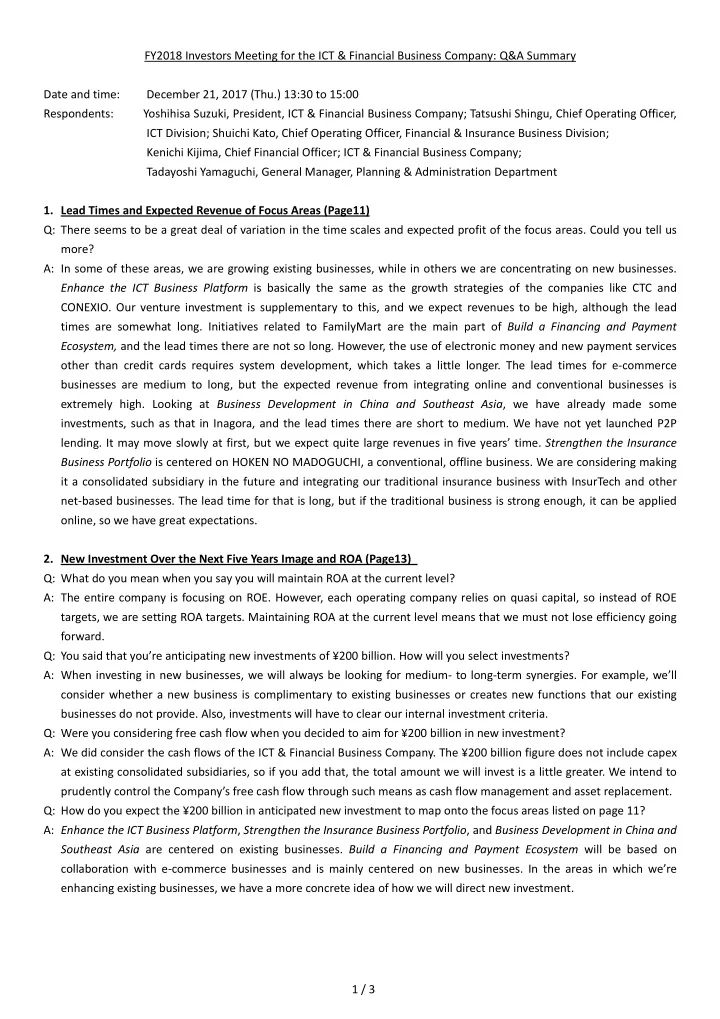
1 / 3 FY2018 Investors Meeting for the ICT & Financial Business Company: Q&A Summary Date and time: December 21, 2017 (Thu.) 13:30 to 15:00 Respondents: Yoshihisa Suzuki, President, ICT & Financial Business Company; Tatsushi Shingu, Chief Operating Officer, ICT Division; Shuichi Kato, Chief Operating Officer, Financial & Insurance Business Division; Kenichi Kijima, Chief Financial Officer; ICT & Financial Business Company; Tadayoshi Yamaguchi, General Manager, Planning & Administration Department

  • 1. Lead Times and Expected Revenue of Focus Areas (Page11)

Q: There seems to be a great deal of variation in the time scales and expected profit of the focus areas. Could you tell us more? A: In some of these areas, we are growing existing businesses, while in others we are concentrating on new businesses. Enhance the ICT Business Platform is basically the same as the growth strategies of the companies like CTC and

  • CONEXIO. Our venture investment is supplementary to this, and we expect revenues to be high, although the lead

times are somewhat long. Initiatives related to FamilyMart are the main part of Build a Financing and Payment Ecosystem, and the lead times there are not so long. However, the use of electronic money and new payment services

  • ther than credit cards requires system development, which takes a little longer. The lead times for e‐commerce

businesses are medium to long, but the expected revenue from integrating online and conventional businesses is extremely high. Looking at Business Development in China and Southeast Asia, we have already made some investments, such as that in Inagora, and the lead times there are short to medium. We have not yet launched P2P

  • lending. It may move slowly at first, but we expect quite large revenues in five years’ time. Strengthen the Insurance

Business Portfolio is centered on HOKEN NO MADOGUCHI, a conventional, offline business. We are considering making it a consolidated subsidiary in the future and integrating our traditional insurance business with InsurTech and other net‐based businesses. The lead time for that is long, but if the traditional business is strong enough, it can be applied

  • nline, so we have great expectations.
  • 2. New Investment Over the Next Five Years Image and ROA (Page13)

Q: What do you mean when you say you will maintain ROA at the current level? A: The entire company is focusing on ROE. However, each operating company relies on quasi capital, so instead of ROE targets, we are setting ROA targets. Maintaining ROA at the current level means that we must not lose efficiency going forward. Q: You said that you’re anticipating new investments of ¥200 billion. How will you select investments? A: When investing in new businesses, we will always be looking for medium‐ to long‐term synergies. For example, we’ll consider whether a new business is complimentary to existing businesses or creates new functions that our existing businesses do not provide. Also, investments will have to clear our internal investment criteria. Q: Were you considering free cash flow when you decided to aim for ¥200 billion in new investment? A: We did consider the cash flows of the ICT & Financial Business Company. The ¥200 billion figure does not include capex at existing consolidated subsidiaries, so if you add that, the total amount we will invest is a little greater. We intend to prudently control the Company’s free cash flow through such means as cash flow management and asset replacement. Q: How do you expect the ¥200 billion in anticipated new investment to map onto the focus areas listed on page 11? A: Enhance the ICT Business Platform, Strengthen the Insurance Business Portfolio, and Business Development in China and Southeast Asia are centered on existing businesses. Build a Financing and Payment Ecosystem will be based on collaboration with e‐commerce businesses and is mainly centered on new businesses. In the areas in which we’re enhancing existing businesses, we have a more concrete idea of how we will direct new investment.

slide-2
SLIDE 2

2 / 3

  • 3. FamilyMart and POCKET CARD

Q: Going forward, as you bring in peripheral businesses related to FamilyMart and UNY, in what business areas do you have particularly high expectations? A: The ICT & Financial Business Company is providing support to rebuild the financial functions of FamilyMart. We will develop POCKET CARD into a key financial business vehicle mainly for ITOCHU and FamilyMart. More specifically, we will begin by increasing the number of users of FamilyMart‐related credit cards, and then further increase membership by soliciting our customers to use POCKET CARD. Q: What functions can you provide for POCKET CARD? It seems like POCKET CARD isn’t based on fintech know‐how, so is there a possibility that you’ll run into a bottleneck as you move forward? A: We have contributed to a number of co‐branded credit cards, such as those for Famima Credit (with FamilyMart), Kohnan DIY stores, and, recently, Shimachu. Going forward, we aim to not only utilize POCKET CARD as the core of FamilyMart’s payment services, but strengthen a range of services, such as cardless payment, to meet the needs of customers at participating vendors, such as ZOZOTOWN and MAGASeek. Fintech payment services often don’t have reliable credit data. This is an area where we can take advantage of the strengths of our offline businesses by, for example, checking default rates using credit data. When fintech businesses seek the capabilities of offline companies, the value of POCKET CARD will emerge. 4. CP and CITIC Q: In cross‐border e‐commerce, you’re gradually advancing initiatives with CP and CITIC. How are these initiatives different from Inagora, and is there any possibility of collaboration in the future? A: SAKURA Links, which we’re working on with CITIC, and Inagora operate in parallel lanes; their customers, products and mechanisms are different, and both are interesting businesses. Inagora is a three‐year‐old startup, and has built a framework comprising two businesses: a B‐to‐B business for major Chinese e‐commerce businesses, such as Alibaba’s Tmall, and a B‐to‐C business based on its own mobile platform. The company already has billions of yen in sales, and is

  • n track to achieve profitability in the coming fiscal year. Inagora is also building good relationships with Japanese

manufacturers and has over 30,000 SKUs. CP and CITIC are interested in this business, and the cooperation of Inagora and SAKURA Links will likely be reinforced down the line. Each has its strengths, and CP or CITIC could perhaps enter a capital alliance with Inagora in order to expand its business in the future. Q: Looking at your financing and payment and mobile service businesses, in China, for example, there are already payment businesses like Alipay and WeChat. Will you partner with such businesses or compete with them? Also, how will you connect FamilyMart with CP and CITIC? A: At present, the ICT & Financial Business Company has not decided on any concrete themes to pursue regarding FamilyMart in China. We are still gathering and examining information. In terms of mobile businesses, we are considering expanding the mobile insurance business we operate in Japan to the CP and CITIC groups, but that has no direct relation to Alipay. In addition, CP has a mobile business called True in Thailand, which we think might be a path for business development. 5. Others Q: Why are you looking to increase your venture investments now? A: In the ICT Division, we have been making venture investments in Silicon Valley for more than twenty years. Our investments there now total more than ¥10 billion, and we hope to invest even more going forward. Demand from Japanese companies seeking to actively use AI, Fintech and other venture‐related technologies and services is starting to emerge, and we aim to meet that demand alongside CTC. We made a venture investment in Inagora two years ago, and have now decided to increase our stake to 20% and make it one of our affiliates. We hope to increase such initiatives going forward. Q: Regarding venture investments, like those in Silicon Valley, I get the impression that you are a minority investor. Do you have any intention of stepping up your venture investments to make your investees affiliates or are you content with

slide-3
SLIDE 3

3 / 3 minority investments? A: As a Group, our approach when making venture investments is focused on eventually bringing the investment targets in as affiliates, so we only invest in fields that can generate synergies with our other businesses. Currently, our main focus is start‐ups in Japan. In the past, we regarded less than 10% of such start‐ups as candidates for greater investment, but, going forward, we aim to consider as many as 10% to 15%. Q: If the business environment undergoes major changes, it will likely to lead to the creation of new businesses outside the current areas of your operating companies. As the parent company, what are your thoughts on that? A: Although each operating company has a strong business foundation, none by themselves can cover all potential areas. That’s why new investments are necessary. We need to invest in new technologies, such as AI and IoT, as well as existing businesses and in fields that we don’t currently have in our portfolio. We are considering investment amounts and priorities along with exit strategies. Many of the ideas put forward by operating companies are extensions of current businesses or proposals for incorporating other businesses in order to develop the company making the

  • proposal. We are working with the operating companies to consider such ideas.

Q: Lots of new players are entering the fintech and e‐commerce fields. What is your vision for winning out over the fierce competition? A: We possess wide‐ranging conventional, offline assets, all of which generate profit. At the same time, in the face of the variety of changes and threats brought about by Amazon and other competitors, even conventional businesses have to

  • evolve. Our strength lies in conventional businesses, but rather than view online businesses as a threat, we hope to

seize opportunities to work together. Q: At non‐wholly owned subsidiaries, like CTC, some of the profits and the products of synergies are distributed to minority shareholders. In other words, some the fruits of your efforts are going to these minority interests, which is bad for your shareholders. Do you have any thoughts on this? A: In the Financial & Insurance Business Division, equity‐method associated companies contribute a great deal to profit. By teaming up with strong partners, we have been able to enter excellent businesses and secure profit and know‐how. Right now, we are looking to increase our stake in businesses that we can manage independently, like POCKET CARD, and take a hands‐on approach. Since we’re putting in human resources and money, we of course want to maximize

  • returns. To that end, yes, it’s better to command a larger shareholding ratio, but we also have to keep in mind that

increasing our holdings means increasing our investment. Also, in some cases, minority shareholders provide useful functions that contribute to profit. Q: You’ve said that part of your Company’s role is to evolve ITOCHU’s profit model. Can we take this to mean you will be working with the other Companies to raise their value while also growing yourself? Will the importance of the ICT & Financial Business Company increase under the next medium‐term management plan? A: We hope the ICT & Financial Business Company will play a major role under the next medium‐term management plan, but ICT is just one function and doesn’t readily stand on its own as a business. On the other hand, businesses in such areas as food and textiles will always need ICT and financial functions. So while our Company may not be a concentrated revenue generator, by working with the other Companies, we aim to enhance the performance of ITOCHU as a whole.