G EOLOGICAL REPOSITORY OF F RENCH HLW C IGO P ROJECT : T HE - - PowerPoint PPT Presentation

g eological repository of f rench hlw
SMART_READER_LITE
LIVE PREVIEW

G EOLOGICAL REPOSITORY OF F RENCH HLW C IGO P ROJECT : T HE - - PowerPoint PPT Presentation

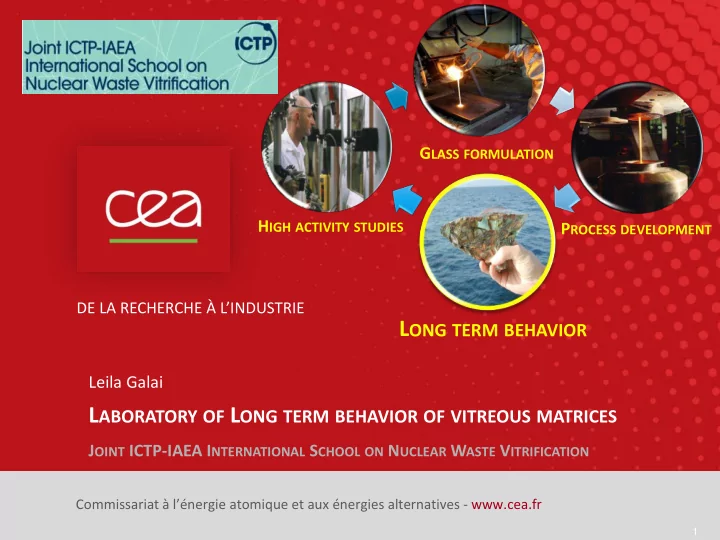
G LASS FORMULATION H IGH ACTIVITY STUDIES P ROCESS DEVELOPMENT DE LA RECHERCHE LINDUSTRIE L ONG TERM BEHAVIOR Leila Galai L ABORATORY OF L ONG TERM BEHAVIOR OF VITREOUS MATRICES J OINT ICTP-IAEA I NTERNATIONAL S CHOOL ON N UCLEAR W ASTE V


slide-1
SLIDE 1

JOINT ICTP-IAEA INTERNATIONAL SCHOOL ON NUCLEAR WASTE VITRIFICATION

Commissariat à l’énergie atomique et aux énergies alternatives

DE LA RECHERCHE À L’INDUSTRIE

Commissariat à l’énergie atomique et aux énergies alternatives - www.cea.fr

LABORATORY OF LONG TERM BEHAVIOR OF VITREOUS MATRICES

JOINT ICTP-IAEA INTERNATIONAL SCHOOL ON NUCLEAR WASTE VITRIFICATION Leila Galai

1

GLASS FORMULATION HIGH ACTIVITY STUDIES PROCESS DEVELOPMENT

LONG TERM BEHAVIOR

slide-2
SLIDE 2

JOINT ICTP-IAEA INTERNATIONAL SCHOOL ON NUCLEAR WASTE VITRIFICATION

Commissariat à l’énergie atomique et aux énergies alternatives

GEOLOGICAL REPOSITORY OF FRENCH HLW

CIGÉO PROJECT : THE GEOLOGICAL STORAGE OF HLW DEVELOPED BY ANDRA A MULTI-BARRIER CONCEPT :

GLASS MATRIX POURED IN STAINLESS STEEL

CANISTER

LOW- ALLOYED STEEL OVERPACK 500-METER DEEP DISPOSAL CALLOVO-OXFORDIAN (COX) CLAYSTONE

Understand the physical and chemical mechanisms that determine glass behavior under repository conditions

NATIONAL AGENCY FOR RADIOACTIVE WASTE MANAGEMENT

2

  • Demonstrating the enviromental safety of the concept : Assessing the long term behaviour of the nuclear glass
slide-3
SLIDE 3

JOINT ICTP-IAEA INTERNATIONAL SCHOOL ON NUCLEAR WASTE VITRIFICATION

Commissariat à l’énergie atomique et aux énergies alternatives 3

1

Description of repository condition key parameters  Callovo-Oxfordian claystone fluid composition and its renewal  Surrounding materials: clay, metal, cement Quantification of the effect of these parameters on glass matrices life-time

2

Identification of glass alteration mechanisms

3 4

Modeling lab experiments  Parametric alteration experiments

METHODOLOGY

The inactive reference material is SON68 glass. This glass contains neither radioactive elements, which are instead simulated by

  • ther elements.

SON68 glass composition in oxide wt%

(Jollivet, 1995) 3

slide-4
SLIDE 4

JOINT ICTP-IAEA INTERNATIONAL SCHOOL ON NUCLEAR WASTE VITRIFICATION

Commissariat à l’énergie atomique et aux énergies alternatives

  • HLW French reference glass rates

Pristine glass Hydrated glass Macroporous alteration layer Crystalline phases 2 µm

Experimental evidence of a dense layer acting as a diffusion barrier and a hydrated glass that conserves glass structure

r0 100°C ~ 1 µm/d r0 50°C ~ 10 nm/y rr 90°C / r0 90°C ~ 10 000

Maximum dissolution rate r0 Rate drop Residual rate rr

(Alteration resumption) Precipitation of specific secondary phases

Formation of the passivating layer

Quasi steady state alteration Precipitation of secondary phase And/or evolution of the passivating layer

Glass dissolution Interdiffusion

Time Alteration regimes

 Leaching experiments in aqueous solutions, in contact with enviromental materials  Solution analysis and solid characterization

IDENTIFICATION OF GLASS ALTERATION MECHANISMS

 Water: main cause of corrosion of the glass packages

4

  • Identify the nature and the properties
  • f the alteration products
slide-5
SLIDE 5

JOINT ICTP-IAEA INTERNATIONAL SCHOOL ON NUCLEAR WASTE VITRIFICATION

Commissariat à l’énergie atomique et aux énergies alternatives 5

H2O

To describe macroscopic properties…

 Ab initio

 Monte Carlo

Accounts for the diffusion and solubility in the gel, integrated with the reactive transport model HYTEC

… from atomic to mesoscopic scale MODELING AND EXPERIMENTAL MULTI-SCALE APPROACH

Detailed mechanistic models :

  • understand coupling at microscopic scale
  • understand elementary mechanisms

Macroscopic scientific models : Justify assumptions of

  • perational models

Geochemical Model Atomistic Models

 Molecular dynamics

(Verney-Carron 2008)

  • (Frugier et al. 2008)

Model validations :

Natural and archaeological analogues of glasses attempt to answer the question of time scale

 GRAAL

slide-6
SLIDE 6

JOINT ICTP-IAEA INTERNATIONAL SCHOOL ON NUCLEAR WASTE VITRIFICATION

Commissariat à l’énergie atomique et aux énergies alternatives

DE LA RECHERCHE À L’INDUSTRIE

Commissariat à l’énergie atomique et aux énergies alternatives - www.cea.fr

STUDY OF REACTION MECHANISMS GOVERNING IRON-

GLASS INTERACTION IN HLW DISPOSAL CONTEXT

Leila Galaï

  • LABORATORY OF LONG-TERM BEHAVIOR OF VITREOUS MATRICES
slide-7
SLIDE 7

JOINT ICTP-IAEA INTERNATIONAL SCHOOL ON NUCLEAR WASTE VITRIFICATION

Commissariat à l’énergie atomique et aux énergies alternatives

Context

7

Lid Glass Matric Low alloyed stainless steel

  • verpack

Pantin de céramique

glass/steel Interaction In presence of water

Impact the long-term behavior of nuclear vitrified waste

Stainless stell primary package

Bring new insights into mechanisms governing the interaction between glass matrix and the stainless steel over-pack for a better prediction of the long term behavior of the nuclear glass under repository conditions

1

CIGÉO PROJECT : THE GEOLOGICAL STORAGE OF HLW DEVELOPED BY ANDRA

slide-8
SLIDE 8

JOINT ICTP-IAEA INTERNATIONAL SCHOOL ON NUCLEAR WASTE VITRIFICATION

Commissariat à l’énergie atomique et aux énergies alternatives

Literature review

Glass-iron system: study of the effect of iron on glass alteraction

De Combarieu, 2007 Carrière, 2017

Hypothesis Si-Fe formation leads to a delay in the saturation of the solution

Burger et al., 2013 Michelin et al., 2013 Arena, 2016 Godon et al., 2013

Highlight the presence of iron silicates

Schegel et al., 2016 Frugier et al. 2007 Mc Vay et al., 1983

Increasing of glass alteration in presence

  • f iron

Simultaneous degradation of glass and iron / steel

Brossel, 2017

Experimental systems too complex to allow a detailed understanding of the mechanisms governing the glass iron interaction

2

  • Difficulty in identifying mechanisms on the

surface of each material

  • Poor literature on the effect of Si on Fe

corrosion

Glass Iron/ Steel

Si B Na Fe2+ ? ? H2

OH- H+

+

No adequate reference experience

  • No unambiguous conclusion on the effect of

iron on the alteration of glass
slide-9
SLIDE 9

JOINT ICTP-IAEA INTERNATIONAL SCHOOL ON NUCLEAR WASTE VITRIFICATION

Commissariat à l’énergie atomique et aux énergies alternatives

Scientific Strategy

3

Glass-steel-water complex system Glass-Solution: Fe2+effect on glass alteration Iron-Solution: Si effect on iron corrosion Understanding of the mechanisms and associated kinetics Combined alteration experiments Glass/Iron/solution Verification of the deduced mechanisms transferability to a more complex system

  • Vcorr.Fer
  • Vprec.Si-Fe
  • Vdisso verre
  • Vprec.Si-Fe

Decomposition of the original system into two simplified model-systems Better understanding of the complex system

slide-10
SLIDE 10

JOINT ICTP-IAEA INTERNATIONAL SCHOOL ON NUCLEAR WASTE VITRIFICATION

Commissariat à l’énergie atomique et aux énergies alternatives

First results Glass-Solution system

4

  • Study of Fe2+ effect on glass alteration kinetics

H2O FeCl2 pH 8,7 6,2

% Va

20 40

Need to work on the same pH to dissociate the effect of iron and pH on glass alteration

0.1 0.2 0.3 0.0 20.0 40.0

NL(B) g/m² Temps (Jours)

CJ2-Tampon CJ2-FeCl2- Tampon CJ2-FeCl2- H2O

 Hides the possible

effect of Fe2+ on glass alteration Need to find an inert buffer towards glass alteration

1. Free pH experiments

 Increasing of glass

alteration in presence of FeCl2

2. Buffered experiments: Buffer NH3/NH4Cl

  • Glove box
  • T= 90°C
  • S/V = 0,5 cm-1
  • CJ2= Si, B, Na, Al
slide-11
SLIDE 11

JOINT ICTP-IAEA INTERNATIONAL SCHOOL ON NUCLEAR WASTE VITRIFICATION

Commissariat à l’énergie atomique et aux énergies alternatives

First results Iron-Solution system

11

P(H2) monitoring 2H++ Fe Fe(II) + H2

  • Study of Si effect on iron corrosion kinetics
  • Sealed reactors to avoid gaz leak
  • Iron Corrosion monitoring

Si(IV)

Fe2+ In solution

  • Si-Fe formation
  • Monitoring of Si

consumption

  • Iron
  • xide

and hydroxide formation in solution

  • Iron oxide and hydroxide

formation on the surface

H2O/OH-…

Oxide layer formed on the surface of Fe powder with little or no evolution in terms of composition and thickness

  • Oxide layer thickness
  • Fe2+ /Fe3+ ratio

Study of iron corrosion kinetics possible only by solution analysis + characterization

In solution

6

  • XPS Characterization

703 708 713 718 723 728 733 Binding energy / eV Intensity / a.u.

 Fe-EP-4

Fe3+ contribution Fe2+ contribution  Fe0 contribution

Fe-2p3/2 Fe-2p1/2

Experience name Duration (Days ) Oxide layer thikness (nm) Fe- EP-4 4 5 Fe- EP-9 9 6 Fe- EP-30 30 6

Iron corrosion experiments

  • 4, 9 et 30 days
  • pH 8
  • T 50
slide-12
SLIDE 12

JOINT ICTP-IAEA INTERNATIONAL SCHOOL ON NUCLEAR WASTE VITRIFICATION

Commissariat à l’énergie atomique et aux énergies alternatives

Fe

  • Vdisso verre
  • Vprec.Si-Fe
  • Vcorr.Fer
  • Vprec.Si-Fe

T = 50 °C pH= 8,2 Borate buffer: H3BO3 ,NaOH Anoxic media (glove-box) Iron solution System : Si Effects on iron corrosion Identical physicochemical conditions: Similar Si-Fe formed Fe CJ1: Na, Si, B H4SiO4

Na Na B B

Fe Sheet (99,95%)

Combined alteration experiments Glass/Iron/solution

  • Characterization: precipitated minerals nature and

stoichiometry

  • Kinetics of formation, Fe corrosion kinetics, glass

alteration kinetics Modeling:

Need to impose identical physicochemical conditions in all experiments

Experimental approach

5

Alterative solution PTFE container Glass powder PTFE container Alterative solution

Glass solution system : Fe effect on glass alteration

slide-13
SLIDE 13

JOINT ICTP-IAEA INTERNATIONAL SCHOOL ON NUCLEAR WASTE VITRIFICATION

Commissariat à l’énergie atomique et aux énergies alternatives

Commissariat à l’énergie atomique et aux énergies alternatives - www.cea.fr

Thank you for your attention

Special thanks to

  • Pierre Frugier
  • Loïc Marchetti
  • Nicole Godon

Leila Galaï leila.galai@cea.fr

13