G.J.M. Smit Contents Efficient architectures Introduction - - PDF document

g j m smit
SMART_READER_LITE
LIVE PREVIEW

G.J.M. Smit Contents Efficient architectures Introduction - - PDF document

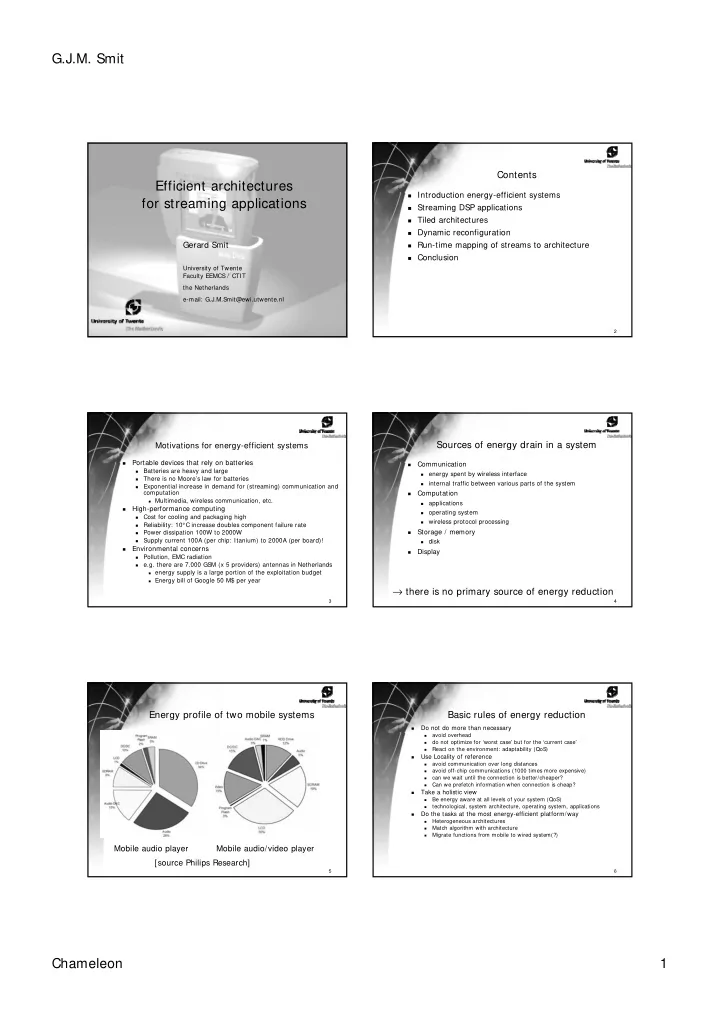
G.J.M. Smit Contents Efficient architectures Introduction energy-efficient systems for streaming applications Streaming DSP applications Tiled architectures Dynamic reconfiguration Gerard Smit Run-time mapping of streams to


slide-1
SLIDE 1

G.J.M. Smit Chameleon 1 Efficient architectures for streaming applications

Gerard Smit

University of Twente Faculty EEMCS / CTIT the Netherlands e-mail: G.J.M.Smit@ewi.utwente.nl

2

Contents

Introduction energy-efficient systems Streaming DSP applications Tiled architectures Dynamic reconfiguration Run-time mapping of streams to architecture Conclusion 3

Motivations for energy-efficient systems

  • Portable devices that rely on batteries
  • Batteries are heavy and large
  • There is no Moore’s law for batteries
  • Exponential increase in demand for (streaming) communication and

computation

Multimedia, wireless communication, etc.

  • High-performance computing
  • Cost for cooling and packaging high
  • Reliability: 10°C increase doubles component failure rate
  • Power dissipation 100W to 2000W
  • Supply current 100A (per chip: Itanium) to 2000A (per board)!
  • Environmental concerns
  • Pollution, EMC radiation
  • e.g. there are 7.000 GSM (x 5 providers) antennas in Netherlands

energy supply is a large portion of the exploitation budget Energy bill of Google 50 M$ per year

4

Sources of energy drain in a system

  • Communication
  • energy spent by wireless interface
  • internal traffic between various parts of the system
  • Computation
  • applications
  • perating system
  • wireless protocol processing
  • Storage / memory
  • disk
  • Display

→ there is no primary source of energy reduction

5

Energy profile of two mobile systems

Mobile audio player Mobile audio/video player [source Philips Research]

6

Basic rules of energy reduction

  • Do not do more than necessary
  • avoid overhead
  • do not optimize for ‘worst case’ but for the ‘current case’
  • React on the environment: adaptability (QoS)
  • Use Locality of reference
  • avoid communication over long distances
  • avoid off-chip communications (1000 times more expensive)
  • can we wait until the connection is better/cheaper?
  • Can we prefetch information when connection is cheap?
  • Take a holistic view
  • Be energy aware at all levels of your system (QoS)
  • technological, system architecture, operating system, applications
  • Do the tasks at the most energy-efficient platform/way
  • Heterogeneous architectures
  • Match algorithm with architecture
  • Migrate functions from mobile to wired system(?)
slide-2
SLIDE 2

G.J.M. Smit Chameleon 2

7

Myths and facts

  • Myths in energy reduction
  • energy consumption is only a hardware problem
  • time will solve the energy problem
  • new battery technology will solve the problem
  • Facts
  • functionality of a device is often limited by required energy

consumption

  • batteries are the largest single source of weight in a portable
  • help from IC technology will slow down
  • energy is a ‘vertical’ parameter and involves all layers
  • solution might be in the higher levels: system architecture,

communication protocols, operating system, applications

  • gap between battery energy and required energy grows
  • communication will require relative more energy than processing

8

Battery gap

  • Battery energy contents improves approx. 10% per year
  • In most portables batteries contribute to 1/3 of the weight
  • 2 AAA batteries have energy contents of ~ 3.3 Wh
  • Required energy grows with far more than 10%

9

Metrics

Power

Energy dissipated in a certain period of time E = P. t [Ws]

time P More power, less energy Less power, more energy

10

Energy efficiency

Energy efficiency =

Essential energy dissipation for a certain function Actually used total energy dissipation

11

Design for energy efficiency

technological system logic dynamic power management compression method scheduling communication error control medium access protocols hierarchical memory systems application specific modules logic encoding data guarding clock management reversible logic asynchronous design reducing voltage chip layout packaging abstraction level examples

12

Technology and logic design level

slide-3
SLIDE 3

G.J.M. Smit Chameleon 3

13

CMOS inverter

V

  • V

i

Vdd

C

l

Iload Icrowbar

Level change: Charge external loads Level change: Short current

CMOS

Inherently low power Cost effective

14

Where does energy go in CMOS digital logic?

  • Dynamic power consumption
  • Charging and discharging capacitors
  • Most dominant (80-95%) in 130 nm technology
  • Short circuit current
  • Short circuit path between supply rails when logic level changes
  • 10% – 15%
  • Leakage
  • Leaking diodes and transistors
  • Problem even in standby
  • Effect is increasing with smaller feature size!
  • Will soon become a significant/dominant portion of total

15

Power consumption approximation

Dynamic power consumption

P = ∑ α C V 2 with: α = switching activity C = total capacity V = voltage swing

Semiconductor trend

V drops 5V → 1.8 V → 1.2 V 0.8 V smaller technologies C decreases (on-chip C, not off-chip C )

16

Minimise capacitance

On-chip 10-50 femto Farads

Internal C reduced by technology scaling E.g. MIPS 25% reduction in power due to migration from 0.8

um to 0.64 um

Off-chip 14 pF

Energy required for 32 x 32 multiplication 5.7 nJ 32 bits data to memory (24 address lines) 20 nJ With smaller feature size gap will increase!!

17

Reordering logic inputs

X & B A P(X=1) = 0.1 Z & C Y & C B P(Y=1) = 0.02 Z & A P(A=1) = 0.5 P(B=1) = 0.2 P(C=1) = 0.1 Circuit a. Circuit b. 18

Technology and logic Summary

Numerous techniques are available

Packaging Technology scaling Circuits Clock gating Data guarding Architecture

Technological level gain is limited to x2 Reduce switching activities is the most effective

technique

slide-4
SLIDE 4

G.J.M. Smit Chameleon 4

19

System architectural level

20

System level

Potentially high gain Three major mechanisms

Avoid unnecessary activity Exploit locality of reference Use most efficient platform

21

System architecture tricks

  • Gated-clocks and power shutdown
  • Dynamic power management
  • More efficient algorithms and architectures
  • Proper I/O interconnect design and packaging
  • Single package
  • Coding of data
  • Interconnection network
  • CPU centric / connection centric / NoC
  • Memory access
  • Recompute rather than refetch from memory
  • Local memories/cache (locality of reference)

22

Memories & busses

  • A significant fraction of total energy budget is consumed in

busses and memories

Minimise bus access

Minimise memory access caching Clustering compression

  • Reorder access
  • Bus encoding techniques
  • Break memory in smaller sub-arrays/banks
  • Each bank can be individually powered down
  • Memory allocation and garbage collector

23

Encoding

  • Large amount of energy goes into off-chip IO
  • Encoding bus data and address can reduce power significantly
  • Examples
  • Gray code: addresses usually increment sequentially by one
  • Compression
  • Bus invert coding

Transmit original or inverted data whichever results in fewer

transitions from previous

Extra signal indicates polarity

  • 2’s complement versus signed magnitude

24

Dynamic power management

Natural focus of designers

Worst-case conditions Peak performance Peak utilisation

Consequence is that system is not fully utilised Dynamic power management exploits periods of

idleness caused by system under-utilisation

slide-5
SLIDE 5

G.J.M. Smit Chameleon 5

25

Problems with power management

Cost of restarting

Latency (e.g. time to spin-up) Extra energy, e.g. higher start-up current disk Disk 2W in active, 1 W in idle, 3W in spin-up

Two main questions

When to shut-down When to wake-up

26

Barriers to voltage scaling

Voltage scaling requires threshold voltage to be

scaled as well

Decrease in noise margin Leakage power will increase

Requires special circuits soft error rate will increase

Caused by alpha particles and cosmic rays Reduced capacitance implies lower energy to

flip a bit

Delay increases.. 27

Speed vs. voltage

Normalised delay Supply voltage [V]

1 3 5 7 1.5 2.0 2.5 3.0

28

Why Dynamic Voltage Scaling?

  • Execute only as fast as necessary to meet deadlines
  • Workload in devices are typically bursty:

Work time

  • We can save energy by slowing down and thus utilize the idle

time.

Work time

29

Traditional

useful computation energy consumption sleep peak time inactivity threshold Wake-up time

30

Voltage scaling under deadline constraints

Example:

task 100 ms deadline, needs 50 ms CPU full speed Traditional: 50 ms computation, 50 ms idle Half speed/voltage scaled: 100 ms comp., 0 idle Ideal situation: ¼ energy reduction

S1 Speed / Voltage time Task 1 Task 2 Task 3 Task 1 S2 S3 D2 D3 D1 Dx deadline task x Sx initiation time task x

slide-6
SLIDE 6

G.J.M. Smit Chameleon 6

31

Why power-management in mobile systems

  • Wireless systems have time varying computational loads
  • Wireless systems often have a Quality / Power trade-off that can

be exploited to suit application needs

  • Wireless systems need to be resilient to variations in the

environment

  • Wireless systems have to be energy-efficient

because they are battery powered

32

Interactive applications are usually bursty

0.1 0.2 0.3 0.4 0.5 0.6 0.7 0.8 0.9 1 5000000 10000000 15000000 20000000 25000000 30000000 35000000

Time (microseconds) Utilization

Speech Rendering Speech Playback Interaction

33

Leading to bursty energy demands..

inst power 0.2 0.4 0.6 0.8 1 1.2 1.4 1.6 1.8 19.5 39.1 58.6 78.2 97.7 117 137 156 176 195 215 234 254 274 293 313 332 352 371 391 410 430 449 469 488 508 528 547 567 586 606 625 645 664 time (seconds) power (w) rebooting the itsy and having Java boot (8 times) clock speed 200 Mhz ->50- >200 calculator scribble scribbile not being used gc? scribble

34

Efficient Architectures for Embedded Systems

35 Old CW: Power is free, Transistors expensive New CW: “Power wall” Power expensive, Xtors free

(Can put more on chip than can afford to turn on)

Old: Multiplies are slow, Memory access is fast New: “Memory wall” Memory slow, multiplies fast

(200 clocks to DRAM memory, 4 clocks for FP multiply)

Old : Increasing Instruction Level Parallelism via

compilers, innovation (Out-of-order, speculation, VLIW, …)

New: “ILP wall” diminishing returns on more ILP HW New: Power Wall + Memory Wall + ILP Wall = Brick Wall

Old CW: Uniprocessor performance 2X / 1.5 yrs New CW: Uniprocessor performance only 2X / 5 yrs?

Conventional Wisdom (CW) in Computer Architecture [Patterson Hotchips2006]

36 1 10 100 1000 10000 1978 1980 1982 1984 1986 1988 1990 1992 1994 1996 1998 2000 2002 2004 2006

Performance (vs. VAX-11/780)

25%/year 52%/year ??%/year

Uniprocessor Performance (SPECint)

  • VAX

: 25%/year 1978 to 1986

  • RISC + x86: 52%/year 1986 to 2002
  • RISC + x86: ??%/year 2002 to present

From Hennessy and Patterson, Computer Architecture: A Quantitative Approach, 4th edition, Sept. 15, 2006

⇒ Sea change in chip design: multiple “cores” or processors per chip

3X

slide-7
SLIDE 7

G.J.M. Smit Chameleon 7

37

Déjà vu all over again?

“… today’s processors … are nearing an impasse as technologies approach the speed of light..”

David Mitchell, The Transputer: The Time Is Now (1989)

  • Transputer had bad timing (Uniprocessor performance↑)

“We are dedicating all of our future product development to multicore designs. … This is a sea change in computing”

Paul Otellini, President, Intel (2005)

  • All microprocessor companies switch to MP (2X CPUs / 2 yrs)

32 4 4 2

Threads/chip 4 2 2 1 Threads/Processor

8 2 2 2

Processors/chip Sun/’05 IBM/’04 Intel/’06 AMD/’05 Manufacturer/Year

38

FIR FFT

xx

Typical Embedded Systems applications combination

Control Streaming (90% ) (Parallel/reconfigurable/spatial) Control (10% ) (GPP: programmable)

39

Reconfigurable architectures

Reconfigurable architecture

General- purpose processor

Application specific modules ASIC flexibility efficiency application e.g. Pentium

Flexibility versus energy efficiency

heterogeneous

40

Focus of Chameleon group

Network-on-Chip Design-time tools

Streaming DSP applications

(Run-time) mapping tiled heterogeneous reconfigurable SoC

Energy-efficient

41

Efficient implementation of streaming applications

  • Holistic approach: everything should fit together like a jigsaw

puzzle

  • Efficient processing platform
  • heterogeneous tiled SoC platform
  • efficient tile processors (e.g. Montium like)
  • Efficient and predictable reconfigurable NoC
  • e.g. virtual channel network + network interface
  • Efficient design-time tools for ‘compiling’ processes to tiles
  • Run-time mapping of process graphs to SoC/NoC
  • determine at run-time near-optimal mapping
  • Fast (partly) reconfiguration of tiles&communication
  • dynamic: while the system is in operation

42

Streaming Applications (1)

  • Process graph with node (= processes/tasks) and edges

(= communication/synchronization)

  • process: e.g. FFT, FIR, DCT, …
  • communication: e.g. sample, OFDM symbol, video frame, …
  • Constant stream of data flows through the network
  • modeled as dataflow graph
  • like a lemming network
  • For our domain streaming applications typically takes 80 to

100% of the processing / communication resources in a system

  • streams remain relatively fixed for a longer period
  • Characteristics
  • predictable temporal behavior
  • predictable spatial behavior
  • relative simple local processing but huge amount of data
  • trend: communication will dominate energy costs rather than

processing

  • adaptive: dynamic (partial) reconfiguration
slide-8
SLIDE 8

G.J.M. Smit Chameleon 8

43

Streaming Applications (2)

Application examples

signal processing for phased array antennas (6000) radar + radio astronomy wireless baseband processing (OFDM) HiperLAN/2, WiMax, DAB, DRM, DVB, ….. multi-media processing (encoding/decoding) e.g. MPEG / TV medical image processing

  • ne page of code but needs several hours of processing

time on the fastest Pentium4 processor

sensor processing e.g. remote surveillance cameras automotive

44

Chameleon template heterogeneous tiled reconfigurable SoC

  • Heterogeneous reconfigurable processing tiles

interconnected by a predictable on-chip interconnection network

  • Match algorithm with architecture
  • General-purpose
  • Fine-grained
  • Coarse-grained
  • Application specific

DSRC = domain specific reconfigurable core

45

Heterogeneous Match algorithm with architecture

  • Bit-level architectures (FPGA)
  • PN-code generation
  • Turbo-encoding
  • Word-level architectures (Montium, DSP)
  • FFT
  • FIR filters
  • Turbo-decoding
  • General-purpose processor (GP)
  • Control oriented programs

(frequent if/then/else constructs)

  • Reconfigurable interconnect
  • Real-time multimedia streaming traffic
  • Bus vs. connection centric

46

What is not our focus?

Control intensive applications

more suitable for standard GPPs complex software operations on small amount of data data caches help here (not in streaming case)

We do assume

(part of the) data can be held locally in a tile fast local data access might mean tiling of datasets

47

A tiled architecture

  • Inherently exploits locality of reference
  • Energy and delay costs of transporting a signal over a wire will

become much higher compared to the costs of computation

  • Tiles do not grow in complexity with technology
  • Technology scales more tiles on chip
  • On-chip network
  • Higher bandwidth, lower power
  • Small tile design
  • Can be highly optimized for low-power
  • Identical tiles have to be verified only once
  • Partial and dynamic reconfiguration
  • Tile can have its own (configurable) clock domain
  • Our vision
  • FPGA like structure with cores instead of CLBs for streaming

applications

48

Characteristics of the Montium Tile Processor

  • Design goals
  • Energy-efficiency
  • Flexibility
  • Small control overhead
  • Avoid compiler and scheduler

bottlenecks

  • Algorithm domain
  • Digital Signal Processing
  • 2048p FFT, FIR, correlation, …
  • Features
  • 16-bit datapath
  • Signed integer and

signed fixed-point arithmetic

  • Streaming I/O
  • Reconfigurable instruction set

1,8 mm2 Area (excluding wires) 45-150 MHz Clock speed

0.5 mW/MHz

Energy

1.10V

Voltage

0.12 µm

Process Montium Tile Processor

www.recoresystems.com

slide-9
SLIDE 9

G.J.M. Smit Chameleon 9

49

Dynamic Reconfiguration

Configuration per tile Fast re-configuration (micro-second scale)

all tiles can be configured in parallel coarse-grain reconfiguration word-level not on bit-level e.g. Montium has 2.6kB configuration size partial re-configuration reconfiguration memory is RAM changing # filter taps, coefficients, etc e.g. change from FFT iFFT takes 16 bytes

50

Energy-efficiency

Locality of reference

Data and storage in one tile Communication as local as possible

Reduce control overhead

e.g. running a FIR almost all control signals stable

Match algorithms with hardware architecture

PN-code generation in bit-level reconfigurable Control-oriented on GPP DSP algorithms on DSP or coarse-grain reconfigurable

Dynamic Voltage (Frequency) Scaling per tile

even switch off unused tiles

51

FIR FFT

Turbo High-level application graph One or more implementations

  • n different

processing tiles

Definition of streaming DSP applications

52

1 2 4 3 5

CCN

Mapping applications to a SoC

  • Mapping of the application is done at run-time
  • Processes Processor Tiles
  • Communication streams Network-on-Chip
  • Central Coordination Node (CCN)
  • The node has a global overview of the system
  • SoC wide optimization to minimize the energy consumption
  • For NoC allocation of channels, routes, bandwidth etc.

CCN

1 2 4 3 5

53

Run-time mapping of applications to tiled architectures (dynamic reconfiguration?)

Only at run-time the mix of applications is known

More applications might be running new applications (after ‘upgrade’)

Only at run-time the environment is known

Systems work in a dynamic environment Adaptive: select algorithms/parameters at run-time Applications can have QoS parameters Video / sound quality requirements

At run-time the available tiles are known

Other applications use your preferred tiles Some tiles / communication links might be faulty tiles may breakdown due to aging / …

54

Seven reasons why coarse-grain reconfigurable failed as efficient architecture for streaming DSP domain E.g. Chameleon Systems, Quick Silver, …

  • 1. Software trap
  • Parallel machines / CG reconfigurable hard to program
  • lack of high-level tool support
  • 2. No holistic view
  • E.g. nice HW architecture but no software toolflow
  • E.g. a minimal NoC router but a complex Network Interface
  • 3. Locality of Reference trap
  • hundreds of ALUs and memories and long wires doomed to fail
  • 4. Communication / computation trap
  • HW accelerator designers tend to forget communication overhead

(see also 2)

  • 5. Lack of predictability
  • Compensate unpredictability (e.g. shared busses) with large buffers
  • 6. Cost trap (configuration has overhead in area and energy)
  • 7. fill in your own reason ….
slide-10
SLIDE 10

G.J.M. Smit Chameleon 10

55

Why are we still working on CG reconfigurable?

It is our only option left

Pentiums are too inefficient FPGAs have their problems Long configuration times Not energy efficient (locality of reference) Difficult to program Little support for dynamic reconfiguration ASICs are too expensive / too inflexible

But we have to learn from our past mistakes 56

Where can we find the clue?

Tiled architectures

Have many tiles instead of one complex high-speed single

processor

Distributed memory & distributed control Dynamic (partial) reconfiguration

Holistic view

Design teams with EE + CS + application developers

Locality of Reference Streaming applications

Predictable Guaranteed QoS NoC (throughput & latency)

57

Conclusion

  • Tiled architectures are a good match for streaming DSP

applications

  • Holistic approach pays off
  • Efficient tiles
  • Efficient NoC
  • Dynamic partial reconfiguration
  • Good tooling
  • Run-time mapping
  • Lots of open issues
  • how do we model applications
  • how do we find parallelism is sequential code?

implicit: use sequential C/Matlab code let the compiler do the

trick

explicit: use parallel programs e.g. Simulink, TTL, … let the

user find the parallelism

  • what are the ideal tiles?
  • Efficient inter-tile communication with different clocks/voltages

58

Questions

  • Acknowledgements
  • PhD students

Gerard Rauwerda Marcel vd Burgwal Yuanqing Guo Nikolay Kavaldjiev Pascal Wolkotte Lodewijk Smit Philip Holzenspies Qiwei Zhang Maarten Wiggers Paul Heysters Jan Jacobs Mohammed Khatib Tjerk Bijlsma

  • more info see chameleon.ctit.utwente.nl

www.recoresystems.com