Galaxy Evolution interstellar matter (ISM) drives galaxy evolution, - PowerPoint PPT Presentation
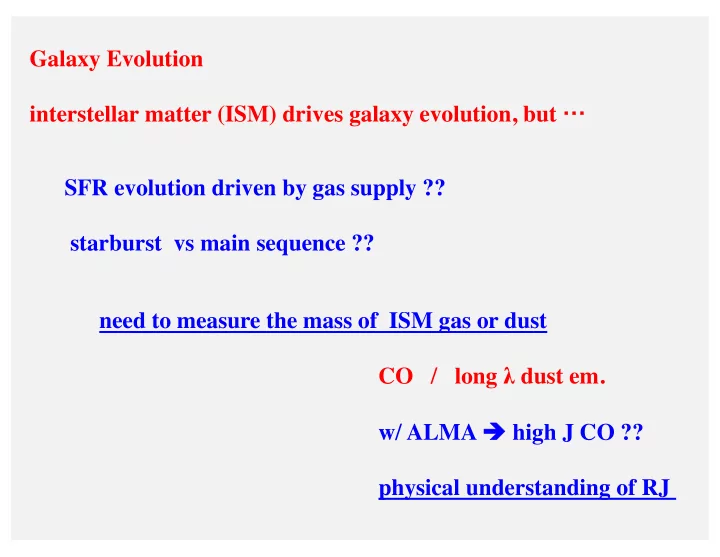
Galaxy Evolution interstellar matter (ISM) drives galaxy evolution, but SFR evolution driven by gas supply ?? starburst vs main sequence ?? need to measure the mass of ISM gas or dust CO / long dust em. w/ ALMA high J CO ??
Galaxy Evolution interstellar matter (ISM) drives galaxy evolution, but … SFR evolution driven by gas supply ?? starburst vs main sequence ?? need to measure the mass of ISM gas or dust CO / long λ dust em. w/ ALMA è high J CO ?? physical understanding of RJ
dust in rad. equil. -- heated by photons from : � stars + AGN � other dust, ie. secondary photons
dust cloud spectrum -- w/ increasing M dust L = 10 12 L ¤ M dust = 10 8 è 6x10 9 M ¤ Scoville, 2011 Canary Is. winter school lectures • peak shifts to longer λ for increased τ (or dust mass) • flux on long λ tail scales linearly with M dust
RJ dust continuum optically thin, dust L ν ∝ T gas M gas D κ ν empirically calibrate w/ low z normal galaxies and ULIRGs + high z SMGs
What T D ? è adopt simple constant 25 K regions of higher T relatively small frac. of mass Orion GMCs Lombardi etal 2014 Auriga-California GMC Harvey etal 2013 only 2% of mass in high T (25 K) region of LkH α 101 most at ~15 K
� 12 � M o n R 2 NGC 2071 � 14 � NGC 2068 O r i o n B � 16 � Galactic Latitude NGC 2024 � 18 � OrionNebula NGC 1977 � 20 � O r i o n A 10 pc � 22 � 214 � 212 � 210 � 208 � 204 � 216 � 206 � Galactic Longitude Fig. 2. Composite three-color image showing the Herschel / SPIRE intensities for the region considered, where available (with the 250 µ m, 350 µ m, and 500 µ m bands shown in blue, green, and red). For regions outside the H erschel coverage, we used the Planck / IRAS dust model ( τ , T , β ) to
� 12 � � 12 � M o n R 2 NGC 2071 � 14 � � 14 � NGC 2068 O r i o n B � 16 � � 16 � Galactic Latitude Galactic Latitude NGC 2024 � 18 � � 18 � OrionNebula NGC 1977 � 20 � � 20 � O r i o n A 10 pc � 22 � � 22 � 216 � 216 � 214 � 214 � 212 � 212 � 210 � 210 � 208 � 208 � 206 � 206 � 204 � 204 � Galactic Longitude Galactic Longitude
Auriga – California GMC (Harvey etal 2013) 70 μ m hot dust extended over ~10 arcmin, cold dust 6 deg
70 μ m Auriga – California GMC dust mass T D 2% of mass in hot region !!
empirical basis for RJ continuum è ISM masses 6.7x10 19 erg/s/Hz/M ¤ w/ less than factor 2 dispersion factor 2 Planck: Milky Way è 6.2x10 19 erg/s/Hz/M ¤ β = 1.8 +- 0.1 Hughes etal ‘17 get 6.4x10 19 quick and reliable !! for 67 MS gal. @ z < 0.3
ISM evolution z = 0.3 to 3 RJ dust continuum è ISM masses ALMA w/ ~ 2 min integrations (CO 100x longer) 1011 pointings w/i COSMOS field è 687 detections of Herschel far infrared sources !! w/ Vanden Bout, Lee, Sheth, Aussel, Capak , Sanders, Bongiorno, Diaz-Santos, Casey, Murchikova, Koda, Laigle, Darvish, Vlahakis, McCracken, Ilbert, Pope, Chu, Toft, Ivison, Morokuma-Matsui, Armus, Masters • Dunne etal mid z samples è dust mass • Fujimoto – sizes of dust em.
logic of this work : all ALMA 1.3 mm & 850 μ m obs. in COSMOS field search for sources at positions of Herschel FIR sources (14000) all Herschel sources w/i FOVs detected !! è 687 detections functional dependence of : 1. ISM ( z, M *, sSFR rel. to MS) 2. SFR / ISM ( z, sSFR rel. to MS, M * ) 3. Accretion rates needed to maintain SF
z M ISM M stellar
SFR M ISM
� � � gas contents correlated w/ ?? � time in cosmic history ( z ) � mass of galaxy ( M stellar ) � starburst vs main sequence ( sSFR / sSFR MS )
� � � gas contents correlated with : � time in cosmic history ( z ) � mass of galaxy ( M stellar ) � starburst vs main sequence ( sSFR / sSFR MS ) 0.32 0.30 ⎛ ⎞ ⎛ ⎞ sSFR M stellar 1.84 9 M sun 1+z ( ) M ISM = 7.07 × 10 ⎜ ⎟ ⎜ ⎟ 10 M sun sSFR MS 10 ⎝ ⎠ ⎝ ⎠
SF law : sSFR/sSFR MS z z SFR SFR M ISM M ISM efficiencies 0.70 0.01 ⎛ ⎞ ⎛ ⎞ ⎛ ⎞ M ISM 1.05 sSFR M stellar ( − 1 ) / ( ) SFR M sun yr ⎟ = 0.31 1 + z ⎜ ⎜ ⎟ ⎜ ⎟ 9 M sun 10 M sun 10 sSFR MS 10 ⎝ ⎠ ⎝ ⎠ ⎝ ⎠
covariances from Monte Carlo Markov Chain fitting SFR fit covariances ISM fit covariances well-behaved w/ single values uncertainties ~0.1 in exponents
� � 0.32 0.30 ⎛ ⎞ ⎛ ⎞ sSFR M stellar 1.84 9 M Θ 1+ z M ISM = 7.07 × 10 ( ) ⎜ ⎟ ⎜ ⎟ 10 M sun sSFR MS 10 ⎝ ⎠ ⎝ ⎠ 0.70 0.01 ⎛ ⎞ ⎛ ⎞ ⎛ ⎞ M ISM sSFR M stellar 1.05 ( − 1 ) / ( ) SFR M sun yr ⎟ = 0.31 1 + z ⎜ ⎜ ⎟ ⎜ ⎟ 9 M sun 10 M sun 10 sSFR MS 10 ⎝ ⎠ ⎝ ⎠ ⎝ ⎠ efficiencies • evolution w/ z : due to both increase in ISM and SF eff. • increase above MS for SBs : higher ISM and SF eff. • ISM varies as M stellar 0.3 and SF eff. indep. of M stellar • not a simple low-z KS law -- higher efficiency H 2 è *’s
evolution rel. to z = 0 (1+z) 2.9 MS (1+z) 1.8 (1+z) 1.1 why ? z
gas depletion times ISM mass fractions M ISM /SFR (10 8 yrs) M ISM /(M stellar +M ISM ) z z at z > 2, ~500 Myr MS 30% -- 80% above MS è accretion
evolutionary continuity of MS SFR M stellar dM ISM accretion needed to • = − 0.7 SFR + M maintain SF : accretion dt
accretion rate (M ¤ yr -1 ) -- contours SFRs - color ISM mass - color z z z M stellar M stellar 0.44 ⎛ ⎞ • Mstellar ) 3.6 acc = 1.12 Msunyr − 1 • 1 + z ⎜ ⎟ ( M ⎜ ⎟ 1010Msun ⎝ ⎠ accretion rates are huge : 100 M sun yr -1 at z > 2
overall cosmic evolution cosmic evol. of ISM cosmic evolution SF and stellar mass mass density SFRD Madau & Dickenson ‘13 z z
summary : 1. RJ dust continuum is fast (2min) and reliable 2. ISM content and SFE evolve each less rapidly w/ z than SFR 0.3 3. ISM mass varies as M stellar 4. above MS, SB due to both increased ISM and higher eff. 5. accretion rate are huge ~ 100 M sun yr -1 specific accretion rate (M acc / M stellar ) : ==> lower at high M stellar
� � Arp 220 -- double nuclei (separation è 412 pc) 11 km baselines !! è 90 mas resolution è 35 pc è resolves nuclear disks !! � � � w/ Murchikova, Walter, Koda, Vanden Bout, Vlahakis, Barnes, Armus, Yun, Sheth, Sanders, Cox, Zschaechner, Tacconi, Torrey, Hayward, Thompson, Genzel, Robertson, Hernquist, Hopkins, van der Werf, Decarli �
Arp 220 @ 77 Mpc � L IR = 2.5x10 12 L ¤ 1 arcsec è 361 pc � � 2 μ m HST image 0.2’’ res. West East huge dust extinction towards nuclei !! è ALMA
integrated CO line and <V> (0,0 = continuum peaks) Arp 220 East CO (1-0) ! Arp 220 West CO (1-0) ! total emission è total ! total flux ! flux ! velocities è <V> ! <V> !
Arp 220 @ 77 Mpc 2 μ m � 1 arcsec è 361 pc L IR = 2.5x10 12 L ¤ � � West East A ~ 2000 mag tow
2.6 mm dust continuum Arp 220 East ! Arp 220 West ! continuum 2.6 mm ! continuum 2.6 mm ! 70 pc at 2.6 mm dust emission West T B = 120 K ~ T D è optically thick NB : T B ~ 200 K è T D > 200 K , yet T FIR ~ 38 K !!
L = 10 12 L ¤ M dust = 10 8 è 6x10 9 M ¤ peak shifts to longer λ for increased τ
� � � � � � � � at 2.6 mm dust emission West T B = 120 K � (expect ~170 K for 10 12 L ¤ R ~ 15 pc) � è τ ~ 1 at 2.6 mm !! � � è N H2 = 2x10 26 cm -2 , A V = 10 5 mags !! � M ISM (west compact nucleus) ~ 2x10 9 M ¤ R < 16 pc � n H2 ~ 10 6 cm -3 � dust column è A V = 10 5 mags !!!!!!!! � �
� � � � � � � � � at 2.6 mm dust emission West T B = 120 K � (expect ~170 K for 10 12 L ¤ R ~ 15 pc) � è τ ~ 1 at 2.6 mm !! � � è N H2 = 2x10 26 cm -2 , A V = 10 5 mags !! � M ISM (west compact nucleus) ~ 2x10 9 M ¤ R < 16 pc � n H2 ~ 10 6 cm -3 � dust column è A V = 10 5 mags !!!!!!!! � = 200 gr cm -2 � ~ 1 ft thick wall of GOLD !! �
� � � summary : � � measure ISM rapidly (2min) w/ RJ dust continuum � gas contents ~ 50% of mass, ‘SB gal.’ have more gas � SF law w/ dep. time ~ 500 Myr � at high z and above MS � more gas and higher eff. (SF/M gas ) � 90 mas imaging of Arp 220 resolves nuclear disks � disk masses from dust cont., CO 1-0 & rotation curves � agree w/i factor 2-3 � obscuration wall !!
dust/gas ratio (Draine etal ‘07) solid points with good sub-mm and CO & HI
dust/gas ratio (Draine etal ‘07) solid points with good sub-mm and CO & HI M dust / M gas for galaxies w/ ! 0.1 ! SCUBA and CO & HI maps ! (Draine etal 2007) ! M dust / M HI+H2 ! è ~constant ratio 0.01 ! for Z ¤ to Z ¤ /3 0.001 ! 8 ! 8.2 ! 8.4 ! 8.6 ! 12 + log 10 (O/H) gas !
my ?? ‒ a puzzle : � Arp 220 W ‒ dust peak on nucleus , CO hole why ? ( 1 £ !!) Arp 220 West CO (1-0) ! Arp 220 West ! continuum 2.6 mm ! cont. – sub total flux ! CO
Recommend
More recommend
Explore More Topics
Stay informed with curated content and fresh updates.