Game theoretic modeling, analysis, and mitigation of security - - PowerPoint PPT Presentation

game theoretic modeling analysis and mitigation of
SMART_READER_LITE
LIVE PREVIEW

Game theoretic modeling, analysis, and mitigation of security - - PowerPoint PPT Presentation

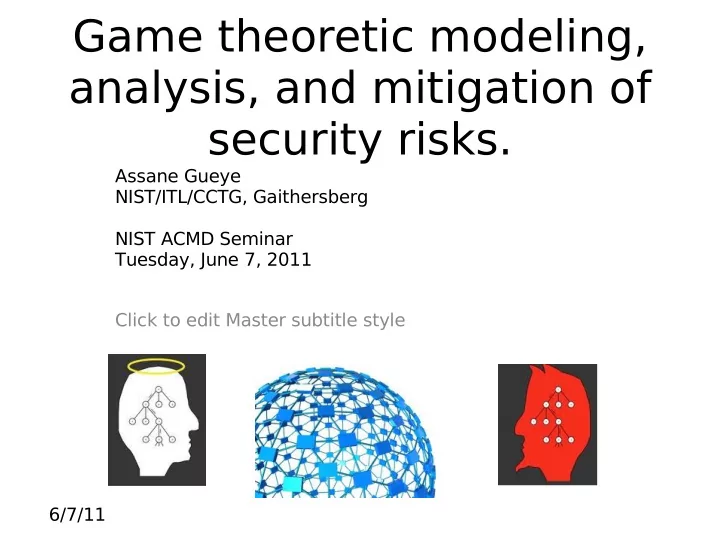
Game theoretic modeling, analysis, and mitigation of security risks. Assane Gueye NIST/ITL/CCTG, Gaithersberg NIST ACMD Seminar Tuesday, June 7, 2011 Click to edit Master subtitle style 6/7/11 Outline Motivations 1. Security 1. Game

slide-1
SLIDE 1

Click to edit Master subtitle style 6/7/11

Game theoretic modeling, analysis, and mitigation of security risks.

Assane Gueye NIST/ITL/CCTG, Gaithersberg NIST ACMD Seminar Tuesday, June 7, 2011

slide-2
SLIDE 2

6/7/11

/ 34

Outline

1.

Motivations

1.

Security

2.

Game Theory for Security

2.

Game Theory

1.

History

2.

Game Theory Basics

3.

Examples of Communication Security Game Model

1.

Intruder Game

22

slide-3
SLIDE 3

6/7/11

/ 34

Motivations

33

slide-4
SLIDE 4

6/7/11

/ 34

Life just before Slammer worm attack 30 minutes later!

44

  • Double size every 8.5 sec
  • 10 min to infect 90% of vulnerable

hosts

èNetwork Outages, cancelled airline

flights, ATM failures…

Source: CAIDA, www.caida.org/publications/papers/2003/sapphire/sapphire.html

slide-5
SLIDE 5

6/7/11

/ 34

55

slide-6
SLIDE 6

6/7/11

/ 34

Who is attacking our communication Systems?

Hacke rs Terrorists, Criminal Groups Hacktivi sts Disgruntled Insiders Foreign Governments

66

?

slide-7
SLIDE 7

6/7/11

/ 34

A lot of good effort!

77

Cryptogra phy Software Security Intrusion Detection systems Firewa lls Anti-Viruses Risk Management Attack Graphs Decision Theory Machine Learning Information Theory Optimizat ion Hardware Security

  • Some practical

solutions

  • Some theoretic basis

… …

slide-8
SLIDE 8

6/7/11

/ 34

Remote Attack

Security

Why Game Theory for Security?

Traditional Security Solutions

Attac k Defense

Game Theory also helps: Trus t Incentiv es Externali ties Machine Intelligence

88

This Talk: How GT can help understand/develop security solutions? Using illustrative Examples! …

Conferences (GameSec, GameNets) , Workshops, books, Tutorials,…

Attacker strategy 1 strategy 2 ….. Defender : strategy 1 strategy 2 …..

A mathematical problem!  Solution tool: Game Theory

Predict attacker’s behavior, Build defense mechanisms, Compute cost of security, Understand attacker’s behavior, etc…

E.g.: Rate of Port Scanning IDS tuning

slide-9
SLIDE 9

6/7/11

/ 34

Game Theory

99

slide-10
SLIDE 10

6/7/11

/ 34

Game Theory

“…Game Theory is designed to address situations in which the

  • utcome of a person’s decision

depends not just on how they choose among several options, but also on the choices made by the people they are interacting with…” “… Game theory is the study of the ways in which strategic

1010

slide-11
SLIDE 11

6/7/11

/ 34

Game Theory: A Little History

1111

  • Cournot (1838), Bertrand (1883):

Economics

  • J. von Neumann, O. Morgenstern

(1944)

  • “Theory of Games and Economic

Behavior”

  • Existence of mixed strategy in 2-

player game

  • J. Nash (1950): Nash Equilibrium
  • (Nobel Prize in Economic Sciences

1994)

von Neumann 1903- 1957 John F. Nash (1928)

  • O. Morgenstern 1902-

1977

slide-12
SLIDE 12

6/7/11

/ 34

Game Theory Basics

  • GAME = (P,A,U)

– Players (P1; … ; PN): Finite number

(N≥2) of decision makers.

– Action sets (A1; … ;AN): player Pi has a

nonempty set Ai of actions.

– Payoff functions ui : A1x … xAN: R; i =

1;….;N

  • materialize players’ preference,

1212

slide-13
SLIDE 13

6/7/11

/ 34

Example: Forwarder’s dilemma

Key Concepts

Forwarding has an energy cost of c (c<< 1) Successfully delivered packet: reward of 1 If Green drops and Blue forwards: (1,-c)

1313

Source: Buttyan and Hubaux, “Security and Cooperation in Wireless Networks”

slide-14
SLIDE 14

6/7/11

/ 34

Example: Forwarder’s dilemma

Key Concepts

Game: Players: Green, Blue Actions: Forward (F), Drop (D) Payoffs: (1-c,1-c), (-c,-c), (-c,1), (1,- c) Matrix representation:

Actions of Green Actions of Blue Reward of Blue Reward of Green

1414

Source: Buttyan and Hubaux, “Security and Cooperation in Wireless Networks”

slide-15
SLIDE 15

6/7/11

/ 34

Equilibrium Concept

Nash equilibrium: “…a solution concept of a game involving two or more players, in which no player has anything to gain by changing his own strategy unilaterally…”

John F. Nash (1928) 1515

slide-16
SLIDE 16

6/7/11

/ 34

Other Concepts

  • Cooperative / Non-

Cooperative

  • Static / dynamic

(finite/infinite)

  • Complete / Incomplete

Information  Bayesian

  • Zero-Sum, Constant-

Sum, Variable-Sum

  • Stochastic

A Course in Game Theory Martin J. Osborne Ariel Rubinstein Game Theory Drew Fudenberg Jean Tirole Network Security: A Decision and Game Theoretic Approach Tansu Alpcan Tamer Basar Security and Cooperation in Wireless Networks Levente Buttyan Jean-Pierre Hubaux 1616

slide-17
SLIDE 17

6/7/11

/ 34

3 Communication Security Game Models

Intrud er Game

p 1

  • p

A lic e

T ru d y B

  • b

X Y Z

Availabilit y Attack

1717

Intellige nt Virus

α

Normal traffic Virus

β

X n

Detection If Xn > λ => Alarm

slide-18
SLIDE 18

6/7/11

/ 34

M’ ≠ Μ

Intruder (Trudy)

What if it is possible that: M

Intruder Game

1818

Scenari

  • :

Networ k

Source (Alice) User (Bob)

M Encryption is not always practical …. Formulation: Game between Intruder and User

slide-19
SLIDE 19

6/7/11

/ 34

1919

Intruder Game: Binary

Y

  • Payoffs:
  • Strategies (mixed i.e. randomized)
  • Trudy: (p0,p1), Bob: (q0,q1)

Alice Trudy Bob

Interce pt

  • One shot, simultaneous choice game
  • Nash Equilibrium?
slide-20
SLIDE 20

6/7/11

/ 34

Intruder game: NE

2020 1 Trudy Bob Always trust Always decide the less costly bit (1) Always decide the less costly bit (1)

1 1 1 1

text

1 1

Payoff :

Trudy

slide-21
SLIDE 21

6/7/11

/ 34

What if the receiver (Bob) can verify the message?

(by paying a cost and using a side secure channel)

2121

p 1-p

Alice

Trudy Bob X Y Z

Pay: V

slide-22
SLIDE 22

6/7/11

/ 34

Cost and Reward

2222

p V 1 B A

Challenge:

Credible threat Deter Attacker from attacking

p 1-p

Alice

Trudy Bob X Y Z

Never use side channel Use only sometimes Use more

  • ften
slide-23
SLIDE 23

6/7/11

/ 34

Intelligent Virus Game

2323

Scenari

  • α

Normal traffic

Viru s

β X n

Detection

If Xn > λ => Αλαρµ, . Assume α known Detection system: choose λ to minimize cost of infection + clean up Virus: choose β to maximize infection cost

slide-24
SLIDE 24

6/7/11

/ 34

Intelligent Virus Game (IDS)

2424

Smart virus designer picks very large β, so that the cost is always high …. Regardless of λ!

1 2 3 4 5 6 7 8 9 1 1 1 .2 1 .4 1 .6 1 .8 2 2 .2 2 .4

λ (/s

e c) Virus Gain: Linear

λ0=

5

λ0=

1

λ0=

1 5

β

Scenari

  • α

Normal traffic

Viru s

β X n

Detection

If Xn > λ => Αλαρµ, .

slide-25
SLIDE 25

6/7/11

/ 34

Intelligent Virus Game (IPS)

2525

Modified Scenario

α Normal traffic

Viru s

β X n

Detection

If Xn > λ => Alarm

  • Detector: buffer traffic and test

threshold

  • Xn < λ  process
  • If Xn > λ Flush & Alarm

  • Game between Virus (β) and Detector

(λ)

slide-26
SLIDE 26

6/7/11

/ 34

Availability Attack Models!

Tree-Link Game:

2626

slide-27
SLIDE 27

6/7/11

/ 34

Model

  • Game

– Graph = (nodes V, links E, spanning

trees T)

  • Defender:

chooses T T

  • Attacker:

chooses e E (+ “No Attack”)

– Rewards

  • Defender: -1e

T 

2727

Exampl e:

Defender: 0 Attacker: - µ2

Defender:

  • 1

Attacker: 1- µ1

– Defender :  on T, to minimize

– Attacker:  on E, to maximize – One shot game

slide-28
SLIDE 28

6/7/11

/ 34

Let’s Play a Game!

Graph Most vulnerable links

Chanc e 1/2 Chanc e 4/7>1/ 2

a ) b ) c )

Assume: zero attack cost µe=0

1/ 2 1/ 2 1/ 7 1/ 7 1/ 7 1/ 7 1/ 7 1/ 7 1/ 7

2828

slide-29
SLIDE 29

6/7/11

/ 34

Critical Subset of Links

  • Definition 1&2: For any nonempty subset E Ε

1.

M(E) = min{| T E|, T  Т} (minimum number of links E has in common with any spanning tree)

  • 2. Vulnerability of E

(E) = M(E)/|E| (minimum fraction of links E has in common with any spanning tree)

  • Definition 3: A nonempty subset C Ε is said to be critical if

(C) = maxE Ε( (E))  (C has maximum vulnerability) vulnerability of graph ( (G)  ) := vulnerability

  • f critical subset

1 2 3 4 5 6 7

E={1,4, 5} |T E|  =2 M(E) =1

Defender: choose trees that minimally cross critical subset

(E) = 1/3 2929 (G) =1 (G)= 1/2 (G)= 4/7

slide-30
SLIDE 30

6/7/11

/ 34

Critical Subset Attack Theorem

Theorem 1:There exists a Nash Equilibrium where

  • Attacker attacks only the links of a critical set C, with equal

probabilities

  • Defender chooses only spanning trees that have a minimal intersection

with C, and have equal likelihood of using each link of C, no larger than that of using any link not in C. [Such a choice is possible.] There exists a polynomial algorithm to find C [Cunningham 1982]

Theorem generalizes to a large class

  • f games.

3030

slide-31
SLIDE 31

6/7/11

/ 34

Some implications

If ν ≤ 0: Attacker: “No Attack” If can invest to make µ high èDeter attacker from attacking

  • Need to randomize choice of

tree Edge-Connectivity is not always the right metric!

ν= 3/4 ν= 2/3 ν= 3/5 2/3 > 3/5 Network in b) is more vulnerable than network in c)

Additional link

Network Design

3131 a ) b ) c )

slide-32
SLIDE 32

6/7/11

/ 34

Conclusi

  • n

Availability Games

– Critical set

  • Vulnerability (

(G)): a metric more refined than  edge-connectivity

  • Analyzing NE helps determine most vulnerable subset
  • f links
  • Importance in topology design
  • Polynomial-time algorithm to compute critical set

Generalization Intruder and Intelligent Virus Games:

  • Most aggressive attackers are not the most

dangerous ones

  • Mechanisms to deter attackers from attacking

3232

Game Theory helps for a better understanding

  • f the Security problem!
slide-33
SLIDE 33

6/7/11

/ 34

3333

This is an “young” research field!

  • A certain number of issues

– Costs model

 Not based on solid ground

– Mixed strategy equilibrium

 How to interpret it?

– Nash equilibrium computation

 In general difficult to compute

– Still “theoretic”?

 ARMOR: L.A Lax airport patrol dispatching

Game Theory for Airport Security

ARMOR (LAX)

Airports create security systems and terrorists seek out breaches.

Placing checkpoint Allocate canine units The ARMOR project: http://teamcore.usc.edu/ARMOR-LAX/

slide-34
SLIDE 34

6/7/11

/ 34

Future Work

  • Repeated versions of the games

– More realistic models – Applications: Attack Graphs

  • Collaborative Security

– T

eam of Attacker vs T eam of Defenders

– T

rust and Security

– Role of Information

  • Security of Cloud Computing

– Are you willing to give away your

3434

slide-35
SLIDE 35

6/7/11

/ 34

Thank you! Questions?

3535