GAS WELL/WATER WELL SUBSURFACE CONTAMINATION Rick Railsback - - PDF document

gas well water well subsurface contamination
SMART_READER_LITE
LIVE PREVIEW

GAS WELL/WATER WELL SUBSURFACE CONTAMINATION Rick Railsback - - PDF document

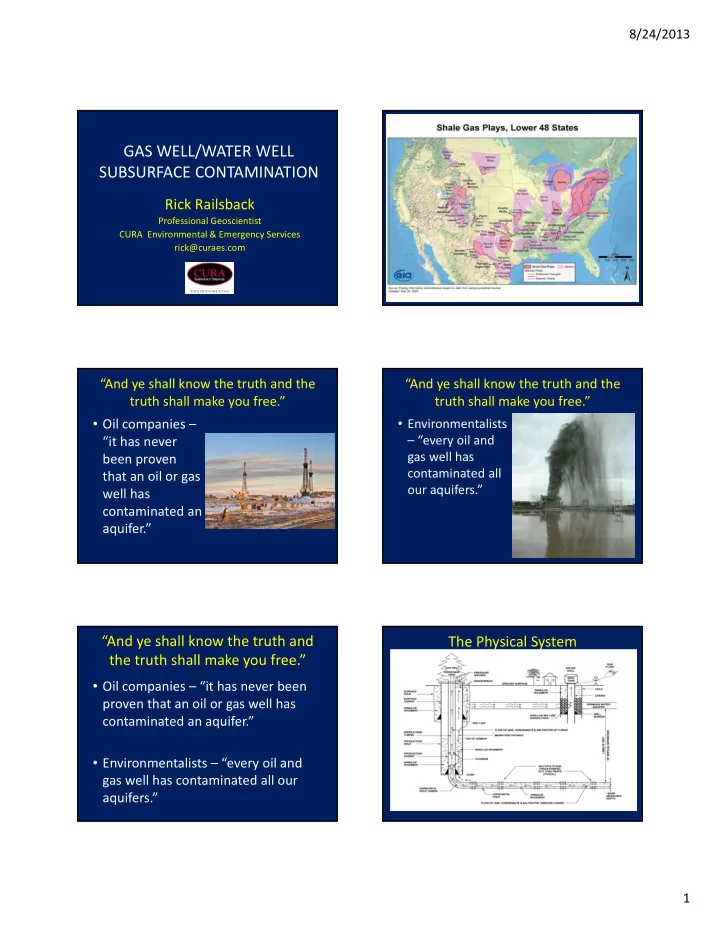
8/24/2013 GAS WELL/WATER WELL SUBSURFACE CONTAMINATION Rick Railsback Professional Geoscientist CURA Environmental & Emergency Services rick@curaes.com And ye shall know the truth and the And ye shall know the truth and the truth shall


slide-1
SLIDE 1

8/24/2013 1

GAS WELL/WATER WELL SUBSURFACE CONTAMINATION

Rick Railsback

Professional Geoscientist CURA Environmental & Emergency Services rick@curaes.com

“And ye shall know the truth and the truth shall make you free.”

  • Oil companies –

“it has never been proven that an oil or gas well has contaminated an aquifer.” “And ye shall know the truth and the truth shall make you free.”

  • Environmentalists

– “every oil and gas well has contaminated all

  • ur aquifers.”

“And ye shall know the truth and the truth shall make you free.”

  • Oil companies – “it has never been

proven that an oil or gas well has contaminated an aquifer.”

  • Environmentalists – “every oil and

gas well has contaminated all our aquifers.”

The Physical System

slide-2
SLIDE 2

8/24/2013 2 Well Geometry (view looking down on the wellhead)

Jet Perforation Well Site during Frac Litigation Support

  • Tools & methods for investigation
  • Generally presented from

simplest tools to more complex least expensive to most expensive

Plan for Investigation

  • Proximity
  • Timing of the impact
  • Other contaminant sources
  • Oil & gas well records
  • Pressure data from the gas well
  • Pressure data from the water well

Plan for Investigation

  • Data on frac geometry
  • Natural gas composition
  • Condensate composition
  • Water composition
  • Seismic data
  • Cement bond logs
slide-3
SLIDE 3

8/24/2013 3

Wireline Logging Truck Wireline Logging Tool Well Log Plan for Investigation

  • Noise logs
  • Temperature logs
  • Gamma ray logs
  • Radioactive tracers
  • Pressure interference tests
  • Installation of monitoring wells

Proximity

  • Radius of influence of wells dependent

upon geology: –Porosity (void space in the rock that is filled with fluids and/or gas) –Permeability (ability of the rock to transmit fluids and/or gas –Pressure gradients –Special geologic conditions (faults, fractures, etc.)

Proximity

slide-4
SLIDE 4

8/24/2013 4

Timing

  • Water well installation
  • Gas well installation:

– Spud date – Surface casing set – Vertical casing set – Horizontal well completed & casing set – Frac job and flow back – Production

  • Time of impact to water well

Timing Other Contaminant Sources

  • A variety of other sources may be available
  • Common sources are usually shallow – within

50 feet of surface

  • Impact to deeper aquifers from shallow

sources unlikely due to shallow water table & impermeable layers

  • Minor amounts of methane occur naturally in

aquifers & may be generated by organics in the water well & equipment

Other Contaminant Sources Oil & Gas Well Records

  • W‐1 Drilling Permit Application
  • G‐1 or W‐2 ‐ Gas or Oil Well Completion Test
  • G‐5 Gas Well Classification Report
  • Railroad Commission Online Research

– http://www.rrc.state.tx.us/data/index.php

  • Railroad Commission Public GIS Map Viewer

– http://gis2.rrc.state.tx.us/public/startit.htm

slide-5
SLIDE 5

8/24/2013 5

Pressure Data from Gas Well Pressure Data from Water Well Data on Frac Geometry

  • Microseismic records the location of the mini‐

earthquakes generated by frac creation

  • Microseismic not routinely run on frac jobs
  • Data presented by industry based on relatively

few data points

  • Fractures may extend a max of 2,000’ above
  • r below perfs (usually only a few 100’)
  • Fractures 3,000’ + below deepest aquifer

Marcellus Shale Microseismic Cross Section

slide-6
SLIDE 6

8/24/2013 6

Barnett Shale Microseismic Cross Section

Natural Gas Composition

  • Methane – CH4 – natural gas

– Microbial gas – Thermal gas – Carbon & hydrogen isotopic composition

  • Heavier gases
  • N2 and CO2 content

Natural Gas Composition Natural Gas Composition Condensate Composition

  • Gas well condensate composed of:

– TPH (total petroleum hydrocarbons) mainly gasoline range organics – BTEX (benzene, toluene, ethylbenzene, xylenes) – marker constituents – VOC (volatile organic compounds) – PAH (polycyclic aromatic hydrocarbons)

Water Composition

(dissolved constituents)

  • TPH ‐ gas, diesel, & oil range organics
  • BTEX – benzene, toluene, ethylbenzene, xylenes
  • VOC – volatile organic compounds
  • PAH – polycyclic aromatic hydrocarbons
  • TPH, BTEX, VOC, & PAH not normally

present in water well water

slide-7
SLIDE 7

8/24/2013 7

Water Composition

(dissolved constituents)

  • Methane – CH4 – natural gas

– Lab analysis for methane & other gases – Flame ionization detector with carbon filter – Methane meter – Explosimeter – Light it? – Methane not normally present in high concentrations in water well water

Water Composition

(dissolved constituents)

  • Minerals & salts – naturally occurring
  • TDS (total dissolved solids) & chlorides

measure dissolved minerals & salts in water

  • TDS – total dissolved solids

– Water wells (500 – 1,800 ppm) – Gas wells (typically > 20,000 ppm)

  • Chlorides

– Water wells (20 ‐ 500 ppm) – Gas wells (typically > 20,000 ppm)

Seismic Data

  • Seismic or sound waves

used to image the subsurface

  • Analogous to

sonograms

  • Gas accumulations give

a “bright spot” amplitude anomaly

  • 3D seismic is available
  • ver most oilfields

Seismic “Bright Spots”

Seismic Data

(Potential Problems)

  • Timing of data acquisition relative to gas

accumulation

  • Seismic data focus may not yield useable data

in shallow subsurface

  • Zone of gas accumulation too thin for seismic

resolution

  • “Bright spot” not a unique solution for gas

Cement Bond Logs

  • Acoustic (sonic) device

utilizes sound waves to image

  • Analogous to sonograms
  • Free pipe returns a much

greater amplitude signal than cemented pipe

  • Amplitude display
  • VDL (variable density log)

display

slide-8
SLIDE 8

8/24/2013 8

Principles of the Cement Bond Log Cement Bond Log Presentation Noise Logs (Sound Surveys)

  • Sensor is an underwater microphone

(hydrophone)

  • Will detect flow within wellbore or

behind pipe

  • Turbulent fluid flow
  • Gas expansion
  • Disturbance of gas/liquid interface

Noise Logs (Sound Surveys) Noise Logs (Sound Surveys) Temperature Logs

  • Temperature increases with depth – normal

geothermal gradient

  • Anomalies created by fluids or gas entering

wellbore or annulus or exiting into formation

  • Identify zones producing or taking fluid
  • Evaluating cement jobs
  • Evaluating frac jobs
slide-9
SLIDE 9

8/24/2013 9

Temperature Logs

  • EPA Underground Injection Control

(UIC) program approves temperature logs to demonstrate well mechanical integrity – “no significant fluid movement into an underground source of drinking water through vertical channels adjacent to the injection wellbore”.

Temperature Logs Gamma Ray Logs

  • Measures natural gamma ray emissions from

the formation

  • Shales – high gamma ray emissions
  • Sands, limestones – low gamma ray emissions
  • Migration of fluids within & adjacent to the

wellbore deposits radioactive salts & zones of migration often marked by high gamma ray emissions

Gamma Ray Logs

Gamma Ray/Neutron Logs

2000 2010

Radioactive Tracers

  • Tracer is a radioactive isotope that is soluble in

gas, oil, and water (iodine; half life 8.1 days)

  • Gamma radiation emitted by the tracer is

detected by a gamma ray tool

  • Gamma radiation penetrates steel, PVC pipe,

cement, & formation

  • 90% of gamma radiation recorded originates

within 1 foot of the detector

slide-10
SLIDE 10

8/24/2013 10

Radioactive Tracers

  • Tool can inject tracer and record gamma

emissions simultaneously

  • Fluid movement & velocity & volume can

be monitored within a well, behind casing, & between wells

Radioactive Tracers

(Well on injection into perfs; 5 logs runs presented on separate logs; flow behind casing into Sand C)

Pressure Interference Tests

  • Downhole pressure gauge installed in the

water well

  • Pressure wave created in gas well by

producing well & shutting it in intermittently

  • Pressure changes recorded in water well
  • Cross contamination requires hydraulic

connection between gas well & water well

Pressure Interference Tests

Installation of Monitoring Wells

Summary

  • 18 different investigative tools – can we

solve the contamination problem??

  • Choose the most time effective tools
  • Choose the most cost effective tools
  • Choose the tools that will support our case
  • Find the “truth”
slide-11
SLIDE 11

8/24/2013 11

“And ye shall know the truth and the truth shall make you free.”

  • Oil companies – “it has never been

proven that an oil or gas well has contaminated an aquifer.”

  • Environmentalists – “every oil and

gas well has contaminated all our aquifers.”

GAS WELL/WATER WELL SUBSURFACE CONTAMINATION

Rick Railsback

Professional Geoscientist CURA Environmental & Emergency Services rick@curaes.com