
SLIDE 1
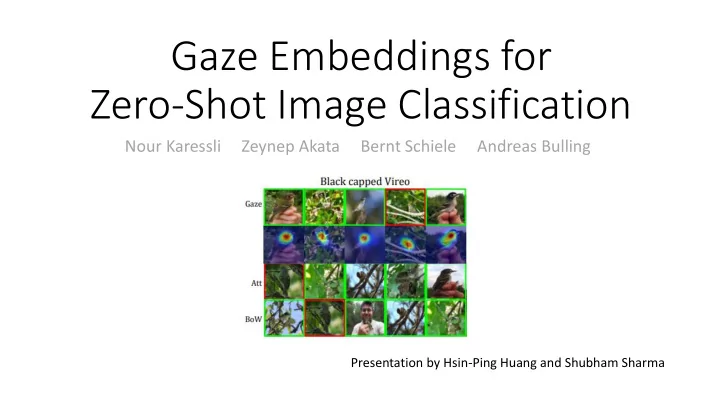
Gaze Embeddings for Zero-Shot Image Classification
Nour Karessli Zeynep Akata Bernt Schiele Andreas Bulling
Presentation by Hsin-Ping Huang and Shubham Sharma
Gaze Embeddings for Zero-Shot Image Classification Nour Karessli - - PowerPoint PPT Presentation
Gaze Embeddings for Zero-Shot Image Classification Nour Karessli Zeynep Akata Bernt Schiele Andreas Bulling Presentation by Hsin-Ping Huang and Shubham Sharma Introduction Attributes Standard image classification models fail
Nour Karessli Zeynep Akata Bernt Schiele Andreas Bulling
Presentation by Hsin-Ping Huang and Shubham Sharma
models fail with the lack of labels.
attributes, is required.
exists: Attributes, detailed descriptions or gaze.
this paper.
[Zero-shot learning tutorial, CVPR’17]
Attributes Descriptions Gazes
and test set.
Gaze Features Gaze Histogram
Gaze Features with Sequence Gaze Features with Grid
7 classes of Woodpeckers 7 classes of Vireos
GFS of One Observer GFS EARLY GFS AVG
Observer 1 Observer 5 Observer 1 Observer 5
tired or have done the observation.
Gaze Features with Sequence (GFS) of One Observer
GFS EARLY
Accuracy (%) Sequence length
GFS AVG
Accuracy (%) Sequence length Beginning End Beginning + End
Gaze Features with Sequence (GFS) of One Observer
GFS EARLY
Accuracy (%) Sequence length
GFS AVG
Accuracy (%) Sequence length
GFS EARLY
Accuracy (%) Sequence length
GFS AVG
Accuracy (%) Sequence length
between the mean gaze are informative.
– Gazes have personal bias, each person have a different mean gaze. – The distribution of the gazes is important.
mean gaze
D Ox Oy
Gaze Features with Sequence (GFS) of One Observer
GFS AVG
Accuracy (%) +O +D +OD
GFS EARLY
Accuracy (%) +O +D +OD
9%↑ 8%↑ 6%↑
subsequent gazes are informative.
– The saccade information is important.
next gaze
SD SOx SOy
Gaze Features with Sequence (GFS) of One Observer
GFS AVG
Accuracy (%) +SO +SD +SOD
GFS EARLY
Accuracy (%) +SO +SD +SOD
1.5%↑ 1.5%↑ 2.8%↑
+O +D +OD +SO +SD +SOD +ALL
10.5%↑
GFS EARLY Accuracy (%)
Existing ZSL models can be grouped into 4: 1.Learning Linear Compatibility: ALE, DEVISE, SJE 2.Learning Nonlinear Compatibility: LATEM, CMT 3.Learning Intermediate Attribute Classifiers: DAP 4.Hybrid Models: SSE, CONSE, SYNC Learning Linear Compatibility Use bilinear compatibility function to associate visual and auxiliary information SJE: Structured Joint Embedding Gives full weight to the top of the ranked list
[Akata et al. CVPR’15 & Reed et al. CVPR’16]
Hybrid Models Express images and semantic class embeddings as a mixture of seen class proportions SSE: Semantic Similarity Embedding Leverages similar class relationships Maps class and image into a common space
[Zhang et al. CVPR’16]
CONSE: Convex Combination of Semantic Embeddings Learns probability of a training image belonging to a class Uses combination of semantic embeddings to classify
[Norouzi et al. ICLR’14]
SYNC: Synthesized Classifiers Maps the embedding space to a model space Uses combination of phantom class classifiers to classify
[Changpinyo et al. CVPR’16]
Gazes
Method Accuracy (%) SJE 62.9 SSE 60.6 CONSE 63.7 SYNC 62.2
Attributes
Method Accuracy (%) SJE 53.9 SSE 43.9 CONSE 34.3 SYNC 55.6
[Xian et al. CVPR’17]
1: (1,2,3,4,5) 2: (4,5) 3: (1,2,3,4) 4: (1,2,3,5) 5: (5) 6: (1,2,4,5)
processing the gaze data.
about either gaze or attributes.