Gender distribution in the global pharmacy workforce Ian Bates 1,2 , - - PowerPoint PPT Presentation

gender distribution in the global pharmacy workforce
SMART_READER_LITE
LIVE PREVIEW

Gender distribution in the global pharmacy workforce Ian Bates 1,2 , - - PowerPoint PPT Presentation

Gender distribution in the global pharmacy workforce Ian Bates 1,2 , Hafeez Hussain 2 , Sherly Meilianti 1,2 , Lina Bader 1 ,Louise Brown 1 1 International Pharmaceutical Federation, The Hague, NL 2 FIP Collaborating Centre, UCL School Pharmacy,


slide-1
SLIDE 1

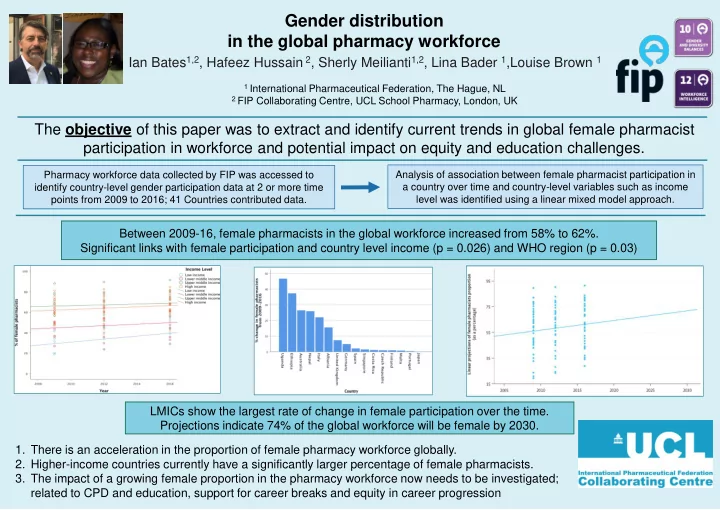
The objective of this paper was to extract and identify current trends in global female pharmacist participation in workforce and potential impact on equity and education challenges.

Gender distribution in the global pharmacy workforce

Ian Bates1,2, Hafeez Hussain 2, Sherly Meilianti1,2, Lina Bader 1,Louise Brown 1

1 International Pharmaceutical Federation, The Hague, NL 2 FIP Collaborating Centre, UCL School Pharmacy, London, UK

Pharmacy workforce data collected by FIP was accessed to identify country-level gender participation data at 2 or more time points from 2009 to 2016; 41 Countries contributed data. Analysis of association between female pharmacist participation in a country over time and country-level variables such as income level was identified using a linear mixed model approach.

Between 2009-16, female pharmacists in the global workforce increased from 58% to 62%. Significant links with female participation and country level income (p = 0.026) and WHO region (p = 0.03)

  • 1. There is an acceleration in the proportion of female pharmacy workforce globally.
  • 2. Higher-income countries currently have a significantly larger percentage of female pharmacists.
  • 3. The impact of a growing female proportion in the pharmacy workforce now needs to be investigated;

related to CPD and education, support for career breaks and equity in career progression LMICs show the largest rate of change in female participation over the time. Projections indicate 74% of the global workforce will be female by 2030.

slide-2
SLIDE 2

Write Learning Outcomes Identify Evidence (Assessment, Portfolios, etc) Collect Evidence Analyze and Interpret Evidence Recommend Improvements

LEARNING AND ADAPTING FROM STUDENT ASSESSMENT DATA

Study Objective

Demonstrate how student assessment data can be used to facilitate changes to program learning outcomes, curriculum, and assessments.

Method

Three years of data from a new assessment was collected and analyzed to evaluate the validity

  • f the tool in assessing student

practice readiness during end-of- curriculum pharmacy practice rotations and to make summative evaluations of curriculum effectiveness.

Jason M. Brunner, PhD; Eric H. Gilliam, PharmD; Megan E. Thompson, PharmD

University of Colorado Skaggs School of Pharmacy and Pharmaceutical Sciences, Aurora, Colorado, United States

Results

Students demonstrated competency in the domains of professionalism, communication, and practice skills supporting the use of the new tool in assessing practice readiness. Aggregate data indicated opportunities to to further strengthen student development.

Conclusion

Students are prepared for

  • practice. Minor changes were

made to learning outcomes to better align with practice

  • expectations. Early learning and

assessment opportunities were introduced to support student development throughout the program.

Assessment Process

slide-3
SLIDE 3

Funded by the American Association of Colleges of Pharmacy.

Same Destination. Different Journey: Towards a Conceptual Framework Exploring Underrepresented Racial Minority Students’ Experiences to Become Pharmacists.

Antonio A. Bush, PhD UNC Eshelman School of Pharmacy University of North Carolina at Chapel Hill

“So Dr. [Jones] was the first black professor I have ever had in my life like from the time I started school until pharmacy school. And she continues to be the only one I’ve ever had. That in itself to me is very significant because I’m going into a field and it’s like I’ve never been shown that somebody that looks like me can do this based off of who have been my professors and who have been the people teaching me.” [Joanna, Black Female] “So there's this pressure to be successful as a student. And then there's this pressure to be successful as a black student and to be one of very few. That pressure, there's a lot of burden there.” [Maurice, Black Male] “I just want to feel a sense of belonging and I don't think I feel that right now. I'm happy and very proud to be here, but it's a different thing when you're coming here every day and you're sitting in the classrooms and you're just going through the motions. I don't always feel like I belong.” [Patrice, Black Female]

slide-4
SLIDE 4

OBSERVATION OF ACTIVITIES UNDERTAKEN BY UNDERGRADUATE PHARMACY STUDENTS ON WARD-BASED HOSPITAL PLACEMENTS

Lynda Cameron1,2 , Janique Waghorn1, Tasnim Rahman1, Jignesh P. Patel1

1 King’s College London, London, UK 2 Guy’s and St Thomas’ NHS Foundation Trust, London, UK

Introduction and Objective: Experiential learning

  • ffers

students a vital

  • pportunity

to contextualise and apply their classroom learning. The UK pharmacy regulator, the GPhC, plans to strengthen the emphasis on experiential learning as undergraduate pharmacy degrees are redesigned, to meet the needs of patients and the public in 21st century healthcare. This includes a focus on developing clinical and communication skills in a “near patient” environment. At King’s College London, pharmacy students undertake hospital-based placements with defined learning objectives (see above) during each year of their undergraduate MPharm degree. These placements are hosted by local teaching hospitals. Informal observation, as well as student feedback, had noted that patient contact on placement was

  • n occasion limited. This ethnographic-type work

therefor sought to understand more formally how time on placement was spent. Method: This work was a teaching and learning evaluation, meaning formal research ethics approval was not required. Students and their supervising pharmacists were informed that the observational work was being carried

  • ut,

and had the

  • pportunity to decline to take part if they so
  • wished. Data collection and analysis focused on

student activity, meaning patient consent to participate was not needed. Using an approach drawing on ethnography, a final year pharmacy student observed the placement activities undertaken by three pairs of year 3 MPharm students. All were attending placements with the surgical pharmacy team at a London teaching hospital. Supervisors were qualified pharmacists undertaking their normal clinical

  • duties. In total students spent six hours on

placement: three hours

  • n

two consecutive

  • afternoons. Data were collected using activity

checklists derived from the pre-defined learning

  • utcomes, and in the form of field notes. Data

were analysed using a narrative approach. Results: Students were focused on finding a patient suitable for their university-based assessment within the first hour of their placement commencing. During the 6 hours on placement, students spoke with either one or two patients. Each pair of students spent over an hour noting down biochemical test results: at least double the length of time spent speaking with patients. Across all three pairs of students, there was consistently more time spent

  • n the second day directly with their supervising

pharmacist than on the first. In two cases students were asked to look further in to specific topics (gentamicin use, and management

  • f

Atrial Fibrillation) between the first and second day of placement. Logging

  • n

to IT systems, and disambiguation of medical abbreviations, were frequently noted as barriers to progressing with clinically-orientated tasks. Conclusion: This work is limited by the small sample size and by looking at only one pharmacy team in one hospital. The supervisor was a different person for each pair, and potentially relevant factors, such a supervisor attitude to education and training, or supervisor confidence in hosting students (which may increase

  • ver time) was not captured. However, across all

pairs included, structuring placements over two days gave students an opportunity to look further into relevant topics between the first and second

  • day. This was associated with a longer duration of

time spent directly with the supervisor on day 2, allowing an

  • pportunity

for professional socialisation and embed contextual learning.

Learning

  • bjective

Detail of what students should have achieved by the end of their 2-day placement in MPharm3

1 Have developed your skills in routine clinical pharmacy activities such as:

  • Medication-history taking
  • Monitoring the clinical, biochemical and haematological effects of drugs

2 Be able to discuss the pharmacological and therapeutic effects of key medicines, and how these should be used safely and effectively in patients 3 Be able to discuss the pathology, clinical manifestations and therapeutics of key diseases 4 Be able to discuss the pharmaceutical care of a patient with a chronic disease 5 Be able to discuss the pharmaceutical and clinical science essential to the practice of clinical pharmacy A “fly on the wall” ethnographic-type study Contact time between students and patients, and students their supervising pharmacist. 20 40 60 80 Pair A Pair B Pair C

Time (minutes)

Time spent with patients, and time with supervisors

Time with patients (day 1 + day 2) Time with supervisor (day 1) Time with supervisor (day 2)
slide-5
SLIDE 5

DEVELOPMENT OF A VISUALIZATION AND ANALYTICAL METHOD OF THE PHARMACY CURRICULUM AT THE UNIVERSITY OF PÉCS, HUNGARY

András Fittler, István Szabó, Róbert Gy. Vida Faculty of Pharmacy, University of Pécs, Hungary Objectives

Logical arrangement of the pharmacy curriculum is essential for the effective educational process. We aim to collect and summarize prerequisites of obligatory subjects, data on student dropout rate, and integrate all relevant information in a visual map. Such decision support and quality management tool will help the Faculty management and subject directors to further develop our curriculum and optimize prerequisite subject structure.

  • Fig. 1.: Visualization in MS Project as a Gantt chart
  • Fig. 2.: Graph visualization in Gephi
  • Fig. 3.: Failure rate categories of an evaluated subject

The project has been supported by the European Union, co-financed by the European Social Fund. EFOP-3.4.3.-16-2016-00005

Methods

Prerequisites of obligatory subjects were exported to various software aiming to visualize the networks of our curriculum. Dropout rates were collected from the electronic administration system (Neptun).

Results

A curricular system can be considered as a graph containing nodes (subjects) and edges (prerequisites). Our 10 semester one-tier master curriculum is highly complex, as the 70 obligatory subjects have more than 110 prerequisites. Visualization in MS Project as a Gantt chart makes visual interpretation difficult. Network analysis and visualization software (eg.: Gephi), was also an inadequate tool to visualize the timeline of education. Key subject specific components (credit value, subject code, semester, module, prerequisites, etc.) and educational properties (e.g.: failure rate, students’ feedback on education) have been identified, and are planned to be integrated into our methodology.

Conclusion

A network analysis and visual presentation of the required subjects of pharmacy curriculum require an individual software developed to meet

  • ur expectations and needs. Applying such novel method will likely

improve curriculum structure and reduce dropout rate by identifying critical subjects with high number of prerequisites and high failure rate.

slide-6
SLIDE 6

Kat Hall | Catherine Langran | Gavin Lawrence School of Pharmacy, University of Reading, UK

AN EVALUATION OF A CERTIFICATE IN BUSINESS ADMINISTRATION (CBA) PROGRAMME FOR MPHARM STUDENTS

Online validated student experience survey1 Peer-led focus groups CBA students (n=24) Enrolled MPharm students (n=497) Perceptions of programme Majority of participants:

  • Satisfied with programme
  • Agreed their business skills had improved
  • Agreed that other skills such as analytical,

team-working and written communication skills had improved Semi-structured telephone interviews In 2015, the School of Pharmacy launched a CBA programme for students to undertake alongside their MPharm; taught by Henley Business School as 3 summer school modules over 2 to 3 years.

  • To evaluate student perceptions of the new CBA programme
  • Identify reasons for students enrolling on the programme

Objectives Design 79% response rate (n=19) 25% (n=1) participation 1.6% (n=8) participation Results Reasons to enrol Opportunity to ‘stand out from the crowd’ Potential learning:

  • People management
  • Leadership

Barriers to enrolment Additional cost of CBA modules Conclusion

  • Students reported perceived benefits of the programme
  • To widen access to these benefits and reduce the financial barrier, core modules are now included in the MPharm
  • The full PG Cert option is still available for those that want to ‘stand out from the crowd’

Limitations Low engagement with focus groups and telephone interviews CBA graduates (n=4)

1.Wilson, K. L, Lizzio, A. & Ramsden, P. (1997). The development, validation and application of the Course Experience Questionnaire. Studies in Higher Education, 22, 33-53.

slide-7
SLIDE 7

A study to Investigate undergraduate pharmacy students’ experience of an integrated curriculum.

Hamde Nazara, Ausaf Khana and Andy Husbanda School of Pharmacy, Faculty of Medical Sciences, Newcastle University, Newcastle Upon Tyne, UK.

Study Objective

Curriculum integration in pharmacy undergraduate programmes has widely been adopted in the United Kingdom and internationally. The operational and delivery strategies across and within these programmes vary across the continuum of Harden’s ladder of integration. This study aims to investigate the undergraduate student experience of an integrated Master of Pharmacy (MPharm) programme at one School of Pharmacy in England.

Study Design

Undergraduate students in stages 1-3 were invited to participate in a series of focus groups (one per stage) to investigate the experience of teaching and learning within this programme. Subsequent semi-structured interviews were undertaken with students across these cohorts to explore the themes derived from the focus groups (figure 1). Focus group discussions and interviews were audio-recorded with written consent, transcribed verbatim and thematically analysed. Participate Recruitment 20 MPharm Students in Stages 1-3 Agreed to Participate. Data Collection 2 Focus Groups 9 Semi-Structured Interviews Focus groups and interviews were audio transcribed and in verbatim and thematically analysed.

Study Results and Conclusion

Four themes were identified from the thematic analysis. The four themes were: teaching in an integrated curriculum, adjusting to an integrated curriculum, defining curriculum integration, and preparing for the role of a pharmacist. Overall students enjoyed integrated teaching, describing it as allowing them to have crucial problem-solving skills and competencies required for the role of a pharmacist. An integrated MPharm curriculum facilities a student’s appreciation and understanding of the individual disciplines relating to pharmacy and, allows students to feel adequately prepared for their future career as a pharmacist. Figure 1: Study Design

slide-8
SLIDE 8

Development and Evaluation of a Situational Judgement Scenarios (SJS) Tool for the Faculty of Pharmacy & Pharmaceutical Sciences at Monash University

Fiona Patterson1, Kirsten Galbraith2,Charlotte Flaxman1, Carl Kirkpatrick2

1 Work Psychology Group, Derby, United Kingdom 2 Monash University, Parkville, Australia
  • Providing students with feedback on their performance on the SJS,

informing their personalised learning plan.

  • Providing an appropriate metric to monitor and evaluate the level
  • f progression of the non-academic attributes of pharmacy

students.

Email: fiona.patterson@workpsychologygroup.com

OBJECTIVES

Following the success of a pilot SJS in 2016, Monash University’s Faculty of Pharmacy and Pharmaceutical Sciences have implemented an SJS in 2017 and 2018.

RESULTS

  • Across 2017 and 2018, students from

across the four cohorts completed the

  • SJS. The tool demonstrated excellent

levels of internal reliability, with a close to normal distribution of total scores.

  • The results indicate the SJS can

differentiate between students, thus providing a sufficient spread of scores to support identification of students that may benefit from additional support.

  • Results showed a significant difference

in SJS scores across year levels, indicating that students further through their training are more likely to achieve a higher score.

  • Native language explained some

variation in students’ SJS scores, however the campus a student was studying at appeared to contribute the most to the variation in SJS score.

CONCLUSIONS

  • THE SJS developed, validated and implemented with a cohort of undergraduate pharmacy students.
  • It was able to differentiate students requiring additional support with skill development.
  • Individual feedback to students on specific skills encouraged reflection and development of a personalised learning plan.

DESIGN AND METHODOLOGY

Develop test specification

Informed by the outcomes of a role analysis Written and reviewed using knowledge from appropriate subject matter experts (SMEs)

Develop SJT scenarios and response options Establish scoring key Test construction Pilot the test Psychometric analysis

Maintain SJT items in an item bank Seeking input from different groups of SMEs In line with test specification To measure fairness, psychometric properties and candidate reactions To analyse psychometric properties and performance of SJT items Securely storing SJT information for ongoing development

Figure 1. Descriptive statistics from the first three cycles of the SJS.

Reporting Year N Reliability Mean SEM Max poss. Mean % SD Min Max No. items 2016-17 678 .91 601.03 12.74 744 80.8 43.06 410 690 201 2017-18 1181 .88 303.03 9.92 395 76.72 28.64 153 369 108 2018-19 1286 .76 329.74 9.71 419 78.70 19.82 229 374 114

Figure 3. Demographics and differences in SJT score based on demographic group in 2018. Figure 2. Histogram to demonstrate distribution of total SJS scores split by year group in 2018. 10 20 30 40 50 220 240 260 280 300 320 340 360 380 Frequency SJS Total Year 1 Year 2 Year 3 Year 4

Demographic Group N Mean SD T-test Sig. Effect Size Australia 747 334.29 18.35 p < .01 d = 0.68 Malaysia 413 321.63 18.75 First language 468 335.55 18.29 p < 0.01 d = 0.51 Second language 655 325.98 19.23
slide-9
SLIDE 9

ARE WE GETTING THE BIG PICTURE? PHARMACISTS’ UNDERSTANDING OF RISK FACTORS AND ABS BSOLUTE RIS ISK IN IN SCR CREENING AND MONITORING

To identify pharmacists’ educational needs for monitoring people’s risk factors and absolute cardiovascular disease (CVD) risk. Three vignette case studies asking pharmacists to describe advice to people without known CVD and their clinical reasoning were

  • designed. Vignettes described people presenting for total cholesterol

(TC) and blood pressure testing at a pharmacy and were sent to the work email address of 329 practicing community pharmacists. Cases provided necessary information for absolute CVD risk assessment. Open-ended responses in the advice and reasoning sections were analysed using content analysis. The coding framework assessed the appropriateness of advice and underlying reasoning in decision making. Twenty-nine pharmacists returned complete responses to all vignettes. Pharmacists provided appropriate advice in regards to lifestyle measures. Pharmacists seemed to focus on isolated risk factors, e.g. TC or smoking, instead of assessing overall CVD risk in the context of the case person’s age, gender and smoking

  • status. None explicitly based their recommendations on application of a risk calculator. Their reasoning

showed an anchoring on isolated risk factors, particularly TC levels, which resulted in inappropriate recommendations of referral and pharmacotherapy when correlated to actual absolute CVD risk. When screening and monitoring people with risk factors for cardiovascular or metabolic illnesses future and practicing pharmacists may benefit from educational strategies which support their decision making skills in

  • verall risk assessment.

Ibrahim Haider, Dr Karen Luetsch School of Pharmacy, The University of Queensland, QLD, Australia

Objective Conclusion Results Method

Rationale in each vignette Vignette 1 Screening a client with recommended TC level and a moderate (13%) CVD* risk estimate (smoker). Vignette 2 Screening a client with elevated TC level and a low (4%) CVD* risk estimate. Vignette 3 Monitoring a patient with known and treated CV risk factors and insignificant increase in TC levels. Table 1: Vignettes’ rationale *Absolute CVD risk was not presented with vignette

5 10 15 20 25 Modify diet Exercise GP referral Vignette 1 Vignette 2 Vignette 3 5 10 15 20 25 30 TC level is too high BP is elevated Vignette 1 Vignette 2 Vignette 3

Graph 1: Advice recommendations Graph 2: Reasons of Advice

slide-10
SLIDE 10

Table 1. Pre and post workshop survey results A multiple linear regression found a significant correlation between the video and reflection submission and overall OSCE mark, OSCE communication mark and OSCE analytical checklist mark (Table 2), indicating that students that created a video and submitted a reflection performed better in OSCEs than students that did not. Table 2. Multiple regression of OSCE workshop activities (independent variables)and OSCE performance (dependent variables)

The thematic analysis of students’ reflections identified two main themes:

Vivienne Mak, Thao Vu, Nilushi Karunaratne, Wendy Yao, Lauren Randell, Daniel Malone Faculty of Pharmacy and Pharmaceutical Sciences, Monash University, Melbourne, Australia

A A structured approach to the use of videos and reflective practice in preparing for OSCEs

OBJECTIVE

VIDEO RECORDING

Students made a video recording responding to a simple primary care problem

REFLECT

Reflected on video & how prepared they felt for the OSCEs pre-workshop

2 HOUR WORKSHOP

Watched peers’ videos & provided individualised peer feedback in small group setting

REFLECT

Evaluated how helpful the workshop was & how prepared they felt for the OSCEs. They also reflected on their OSCE performance

To explore the influence of structured Objective Structured Clinical Examination (OSCE) preparation activities that involved To investigate the influence of these activities in preparing students for OSCEs, a mixed methods design was employed. Data obtained from 192 students from 1st year pharmacy in 2017 were analysed. The quantitative component included multiple regression analysis of the data from: 1.pre and post-workshop surveys of the student participants 2.learning analytics in terms of student attendance and completion data of activities and OSCE marks. The qualitative component involved a thematic analysis of students’ reflections of their self-recorded video and their OSCE video was conducted using NVivo, v11 (QSR International)

Item Disagree Neutral Agree Pre-workshop I currently feel prepared for the OSCEs 36% 51% 13% Post-workshop Watching student OSCE video examples helped me prepare for the OSCE 5% 9% 86% Filming, watching and reflecting on my role play video allowed me to learn and improve on my skills for the OSCE 4% 4% 92% Reviewing and providing feedback on my peer’s role play videos allowed me to learn and improve on my skills for the OSCE 9% 4% 87% After the workshop, I feel prepared for the OSCEs 7% 39% 54% Overall OSCE mark OSCE communication mark OSCE analytical checklist mark

  • Std. B

P

  • Std. B

P

  • Std. B

P Video and reflection submission .272 .001 .265 .002 .209 .014 Workshop attendance .091 .272 .059 .482 .133 .116 Video-based reflective practice enabled students to identify gaps in their own learning Theme One Reflective practice enabled students to initiate a variety of learning strategies to direct their future learning towards the learning goal. Theme Two

Looking back at the video recording of the test is useful for me to see what I did well and what mistakes I made. I was able to ask all the required questions to decide which medication to give and I counselled the patients about side effects and instructions

  • n how to use the medication . On the other hand, I can see that I

did not speak clearly sometimes and use some jargons which made the patient a bit confusing. (Student’s reflection)

video reflective practice in preparing First Year Pharmacy students for OSCEs.

DESIGN

First Year Pharmacy students participated in structured OSCE preparation activities.

RESULTS

A greater proportion of students reported feeling confident for the OSCEs after the workshop, compared to before the workshop (Table 1).

CONCLUSION

The use of video-based reflective practice correlated positively with student OSCE performance. Video-based reflective practice helped enhance students’ awareness of their learning and stimulated them to consider various learning strategies according to their own learning needs for OSCEs.

“It is always a learning process for me as a pharmacist-in-training. Besides having a good knowledge about medication, I cannot doubt the importance of communication skills in the interaction with the patients. I will practice role playing with my friends every Saturday such that each of us take turn to play the role of the pharmacist. The case scenario will be based on the topic I learn in that week. Also, I am currently working in a community pharmacy which I believed, can gain more hands-on experience as I get to interact with the patients and will encounter different scenarios.” (Student’s reflection)

  • 1. Austin, Z., O'Byrne, C., Pugsley, J. and Munoz, L.

(2003). Development and Validation Processes for an Objective Structured Clinical Examination (OSCE) for

REFERENCES

Entry-to-Practice Certification in Pharmacy: The Canadian Experience. American Journal

  • f Pharmaceutical Education, 67(3), p.76.
  • 2. Baecher, L., Kung, S.C., Jewkes, A.M. and Rosalia, C. (2013). The role of video for self-

evaluation in early field experiences. Teaching and Teacher Education, 36, pp.189-197.

Contact details: For further details, contact: Dr Vivienne Mak - Vivienne.Mak@monash.edu

slide-11
SLIDE 11

PHARMACY STUDENT CHARACTERISTICS ASSOCIATED WITH SUCCESSFUL ACCEPTANCE INTO A PHARMACY POST-GRADUATE TRAINING PROGRAM

Kathryn A. Morbitzer, PharmD, MS, Stephen F. Eckel, PharmD, MHA, BCPS UNC Eshelman School of Pharmacy, University of North Carolina, Chapel Hill, NC

BACKGROUND METHODS

  • Over the past several years, acceptance into pharmacy post-graduate

training residency programs has become increasingly competitive1

  • There has been a 98% increase in the number of pharmacy

students pursuing residency between 2008 and 20142

  • Consequently, pharmacy residency application reviewers and

interviewers spend a significant amount of time, effort, and resources screening applications and ranking candidates to assess the best fit for their residency program

  • There have been a few previous attempts to identify applicant

characteristics associated with offering a residency program interview and matching success3,4

  • Surveys of pharmacy residency directors found pharmacy school

reputation and strong letters of recommendation and intent as priorities for granting a residency program interview5,6

  • Evidence supporting specific strategies to streamline the

application process for residency programs is lacking

  • The University of North Carolina Medical Center’s (UNCMC) Health-

System Pharmacy Administration (HSPA) residency program is a 24- month program which accepts four residents per year

  • Over the last 4 application cycles, the number of applicants for the

HSPA residency program has increased by 33%, resulting in 154 applications for 16 available positions

  • A need exists to identify opportunities to streamline and optimize

the application process

RESULTS CONCLUSIONS

  • All candidate’s who applied during the 2015 – 2016, 2016 – 2017,

and 2017 – 2018 application cycles were including within the evaluation

  • Data collected for each applicant included:
  • Academic performance
  • Pharmacy school ranking
  • Prior pharmacy work experience
  • Prior research experience
  • Pharmacy organization involvement
  • Number of scholarships and awards received
  • Applicants from the 2018 – 2019 application cycle were used for

validation of the developed models

  • Statistical analyses performed included:
  • Bivariable analyses for planned stratifications of applicants

according to whether applicants were offered an on-site interview and final rank among candidates interviewed

  • Advanced regression modeling to identify predictors of applicants
  • ffered an on-site interview
  • Agreement statistics to validate the predictive computational

models

REFERENCES OBJECTIVE

  • Objective criteria within the realms of academic performance and prior work experience may be useful to

streamline the application screening process for post-graduate training programs

  • Pharmacy school GPA was the only objective characteristic found to be associated with applicant final

ranking

  • If pharmacy schools trend towards implementing pass/fail curricula, it will be imperative to realize other

indicators of academic performance

  • Future research is needed to determine best practices for analyzing subjective applicant attributes
  • 1. Caballero J. Am J. Health Syst Pharm. 2012:1-20.
  • 2. National Matching Services Inc. http:natmatch.com.
  • 3. Ensory CR. Am J Health Syst Pharm. 2013;70:1670-5.
  • 4. Phillips JA. Am J Pharm Educ. 2016;80(5):84.
  • 5. Gohlke AL. J Pharm Pract. 2014;27:84-8.
  • 6. Jellinek-Cohen SP. Am J Health Syst Pharm.

2012;69:1105-8.

  • To identify characteristics associated with successful invitation to

interview and final ranking for the UNCMC’s HSPA residency program

Table 1: Characteristics of applicants offered on-site interview

Variable

Offered Interview (n = 70) Not Offered Interview (n = 45) p-value Undergraduate grade point average, median (IQR) 3.47 (3.27-3.76) 3.4 (3.27-3.72) 0.7 Pharmacy school ranked in top 25%, n (%) 46 (65.7) 24 (53.3) 0.18 Pharmacy school grade point average, median (IQR) 3.63 (3.46-3.79) 3.35 (3.2-3.49) <0.001 Prior undergraduate degree, n (%) 46 (65.7) 23 (51.1) 0.12 Additional graduate degree, n (%) 9 (12.9) 7 (15.6) 0.68 Hospital pharmacy technician experience, n (%) 6 (8.6) 6 (13.3) 0.53 Hospital pharmacy intern experience, n (%) 49 (70) 17 (37.8) 0.001 Community pharmacy technician experience, n (%) 20 (28.6) 10 (22.2) 0.45 Community pharmacy intern experience, n (%) 42 (60) 28 (62.2) 0.81 Poster presentation during pharmacy school, n (%) 56 (80) 27 (60) 0.02 Publication during pharmacy school, n (%) 8 (11.4) 9 (20) 0.21 National organization leadership position, n (%) 29 (41.4) 9 (20) 0.03 University organization leadership position, n (%) 66 (94.3) 40 (88.9) 0.29 University organization president, n (%) 39 (55.7) 19 (42.2) 0.16 Total organization involvement, median (IQR) 5 (4-7) 5 (3-6) 0.08 Total awards, median (IQR) 1.5 (0-3) 1 (0-2) 0.13 Total scholarships, median (IQR) 2 (1-3) 1 (0-2) 0.002

Table 2: Characteristics of applicants in final top 8 ranking

Variable

Ranked in Top 8 (n = 24) Not Ranked in Top 8 (n = 91) p-value Undergraduate grade point average, median (IQR) 3.44 (3.30-3.77) 3.47 (3.27-3.72) 0.61 Pharmacy school ranked in top 25%, n (%) 18 (75) 52 (57.1) 0.16 Pharmacy school grade point average, median (IQR) 3.68 (3.51-3.80) 3.48 (3.23-3.70) 0.003 Prior undergraduate degree, n (%) 19 (79.2) 50 (54.9) 0.06 Additional graduate degree, n (%) 4 (16.7) 12 (13.2) 0.74 Hospital pharmacy technician experience, n (%) 1 (4.2) 11 (12.1) 0.46 Hospital pharmacy intern experience, n (%) 17 (70.8) 49 (53.8) 0.17 Community pharmacy technician experience, n (%) 8 (33.3) 22 (24.2) 0.43 Community pharmacy intern experience, n (%) 15 (62.5) 55 (60.4) 0.9 Poster presentation during pharmacy school, n (%) 18 (75) 65 (71.4) 0.8 Publication during pharmacy school, n (%) 2 (8.3) 15 (16.5) 0.52 National organization leadership position, n (%) 10 (41.7) 28 (30.8) 0.34 University organization leadership position, n (%) 24 (100) 82 (90.1) 0.2 University organization president, n (%) 16 (66.7) 42 (46.2) 0.1 Total organization involvement, median (IQR) 5 (4-6) 5 (4-7) 0.9 Total awards, median (IQR) 2 (0.5-2.5) 1 (0-2) 0.24 Total scholarships, median (IQR) 1 (0-3) 1 (0-2) 0.51

Table 3: Relative descriptor importance for applicants offered interview

Variable

Descriptor Importance (%) Pharmacy school grade point average 61 Total scholarships 18 Hospital pharmacy intern experience 8 National organization leadership position 5 University organization leadership position 3 Total organization involvement 1 Undergraduate grade point average 1 Prior undergraduate degree 1 Total awards 1 University organization president 1 Poster presentation during pharmacy school Hospital pharmacy technician experience Additional graduate degree Publication during pharmacy school Pharmacy school ranked in top 25% Community pharmacy intern experience Community pharmacy technician experience

  • Applicants were more likely to be offered an on-site interview if:
  • Had previous work experience as a hospital intern irrespective to GPA and

number of scholarships

  • No previous work experience as a hospital intern and:
  • > 3 scholarships awarded and GPA > 3.25
  • > 1 scholarship awarded and GPA > 3.4
  • 1 scholarship awarded and GPA > 3.5
  • 0 scholarships awarded and GPA > 3.85
  • Agreement statistics analyses including applicants from the 2018 – 2019

application cycle (n = 39):

  • Model including hospital intern experience, GPA, and number of

scholarships:

  • Kappa = 0.22 indicating fair agreement
  • Model including GPA and number of scholarships
  • Kappa = 0.52 indicating moderate agreement

Regression Modeling and Validation Findings

  • There were 154 applicants included over four application cycles
  • 115 applicants were within the application cycles evaluated for characteristics associated with invitation for interview and final ranking
  • 39 applicants were contained within the application cycle used for validation of analyses
slide-12
SLIDE 12

DEVELOPMENT OF BACHELOR AND MASTER DEGREE PROGRAMMES IN GLOBAL HEALTH

John A Pieper, Stephanie Lukas, Brett Craig, Brenda L Gleason, Kenneth W Schafermeyer, Michael Sass, Heather Flabiano

  • St. Louis College of Pharmacy, St. Louis, Missouri USA

Objective To identify and recommend potential new undergraduate and graduate programs at St. Louis College of Pharmacy Design A New Academic Program Evaluation Task Force was formed that followed a five‐step process: 1) faculty‐generated academic program ideas, 2) development of a curriculum shell, 3) market analysis, 4) financial projection based on tuition revenues and expenses, 5) submission of selected programs to President and Board of Trustees for approval. Results Bachelor and Master degree programs in Global Health were approved. The Bachelor of Arts (BA) degree in Global Health consists of:  121 semester credit hours  emphasizes the environmental, cultural, economic and political aspects of global health  requires field work The Master of Science (MSc) degree in Global Health consists of:  32 semester credit hours  intended for individuals from a wide range of health disciplines and professions  integrates health and social science perspectives within a global framework  Instruction will be self‐directed, formal and interactive lectures, seminars, tutorials, case studies and field research An accelerated BA to MSc option is planned. Conclusion A collaborative faculty‐led initiative, incorporating marketing and financial and curriculum design principles, identified new academic programs in Global Health. These degrees will be unique offerings within a college or school of pharmacy in the USA.

slide-13
SLIDE 13

CURRICULAR TRANSFORMATION OF A PHARM.D. PROGRAM

Frank Romanelli, Pharm.D., MPH; University of Kentucky College of Pharmacy Objective

To completely re-imagine and restructure an existing Pharm.D. curriculum.

Design

A multi-pronged approach was used to re-imagine, design, and execute a novel Pharm.D. curriculum. The transformation included changes to both delivery and content. Especially unique elements included a 6-semester community service learning program, a required course in diff dx, and a co-joined lab course sequence that does not sequester students by professional year. The transformation also included the adoption of 2 psychometrically sound high stakes assessments, one at the end of the 2nd second professional year and another at the end of the 3rd third professional year.

Results

6 semesters of the new curriculum have been instructed including a new experiential program. Initial MileMarker and PCOA data are available for analysis along with information provided by IPPE and APPE preceptors.

Conclusion

An innovative and ambitious curricular re-design was

  • undertaken. Significant effort was

involved in the execution of the

  • riginal plan and design.

Preliminary data indicate that the reformed curriculum is meeting

  • bjectives.
slide-14
SLIDE 14

Evaluation of a novel Clinical Learning in Practice (CLIP) model in UK Teaching Hospitals for Undergraduate Pharmacy students

Wigg DN, Young N, Hanning LN, Wareing T, Goddard D & Cooper G Department of Pharmacy and Pharmacology, University of Bath, Bath, BA2 7AY, UK Presenting Author: Danielle Wigg

References: General Pharmaceutical Council (GPhC) (2011). Future Pharmacists: Standards for the Initial Training and Education of Pharmacists. London: General Pharmaceutical Council; Miller, G.E (1990). The assessment of clinical skills/performance. Academic Medicine (Suppl.); 65: S63-S7.

Background & Objectives The University of Bath MPharm programme was redesigned with the aim to produce pharmacists with increased clinical competence. Practice Educator posts were created to bridge the gap between academic study and professional practice, with the responsibility for designing, developing and implementing CLIP (Clinical Learning in Practice) in four teaching hospitals in the United Kingdom. Key to CLIP design was the use of Miller’s Pyramid

  • f Clinical Competence (1990) and professional GPhC Graduate Outcomes

(2011) to design learning which moves from “knows” to “shows how”. Study Design As part of the evaluation process, a specifically designed self-administered evaluation tool was applied, to determine if self-reported confidence had grown in key areas. Two time points were examined: prior to the first CLIP session and on completion of the first CLIP year (2017/18). Results 87% of students (n=63) were <20 years of age with 63% of students being

  • female. The evaluation tool demonstrated a good level of internal

consistency, with strong evidence that CLIP significantly improves confidence across all GPhC Graduate Outcome themes (2011) (n=63; p<0.05) (See Fig 1).

Fig 1: Mean Confidence across all GPhC Graduate Outcome Themes (2011) Pre & Post First CLIP year

Conclusion The inclusion of CLIP within the curriculum demonstrates a statistically significant improvement in students’ confidence in a clinical environment and their progression towards GPhC Graduate Outcomes. The developed programme meets a number of FIP Workforce Development Goals including the use of competency frameworks to support the translation of pharmaceutical science into professional practice.